Uechi-ryū Karate
Kanbun Uechi's karate from Fuzhou, China, built on Sanchin, heavy conditioning and fingertip and toe techniques, and taken to the United States and Britain from Okinawa's Futenma dojo.
Updated
- Founder
- Kanbun Uechi (1877-1948)
- Founded
- 1932, Wakayama (as Pangainūn-ryū); named Uechi-ryū in 1940
- Origin
- Pangainūn, Fuzhou, China
- Lineage
- Pangai-noon (Fuzhou, China)
Uechi-ryū has closer ties to Chinese martial arts than almost any other karate style. Its founder learned it in China, taught it first in mainland Japan, and only later saw it named after him. The style is known for Sanchin, hard body conditioning and a set of pointed, penetrating strikes.
Kanbun Uechi and Pangainūn
Kanbun Uechi was born on 5 May 1877 in Izumi, in the Motobu area of northern Okinawa.1 In 1897, aged 19 or 20, he went to Fuzhou in Fujian Province, China.2, 4, 9 There he studied under Shū Shiwa (Zhou Zihe), a master of southern Shaolin boxing, learning a method known as Pangainūn, “half-hard, half-soft”.5, 9 According to Uechi-ryū’s own history, he received a teaching licence in 1904 and in 1906 opened his own school in Nanjing County, Fujian (not the city of Nanjing).5, 9 He spent about 13 years in China in all, returning to Okinawa in 1909 or 1910.2, 3, 9
Wakayama and the name
In 1924 Uechi moved to Wakayama in mainland Japan for work, and from 1926 he began teaching there.1, 2, 5 In 1932 he opened a dojo in Tebira, Wakayama City, as the Pangainūn-ryū Karate-jutsu Research Institute.2, 9
In 1940 the style took the name Uechi-ryū.1, 5 The Uechi-ryū Rengōkai’s history links the name to his son Kanei Uechi, who put up a sign reading “Uechi-ryū Karate-jutsu” when he moved his dojo to Amagasaki that year.9
Kanei returned to Okinawa in 1942 and first taught in Nago; Kanbun returned in 1946, and died on 25 November 1948.1, 4, 9
Kanei Uechi and the Futenma dojo
Kanei Uechi (1911–1991), the style’s second head, built it into the form practised today.4, 7 After Nago he opened a makeshift dojo in Ginowan, which became the Futenma dojo, the style’s headquarters. It was rebuilt in reinforced concrete in 1963 and again in 2023–24.4 One of his senior students, Ryūkō Tomoyose, helped set up the Ginowan dojos from 1949.15 The style is now led by the fourth head of the Uechi family, Sadanao Uechi (born 1971).4
The eight kata
Kanbun Uechi passed on three kata: Sanchin, Seisan and Sanseirui.3, 4, 5 Kanei Uechi, working with his father’s senior students, devised five more, giving the eight empty-hand kata practised today: Sanchin, Kanshiwa, Kanshu, Seichin, Seisan, Seirui, Kanchin and Sanseirui.3, 4 In 2018 Okinawa Prefecture published an official Uechi-ryū manual as part of its karate research project.8
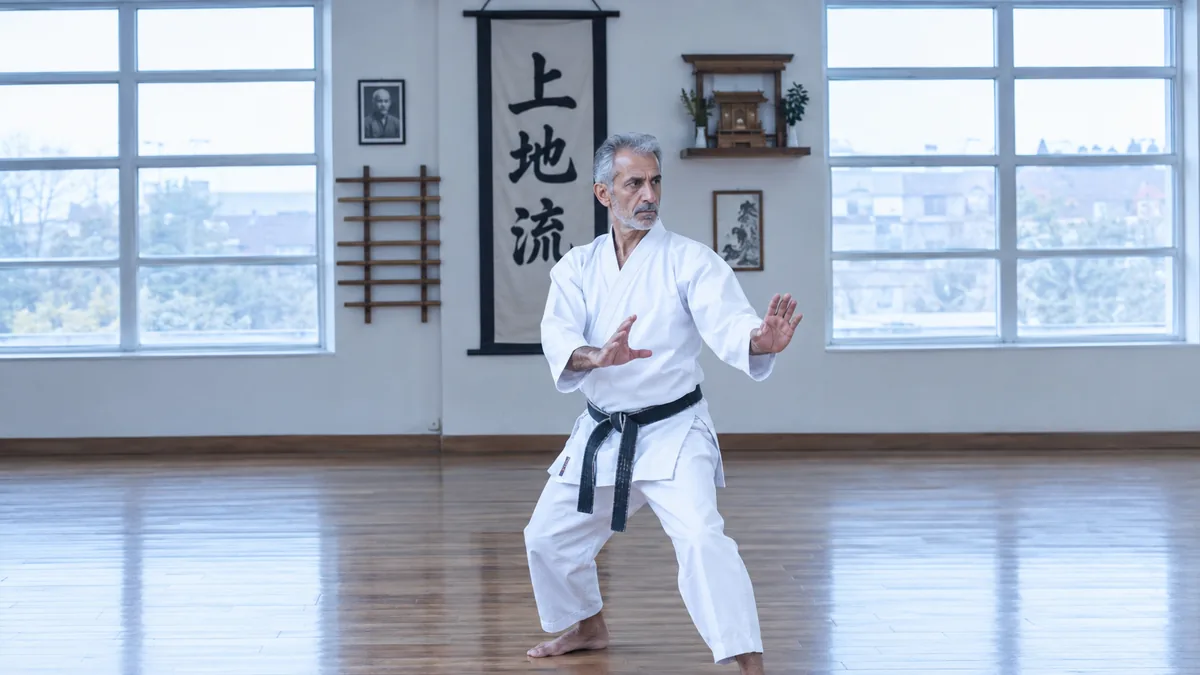
Sanchin is the heart of the style, as it is in Gōjū-ryū: a slow, tense kata that builds structure, breathing and the ability to take impact. In Uechi-ryū it is performed with open hands.4
How Uechi-ryū trains
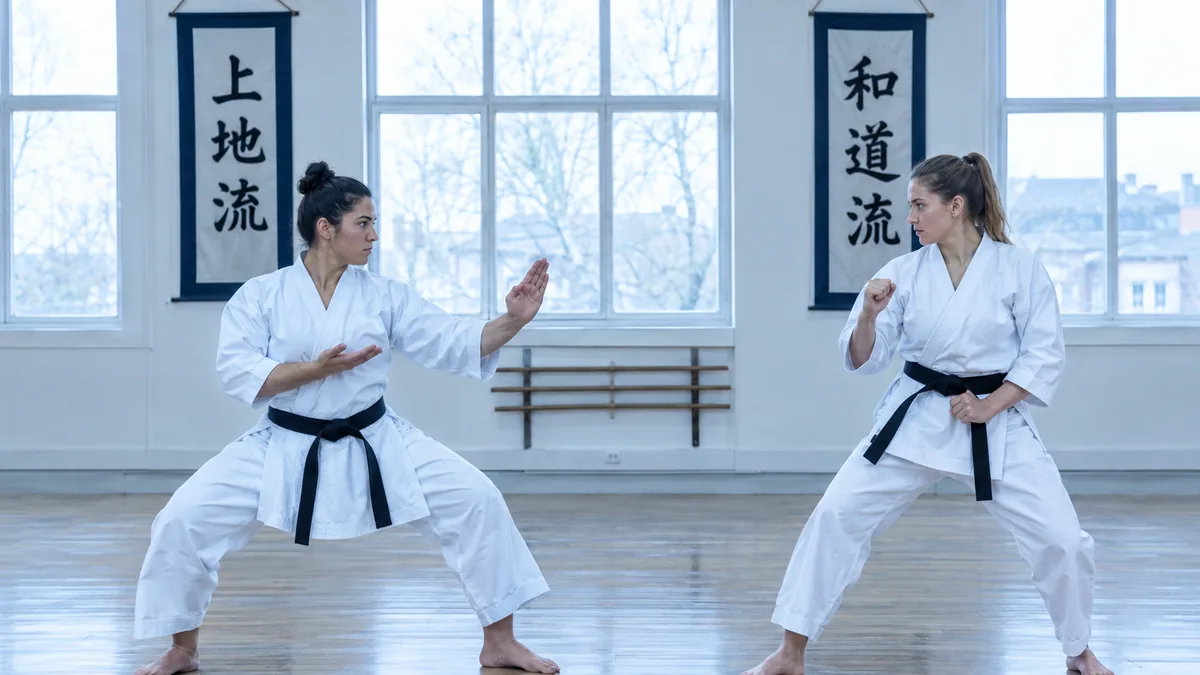
Uechi-ryū is recognisable by its techniques using the fingertips and toes, including one-knuckle strikes, the spear-hand and kicks with the big toe.5, 14 All of them concentrate force on a small striking surface.
Conditioning is a major part of training. Kote kitae, forearm conditioning, has students strike their forearms against a partner’s, and there is a strong tradition of body conditioning by striking the legs and abdomen. Classes also include ten preparatory exercises and thirteen supplementary exercises.4
Uechi-ryū outside Okinawa
United States
In the United States, Uechi-ryū is closely associated with George Mattson, an American serviceman who trained at the Futenma dojo in the late 1950s; the IUKF dates his training to 1957–58, while another account says Tomoyose began teaching him in 1956.10, 15 He began teaching Uechi-ryū in Boston in 1958,11 and he published The Way of Karate in 1963.13 The International Uechi-ryū Karate Federation, which he founded, has been led since 1 January 2026 by Justin Testa.12
Britain and Europe
In Britain, one of the founders of the Uechi-ryū Karate-dō Association (Great Britain) was David Scott, who trained under Kanei Uechi at Futenma in 1974 and then started a dojo in Liverpool.14 In 2024, students from France and Belgium were among those training at the head dojo in Okinawa.4
Uechi-ryū in Okinawa today
The Cabinet Office describes Uechi-ryū as one of the four families of Okinawan karate, alongside the Shuri-te, Naha-te and Tomari-te lines.3 Styles that grew out of it, including Shōhei-ryū (the Okinawa Karate-dō Kyōkai) and Kōnan-ryū, are recognised as separate styles in Okinawa.6
Timeline
- 1877: Kanbun Uechi born in Motobu, Okinawa.1
- 1897: Uechi goes to Fuzhou.9
- 1904: receives a teaching licence, by Uechi-ryū’s own account.9
- 1909–1910: returns to Okinawa.3, 9
- 1924: moves to Wakayama.2
- 1926: begins teaching in Wakayama.1
- 1932: opens the Pangainūn-ryū Karate-jutsu Research Institute.9
- 1940: the style is named Uechi-ryū.1
- 1942: Kanei Uechi returns to Okinawa.9
- 1946: Kanbun Uechi returns to Okinawa.9
- 1948: Kanbun Uechi dies.1
- 1958: George Mattson begins teaching in Boston.11
- 1963: the Futenma dojo is rebuilt; The Way of Karate published.4, 13
- 1974: David Scott trains at Futenma.14
- 1991: Kanei Uechi dies.7
- 2018: Okinawa Prefecture publishes the Uechi-ryū manual.8
Is Uechi-ryū right for you?
Uechi-ryū suits people who want a compact, practical style with close-range techniques and real toughness. The syllabus is small and the training is hard on the body. If you want long-range movement or a big kata syllabus, Shotokan or Shitō-ryū cover that better.
Key kata
- Sanchin
- Kanshiwa
- Kanshu
- Seichin
- Seisan
- Seirui
- Kanchin
- Sanseirui
Major organisations
- Uechi-ryū Karate-dō Kyōkai — the Uechi family's line, led by the fourth head, Sadanao Uechi
- International Uechi-ryū Karate Federation (IUKF) — founded by George Mattson; president Justin Testa since 2026
- Uechi-ryū Karate-dō Association (Great Britain) — British association
References
Compiled by the KarateLifestyle editorial team from the sources below and checked against them in September 2026. Where sources disagree, both versions are given. Sources marked "affiliated" are a karate organisation's own account and are used for dates and details that independent records do not cover.
- 上地完文 (Uechi Kanbun). Okinawa Compact Encyclopaedia, Ryukyu Shimpo, 2003
- 上地完文 (Uechi Kanbun). Kotobank, entries from 日本人名大辞典+Plus (Kodansha) and 20世紀日本人名事典 (Nichigai Associates)
- 沖縄空手の紹介 (Introduction to Okinawan karate). Cabinet Office of Japan, drawing on the Okinawa Karate Kobudō Encyclopaedia
- 沖縄伝統空手のいま 道場拝見 (8) 上地流宗家道場(普天間修武館). Yanagihara Shigeo, WEB Daisan Bunmei, 20 October 2024
- 上地完文翁銅像 (Statue of Uechi Kanbun). Okinawa Traditional Karate-dō Promotion Association
- 流派 (Styles). Okinawa Traditional Karate-dō Promotion Association
- [師の教え](4) 上地完英氏 上地流空手道2代目宗家(1911~91). Okinawa Times, Weekly Okinawa Karate no. 187
- Okinawa Karate Style Research Project: Uechi-ryu Manual. Okinawa Prefecture, Karate Promotion Division, 2018 (National Diet Library record)
- 上地完文翁銅像の台座に刻まれる歴史. Uechi-ryū Karate-dō Rengōkai (affiliated)
- History of IUKF. International Uechi-ryū Karate Federation (affiliated)
- George E. Mattson. International Uechi-ryū Karate Federation (affiliated)
- IUKF organization announcement effective January 1, 2026. International Uechi-ryū Karate Federation, 2 January 2026 (affiliated)
- The Way of Karate. George E. Mattson, Charles E. Tuttle, Rutland and Tokyo, 1963 (LCCN 62014116)
- Uechi-Ryu Karate-Do Association (GB). Uechi-Ryu Karate-Do Association, Great Britain (affiliated)
- Ryuko Tomoyose. uechi-ryu.com, George Mattson's site (affiliated)