Uechi-Ryu Kata List: Every Form in the Syllabus, Its Chinese Origins, and Why the Style Has So Few
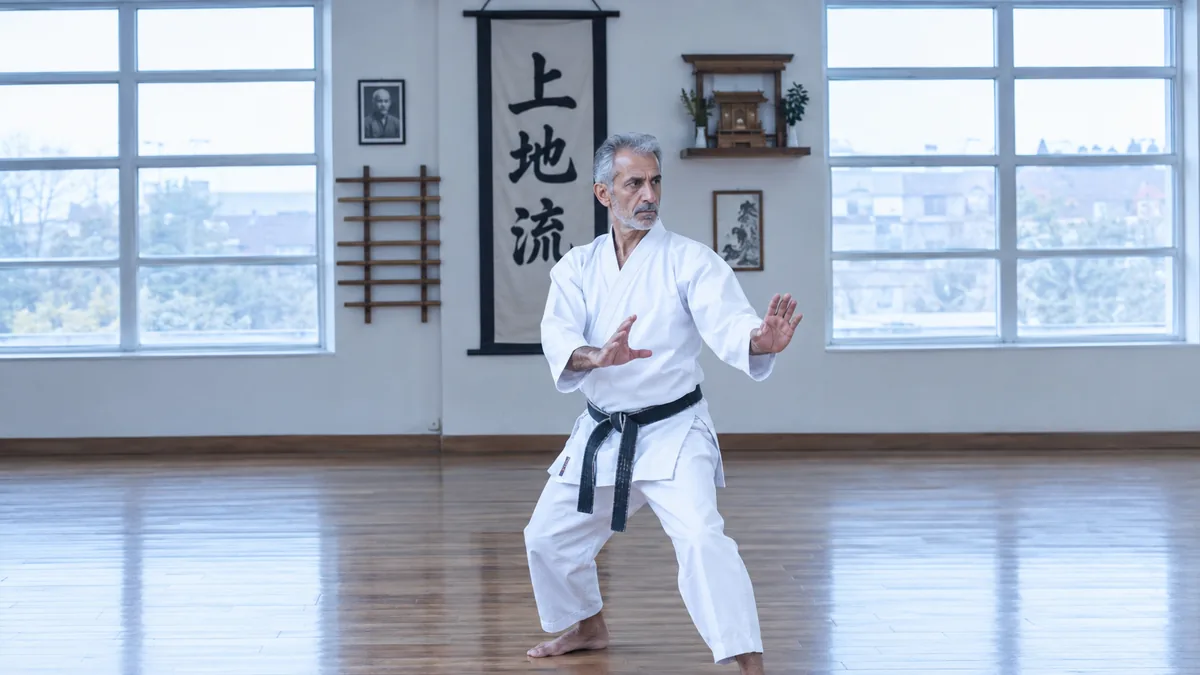
Most styles bury students in kata. Shotokan has 26. Shito-ryu has over 60, though the core syllabus is sometimes quoted as 53 - see our Shitō-ryū Kata List if you want to understand why. Uechi-Ryu has eight. That number is not a limitation. It is a philosophy.
If you train in Uechi-Ryu and someone from another style has ever looked at your syllabus with mild pity, this article is the rebuttal. Eight kata, trained properly, will keep a serious practitioner occupied for a lifetime. The question worth asking is not “why so few?” but “what does it mean to actually finish learning one?”
Where These Kata Come From
Uechi-Ryu traces directly to a specific Chinese martial arts tradition, not the broad Okinawan synthesis that produced most other karate styles. In the late nineteenth century, Kanbun Uechi traveled to Fuzhou in Fujian Province, China; multiple historical accounts identify 1897 as the year he went, at around nineteen years old. In China, he trained under a teacher remembered in Japanese sources as Shu Shiwa - commonly identified with the Chinese name Zhou Zihe (1874 to 1926). The Fuzhou Wushu Association accepts that Kanbun trained with Zhou Zihe for 13 years in total, mastering the three kata Sanchin, Seisan, and Sanseiryu, as well as learning kote kitae (forearm tempering). The system he brought back is known to his students as Pangai-noon, often glossed as “half-hard, half-soft.”1 The kata he brought back reflect that Chinese origin unmistakably.
The style’s Chinese roots show up in ways that matter technically, not just historically:
- Circular hand techniques - the hikite in Uechi-Ryu does not simply pull back to the hip. It often describes an arc, intercepting or redirecting as it withdraws.
- Finger and one-knuckle strikes - nukite and hiraken are not decorative. The conditioning work (sanchin training, kotekitae) exists because these weapons require it.
- Natural stances - compared to the deep, wide stances of Shotokan or the rooted horse stance of some Goju-Ryu work, Uechi-Ryu stances are relatively upright and mobile, reflecting the Fujian influence.
- Simultaneous block-and-strike - many sequences involve circular intercepting movements and combined block-and-strike methods rather than sequential action, which changes the timing logic entirely.
After Kanbun’s death, his son Kanei Uechi was instrumental in formalising and expanding Uechi-Ryu, effectively creating the style in its present form by establishing a systematic curriculum and adding five bridging kata to the original three his father had taught. Kanei Uechi founded the Uechi-Ryu Karate-Do Association (Uechi-Ryu Karate-Do Kyokai), now headquartered in Ginowan, Okinawa. The kata list as it exists today reflects that development.
The Eight Kata, in Order
Sanchin
Everything starts here and, honestly, everything returns here. Sanchin is the foundation kata of Uechi-Ryu and one of the most demanding forms in any karate syllabus when trained correctly. It is shared with Goju-Ryu (see our Goju-Ryu Kata List for how that style uses it), but the Uechi version differs in structure and emphasis.
Literally meaning “three battles,” Sanchin can be considered an educational kata that helps practitioners understand the Sanchin Dachi stance, the movements in Uechi-Ryu, and the alignment of different body parts that will be used in the higher-level kata. The kata is short - three forward sequences, turns, and returns - but that brevity is the point. Every repetition is an opportunity to test and develop the internal tension, breathing, and body connection that underpins the entire system. The Uechi-Ryu version is typically performed open-handed, emphasising the nukite strike and the circular hand movements that characterise the style.1
Most beginners think Sanchin is about being hit. Instructors test it by striking the practitioner’s body to check tension and structure, so the assumption is that the kata is about hardening the body. That misses it. The tension is a diagnostic tool - it tells you whether your structure is connected or not. When it is connected, you feel the impact distribute through your whole body rather than landing on one spot. When it is not, you know immediately.
The correction that most often improves Sanchin is the relationship between the feet and the hips. A common mistake is to grip with the toes and tighten the legs in isolation. What you want is the tension to originate from the floor upward - feet rooted, knees slightly inward, hips tucked, abdomen engaged - so that the whole body acts as a single unit. When that connection works, the strikes feel like they come from somewhere much deeper than the shoulder.
Kanshiwa
Kanshiwa is the second of the eight kata in Uechi-Ryu. Its name is formed from the first kanji “Kan,” in homage to Kanbun Uechi, and the two final characters “Shi” and “Wa,” in tribute to Shu Shiwa, Kanbun’s teacher from Fujian.1 It emphasises learning open-handed blocks (Mawashi Uke) and 45-degree kicks (Sokuto Geri), and teaches the timing of blocking and striking.1 Based on the tiger style, it develops strength and continues to harden the body.
One mistake that comes up constantly in Kanshiwa is treating the circular blocks as sweeping gestures. They are not. Each circular movement should feel like it is describing a tight, controlled arc - enough to redirect, not so large that it creates an opening. If the block travels past the centre line, you have given away your own structure.
Kanshu
Kanshu is the third kata in Uechi-Ryu, developed by Itokazu Seiki, a student of Kanei Uechi. Its name combines the first kanji “Kan” in honour of Kanbun Uechi and the kanji “Shu” in honour of Shu Shiwa.1 The kata aims to teach precision in both movements and timing, with the introduction of crane techniques.1 It is sometimes referred to in older sources as Daini Seisan (“Second Seisan”), which distinguishes it clearly from the Seisan that Kanbun brought from China. It requires a cleaner understanding of ma-ai than the earlier forms, and introduces more complex direction changes.
Seichin
Seichin was created by Saburo Uehara and means “ten conflicts.” It sits in the middle of the syllabus and is where many practitioners begin to understand what Uechi-Ryu is actually asking for. A very “Chinese” kata, Seichin draws from the original Pangai-noon techniques and incorporates many circular movements, progressively developing the body’s coordination and strength.1
The kata contains sequences that only make sense if you understand the simultaneous block-and-strike principle. If you are performing them as block-then-strike, the timing is wrong and the bunkai does not work.
This is worth pressing on. A common misconception is that the block and the counter are sequential because that is how most people are introduced to karate. In Seichin, several techniques require both hands to arrive at their targets at the same moment - one intercepting, one striking. When that clicks, the kata feels completely different. The hands stop feeling like they are taking turns and start feeling like they are connected.
Seisan
This is the central kata of the system - one of the three brought directly from China by Kanbun Uechi. Seisan means “thirteen,” referring to the thirteen modes of attack and defence; the number also corresponds to the thirteenth hall of the Shaolin temple, where monks would revise techniques learned in the previous rooms.1 The kata was originally brought from China by Kanbun Uechi and later slightly modified by Kanei, who added the first line. Some sources describe it as the kata Kanbun taught most exclusively in the early years of his teaching, before the curriculum was expanded. Whether or not that account is precise in every detail, Seisan carries the weight of the style’s core principles.
Seisan contains the knee kicks, the open-hand strikes, the circular deflections, and the breathing work that define Uechi-Ryu. If you want to understand what the style is, watch someone perform Seisan well. If you want to understand whether a practitioner truly knows the style, watch how they perform Seisan under pressure - at a grading, after a hard training session, when they are tired.
Seiryu
Seiryu literally means “sixteen.” The number sixteen can be interpreted as the attainment of maturity. This kata was created by Kanei Uechi; its execution requires strong legs, a good sense of balance, and coordination, as it incorporates rotating dragon techniques.
Seiryu develops the practitioner’s ability to generate power from close range. The kata contains techniques that work at a distance where most karateka would consider themselves too close to strike effectively. That is the lesson. When the structure from Sanchin is genuinely internalised, close range is not a problem - it becomes an advantage.
Kanchin
Kanchin is formed by the first kanji “Kan” in homage to Kanbun Uechi and the kanji “Chin,” meaning “battle.”1 It was created by Kanei, who wanted to preserve his father’s memory. In Kanchin, you primarily find the favourite techniques of Kanbun, as well as the introduction of techniques from Sanseiryu, including the double block Watari Uke.
Kanchin is sometimes described as a bridge between the foundational kata and the advanced forms. It revisits Sanchin principles in a more complex movement pattern and demands a level of body integration that takes years to develop properly. Most practitioners who think they know Kanchin discover, when they train it seriously, that they were performing the shapes without the content.
Sanseiryu
Sanseiryu literally means “thirty-six,” referring to 36 modes of attack and defence.1 It is also called the kata of the 36th chamber, as Shu Shiwa was known as the priest of the 36th chamber.1 Sanseiryu was the most evolved of the three kata brought from China by Kanbun. It combines all the techniques learned in the previous kata - within it you find the tiger, crane, and dragon styles.1
The final kata in the Uechi-Ryu syllabus is also the most demanding. Sanseiryu contains the full range of the style’s techniques and requires the practitioner to sustain the quality of movement and tension across a longer, more complex sequence. It is not a kata you perform well by learning the pattern. You perform it well by having genuinely absorbed the earlier seven.
Why Eight Is the Right Number
This is worth stating plainly: we think the Uechi-Ryu approach to kata volume is more honest than styles that expand their syllabi by accumulating forms. There are eight kata in Uechi-Ryu; the three original kata from Pangai-noon are Sanchin, Seisan, and Sanseiryu, while the other five were added to the style by Kanei Uechi and other senior students of Kanbun to further develop practitioners’ techniques. Eight kata, each with layers of bunkai, conditioning requirements, and technical depth, is not a thin curriculum. It is a focused one.
The argument for a larger syllabus is that more kata expose practitioners to more movement patterns, more tactical situations, more variety. That argument has merit in some contexts. But it carries a cost: when there are sixty or more kata in a syllabus, the pressure to demonstrate breadth replaces the pressure to demonstrate depth. Practitioners learn to perform kata rather than to know them.
With eight kata, there is nowhere to hide. Every form gets revisited. Senior practitioners perform Sanchin alongside beginners, and the gap in quality is immediately visible - not because the senior knows more kata, but because they know this one more completely. That transparency is valuable. It keeps the training honest.
The question of whether kata actually transfers to sparring is a live one in every style. In Uechi-Ryu, the answer is more legible than in many others because the kata contain specific tactical situations - the close-range work, the simultaneous techniques, the low kicks - that show up in kumite in recognisable form.
Common Mistakes Worth Addressing
Performing Sanchin as a strength exercise. The tension in Sanchin is dynamic, not static. Holding yourself rigid from the first movement is the wrong approach. The tension should engage and release with the technique, like a wave rather than a wall. When it is static, you are training stiffness. When it is dynamic, you are training structure.
Rushing the circular techniques. The circular blocks and strikes in Uechi-Ryu kata feel slow compared to the linear techniques many practitioners are used to. A common response is to speed them up to make them feel more powerful. This is backwards. The power in a circular technique comes from the path, not the speed. Rushing it shortens the path and removes the power.
Ignoring the kicks. Uechi-Ryu style emphasises kicks below the waist throughout its kata, and these low kicks are easy to underperform because they are not dramatic. Many beginners execute them as token gestures. These are the techniques that work at close range when everything else has collapsed. Train them as if they matter, because in application, they are often the technique that matters most.
Treating the kata as separate from the conditioning. Uechi-Ryu’s kote kitae involves the ritualised pounding of one’s fists and forearms against the forearms of a partner - and Kanbun Uechi learned this conditioning exercise in China. It is not supplementary to the kata - it is what makes the kata functional. The open-hand strikes in the forms require conditioned weapons. Practitioners who learn the kata patterns without the conditioning work are learning the shape without the substance.
Community Perspective
There is genuine disagreement within Uechi-Ryu communities about how strictly the Chinese origins should inform modern practice. Some associations emphasise the Fujian connection heavily, seeking to preserve or recover elements of the original Chinese system. Others treat the style as a fully Okinawan art that happens to have Chinese roots, and focus on the Okinawan development under Kanei Uechi and subsequent teachers.
This is not a trivial debate. It affects how bunkai is interpreted, how the conditioning work is weighted, and how the kata are performed in competition versus in the dojo. Like many arts, Uechi-Ryu experienced organisational splits after its founder’s death, with some senior practitioners creating other organisations or styles, including Shohei-Ryu and recreated versions of Pangai-noon. Different associations - particularly between Okinawa, Japan, North America, and Europe - have developed their own emphases over time.
The position worth holding, we think, is that understanding the Chinese origin makes you a better practitioner of the Okinawan art. Pangai-noon had movements based on the tiger, crane, and dragon, and was a fusion of two different styles - Southern Shaolin Ken, an offensive and hard-bodied style of Chinese kempo, and Eishu Ken, a softer, more defensive style - making it “half-hard, half-soft,” a descriptor that still applies to Uechi-Ryu today. Knowing why the circular techniques exist, what the open-hand strikes were designed to do, and how the Fujian system approached close-range fighting gives you context that improves execution. You do not need to resolve the historical debate to benefit from the historical knowledge.
Understanding how kata names and origins get complicated across styles is worth exploring further - our piece on Pinan vs Heian covers how the same political and historical forces shaped the broader Okinawan karate tradition.
If you are working on the quality of transitions between techniques within any of these forms, Kata Transitions covers the specific problem of making the joins disappear - relevant to every kata in this list, but especially to the longer forms like Sanseiryu.
Key Takeaways
- Train Sanchin more than you think you need to. It is not a beginner’s kata that you graduate past. Senior practitioners return to it because it is the diagnostic tool for everything else in the system.
- The correction that most often improves Uechi-Ryu kata is slowing down the circular techniques, not speeding them up. Power in circular movement comes from completing the path, not rushing through it.
- If the bunkai does not work, the kata is being performed incorrectly. This is especially true for the simultaneous block-and-strike sequences in Seichin and Seisan. If the timing feels sequential, the technique is wrong.
- Do not separate the conditioning from the kata. The open-hand weapons in the forms require the kotekitae work to function. One without the other is incomplete training.
- Understanding the Chinese origins is practically useful, not just historically interesting. Knowing that the style comes from a half-hard, half-soft Fujian system explains the circular techniques, the upright stances, and the close-range emphasis in ways that improve how you execute them.
- Eight kata is a curriculum, not a limitation. The depth is in the repetition and the honesty it demands - there are no obscure forms to retreat to when the core kata expose a weakness.
References
Checked by the KarateLifestyle editorial team against Uechi-Ryu association primary sources (Oryukai, Kenkyujo, Kenyukai), historical timelines, and published kata syllabi in October 2026. Historical accounts of Kanbun Uechi's time in China vary slightly between sources on precise dates and duration; the 13-year total with 10 years of formal study before his teaching licence is the most consistently cited figure.
- The 8 Katas of Uechi-Ryu Karate – Uechi-Ryu Karate-Do Oryukai. Uechi-Ryu Karate-Do Oryukai (affiliated to URKDE and the Uechi-Ryu Karate-Do Association, Ginowan, Okinawa). Undated.
The weekly digest
New karate articles, once a week
One email every week with everything new on Karate Lifestyle. No spam; unsubscribe in one click.
We'll email you to confirm. See our privacy policy.