Kyokushin Kata List: Every Form in the Syllabus, Its Origin, and Why Kyokushin Kept So Few Compared to Other Styles
Most styles collect kata the way some dojos collect trophies - more is treated as more. Kyokushin went the other way. Mas Oyama built a syllabus with a deliberately small number of forms, and that decision was not a shortcut. It was a philosophy. If you train in Kyokushin and have ever been asked by a Shotokan or Shito-ryu practitioner why you “only know a few kata,” this article is your answer - and it is a better answer than most people give.
Why Kyokushin Has So Few Kata
The short version: Oyama was not interested in breadth. He was interested in what worked under pressure.
Kyokushin’s full-contact kumite format is the context that explains everything about the kata syllabus. When your sparring involves full-power body strikes and you test yourself against that regularly, your standards for what belongs in a kata change. Techniques that are impractical, overly ceremonial, or disconnected from real striking mechanics tend to get filtered out quickly when you train the way Kyokushin practitioners train.
Compare this with Shito-ryu’s enormous syllabus, which runs to over fifty kata depending on the association. That breadth reflects a different philosophy - preservation of multiple lineages, historical completeness, and a strong competition kata culture. Neither approach is wrong, but they are solving different problems. Kyokushin is solving for depth. Uechi-ryu takes a similar minimalist position for related reasons.
Oyama’s stated view, documented in his writings and widely reported by senior students, was that a practitioner should know a small number of kata thoroughly rather than many kata superficially. This is not a radical idea - it is the same logic that makes a specialist more useful than a generalist in many fields. What makes Kyokushin unusual is how seriously the organisation has stuck to it.
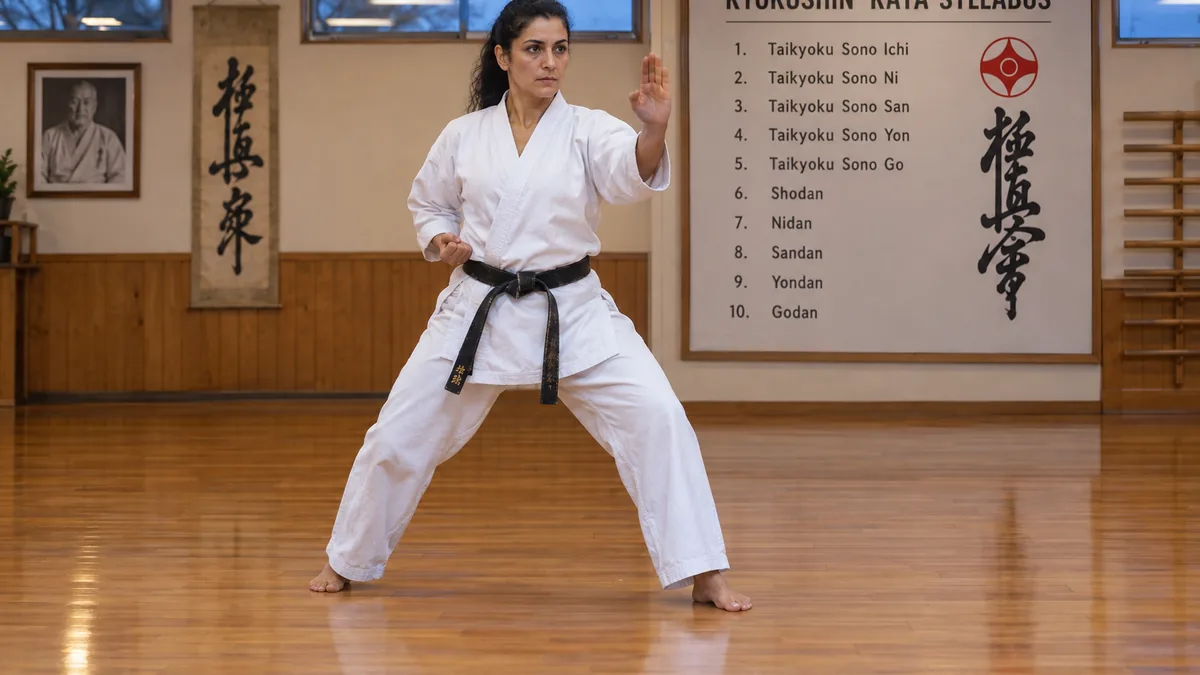
The Kyokushin Kata Syllabus
Kyokushin divides its kata into two groups: Ura (turning or reverse) versions and the standard forms. The Ura kata are performed moving in the opposite direction from the standard form, which develops spatial awareness and tests whether you actually understand the kata or have simply memorised a sequence. If you want to understand what mirroring a form actually teaches, we cover that in detail here.
The standard syllabus recognised across most Kyokushin organisations includes the following.
Taikyoku Series
Taikyoku Sono Ichi, Ni, San - These are foundational forms, simple by design. The Taikyoku kata were developed by Yoshitaka Funakoshi (Gichin Funakoshi’s son) and introduced by Gichin as introductory forms for beginners. Most sources credit Yoshitaka with devising the sequences, while Gichin named them and published them in his writings. Oyama drew them into Kyokushin from his background in Shotokan, where he had trained under the Funakoshi family.1 They do the job they were designed to do: establish basic stance, movement, and blocking structure without cognitive overload.
As a white belt, the temptation is to dismiss these as too simple to matter. That is the wrong read. The correction that most beginners need in Taikyoku is not about the techniques themselves - it is about the transitions. The moment between techniques is where tension bleeds out, posture collapses slightly, and the kata stops being a sequence of connected actions and becomes a list of individual moves. Kata transitions deserve their own attention, and the Taikyoku series is where you either build good habits in this area or you do not.
Taikyoku Sono Ichi Ura, Ni Ura, San Ura - The Ura versions of all three. Performed in the opposite direction.
Pinan Series
Pinan Sono Ichi through Go (five kata, plus five Ura versions) - The Pinan series is where Kyokushin’s syllabus starts to get genuinely interesting. These kata were created by Anko Itosu, most likely between 1902 and 1907, as a way to introduce karate to Okinawan school children. They were formally integrated into the Okinawan school physical education system from around 1905. They were designed to be learnable, not to conceal advanced technique - which is a point worth making because a lot of mystification gets attached to them unnecessarily.
In Kyokushin, the Pinan kata carry more weight than they do in some other styles because the syllabus is not crowded with alternatives. You will practice these forms for years, and senior practitioners will still find things to refine. The Pinan series is where most practitioners spend the bulk of their kata training time, and that is appropriate. The depth is there if you look for it.
A common mistake in the Pinan series is treating the age-uke (rising block) as a purely defensive technique. Many instructors cue this as a strike to the underside of an attacking arm rather than a passive block - which changes the body mechanics entirely. When you apply that interpretation, you feel the difference immediately: the technique becomes more committed, more rooted, and the hip drives it rather than the arm pulling upward.
Sanchin
Sanchin - This is the kata that most clearly shows Kyokushin’s connection to older Okinawan and Chinese martial traditions. Sanchin appears in Uechi-ryu and Goju-ryu as well, and its presence in Kyokushin reflects Oyama’s training background, which included study under So Nei Chu, a Goju-ryu practitioner and senior figure in that system.1
Sanchin is performed slowly, with muscular tension throughout, and in Kyokushin it is typically tested by an instructor striking the practitioner’s body during performance. The testing process is called shime in Goju-ryu; Kyokushin uses similar testing methodology. The purpose is to verify that the tension and structure are real, not performed. You cannot fake a properly rooted Sanchin when someone is checking your body alignment with a strike to the ribs.
What correct Sanchin tension actually feels like is difficult to describe until you have experienced it. The whole body should feel connected - not rigid and locked, but engaged from the feet through the core to the hands. When it is wrong, it feels like wearing armour that does not fit. When it is right, it feels like the armour is part of you.
Tensho
Tensho - Oyama regarded Tensho as one of the most important kata in the syllabus, and we think he was right. It combines the structural tension of Sanchin with circular, flowing hand techniques that develop sensitivity and wrist strength. Tensho was created by Chojun Miyagi, founder of Goju-ryu, around 1921, as a softer counterpart to Sanchin. It was adapted from the Chinese Rokkishu exercises, which emphasise the rotation of the forearms and wrists. Oyama brought it into Kyokushin from his Goju-ryu training lineage.1
The mistake most practitioners make with Tensho is rushing the hand techniques. They look simple - circular sweeping movements - and beginners tend to move through them quickly to get to the next posture. Senior practitioners do the opposite. The hand techniques in Tensho are where the kata lives. Slow them down, maintain tension through the full arc, and you will feel the forearm musculature working in a way that fast performance completely bypasses.
Gekisai Dai and Gekisai Sho
Gekisai Dai and Gekisai Sho - These kata were created by Chojun Miyagi in 1940 and adopted into the Kyokushin syllabus. They are more dynamic than the Pinan series and introduce techniques including mae-geri (front kick) combinations and stronger hip-driven strikes. Gekisai Dai in particular is a useful bridge between the foundational kata and the more demanding forms higher in the syllabus.
Yantsu, Tsuki No Kata, Saifa, Seipai, Kanku
Yantsu - A kata found primarily in Kyokushin, with origins that are not entirely clear in the historical record. It emphasises deflecting techniques and counterattacking from an evasive position rather than meeting force with force.
Tsuki No Kata - Straightforward by name and by nature: a striking kata. The emphasis is on committed, full-power punching combinations. Useful for developing the physical sensation of driving strikes from the hips rather than the shoulder.
Saifa and Seipai - Both come from Goju-ryu and appear in multiple Okinawan styles. Saifa includes circular hand techniques and close-range striking; Seipai is more complex and contains techniques that require real application study to understand. Treating these as sequences to memorise is the wrong approach. Whether kata practice actually transfers to sparring depends heavily on how you approach it, and Saifa and Seipai are good examples of forms where application work makes the difference.
Kanku - The most demanding kata in the standard Kyokushin syllabus. It is long, physically demanding, and contains a wide range of techniques. Kanku is Kyokushin’s version of the Kushanku kata of Okinawan tradition - the same lineage that appears in Shotokan as Kanku-Dai. In Kyokushin, it is typically associated with higher kyu and dan grades.
The Embusen Question
Every kata in the Kyokushin syllabus has a specific floor pattern - the embusen - and understanding why those patterns exist changes how you practice. The Taikyoku kata use a simple I-shaped line. The Pinan series are more varied. Kanku is more complex still. These patterns are not arbitrary. We explain the function of embusen in detail here, but the short version is: the directions you move correspond to the directions from which attacks are imagined to come. When you understand that, the kata stops being a solo performance and starts being a training simulation.
Community Perspective
There is genuine disagreement within Kyokushin about where kata sits in the training hierarchy. Some dojos treat kata as a secondary concern - something practiced for grading and then set aside in favour of kihon and kumite. Others, particularly those with strong connections to the older Okinawan traditions, treat kata as the primary vehicle for understanding technique and application.
Practitioners who have trained for many years often report a shift in how they value kata. At lower grades, kumite feels more relevant - it is immediate, competitive, and gives clear feedback. At higher grades, many practitioners return to kata with more interest, particularly to Sanchin and Tensho, because the qualities those kata develop - structure, tension, connection - become more visible as technical understanding deepens.
The debate about whether Kyokushin’s limited syllabus is a strength or a limitation also surfaces regularly. The case for limitation is made above. The counterargument is that a broader kata base exposes practitioners to a wider range of techniques and movement patterns. Both positions have merit. We favour the Kyokushin approach for practitioners primarily focused on contact sparring, and we think the depth argument holds up in practice - provided the kata are actually studied rather than just performed.
Key Takeaways
- The Kyokushin kata syllabus is small by design, not by accident - depth of understanding in fewer forms is the explicit goal, and grading expectations reflect this
- Taikyoku and Pinan kata are not beginner throwaway forms; they are where foundational habits in transitions, stance, and hip mechanics are built or not built
- Sanchin and Tensho are the forms most associated with senior development in Kyokushin - if you are rushing through them, you are missing the point of both
- The Ura versions of each kata are a genuine test of understanding; if you cannot perform the reverse version with the same quality, you have memorised the kata rather than learned it
- Application study - working out what each technique is for and against what attack - is what separates kata practice that improves your fighting from kata practice that does not
- If your Sanchin looks the same before and after your instructor tests it with strikes, either the testing was too light or your structure is not what you think it is
References
Checked by the KarateLifestyle editorial team against official karate governing body and association records, published martial arts histories, and primary association pages in November 2026. Dates for the Pinan kata vary between sources by a few years; the range circa 1902 to 1907 is noted in the text.
- Mas Oyama, 1923–1994: Founder of Kyokushin Karate. Martial Arts Professional. Confirms Oyama trained in Shotokan under the Funakoshi family and in Goju-ryu under So Nei-chu; gives founding dates of dojo (1953) and IKO (1964).
The weekly digest
New karate articles, once a week
One email every week with everything new on Karate Lifestyle. No spam; unsubscribe in one click.
We'll email you to confirm. See our privacy policy.