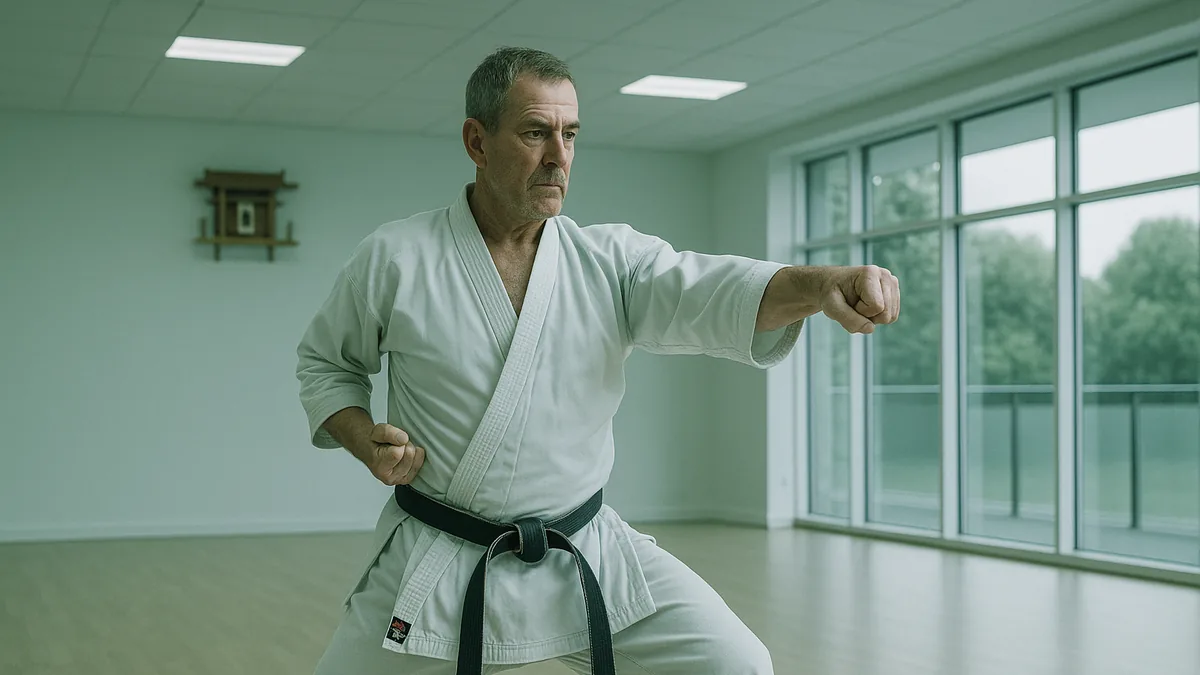
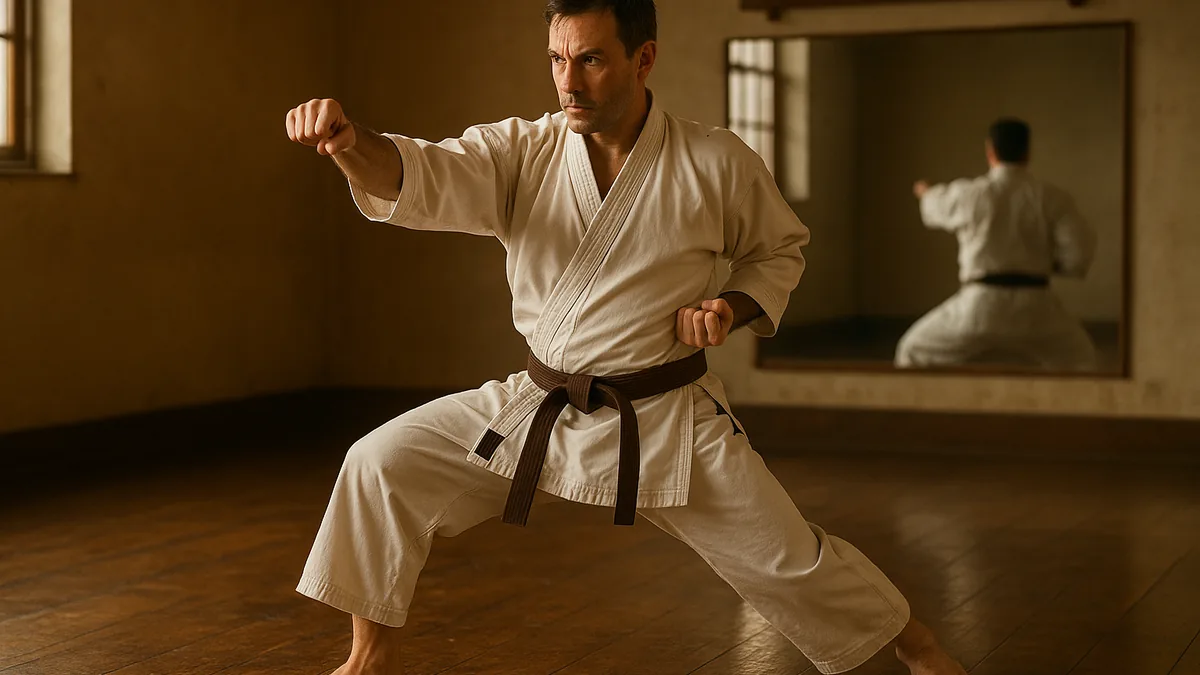
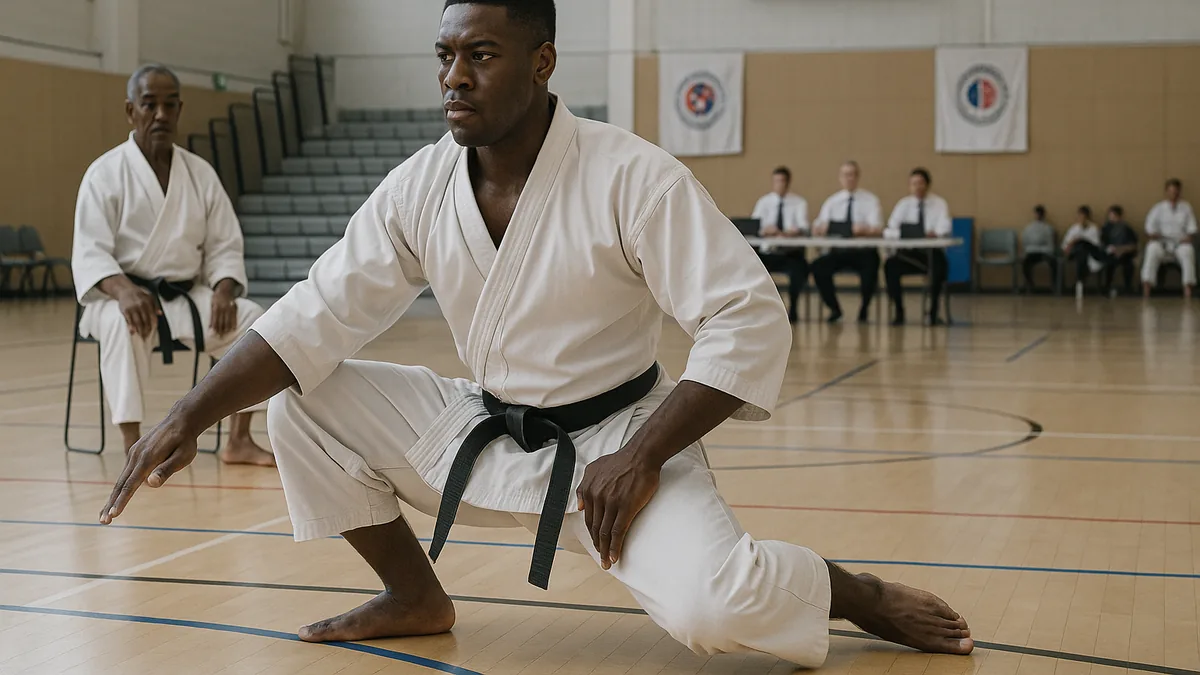
Performing Kata Left-Handed: What Mirroring a Form Actually Teaches You and When Instructors Use It
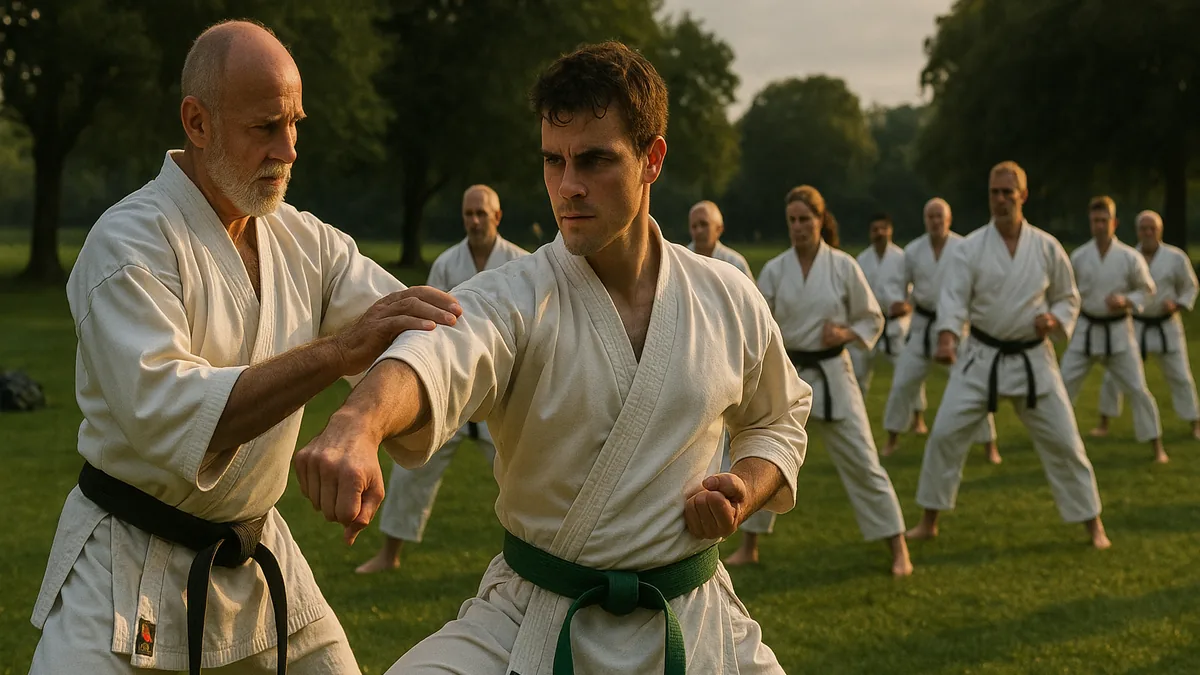
The first time an instructor told me to perform Bassai Dai mirrored - starting right foot instead of left, stepping the opposite direction, reversing every turn - I genuinely thought he was messing with me. I’d been doing that kata for three years. I knew it. And within about four moves, I was completely lost.
That moment told me more about my kata than any grading feedback ever had.
What Mirroring Actually Exposes
When you perform a kata the normal way, your body learns sequences. Step, turn, block, punch. You think you understand the technique, but a lot of what you’re doing is pattern recall. Your feet know where to go. Your arms follow. It feels like karate, but a significant portion of it is just motor memory executing a script.
Flip it. Now your left hand leads where your right hand always has. Your right foot steps where your left foot knows the floor. Suddenly you have to think about what you’re actually doing, not where you’re going next.
I’ve noticed that practitioners who mirror a kata for the first time fall into two camps. The ones who struggle with direction - they keep turning the wrong way, hesitating at each embusen change - and the ones who struggle with technique. The first group has learned the pattern but not the body mechanics underneath it. The second group actually understands more than they realise; their problem is coordination, not comprehension. I’d take the second group every time.
What mirroring strips away is the comfort of habitual movement. You can’t coast. Every technique has to be consciously generated, which means you’re suddenly aware of things you’ve been glossing over for years. Where exactly does your weight shift before that turn? Is your hikite actually pulling back, or is it just arriving at your hip because it always arrives at your hip at that moment? Do you know why your elbow is at that angle, or have you just always held it there?
The Mechanics You Didn’t Know You Were Missing
Here’s what I tell students when I introduce mirrored kata work: your strong side has been compensating for your weak understanding.
Most of us are right-handed. Most kata start and favour what ends up being our stronger side, at least in the sense that we’ve drilled it more. When you reverse everything, your non-dominant side has to carry techniques it’s never been responsible for. And you’ll feel the difference immediately - not just in coordination, but in power generation.
On your trained side, a gyaku-zuki might feel connected. Hip, shoulder, fist, all arriving together with some sense of unity through the body. On the mirrored side, that same punch often feels like you’re throwing your arm. The hip doesn’t fire the same way. The shoulder doesn’t load the same way. It feels wrong at first, but what it’s actually doing is showing you that you’ve been relying on a trained groove rather than genuine mechanical understanding.
The correction that works here isn’t to drill the mirrored version until it feels like the normal version. It’s to use the discomfort as a diagnostic. Why does the hip feel disconnected? Because you’ve never had to consciously initiate rotation from that side - it’s always happened automatically. Now you have to find it deliberately. And once you find it deliberately on the weak side, you often go back to your strong side and realise you can generate more power because now you actually understand what you’re doing.
This connects to something I’ve written about elsewhere - the way kata breathing exposes similar gaps. When breathing is habitual rather than understood, reversing kata disrupts your breath pattern too. Students kiai at the wrong moment because the kiai is attached to a position in the sequence, not to the technique itself. That’s worth knowing.
When Instructors Use This and Why
I’ve seen mirrored kata used three different ways across the dojos I’ve trained in, and they serve different purposes.
As a diagnostic tool. A senior instructor I trained under for several years used to ask students to perform a kata mirrored during private sessions, never in class. He wasn’t grading them on it. He was watching for what fell apart. If your stances collapsed on the mirrored side, he knew your stances weren’t as solid as your grading performance suggested. If your transitions became hesitant, he knew you were navigating by memory rather than principle. He’d never say any of this directly - he’d just quietly start giving you corrections in your normal kata that addressed exactly what he’d seen in the mirror version.
As a humility check. I’ve also seen it used - and I’ll be honest, used it myself - when a student is getting too comfortable. Not complacent exactly, but settled. They perform well, they know it, and something in their training starts to feel like maintenance rather than development. Asking them to mirror a kata they’ve done for years resets that. It’s not punitive. It’s just a reminder that understanding has more floors to it than they’ve reached.
As a pre-grading challenge. A few instructors I know use mirrored kata in the lead-up to gradings, not as part of the grading itself, but as preparation. The thinking is straightforward: if you can perform a kata mirrored with reasonable competence, you understand it well enough that nerves on grading day won’t strip it from you. The grading version will feel easy by comparison. I think this is genuinely smart preparation, and I’d recommend it to anyone who struggles with performance anxiety in formal settings.
The Perspective Shift That Actually Matters
There’s a subtler thing mirroring does that I didn’t appreciate for a long time. It changes how you see other people perform the kata.
Once you’ve struggled through a kata mirrored, you watch the normal version differently. You notice the moments where other practitioners hesitate, where their timing is slightly off, where a turn happens a fraction late. You notice it because you’ve felt those hesitations from the inside. You’ve been in that moment of not quite knowing where your weight should be.
I used to think I could assess my own kata reasonably well. I can’t - not fully, and I’ve written about the limits of self-assessment here. But mirroring gave me a reference point that video alone doesn’t. It gave me the feeling of what uncertainty looks like from the inside, which made me better at recognising it from the outside, both in students I teach and in my own performance.
The thing that changed my understanding most was realising that kata is not a sequence. It’s a vocabulary. When you know a language well enough, you can say the same thing in different ways. When you only know phrases, you can only repeat them. Mirroring is the test of whether you know the language or just the phrases.
Community Perspective
This is one of those training methods that splits dojos pretty cleanly. Some instructors won’t touch it - they see kata as a fixed form and mirroring as introducing confusion that serves no purpose. Their argument is that kata has a correct direction and deviating from it trains the wrong thing. I understand the position, but I don’t agree with it. The form is a vehicle, not the destination.
Others use it regularly, almost as a standard drill. I’ve trained with practitioners from certain Shotokan associations where mirrored kata was a normal part of intermediate-level training, and from Wado-ryu backgrounds where it was almost unheard of. It doesn’t seem to follow style lines cleanly - it’s more about individual instructor philosophy.
What I’ve noticed is that opinions on this tend to shift with experience. Junior students often resist it because it feels like it’s undermining something they worked hard to learn. Senior practitioners tend to see it as exactly what it is: a tool for going deeper into something they already know. That shift in perspective is itself worth paying attention to.
If you’re interested in how the same kata changes across different contexts - not just mirrored but across styles entirely - this piece on performing the same kata in different styles gets into the mechanics of what’s fixed and what’s variable in ways that connect directly to what mirroring reveals.
Key Takeaways
- Mirroring a kata exposes whether you’ve learned the mechanics or just the sequence. If you can’t perform it mirrored, you know more about the pattern than the technique.
- Use the discomfort on your non-dominant side as a diagnostic, not a failure. The hip that won’t fire, the stance that collapses - these are telling you something your normal performance was hiding.
- The correction that works isn’t to drill the mirrored version to fluency. It’s to find what’s missing, take that understanding back to your normal side, and feel the difference.
- If you teach, try asking a student to mirror a kata privately before offering corrections. What falls apart will tell you where to focus - and it’s often not where you expected.
- Mirroring works particularly well as pre-grading preparation. If the kata holds together mirrored, the normal version under pressure will feel manageable.
- The deeper value is perceptual. Once you’ve felt the inside of a mirrored kata, you watch all kata differently. You start recognising uncertainty in others because you’ve felt it in yourself.
The weekly digest
New karate articles, once a week
One email every week with everything new on Karate Lifestyle. No spam; unsubscribe in one click.
We'll email you to confirm. See our privacy policy.