How to Improve Your Kata
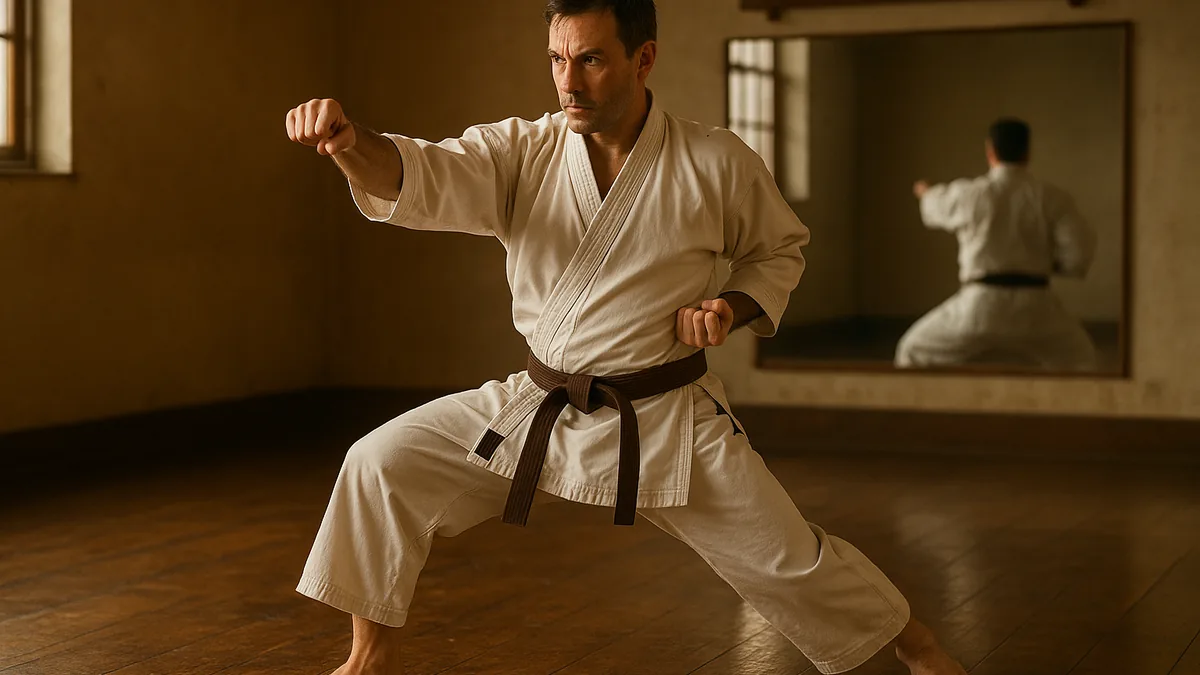
Most people who’ve been training for a few years can perform their kata. They know the sequence, they hit the turns, they finish more or less where they started. But watch closely and you’ll see the same thing I see constantly at gradings and squad sessions: kata done about the technique, not with it. The shape is there. The intent isn’t.
That gap - between knowing the form and actually doing the form - is where most practitioners get stuck. And it’s not for lack of effort. It’s usually a misunderstanding of what kata is actually asking of you.
The Memorisation Trap
When you’re a white belt, kata is a memory problem. You’re trying to hold the sequence in your head while your body does something it’s never done before. That’s completely normal - that’s the job at that stage. But the mistake I see constantly is that practitioners treat kata like a memorisation problem for far too long. They keep drilling the sequence instead of drilling the content of the sequence.
I’ve noticed this most clearly with students preparing for kyu gradings. They’ll run the kata ten times in a row, and by the tenth rep it looks almost identical to the first - same rushed transitions, same flat strikes, same disconnected stances. They’ve practised the pattern, not the technique. The repetition isn’t building anything because they’re not giving themselves anything to build with.
What I tell students is this: once you know the sequence well enough to stop thinking about what comes next, your real kata training has just started. Before that, you’re just learning the map. You haven’t started the journey.
If you’re not sure where you are with this, What Is Kata? A Practitioner’s Guide to Karate’s Solo Forms gives a solid grounding in what the form is actually supposed to represent - worth reading before you invest another hundred repetitions in something you might be misunderstanding.
What Actually Changes With Experience
As a white belt I thought kata was about remembering and reproducing. By brown belt I realised it’s about pressure - applying force into every technique as if it matters, because in the context the kata is describing, it does.
The thing that actually changed my understanding was a session with a senior instructor who stopped me mid-kata, put his hand in front of my oi-zuki, and said “hit my hand.” I punched. He barely moved. He said, “Now do it like you mean it.” Same punch, same position - but this time I drove from the back foot, turned the hip through, and snapped the fist at the last moment. His hand moved. He said, “That’s the kata. Do the whole thing like that.”
That was the correction that changed everything for me. Not a technical adjustment - a shift in intent. And it’s something you genuinely cannot teach someone who isn’t ready to understand it yet. You have to see it, feel it, and have it demonstrated on your own body before it clicks.
The progression I’ve observed over years of grading students looks roughly like this:
- White to yellow belt: Sequence and basic form
- Orange to green belt: Stances stabilise, transitions get smoother, but technique is still mostly surface-level
- Blue to purple belt: Power starts appearing in individual techniques, but inconsistently - some moves are alive, others are still placeholders
- Brown belt: The whole kata starts to feel connected. You notice when a technique is dead. You can feel the difference.
- Shodan and beyond: You stop performing the kata and start doing it. The audience becomes irrelevant. The techniques are directed at something specific.
That last shift - from performing to doing - is the one most practitioners underestimate. It requires you to have a clear idea of what each technique is for. Which brings us to bunkai.
You Can’t Do Kata Properly Without Knowing What It Means
I’ll be direct about this: if you don’t have at least a working understanding of the applications in your kata, you’re guessing at the intent of every technique. And guessing produces vague technique.
I’ve seen students who’ve trained for five or six years perform kata that looks technically decent but feels completely hollow - and almost every time, when I ask them what a particular move is doing, they don’t know. They’ve been drilling a shape without understanding what the shape represents. The result is kata that looks like a performance rather than a record of fighting technique.
This doesn’t mean every application has to be the “correct” one - there are entire debates about that, and What Is Bunkai? How to Train Kata Applications That Actually Work covers that territory properly. But you need something to direct your technique at. Even a working hypothesis is better than nothing, because it gives you something to feel against.
When I know that a particular sequence represents a grab-and-strike combination, I perform it differently than if I think it’s just a step-punch. The tension in the gripping hand, the body weight shifting into the pull, the timing between the two actions - all of that changes. The technique becomes specific. And specific technique looks completely different to vague technique, even if the shape is identical.
The Mistakes I See Most Often
Rushing the Transitions
This is the most common thing I see, and it almost always comes from the same place: practitioners trying to show that they know what comes next. The technique finishes, and before it’s even landed, the body is already moving toward the next one.
The correction that works best here is to make the student hold the finish position for a full second. Not as a permanent habit, but as a diagnostic tool. If they can’t hold it - if they wobble, or have to adjust - the technique wasn’t finished. It was abandoned. You can’t rush a technique and commit to it. Pick one.
Kiai at the Wrong Moment
Most beginners shout at the end of the technique. The kiai should be with the technique - the exhalation drives the power, not the other way around. When you hear someone kiai after the punch has already landed, you know the breath and the body aren’t connected yet.
I’ve noticed that when this gets corrected properly, the whole kata changes. The kiai techniques suddenly have more snap, more compression. It feels like something clicked in the body. That’s because it did - the breath is part of the mechanism, not a decoration.
Flat Stances With No Weight
You’ll hear your instructor say “lower your stances” repeatedly. You won’t understand it until you feel what a properly weighted stance does to your striking power. It’s not about how low you can get - it’s about where your weight is.
When your weight is genuinely settled into the stance, you’ll feel stable in a way that’s almost surprising the first time you experience it. A push that would normally shift you barely registers. More importantly, you have something to drive from. The hip rotation connects to the floor through the stance. Without that connection, you’re punching with your arm. With it, you’re punching with your whole body.
Ignoring the Chamber
The hikite - the pulling hand - is not a formality. I’ve spent years watching students perform technically sound punches while their pulling hand floats back lazily to the hip. The chamber is half the technique. It’s the tension that makes the striking arm’s movement meaningful.
What I tell students is to imagine they’re pulling someone’s arm off balance with the hikite while simultaneously striking. When that image is in the head, the pull becomes sharp, intentional, and timed with the strike. The whole technique compresses into a single moment instead of two separate actions.
Kata and Sparring - The Connection Is Real, But Not Automatic
I think the reason a lot of practitioners dismiss kata as irrelevant to sparring is that they’ve never trained it in a way that makes the connection obvious. If you’ve only ever done kata as a sequence of shapes, of course it doesn’t help your kumite. But if you’ve trained the applications, and you’ve done the kata with genuine intent behind every technique, you start to notice things.
The hip mechanics in a well-trained gyaku-zuki are the same mechanics that make your counter off a failed attack devastating in jiyu-kumite. The shifting weight in a gedan-barai is the same weight shift that takes you off the line of an incoming kick. The timing isn’t automatic - you have to bridge it deliberately - but the physical foundations are the same.
Does Kata Actually Help Your Sparring? goes into this in more depth, and it’s worth thinking about seriously rather than assuming the answer is obvious either way. The honest answer is: it depends entirely on how you train it.
If your kata training is disconnected from any understanding of application, and your sparring training never references the body mechanics you’ve built in kata, then no - they won’t help each other. But that’s a training problem, not an inherent limitation of kata.
Community Perspective
There’s a genuine split in the karate community on this, and I think it’s worth being honest about it rather than pretending there’s one correct answer.
Some instructors - particularly in competition-focused dojos - treat kata primarily as a performance discipline. The emphasis is on visual precision, timing, and presentation. In that context, the depth of application knowledge matters less than the quality of execution under pressure. I’ve seen practitioners trained this way who perform kata that is genuinely impressive to watch.
Others - and I lean this way - think that approach produces kata that is technically polished but functionally hollow. The argument is that you can’t fully commit to a technique you don’t understand, and that without application knowledge, kata training is just choreography.
The counterargument I’ve heard from competition coaches is that the physical discipline of high-level kata training builds attributes - focus, precision, body control - that transfer regardless of whether you understand the applications. I don’t fully agree, but I take the point. I’ve seen competition kata practitioners who have exceptional body mechanics.
Where I’ve landed, after a lot of years and more than a few arguments about this after training: the best kata practitioners I’ve trained with have both. They understand what the techniques are doing and they’ve refined the execution to a high level. The application knowledge gives them intent. The technical training gives them precision. You don’t have to choose - but if you’re going to prioritise one, I’d start with understanding what you’re actually doing.
Kihon Is the Foundation You Keep Coming Back To
One thing I’ve changed my mind on over the years: I used to think that kata training could compensate for weak kihon. It can’t. If your gyaku-zuki in kihon is disconnected - arm moving independently of the hip - it will be disconnected in kata. The kata won’t fix it. If anything, the kata will give you a way to hide it, because there’s always the next technique coming.
Kihon forces you to stay with the technique. You do the punch, and then you stand there, and your instructor can see exactly what happened. There’s nowhere to go. That exposure is uncomfortable, but it’s where the real corrections happen.
Why Kihon Still Matters at Every Belt Level makes this case better than I can in a paragraph, and it’s worth revisiting even if you’ve been training for years. I’ve gone back to basics more times than I can count, and every time I find something that was degrading without me noticing.
Key Takeaways
- Once you know the sequence, stop drilling the sequence. Start drilling the content - each technique, each transition, each stance. The map is done. Now do the work.
- Know what every technique is doing. Even a working hypothesis is better than vague intent. Vague intent produces vague technique, and vague technique looks exactly like what it is.
- The kiai, the hikite, and the stance are not decorations. They are load-bearing parts of the technique. If any of them is absent or lazy, the technique is incomplete regardless of how the striking limb looks.
- Hold your finish positions. If you can’t hold them, you didn’t finish them. Diagnose before you repeat.
- Build the bridge to sparring deliberately. Kata mechanics and kumite mechanics are the same mechanics - but the connection doesn’t happen automatically. You have to train it consciously.
- Go back to kihon regularly. Not as a punishment or a beginner exercise - as a diagnostic. Things degrade. Kihon shows you what’s gone wrong before the kata hides it.
The weekly digest
New karate articles, once a week
One email every week with everything new on Karate Lifestyle. No spam; unsubscribe in one click.
We'll email you to confirm. See our privacy policy.