What Is Bunkai? Training Kata Applications
Most people who train kata have never actually done bunkai. They think they have - they’ve done the paired drills their instructor showed them, they’ve gone through the movements with a partner, maybe they’ve even performed it at a grading. But they’ve been doing bunkai about kata rather than bunkai from kata. There’s a difference, and it took me an embarrassingly long time to understand it.
What Bunkai Actually Is (And What It Isn’t)
The word means analysis or disassembly - you’re taking the kata apart to understand what each movement is doing. But here’s where most of us go wrong early on: we treat it like a translation exercise. Movement A in the kata equals Technique B in a fight. One-to-one correspondence. Neat, tidy, and almost entirely useless.
I used to think bunkai was the kata’s instruction manual. You do the form, then you decode it, and now you know what it means. By the time I was working towards my shodan, I’d started to suspect that wasn’t right. By the time I was actually teaching students, I was certain it wasn’t.
What bunkai actually is - and I’ll defend this position - is a method of pressure-testing your understanding of the kata. You’re not looking for the one correct application. You’re asking: what would have to be true about a real situation for this sequence of movements to make sense? That question opens up far more than any fixed drill.
The kata Bassai Dai doesn’t have a secret meaning that the masters encoded and you need to decrypt. What it has is a set of principles - about angle, about structure, about how to deal with a grabbing or striking opponent at close range - and the bunkai is how you find, test, and internalise those principles. If you want a deeper look at what kata is actually doing as a training method, the what is kata guide covers the foundation well.
Why Most Bunkai Training Doesn’t Transfer
One mistake I see constantly - and I made it myself for years - is training bunkai as choreography. Two people face each other, the attacker throws a predetermined technique, the defender performs the kata sequence, uke takes a fall, everyone bows. Repeat ten times. Next technique.
The problem isn’t the drilling itself. The problem is the attack is fake, the timing is fake, and the defender already knows what’s coming. You’re rehearsing a performance, not developing a skill.
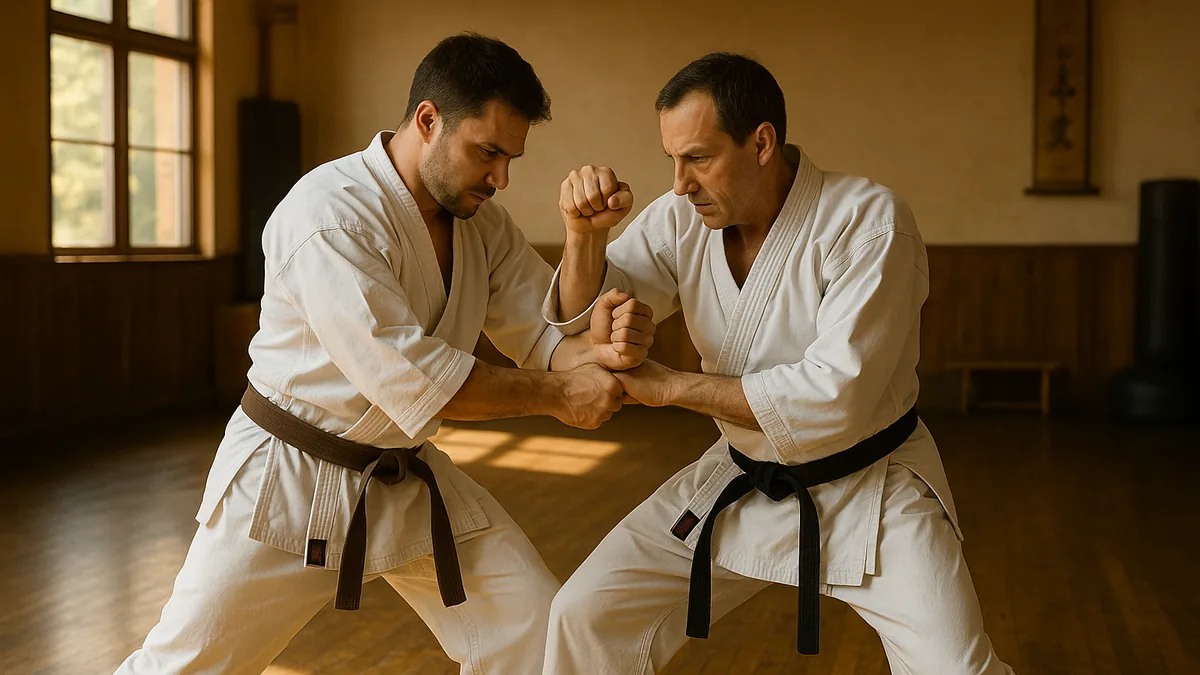
What I tell students when they first start working bunkai with a partner is this: the attacker’s job is to make the technique fail. Not to be uncooperative for the sake of it, but to apply genuine pressure - real grips, real resistance, real attempts to recover. If the application only works when uke stands still and waits, it doesn’t work. You haven’t found the application yet. You’ve found a mime of it.
The correction that makes the biggest difference in early bunkai work is changing the quality of the attack. When uke actually grabs your wrist with intent, suddenly the wrist release from Pinan Shodan has to be done with correct rotation, correct body drop, correct timing - or it doesn’t release. That’s the information you need. That’s the feedback the kata is trying to give you.
The Gap Between Kata and Alive Training
There’s a real tension here that practitioners argue about, and I think both sides have a point. Some instructors insist that bunkai must stay close to the kata movement - if the kata shows a gedan barai, your application should look like a gedan barai. Others say the kata is just a memory device and the applications can diverge significantly from the surface movement.
I sit somewhere in the middle, but closer to the second camp. The kata encodes principles, not techniques. The outward shape of a movement is a hint, not a prescription. A downward sweeping motion might be a block, a grab, a throw entry, or a limb destruction - depending on what the attacker is doing. The kata doesn’t change. Your understanding of it should.
How to Actually Train Bunkai
The method I’ve found most productive - and I’ve tried a few - works in three stages.
Stage one: find a plausible application. Take a sequence of three to five movements from a kata. Ask yourself what attack would make the defender’s first movement necessary. Not what attack looks similar to the defender’s response - what attack would require that response. This is harder than it sounds. It forces you to think about range, angle, grip, and initiative rather than just shape-matching.
Stage two: drill it slowly with a resisting partner. Not resistant in the sense of trying to escape - resistant in the sense of maintaining genuine physical pressure throughout. The attacker holds the grab, keeps their weight forward, doesn’t telegraph the next move. You’ll feel immediately where the application has gaps. When the hip rotation connects properly in a throw or takedown, you feel it through your whole body - there’s a moment where uke’s balance just goes, almost without effort. When it’s wrong, you’re muscling it, and you know it.
Stage three: add context and variability. Change the attack slightly. What if the grab is higher? What if the opponent is taller? What if they pull instead of push? A good bunkai application doesn’t break the moment the variables shift. If it does, you haven’t found the principle yet - you’ve found one narrow expression of it.
This is a longer process than most people expect. I spent about six months working through the first three Pinan kata seriously, and I’m still finding things in them.
The Mistakes I See Most Often
Skipping the close range problem. Most people train bunkai at medium striking range, because that’s comfortable and familiar. But a lot of kata movement only makes sense at very close range - inside punching distance, where grabbing and controlling is more relevant than striking. I’ve seen students try to make a sequence work at sparring distance and get completely confused. Step inside. The movement often makes immediate sense once you’re at the right range.
Treating uke as a prop. This one I’ve seen at every level. Uke throws the attack, then essentially switches off and waits to receive the technique. In a grading context I understand why it happens - you don’t want to mess up your partner’s demonstration. In training, it’s a waste of time. What I tell students is: uke is doing bunkai too. Uke is learning what it feels like to have their balance broken, their structure compromised, their attack redirected. Both people should be getting something from every repetition.
Over-explaining before under-feeling. I’ve done this as an instructor more times than I’d like to admit. You show a bunkai application, explain the theory behind it, give the historical context, draw connections to other kata - and then the students go off to drill it and it doesn’t work because they haven’t felt the basic mechanics yet. The explanation should come after the physical experience, not before. Let them struggle with it first. Then the explanation lands.
Ignoring the transitions. Kata has techniques, but it also has the movements between techniques - the turns, the steps, the chamber positions. I’ve noticed that beginners focus entirely on the obvious strikes and blocks and ignore everything else. Some of the most interesting bunkai is in the transitions. A turn in kata isn’t just repositioning - it’s often a throw, a takedown entry, or a break from a grab. If you’re only looking at the punches and blocks, you’re reading every other word.
How Your Understanding Changes With Experience
As a white belt, I thought bunkai was about learning what the kata movements “meant.” There was a correct answer, and the instructor knew it, and eventually I’d be told.
By brown belt, I’d started to suspect the kata meant different things depending on what question you brought to it.
By the time I was teaching, I’d changed my view entirely. The kata doesn’t have a fixed meaning waiting to be discovered. It has a structure that rewards serious inquiry. The more you know about fighting - about range, about balance, about how people actually grab and push and strike - the more the kata reveals. It’s not that the kata changes. It’s that you change, and you bring different questions to it.
That’s why senior practitioners often say the kata gets more interesting as you progress, not less. It’s not nostalgia. The kata genuinely contains more than you can access at any given stage of your development. If you want to see how this connects to actual sparring performance, does kata actually help your sparring? gets into the specific transfer mechanisms.
Community Perspective
This is probably the most actively debated topic in traditional karate right now, and I think that’s a good thing.
There’s a real split between practitioners who insist on staying close to the kata’s surface movement in bunkai - every gedan barai is a downward block, every age uke is a rising block - and those who’ve moved toward what’s sometimes called “pressure-tested” or “alive” bunkai, where the application might look quite different from the kata movement but works against genuine resistance.
I’ve trained with instructors on both ends of this spectrum. The more traditional approach has value - it keeps the kata intact as a transmission vehicle and prevents people from projecting whatever they want onto it. But I’ve also seen it produce bunkai that only works if uke cooperates perfectly, which tells you nothing useful about whether the application actually functions.
The other side has its own problems. When practitioners start with “what works in a fight” and then reverse-engineer kata applications to fit, you can end up with bunkai that’s just grappling or MMA with a kata wrapper. The kata stops being the source and becomes a justification.
Where I’ve landed - and I’ve changed my mind on this more than once - is that the kata should constrain your bunkai enough to keep you honest, but not so rigidly that you’re defending applications that don’t work. If your application requires uke to be completely passive, the kata is telling you something. If your application has drifted so far from the kata that you couldn’t trace it back, you’ve probably lost the thread.
The practitioners I respect most are the ones who keep returning to the kata with new questions rather than settling on a fixed set of applications and stopping there.
Bunkai in the Context of Your Wider Training
Bunkai doesn’t exist in isolation. It’s most useful when it’s in conversation with your kihon, your kumite, and your physical conditioning. An application that works in slow bunkai drilling but falls apart in jiyu-kumite usually has a timing or structure problem - and the only way to find that is to actually test it under pressure.
I’ve found that solo training drills that actually transfer to kumite are particularly useful for bridging this gap. The mechanics you develop in bunkai need to become reflexive before they’re available under pressure, and that requires a lot of repetition outside of paired drilling.
Stance is also worth mentioning here. A lot of bunkai applications fail not because the technique is wrong but because the base is wrong - the practitioner is too high, too narrow, or not rooted enough to generate or absorb force. If you’re finding that your applications keep collapsing under any real resistance, karate stances explained is worth revisiting with bunkai specifically in mind. The stance work isn’t separate from the application - it’s what makes the application possible.
Key Takeaways
- Start with the attack, not the technique. Ask what attack would make the kata movement necessary, not what the kata movement looks similar to. This single shift changes everything about how you analyse kata.
- Make uke a genuine participant. Real grips, real resistance, real attempts to recover. If the application only works on a passive partner, you haven’t found the application yet.
- Work close range first. Most kata bunkai operates inside punching distance. If a sequence isn’t making sense, step in. The movement often resolves immediately.
- Feel it before you explain it. Drill the mechanics until you can feel when it’s working and when it isn’t. The theory should confirm what your body already knows, not substitute for it.
- Return to the kata regularly. Your bunkai should evolve as your understanding of fighting deepens. If your applications haven’t changed in three years, you’ve stopped asking questions.
- Test under pressure. Slow drilling is where you find the application. Alive training is where you find out if it actually works. You need both, and you need to be honest about which one you’re doing.
- If you want to understand why so many applications collapse under resistance, why most bunkai doesn’t work examines the common failure points. And for a practical framework on applying kata to real scenarios, training kata for self-defence bridges that gap.
The weekly digest
New karate articles, once a week
One email every week with everything new on Karate Lifestyle. No spam; unsubscribe in one click.
We'll email you to confirm. See our privacy policy.