Embusen: Understanding Kata Floor Patterns and Why They Are Not Decoration
Most people treat embusen like a map they memorised once and then stopped thinking about. You learn the shape of the kata - the line, the cross, the H-pattern, whatever it is - you make sure you end roughly where you started, and then you get on with focusing on the techniques themselves. I did exactly this for the first few years of my training, and honestly, a lot of the students I grade still do it.
The problem is that when embusen is treated as a finishing requirement rather than a structural principle, the whole kata starts to come apart in ways that are hard to diagnose. Your timing gets inconsistent. Your transitions feel rushed or hesitant. Your techniques lose their grounding. And you can’t figure out why, because you’re focused on your hands, your kiai, your stances - all the visible things - while the actual problem is that you’ve lost your relationship with the floor beneath you.
What Embusen Actually Is
Embusen is the floor pattern traced by a kata - the sequence of directions, turns, and positions that make up its spatial structure. Every kata has one. Heian Shodan moves along a line. Bassai Dai opens with a dramatic shift that immediately establishes a cross-shaped orientation. Kanku Dai covers a lot of ground in multiple directions before returning to the start.
I used to think of this as a kind of choreographic convenience - a way of keeping the kata contained in a limited training space. That’s not wrong, but it’s missing the point by about ninety percent.
What I eventually understood, after probably six or seven years of serious training, is that embusen encodes the combat logic of the kata. The direction you move is telling you something about where the attack is coming from and where you’re going in relation to it. A turn isn’t just a turn - it’s a response to a threat from a new angle. When you step forward into a technique, you’re closing distance. When you step back, you’re creating it. The floor pattern is the spatial memory of the kata’s bunkai, even when you’re not consciously thinking about bunkai at all.
My instructor used to say “move first, technique second.” I didn’t understand it until maybe brown belt level. What he meant was that the embusen movement - the step, the pivot, the directional shift - sets up the technique. If you get the movement wrong, the technique is already compromised before your hands have done anything.
The Geometry Is the Fighting
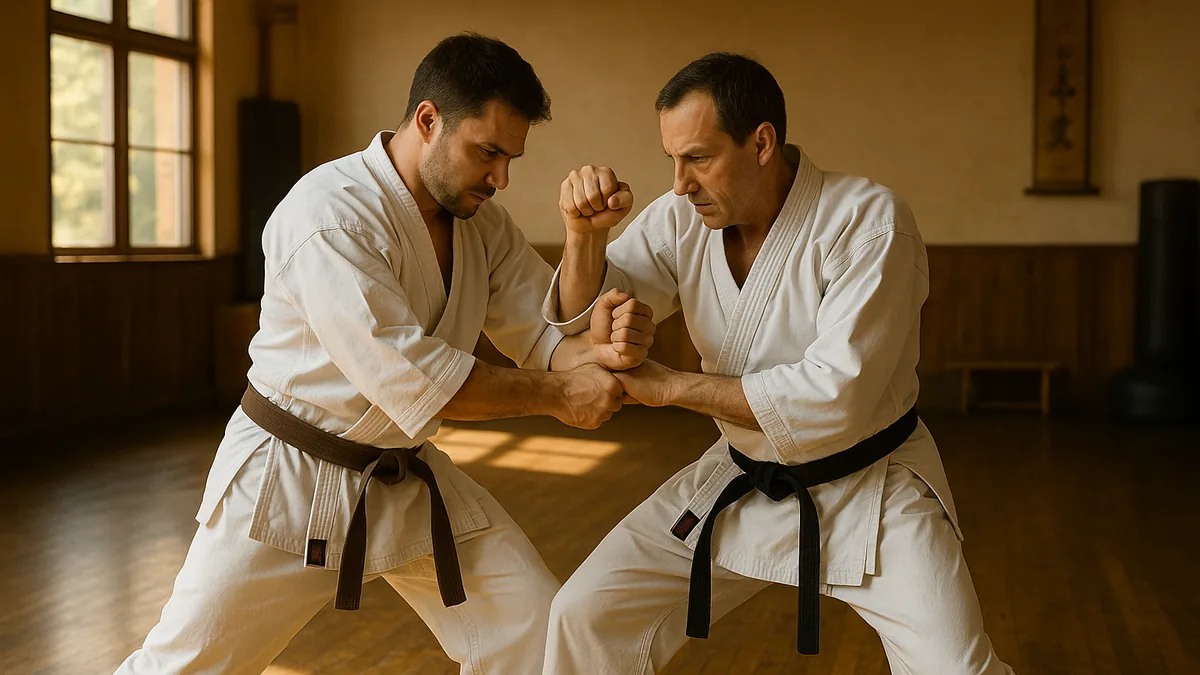
Here’s the thing that actually changed my understanding: I was working with a training partner on the opening sequence of Heian Nidan, and we were doing it as a two-person drill. I kept getting the timing wrong on the side block. My instructor watched for a while and then said, “You’re not moving off the line.”
He wasn’t talking about my block. He was talking about my step. I was stepping straight back instead of stepping at an angle, which meant I was staying in the path of the attack instead of clearing it. The block was technically fine in isolation. In context, it was useless because my embusen was wrong.
That’s when it clicked. The floor pattern isn’t describing where you happen to end up after each technique. It’s describing where you need to be for each technique to work. The geometry of the kata is the geometry of the fight.
This is why I get frustrated when I see students - and sometimes quite senior students - treating the embusen as a rough guideline. “I ended up about there, close enough.” No. The degree of your turn matters. Whether you step at forty-five degrees or ninety degrees matters. The length of your step matters. These aren’t aesthetic choices. They’re functional ones.
When you get the embusen right - when you’ve internalised it to the point where you move into position instinctively - you’ll feel a difference in how your techniques land. There’s a solidity that comes from being in the right place. The technique feels grounded because your body is where it needs to be relative to the imaginary opponent. When you’re slightly off, the technique feels like it’s reaching for something that isn’t quite there.
Common Mistakes I See Constantly
Drifting over time. This is the most common one. The kata starts on the line, and by the halfway point the student is two metres to the left of where they should be. It happens gradually, through small errors in step length and turn angle that compound over the sequence. I’ve seen students finish a kata facing the wrong direction entirely and not notice. The correction isn’t to think harder about where you’re going - it’s to use fixed reference points in the dojo. Pick a mark on the floor or a point on the wall and track your position against it throughout the kata.
Rushing the turn to get to the technique. One mistake I see constantly with beginners working on kata like Heian Yondan is that they treat the turn as dead time - something to get through quickly so they can do the actual technique. So the turn is fast and sloppy, and then there’s a tiny hesitation before the technique as they try to find their footing. The turn and the technique are one movement. The turn is how the technique gets its power. When students rush it, they’re throwing away the hip rotation that should be driving the block or strike.
Treating the embusen as two-dimensional. Floor patterns are drawn on flat paper, but kata happens in three dimensions. I’ve noticed that students who study embusen only as a diagram tend to forget about height changes - the drop into a low stance that shifts your centre of gravity, the rise through a technique, the compression before an explosive movement. The vertical dimension is part of the pattern too.
Ending up in the wrong place and compensating. This one is subtle. Some students know they’ve drifted and try to correct it in the final few moves by taking slightly longer or shorter steps. This looks wrong immediately - the technique suffers because the step length is being dictated by navigation rather than by what the technique requires. If you’ve drifted, acknowledge it, reset, and work out where the error started. Don’t patch it at the end.
Spatial Awareness as a Training Tool
I think one of the most underused training methods is performing kata with deliberate spatial constraints. Put a line of tape on the floor marking where you should start and finish. Work in a smaller space than you’re comfortable with. Train on an uneven surface occasionally if you can do it safely.
What this does is force you to commit to your embusen rather than drifting into whatever space is available. When the tape is there, you can’t pretend you finished close enough. Either you’re on the mark or you’re not.
I’d also recommend walking the embusen without techniques periodically - just the steps, turns, and directional changes, at slow speed, paying attention to exactly where your feet land. This strips away the distraction of the techniques and lets you focus purely on the spatial structure. Most students find this surprisingly difficult at first because they’ve been using the techniques as memory cues rather than the floor pattern itself.
This connects directly to something worth reading if you’re working on refining your kata overall - the piece on how to improve your kata covers some complementary approaches to this kind of deliberate practice.
Embusen Under Pressure
Here’s where the real test is. In a grading environment, embusen tends to fall apart. I’ve seen it dozens of times - a student who performs a kata consistently well in training suddenly drifts badly under examination conditions. The reason is almost always that pressure causes them to focus inward on their techniques and lose their spatial awareness entirely.
What I tell students preparing for grading is this: if you can only hold one thing in your mind during the kata, make it the embusen. The techniques are drilled enough that they’ll largely take care of themselves. The embusen requires active spatial attention, especially under stress. If you stay on your line, your techniques will land where they’re supposed to land. If you lose the line, everything else starts to compensate and degrade.
There’s a good breakdown of what examiners are actually watching for in kata for grading - and spatial precision consistently comes up as a differentiator between students who perform competently and students who perform excellently.
The students who impress at grading aren’t always the ones with the most powerful techniques. They’re often the ones who look like they own the space they’re moving through. That quality - that sense of inhabiting the kata’s geometry rather than just passing through it - comes from really understanding embusen.
Community Perspective
There’s a genuine divide in how different dojos and associations treat embusen in training, and it’s worth being honest about it.
In some traditional dojo environments, embusen precision is drilled from white belt - students are expected to return exactly to their starting point from early on, and significant deviations are corrected immediately. In other environments, particularly those with a stronger competition focus, embusen tends to get less attention than visual impact and power. The kata might look impressive and still be spatially imprecise.
I’ve trained in both environments and I think the traditional approach is right, but I understand why competition-focused training deprioritises it. Judges at tournament level often aren’t watching embusen closely unless the deviation is dramatic. So students who train primarily for competition can develop technically impressive kata with structurally loose floor patterns and get rewarded for it.
The longer-term problem, which I’ve seen play out with students who come back to traditional training after competition-focused periods, is that rebuilding spatial precision is genuinely difficult. The habits are deep. It’s much harder to correct embusen at shodan level than at sixth kyu.
If you’re navigating the difference between kata for competition and kata for understanding, the piece on how to transition between kata for grading and kata for understanding is worth your time.
My position is that embusen precision should be treated as foundational from the start, regardless of whether you’re training for competition or not. The spatial structure of the kata carries the combat logic. If you get casual about the floor pattern, you’re getting casual about what the kata is actually teaching you.
Key Takeaways
- Walk the embusen of your kata without techniques regularly - just the steps and turns at slow speed. If you find this difficult, your spatial awareness of the kata needs work.
- Use fixed reference points in the dojo to track your position throughout the kata. Tape marks on the floor are not cheating - they’re a training tool.
- The turn is part of the technique, not a transition between techniques. If you’re rushing the turn to get to the block or strike, you’re losing the power that the turn generates.
- If you end a kata in the wrong place, trace the error back to where it started rather than compensating in the final moves. Compensation makes the problem harder to find and fix.
- Under pressure, prioritise spatial awareness over technique focus. The techniques are drilled - the embusen requires active attention, especially when you’re nervous.
- Embusen precision is a differentiator at grading level. Students who look like they own the space they’re moving through consistently stand out - and that quality is trainable.
The weekly digest
New karate articles, once a week
One email every week with everything new on Karate Lifestyle. No spam; unsubscribe in one click.
We'll email you to confirm. See our privacy policy.