Why Most Bunkai Doesn't Work
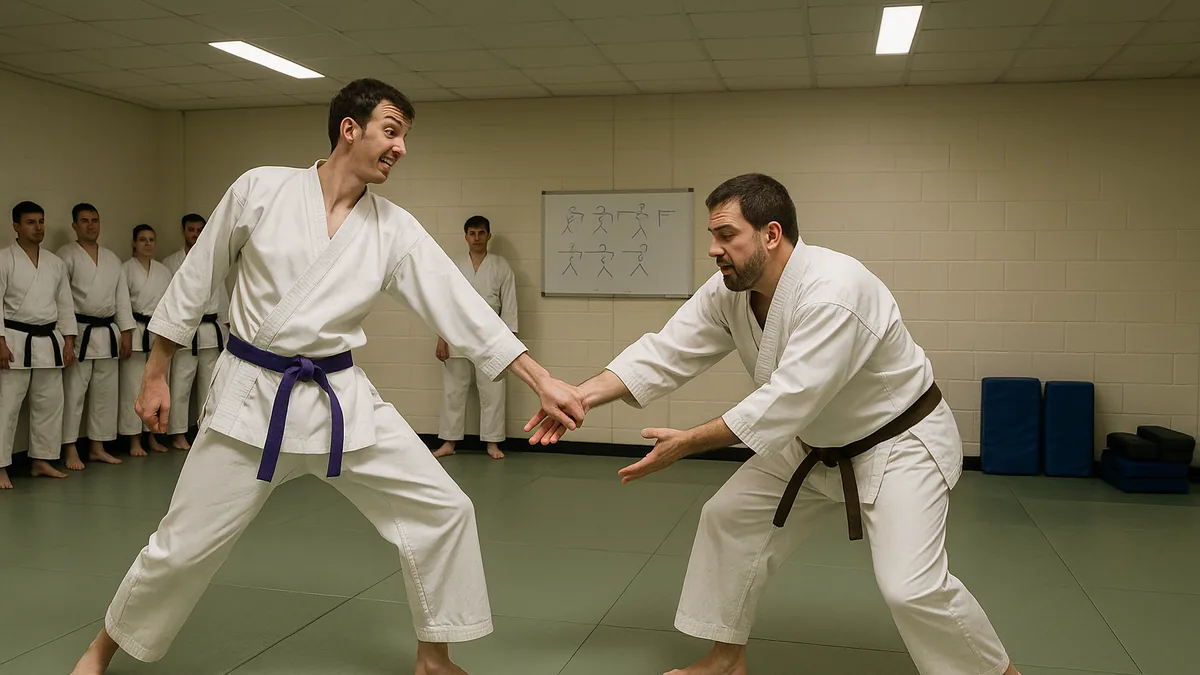
I’ve watched students spend years drilling bunkai that would fall apart the moment someone actually resisted. Not because they weren’t training hard, but because nobody had told them the truth about what they were doing. The bunkai looked clean, the partner cooperated perfectly, and the application made geometric sense on a whiteboard. In a real exchange, against someone who didn’t know their cue, it was useless.
That’s the problem we need to talk about.
The Cooperative Partner Problem
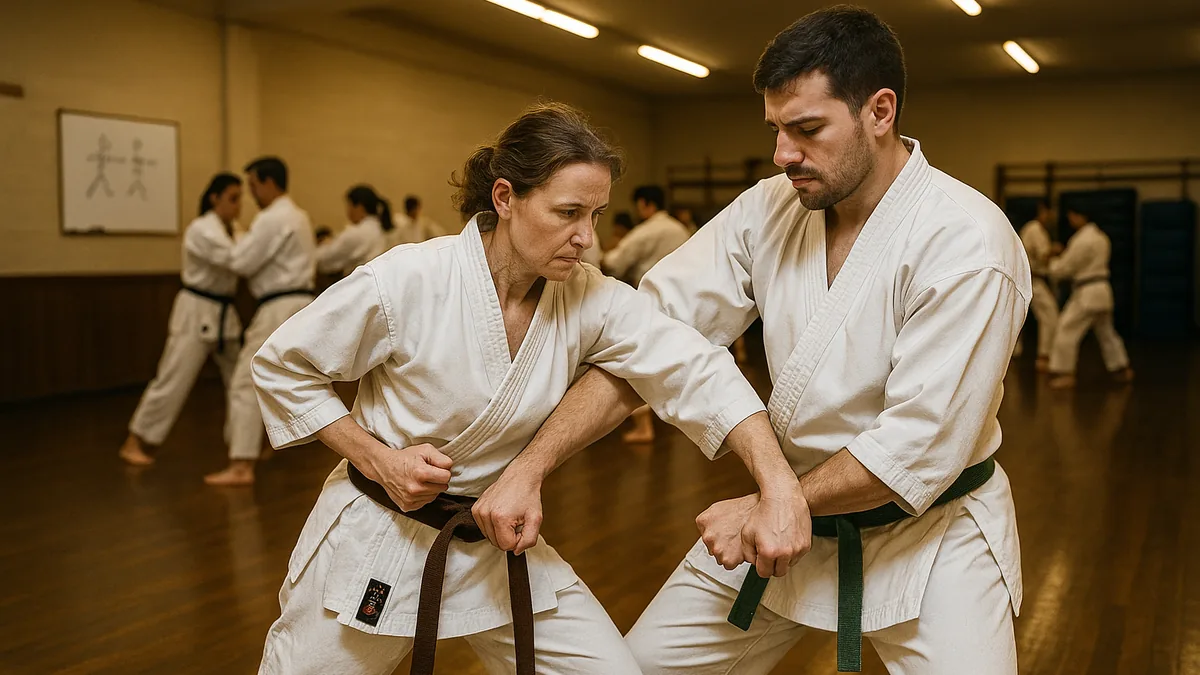
Most bunkai fails because it’s built on a foundation of compliance. Your partner attacks in a specific way, at a specific angle, with a specific amount of force. You apply the technique. It works. You both nod. You’ve proven nothing.
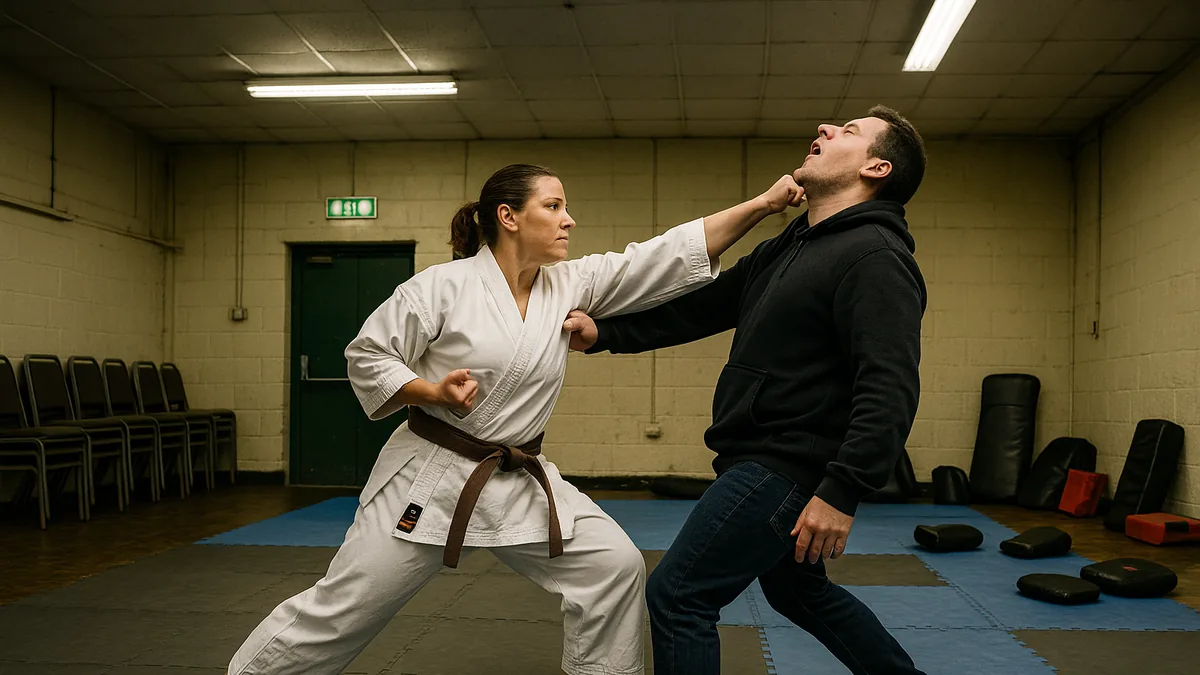
I’ve seen this pattern in every dojo I’ve trained in. The attacker throws a lunging punch that no one would actually throw in a fight. The defender steps offline, applies the application, and the attacker crumples or freezes. It looks great. The instructor approves. But nobody has tested whether the entry works against a real committed attack, whether the grip is achievable when someone is actually trying to pull away, or whether the follow-up has any stopping power.
What’s happening is that both partners have unconsciously agreed on a script. The attacker knows what’s coming and adjusts their body to make the technique possible. The defender never has to solve an actual problem. You’re rehearsing a demonstration, not developing a skill.
The correction that actually works here is to deliberately break the script. Have the attacker vary their attack - different timing, different angle, slightly different range. Not to sabotage the drill, but to make the defender find the technique rather than just perform it. If the bunkai only works when everything is perfect, it’s not bunkai. It’s choreography.
What “Functional” Actually Means
I think the word functional gets thrown around too loosely. People say their bunkai is functional because it involves contact, or because it’s based on a self-defence scenario, or because a well-known instructor endorsed it. None of that makes it functional.
What I tell students is that a functional application has to survive three tests. First, does it work against a non-compliant partner who knows roughly what’s coming but isn’t cooperating? Second, does it work when the entry is slightly off - when your position isn’t perfect, when the angle is wrong, when you’re a fraction late? Third, can you make it work under any kind of pressure, even just light resistance?
Most bunkai fails the first test. Almost all of it fails the second. Very little of it survives the third.
The thing that changed my understanding was a session where my instructor at the time told us to drill a specific Heian application - a sequence from the opening movements - but the attacker was allowed to pull back or redirect once the defender made contact. Just that one variable. The room went quiet very quickly. Nobody’s application worked anymore. We’d all been relying on the attacker staying put.
That session was more valuable than a year of polished, cooperative bunkai drilling.
Why Instructors Teach It This Way Anyway
I’m not trying to blame instructors here. There are real reasons why cooperative bunkai dominates most clubs.
Teaching functional applications takes a lot more time. You need to develop the drill slowly, build in resistance gradually, and manage a room full of students at different levels. It’s much easier to teach a clean, visual sequence that everyone can follow than to develop the sensitivity and timing that makes an application actually work.
There’s also a grading culture problem. Most grading panels want to see bunkai that looks good - clean technique, clear application, controlled execution. If you show up with rough, pressure-tested bunkai that involves awkward entries and messy follow-ups, you might actually score worse than someone who performs a pristine but useless sequence. I’ve seen it happen. The system rewards performance over function.
And honestly, some instructors don’t know the difference. They learned cooperative bunkai, they never had it seriously tested, and they genuinely believe it works. That’s not a criticism - it’s a structural problem in how kata knowledge gets passed down.
For a deeper look at some of the layers that get lost in transmission, the piece on hidden techniques in kata is worth your time. A lot of the most functional applications aren’t the obvious ones.
The Performative Tells
I’ve noticed a few patterns that reliably signal bunkai that’s been built for performance rather than function.
The attacker freezes after the initial technique. In any real application, you’d need to deal with what comes next - the person recovering, counter-attacking, resisting. If the bunkai ends with the attacker static and the defender posed, nothing has been tested.
The application requires the attacker to hold a specific position. A wrist grab that only works if the attacker keeps their arm extended. A throw that requires the attacker to stay rigid. Any technique that depends on the attacker not responding naturally is a technique that won’t work when it matters.
The entry is too clean. In real exchanges, you’re rarely in perfect position. If the bunkai only works from a specific stance, at a specific distance, with a specific weight distribution, the margin for error is too small to be useful.
The application is visually impressive but physically shallow. You’ll feel this if you pay attention - some techniques land with real weight behind them, you feel the structure through your body, there’s a genuine mechanical advantage. Others look dramatic but feel like nothing. The attacker has to sell the reaction because the technique hasn’t actually done anything.
For anyone working through the Heian series, these issues show up constantly. The Heian Shodan breakdown covers some of this in the context of those specific movements, and the broader Heian series overview is useful for understanding what each kata is actually developing.
How to Test Your Applications Honestly
Here’s what I’d actually recommend, and I say this having wasted a lot of time on bunkai that I thought was solid until I pressure-tested it.
Start with the entry. Before you worry about the full application, drill just the entry against a live, moving partner. Can you actually get into position from a realistic attack? Most bunkai falls apart here before it even starts.
Add resistance incrementally. Not all at once - that just creates chaos. Start with the attacker offering 30% resistance, then 50%, then 70%. You’re not sparring, you’re stress-testing. The goal is to find where the technique breaks down so you can fix it.
Change the attacker’s response. What happens if they don’t react the way your bunkai assumes? What if they pull back instead of pushing forward? What if they grab with the other hand? If the technique collapses under any variation, you’ve found something worth working on.
Train it tired. This sounds obvious but most people never do it. Drill the application at the end of a hard session when your coordination is degraded. Techniques that rely on fine motor precision will disappear. The ones that survive are the ones built on good structure and timing rather than perfect execution.
The bunkai partner drills resource has some specific drill formats that build this kind of honest testing into the practice, which is worth working through with a regular training partner.
I’d also say - don’t avoid the awkward applications. The ones that feel clumsy at first are often the ones that are doing something real. The techniques that feel too smooth, too easy, too cooperative - those are the ones I’d look at hardest.
Community Perspective
This is one of those topics where experienced practitioners genuinely disagree, and I think that’s worth acknowledging.
There are serious karateka - people who’ve trained for decades, who’ve competed, who’ve taught - who think pressure-testing bunkai is misguided. Their argument is that kata applications were never meant to be extracted and drilled as fighting techniques. The kata is a training tool for developing body mechanics, and reading it as a fighting manual is a category error. I understand that position. I don’t fully agree with it, but it’s not a stupid argument.
There’s also a real split between styles and associations. Some Shotokan clubs treat bunkai as almost ceremonial - it’s there, you learn it, you perform it for grading, and the actual fighting development happens in kumite. Other clubs, particularly those influenced by Iain Abernethy’s work or the Okinawan pragmatic tradition, treat bunkai as the core of the art. Tekki Shodan, for example, reads very differently depending on which tradition you’re coming from - the Tekki Shodan breakdown gets into some of that.
My honest view is that if you’re going to do bunkai at all, it should be functional. If it’s purely ceremonial, call it that. What I find frustrating is the middle ground where practitioners believe their bunkai is practical when it’s never been seriously tested. That’s the gap worth closing.
Key Takeaways
- Test the entry first. Most bunkai fails before the main technique even begins. Drill the entry against a moving, non-compliant partner before adding anything else.
- Break the script deliberately. Have your partner vary their attack within the drill. If the application only works when everything is preset, it isn’t working - it’s being performed.
- Watch for the freeze. If the attacker stops moving after the first technique, you haven’t tested anything. Real application requires dealing with what comes next.
- Add resistance incrementally. 30%, 50%, 70% - not chaos, but genuine pressure. Find where the technique breaks before you need it to work.
- Train it tired. Techniques that rely on fine motor precision will disappear under fatigue. The ones that survive are worth keeping.
- Be honest about what you’re doing. Ceremonial bunkai isn’t worthless - it develops other things. But don’t mistake it for functional application work. Know which one you’re actually practising.
The weekly digest
New karate articles, once a week
One email every week with everything new on Karate Lifestyle. No spam; unsubscribe in one click.
We'll email you to confirm. See our privacy policy.