Tekki Shodan Breakdown
Most people treat Tekki Shodan like a warm-up kata. They know it well enough to perform it at grading, they do it when the instructor calls it, and then they move on to something that feels more impressive. I did exactly that for the first three or four years of my training. I thought it was a stepping stone - something you learned before the more complex kata. It took me until about second dan before I genuinely understood what was being asked of me, and even then it was a senior instructor pulling me aside after a grading that finally cracked it open.
She watched me perform it, nodded slowly, and said: “You’re doing the movements. You’re not doing the kata.” I had no idea what she meant. I do now.
What Tekki Shodan Is Actually Training You For
The first thing to understand is that this kata is not a simplified version of something else. It’s a specialist tool. The entire kata is performed in kiba-dachi along a single line, with no forward movement, no retreating, and no turning. If you’re coming from the Heian series - and if you want context on how the Heian kata build your foundational movement, the Heian Series breakdown is worth reading first - the shift into Tekki feels genuinely strange. You’ve spent months or years learning to move forward and back, to turn, to cover distance. Tekki removes all of that.
That’s not a limitation. That’s the point.
The kata is training you for close-range, close-quarters work where you have no room to manoeuvre. Think about what that means in a real altercation - you’re against a wall, you’re in a crowd, someone has closed the distance before you had time to create space. The lateral shuffling, the tight strikes, the body mechanics of kiba-dachi - it all makes sense when you frame it that way. I used to think the kata was about discipline and stances. By brown belt I realised it was about what you do when you can’t move the way you want to.
Kiba-Dachi: The Foundation Everything Else Depends On
I’ve seen more students fail to understand kiba-dachi than almost any other fundamental in the dojo. And the reason isn’t laziness - it’s that most beginners learn it as a shape rather than a structure.
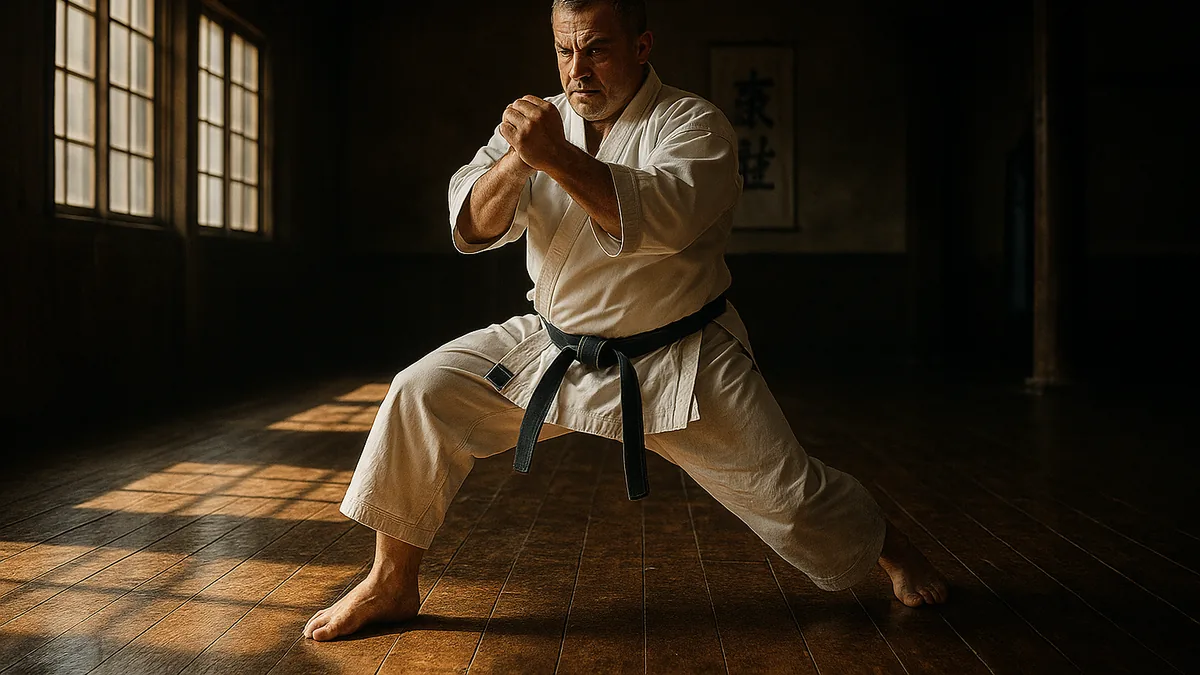
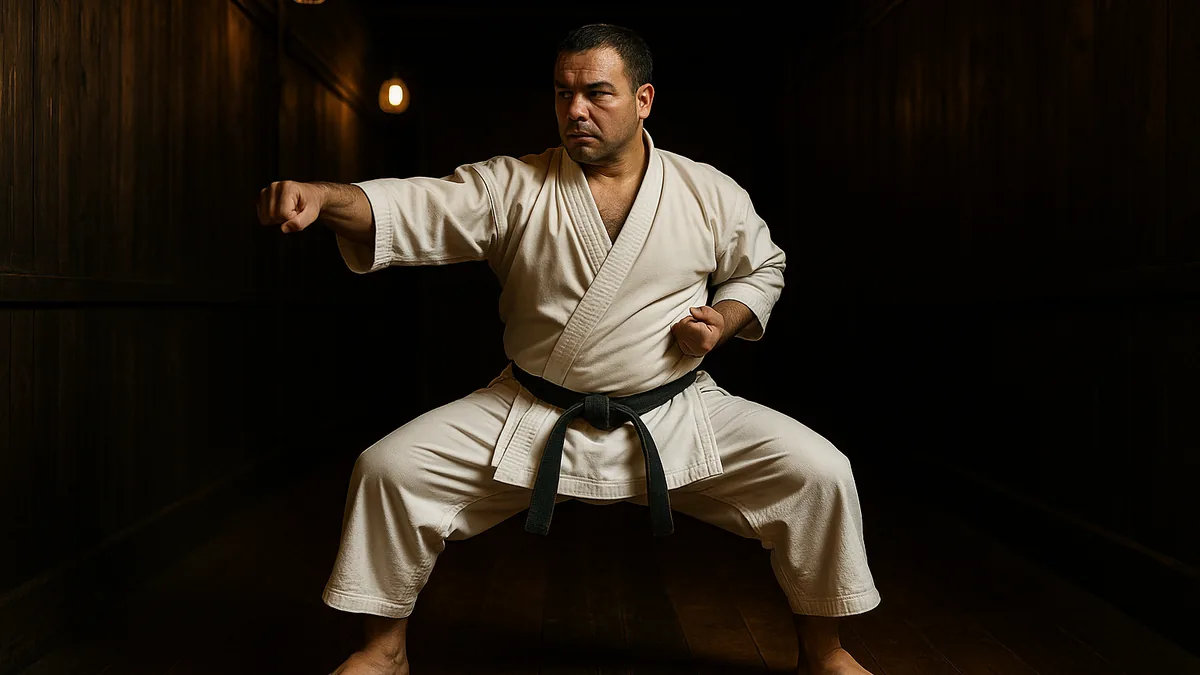
The visual instruction is: feet shoulder-width apart (or wider), toes forward, knees pushed out over the toes, hips low. That’s accurate as far as it goes. But what I tell students is that kiba-dachi should feel like you’re gripping the floor with your feet and your inner thighs are pulling toward each other. Not collapsing inward - pulling. There’s active tension through the whole stance that you don’t get from just standing in the right position.
When kiba-dachi is correct, you’ll feel it in your adductors and your glutes more than your quads. Most beginners feel it entirely in their quads, which tells me they’re sitting into the stance passively rather than driving their knees outward actively. The correction that makes the biggest difference here is asking students to imagine they’re trying to spread the floor apart with their feet - not lifting, not pushing forward, but pulling outward. That external rotation locks the hips in a way that passive kiba-dachi never does.
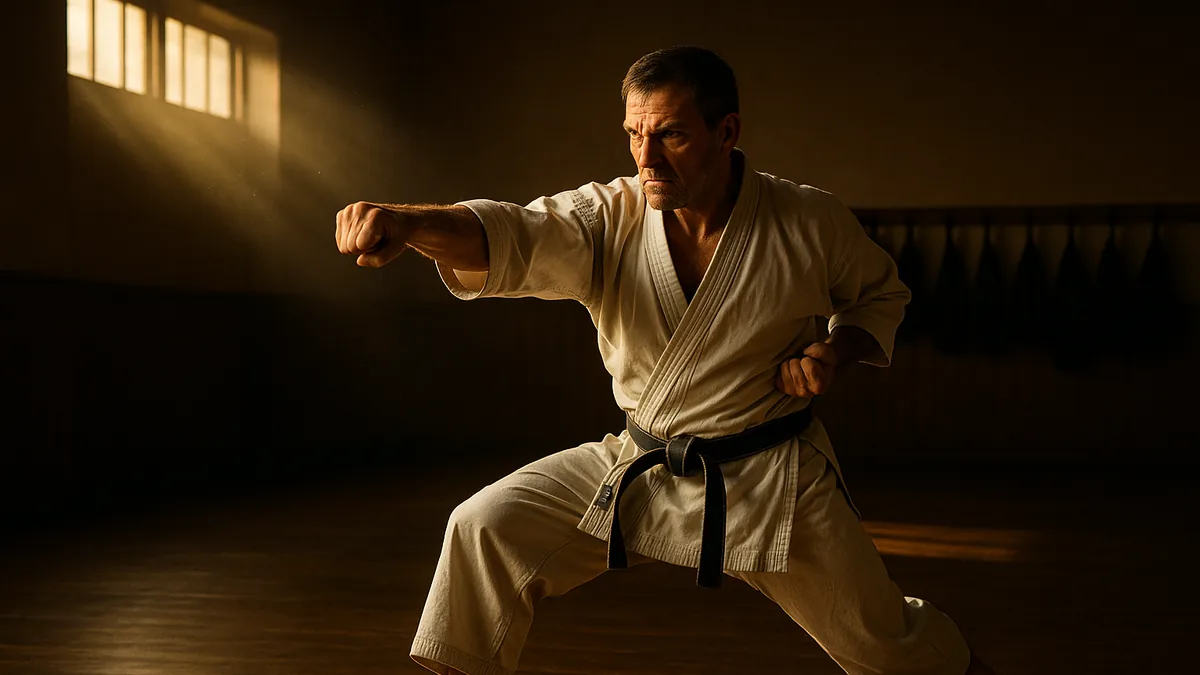
Why does this matter for Tekki specifically? Because every single technique in this kata - every punch, every block, every elbow - is powered from this stance. If the foundation isn’t generating force, you’re just waving your arms around. The hip rotation in kiba-dachi is different from the hip rotation in zenkutsu-dachi. In a forward stance, you’re rotating around a vertical axis. In kiba-dachi, the rotation is tighter, more compressed, and the power transfer into your techniques has to happen differently. It took me years to understand why my Tekki punches felt weaker than my regular gyaku-zuki, and it came down to the fact that I was trying to generate power the same way. Once I understood that the lateral compression of kiba-dachi creates its own type of hip drive, the techniques started to feel completely different.
The Lateral Movement Problem
One mistake I see constantly when students first learn Tekki is that they treat the lateral stepping as transition movement - something that happens between the real techniques. They step, then they do the technique. The stepping is just getting from A to B.
That’s wrong, and it’s the single biggest thing that separates competent Tekki from excellent Tekki.
The movement in Tekki is the technique. The way you transfer your weight across kiba-dachi, the way you pull the trailing leg in before driving the lead leg out, the way your centre of gravity stays level throughout - this is what the kata is teaching. The stepping itself should feel like controlled falling. You shift your weight, the body follows, and you arrive in the next position already loaded and ready to strike. If you’re stepping and then loading, you’ve broken the sequence.
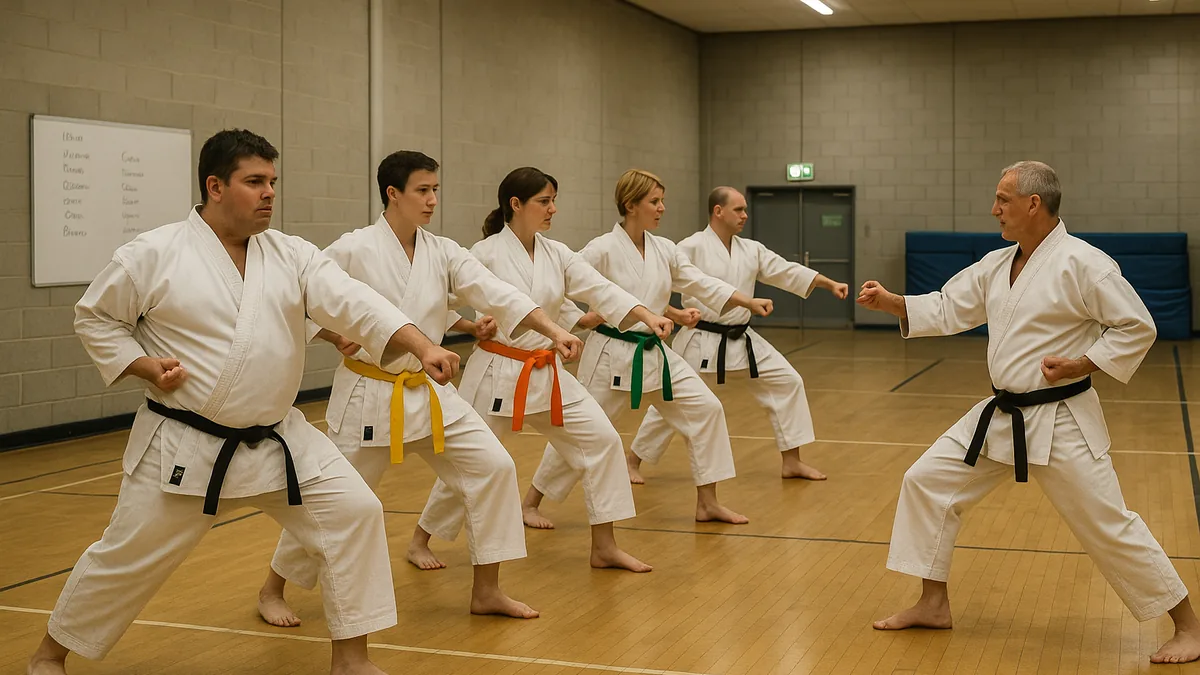
I had a student last year who had clean, powerful techniques but his Tekki looked choppy and disconnected. The issue was exactly this - he was treating each technique as a separate event. What fixed it was drilling the stepping pattern completely stripped of hand techniques for about three weeks. Just the footwork, over and over, until the weight transfer became automatic and he stopped thinking of it as movement between techniques.
The other lateral movement issue is head height. Your head should travel in a straight horizontal line throughout the kata. I’ve noticed that most students bob up and down as they step - they rise as the foot comes in and drop as they land. This is a dead giveaway that the stance isn’t being maintained through the transition. If your head stays level, your stance is working. If it’s rising and falling, you’re losing and rebuilding your base with every step.
Nami-Gaeshi: The Technique Most People Fake
Nami-gaeshi - the returning wave kick - is the moment where you see who actually understands Tekki and who has just memorised the pattern.
What I see most often is a small lift of the foot, a vague circular motion, and then the foot comes back down. It looks like nami-gaeshi. It is not nami-gaeshi.
The technique is a rising deflection with the inside of the foot, designed to scoop an incoming foot sweep or low kick. The foot comes up sharply along the inside line, the knee drives upward, and the foot returns to the floor in a controlled drop - not a passive landing. When it’s done correctly, you’ll feel a distinct snap through the hip and knee, and the return to kiba-dachi should feel like you’re stamping your base back into the floor.
My instructor used to say “the wave goes up, the wave comes down” and I thought that was just a poetic description of the foot path. I didn’t understand it until someone actually tried a low sweep on me in a bunkai drill and I had to use it under pressure. The wave metaphor is about momentum - the energy goes up through the rising foot, and that same momentum drives the foot back down with force. It’s not a lift and a drop. It’s a continuous motion that happens to change direction.
The reason most students fake it is that it requires genuine hip flexibility and a certain degree of balance confidence in kiba-dachi that takes time to develop. If your kiba-dachi is shaky, you’re not going to commit to a sharp nami-gaeshi because you’ll lose your base. This is another reason why the stance work comes first - everything else in Tekki depends on it.
Close-Range Applications: What the Kata Is Actually Showing You
The techniques in Tekki are all designed for close range - elbows, short punches, hooking blocks. If you’re performing them with full extension like you would in a Heian kata, you’re misunderstanding the distance they’re intended for.
I think this is where bunkai practice becomes genuinely important for Tekki in a way that it isn’t always for other kata. With something like Heian Shodan, the applications are relatively readable from the movements themselves. With Tekki, the techniques are compressed and the angles are unusual, and without working through the applications you’ll never understand why the kata is structured the way it is.
The gedan-barai that opens the kata, for instance - most people perform it as a standard downward block. But in the context of Tekki’s close-range premise, it reads more naturally as a pulling or grabbing action combined with a downward press. The kagi-zuki (hook punch) makes no sense at full extension but makes complete sense as an elbow-range strike to the side of the head or jaw when someone is directly beside you. Work through the applications and the kata suddenly becomes a coherent close-quarters system rather than a collection of unusual movements.
In jiyu-kumite, the hip mechanics you develop through Tekki become your fastest counter when an opponent has closed to grappling range. The short, compressed hip rotation that powers kagi-zuki is exactly what you need when there’s no room for a full gyaku-zuki. I’ve used it - not consciously at first, but the movement was there because the kata had drilled the pattern.
Community Perspective
There’s a genuine split in how different instructors and associations approach Tekki, and I think it’s worth being honest about it.
Some instructors treat it primarily as a conditioning kata - the stance work, the hip strength, the balance. They’re not wrong. Tekki will absolutely develop qualities that improve everything else you do. Other instructors are deeply invested in the bunkai and treat it as a sophisticated close-range fighting system. Also not wrong.
Where it gets interesting is the question of when to introduce it. In the Shotokan tradition I trained under, Tekki Shodan comes after the Heian series and before the more advanced kata. In some other schools, it’s introduced much later. I’ve changed my view on this over the years. I used to think it was too specialised for intermediate students. Now I think the earlier you get people into kiba-dachi properly, the better - because the stance work feeds everything else. If you want to think about how kata selection affects your overall development, the article on how to improve your kata has some useful framing.
There’s also debate about how literally to take the lateral-only movement. Some practitioners argue the kata should be understood as symbolic - that the techniques can be applied in all directions and the lateral line is just a training constraint. Others insist the applications only make sense in the lateral context. I lean toward the second view, but I’ve trained with senior practitioners I respect who hold the first position, so I hold my opinion loosely on that one.
What Examiners Are Actually Looking For
If you’re preparing Tekki Shodan for grading, the kata for grading guide covers the general principles, but Tekki has specific things that examiners focus on.
The two things that will separate a good performance from a mediocre one are stance consistency and rhythm. Examiners who know this kata well are watching whether your kiba-dachi maintains its depth and width through every transition, and whether the kata has an internal rhythm rather than a series of disconnected events. The lateral movement should feel inevitable - like the kata is pulling you along rather than you dragging yourself through it.
Nami-gaeshi will be noticed. A sharp, committed nami-gaeshi signals that you understand the kata. A vague foot lift signals that you’ve learned the shape.
Key Takeaways
- Drill kiba-dachi in isolation before worrying about the hand techniques - if the stance isn’t working, nothing else will. Spend a week just on the stepping pattern with no arm movements.
- The lateral movement is the kata - not the transitions between techniques. If you’re stepping and then striking, you’ve broken the sequence. Work on arriving already loaded.
- Nami-gaeshi requires commitment. Do it slowly and deliberately until the hip snap is there, then build speed. A half-hearted nami-gaeshi is worse than a slow one.
- Work the bunkai. Tekki’s techniques won’t make sense at full extension - you need to feel them at the correct distance with a partner before the kata will read properly.
- Your head height is your diagnostic. If it stays level through every transition, your stance is working. If it rises and falls, go back to the stepping drill.
- The close-range hip mechanics you develop here will show up in your sparring. You may not notice it happening, but the pattern gets into your body - and that’s exactly what kata is supposed to do.
The weekly digest
New karate articles, once a week
One email every week with everything new on Karate Lifestyle. No spam; unsubscribe in one click.
We'll email you to confirm. See our privacy policy.