Bassai Dai Breakdown
Most people who perform Bassai Dai look like they’re doing it right. The stances are there, the sequence is correct, the timing is passable. But there’s a flatness to it - a sense that the kata is being navigated rather than executed. I’ve seen this in students who’ve trained for three or four years, and I’ve seen it in myself on video from about ten years ago. The shape is correct. The intent is missing.
That’s the thing about Bassai Dai that nobody tells you early enough: it’s not a kata you learn once and then refine. It’s a kata that completely changes what you think you know about karate, usually multiple times. The version you perform at 2nd kyu is a different kata to the one you perform at 2nd dan - not because the sequence changes, but because your understanding of what it’s asking you to do changes fundamentally.
This is why I consider it the gateway kata. Not just because it’s the first kata many associations require for black belt, but because it demands things from you that the Heian series never asked for. If you’ve worked through the Heian series and understood what each one was teaching you, Bassai Dai is where all of that gets tested under pressure.
What Bassai Dai Is Actually Teaching You
The name is usually translated as “to storm a fortress” or “to extract from a fortress.” I spent years thinking that was just poetic language. The thing that actually changed my understanding was when a senior instructor told me to stop thinking about the kata as a sequence of techniques and start thinking about it as a shift in momentum.
Every major movement in Bassai Dai involves either absorbing force or redirecting it. You’re not generating attacks from a neutral position - you’re constantly responding to incoming energy and using it. The opening sequence alone, that initial step and double-arm movement, is not a block followed by a strike. It’s a commitment to changing the direction of an encounter. You’re moving into something, not away from it.
That’s the fortress metaphor made physical. You’re not defending a position. You’re taking one.
The Opening Movement: Where Most People Go Wrong Immediately
I’ve noticed that students almost universally rush the opening. They treat it as a preamble - something to get through before the “real” kata starts. This is a mistake that compounds throughout the entire performance.
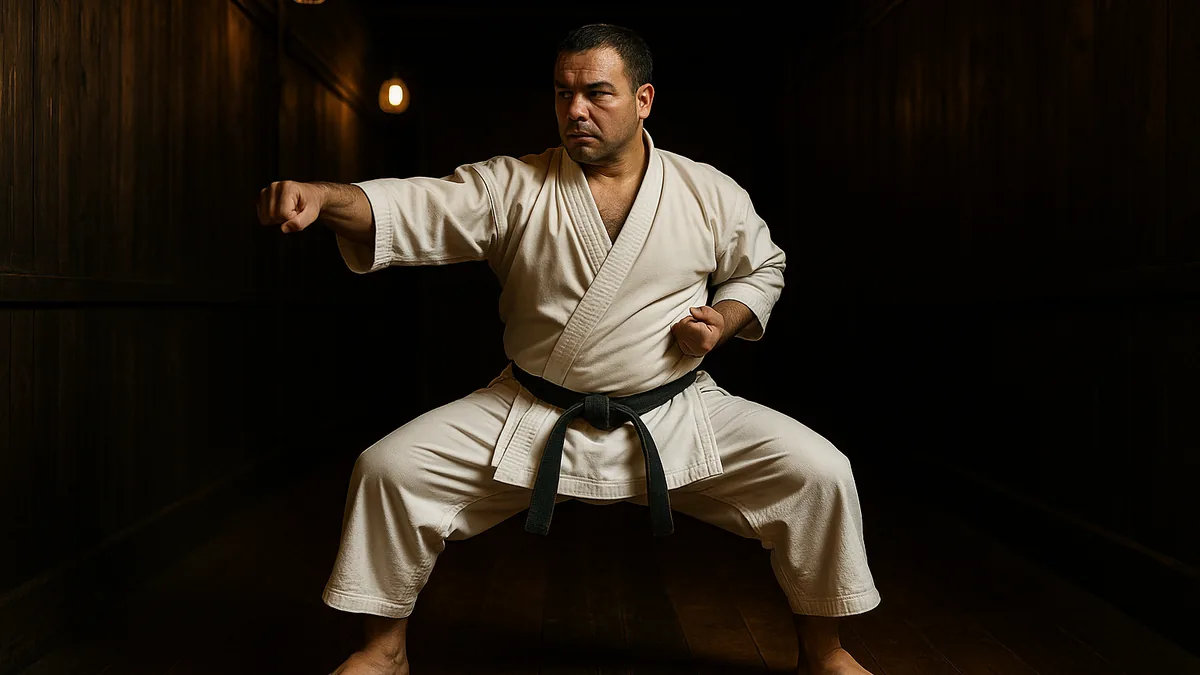
The opening of Bassai Dai is a declaration of intent. The step forward into the gedan-barai position should feel like you’re driving your whole body mass into the ground. When it’s done correctly, you’ll feel a kind of settling - a heaviness in the hips that tells you your centre of gravity has dropped and committed. When it’s done incorrectly, you feel nothing. Your weight stays high, you step and block as two separate actions, and you’ve already lost the thread.
What I tell students is this: the step and the arm movement are one thing, not two. The hip drop drives the arms. If your arms arrive before your hip has settled, you’ve separated cause from effect. The block has no weight behind it because the weight hasn’t gone anywhere yet.
The correction that makes the biggest difference here is to slow the opening down in practice until the student can feel the hip drop drive the gedan-barai. Not think about it - feel it. Once that connection is established, you can bring the speed back and the technique holds together.
Hip Rotation: The Difference Between Performing and Executing
Bassai Dai is a masterclass in hip rotation, and I mean that in a specific sense. It’s not just about rotating the hips for power on punches - the kata uses hip rotation in ways that most students haven’t encountered before.
The morote-uke sequence in the middle section is where this becomes obvious. I used to think those techniques were about the arms - the double forearm block looks like an arm technique. By brown belt I realised the arms are almost irrelevant. The power comes from a sharp hip rotation that the arms are just attached to. If you isolate the arms and do the technique without the hip, it feels weak and unconvincing. When the hip rotation connects properly, you feel the impact travel from the floor through your legs, through your hips, and out through both forearms simultaneously. It’s a completely different physical experience.
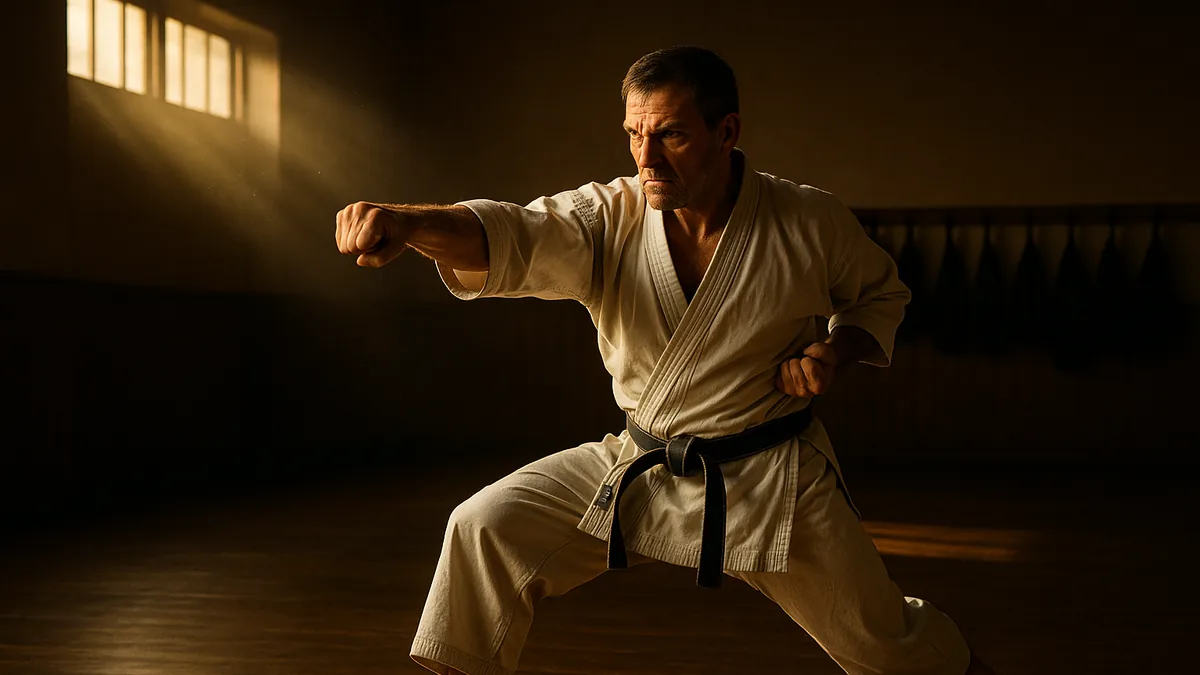
The same principle applies to the uraken strikes. Most students throw these from the elbow - a snapping arm movement that looks fast but has no weight. The correct version starts from a hip rotation that the arm follows. When you get this right, the uraken feels almost effortless because you’re not muscling it. The hip does the work and the arm rides it.
I’d recommend drilling these techniques in isolation before trying to connect them in the kata sequence. Slow hip rotation, feel where the power is coming from, then gradually add speed. Trying to learn the hip rotation while also managing the sequence is too much to hold at once.
Stance Transitions: The Hidden Difficulty
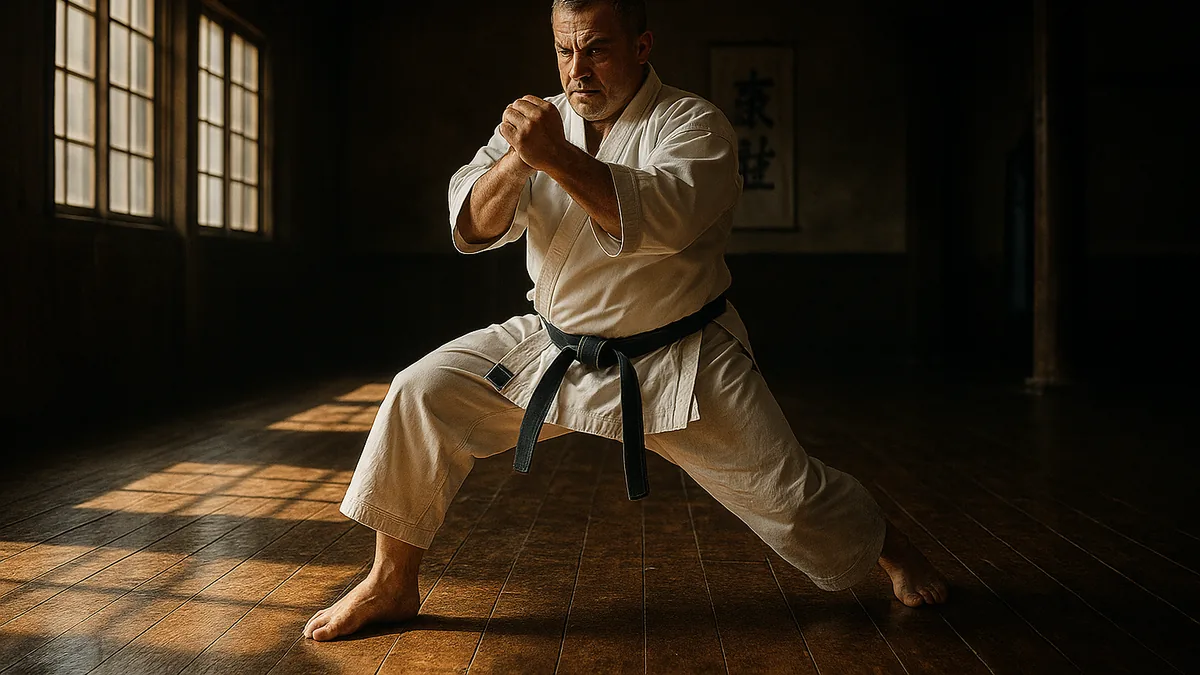
The stance transitions in Bassai Dai are technically demanding in a way that isn’t immediately obvious. The kata moves between zenkutsu-dachi, kokutsu-dachi, and kiba-dachi in ways that require genuine hip mobility and control of body weight.
The transition from zenkutsu to kiba-dachi that appears in the middle section trips students up constantly. What I’ve seen happen is that students pivot on their feet without actually shifting their centre of gravity - they end up in the shape of kiba-dachi but with their weight still distributed as if they’re in zenkutsu. The stance looks roughly correct from outside but the student has no stability and no power platform.
The correction is to think about where your hips are going, not where your feet are going. In kiba-dachi, your hips should be level and your weight should be distributed equally between both legs, sitting down into the stance rather than standing over it. When you transition into it correctly, there’s a moment where you feel genuinely rooted - like you’ve found the floor in a way that the previous stance didn’t offer.
The kokutsu-dachi sections require the opposite quality. Where kiba-dachi is about rooting and lateral stability, kokutsu is about coiled readiness. Your weight is back but your front leg is live - ready to push off. I think of it as sitting on a spring rather than sitting in a chair. The distinction matters because the techniques that come from kokutsu in Bassai Dai require that you can generate forward movement instantly. If you’re genuinely sitting back with no tension in the front leg, you’ve lost that option.
Bunkai: What the Kata Is Actually Saying
I’ve written elsewhere about what bunkai actually is and why surface-level applications miss the point. Bassai Dai is a good example of a kata where the obvious interpretation and the useful interpretation are quite different.
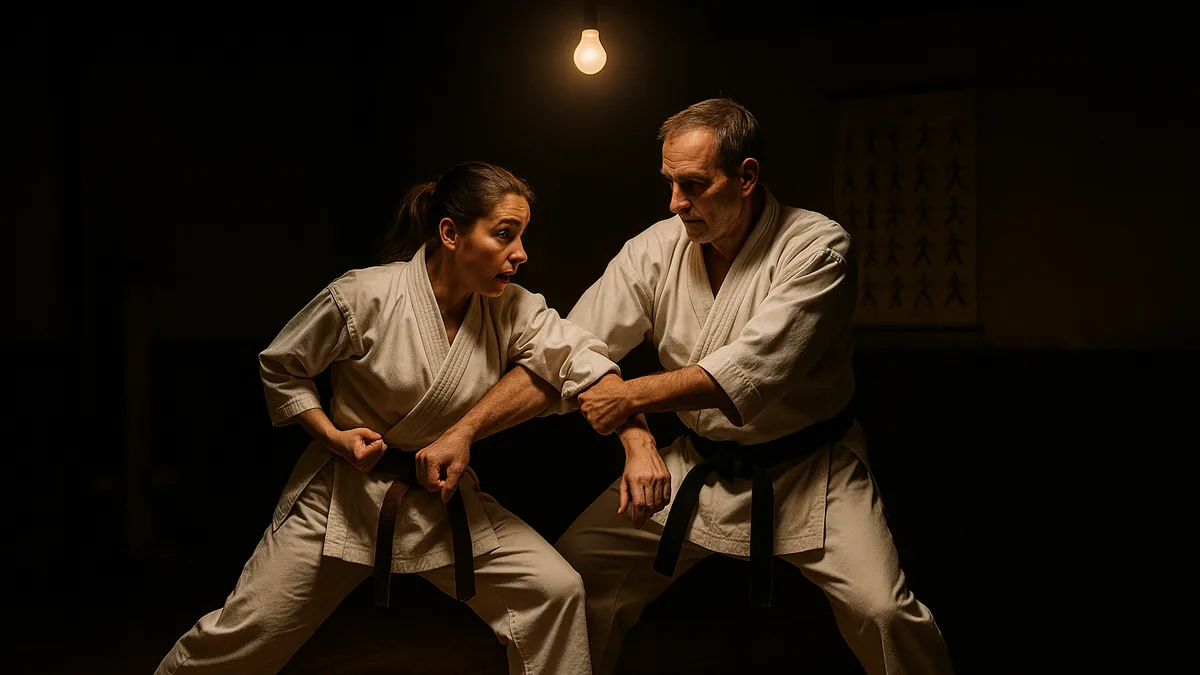
Take the sequence with the hammer fist strikes - the tetsui. The surface reading is two hammer fist strikes to the head. That’s fine as a starting point. The more useful reading, and the one that makes sense of the body mechanics, is that you’re dealing with a grab. The first movement breaks the grip by rotating into it, and the second movement is a strike to the head or neck of someone whose arm you’ve just controlled. When you drill it this way, the hip rotation suddenly makes complete sense - you need that rotation to generate the force to break a grip, not just to power a strike into open air.
The opening morote-uke reads similarly. Two forearms going in different directions simultaneously suggests you’re dealing with a grab from behind, or a two-handed grab from the front, and you’re creating space by driving both arms outward from your centreline. This is a completely different application to “block with both arms” and it changes how you train the movement.
I want to be honest here: there is genuine disagreement in the community about how literally to take bunkai, and I’ve changed my position on this over the years. My current view is that specific applications matter less than understanding the principle behind each movement. If you understand that the morote-uke is about creating space against a grip, you can work out the specific application yourself. If you only know “double block,” you’re stuck.
Why This Is the Gateway Kata
The Heian series, done properly, teaches you the fundamentals - stances, basic blocks and strikes, directional awareness, the connection between hip and technique. If you want a good breakdown of what each kata in that series is actually building, the Heian series article covers this well. But the Heian kata are, in a sense, teaching you vocabulary. Bassai Dai is where you start writing sentences.
What makes Bassai Dai a gateway is that it cannot be performed competently through mechanics alone. You can learn Heian Shodan by memorising the sequence and drilling the techniques. Bassai Dai requires something more - a quality of intent in each movement that either exists or doesn’t. Examiners can see it immediately. The kata either has presence or it doesn’t.
I’ve graded students who knew every movement of Bassai Dai perfectly and still failed to convince anyone watching that they understood what they were doing. I’ve also seen students perform it with occasional technical errors but with such clarity of intent that the errors almost didn’t matter. If you’re preparing for a grading, the kata grading article is worth reading, but the core point is this: examiners are watching for understanding, not just accuracy.
Common Mistakes I See Constantly
Treating the kiai points as performance moments. The kiai in Bassai Dai should emerge from the technique, not be added to it. I’ve seen students hold back on a movement to set up a big kiai, which means the technique is serving the shout rather than the shout expressing the technique. The kiai is a consequence of full commitment. If it sounds forced, the commitment wasn’t there.
Losing the connection between techniques in the sequence. Each technique in Bassai Dai should flow from the one before it. The end position of one movement is the start position of the next. I’ve noticed students who drill individual techniques well but perform the kata in chunks - technique, pause, technique, pause. The pauses aren’t timing, they’re gaps in understanding. What I tell students is to think about what your body is doing between techniques, not just during them.
Speeding up to hide uncertainty. This is a very human response to performing under pressure, and I’ve done it myself. When you’re unsure of a section, the instinct is to move through it quickly before anyone notices. What actually happens is that the speed draws attention to the lack of control. Slow the uncertain sections down in practice until you own them. Speed should come from confidence, not from avoiding scrutiny.
Shallow stances throughout. This is exhausting to correct because it comes back repeatedly. Shallow stances feel more natural because they’re less physically demanding. But Bassai Dai performed in comfortable stances looks like a demonstration of shapes rather than a kata. The depth isn’t aesthetic - it’s mechanical. Low stances create the leverage that makes the techniques work. When your stance is shallow, your hip rotation is limited, and when your hip rotation is limited, your techniques have no power.
Community Perspective
There’s a genuine split in how different associations and instructors approach Bassai Dai, and I think it’s worth being honest about it rather than pretending there’s one correct way.
In some dojos, Bassai Dai is taught primarily as a performance kata - the emphasis is on appearance, timing, and the overall impression it creates. In others, particularly those with a stronger bunkai culture, the kata is taught as a fighting system and every movement is trained against a partner before it’s drilled solo.
I’ve trained in both environments and my honest view is that neither extreme works well on its own. Kata trained purely for performance becomes disconnected from any martial reality - the techniques start to drift toward what looks impressive rather than what works. But kata trained purely as bunkai can lose the quality of movement that makes it more than just a collection of techniques. The kata vs kumite debate touches on this tension, and it’s real.
What I’ve settled on, after years of going back and forth, is that you need both. You need to understand what each movement is for - which means doing the bunkai work - but you also need to be able to perform the kata as a unified whole with consistent quality of movement throughout. One without the other gives you half a kata.
There’s also genuine disagreement about how much variation is acceptable between styles. Shotokan Bassai Dai looks quite different to Shito-ryu Bassai Dai in places, and both look different to Wado versions. I’ve seen practitioners get very heated about which is “correct.” My view is that the underlying principles - the hip rotation, the commitment of movement, the intent - are consistent across versions, and the stylistic differences are less important than people make them.
Key Takeaways
- The opening movement sets the tone for the entire kata - if the hip drop and the arm movement aren’t connected, everything that follows will be compromised. Drill this in isolation until the connection is physical, not intellectual.
- Hip rotation in Bassai Dai is not a technique addition - it is the technique. When you feel the rotation driving the arms rather than the arms moving independently, you’ve found the correct mechanics.
- Stance transitions require you to move your centre of gravity, not just your feet. Know where your weight is going before your feet start moving.
- Bunkai matters not because you need specific applications but because understanding the principle behind each movement changes how you train it. “Double block” and “breaking a grip” produce different physical qualities in the same technique.
- Speed should come last. If you’re speeding up to cover uncertainty, you’re training the uncertainty in, not out.
- Bassai Dai cannot be faked at a high level. The kata requires genuine commitment in every movement. If you’re performing it rather than doing it, that will be visible to anyone who knows what they’re looking at.
The weekly digest
New karate articles, once a week
One email every week with everything new on Karate Lifestyle. No spam; unsubscribe in one click.
We'll email you to confirm. See our privacy policy.