Heian Shodan Breakdown
Most white belts think Heian Shodan is easy. It has the fewest moves in the series, the stances are wide and stable, and the techniques are basic by any measure. I thought the same thing when I first learned it. I was wrong, and it took me about three years to realise just how wrong.
The truth is Heian Shodan is the kata that exposes everything. Every bad habit you’re building, every shortcut you’re taking with your hip rotation, every moment where your focus drops between techniques - it’s all visible in this kata. I’ve watched senior grades perform it at gradings and competitions, and I’ve watched white belts perform it at their first assessment. The physical movements are almost identical. The quality is not even close. That gap is what this breakdown is about.
If you want a broader picture of where this kata sits in your development, The Heian Series: What Each Kata Teaches is worth reading alongside this. But right now, let’s get into the detail.
The Opening Sequence: Where Most Beginners Lose the Kata
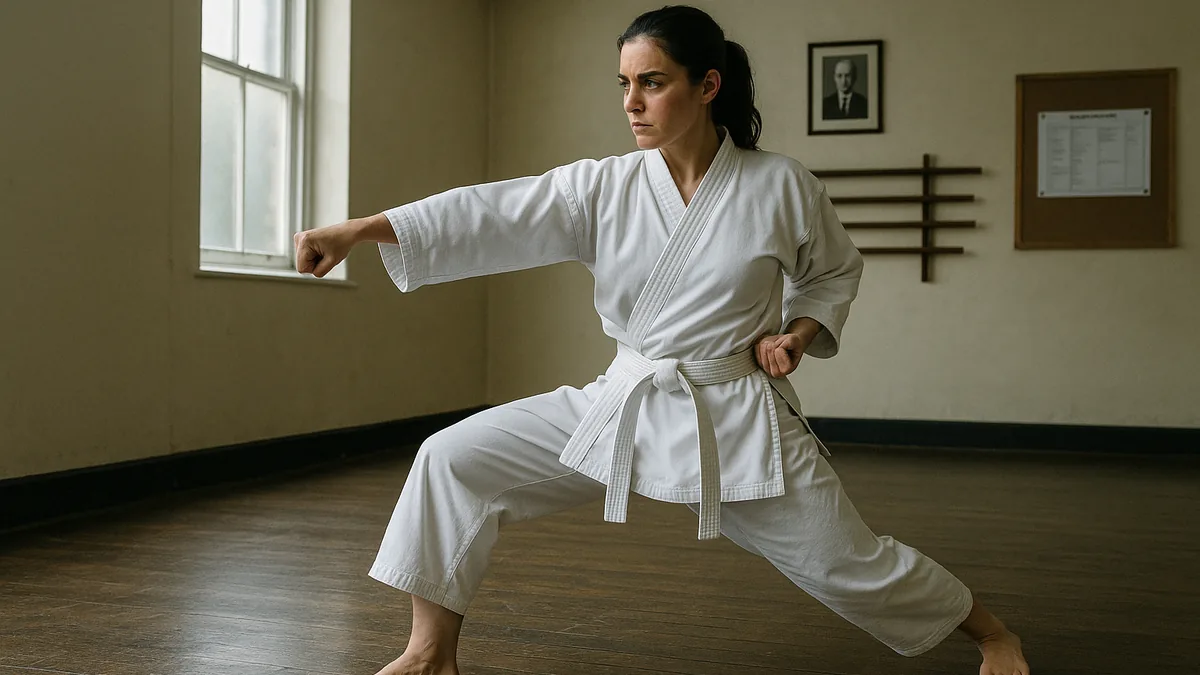
The first move is a left gedan barai - downward block - stepping into zenkutsu dachi. Simple. Except I’ve never seen a beginner do it correctly on their first attempt, and I’ve seen plenty of intermediate students still getting it wrong at 6th kyu.
The mistake is almost always the same: they step first, then block. The feet arrive, the block follows a beat later. It looks disconnected because it is disconnected. What should happen is that the block and the completion of the stance arrive at the same time. The hikite - the pulling hand - snaps back to the hip as the front foot lands. Everything tightens at the same moment. When you get this right, you’ll feel a kind of full-body snap, like the whole technique clicks into place at once rather than happening in parts.
What I tell students is to think of it like a camera shutter. The moment of kime - focus - is a single instant where everything is locked. Not a sequence of events. One event.
The second technique in the opening sequence is the step forward into right oi-zuki - lunge punch. This is where I see the second most common error in the whole kata. Students punch with their arm. The hip rotation is either absent or it’s happening after the arm has already committed. The hip rotation is the whole punch - without it, you’re just throwing your arm at someone and hoping for the best.
My instructor used to grab my belt at the hip and physically push it through the rotation while I punched. I didn’t understand why until about a year in, when I finally felt the difference during a pad session. The punch with proper hip rotation feels like it comes from your centre. The arm is just the final link in a chain that starts from the ground up.
Stances: Getting Low Enough, But Not Too Low
Zenkutsu dachi in Heian Shodan needs to be deep and stable. Most beginners go one of two ways: either they’re barely bending the front knee and standing almost upright, or they’re so low they’ve lost all mobility and their back knee is bent.
The front knee should be directly over the front foot - not past the toes, not short of them. The back leg should be straight. I’ve noticed that when students are tired, the back leg bends first. That’s the tell. When you see the back leg softening, the student has lost the stance.
What actually works for fixing this is practising the stance statically before trying to move in it. Stand in zenkutsu dachi for 30 seconds. Feel where the weight is. It should be roughly 60/40 front to back. Now add a block. Now add a punch. Build the movement onto a foundation you’ve already established, rather than trying to find the stance while you’re moving.
The kokutsu dachi - back stance - appears later in the kata and causes different problems. Students tend to sit too far back, shifting almost all weight to the rear leg, which makes the front leg useless. The front foot should be pointing forward, the rear foot at 90 degrees, and you should feel like you could lift the front foot without any real effort. If lifting that front foot requires a shift of weight, you’re not in the stance correctly.
The Shuto Uke Section: Where the Kata Changes Character
The sequence of shuto uke - knife hand blocks - in the second half of Heian Shodan is where I think the kata reveals its real depth. You shift into kokutsu dachi and perform knife hand blocks to the sides and then forward. Most beginners treat this section as just more blocking. It isn’t.
The hand position in shuto uke is specific: fingers together, thumb tucked, the blocking surface is the outer edge of the hand. The hand that doesn’t block pulls to the solar plexus, palm up. I’ve seen students do this section for months with the hikite ending at the hip in a fist, which is what they’ve been doing for all the punching techniques. That’s not a small error. It changes the entire meaning of the technique.
The transition into the shuto uke sequence also involves a turn that most students rush. You pivot on the back foot, the hands come up in a guard position briefly before the block completes. Rushing this transition means losing the brief moment of protection before the block lands. Slow it down. Feel the guard position before you commit to the block.
Common Mistakes I See Constantly
These are the errors I’ve corrected more times than I can count, at every level from white belt to intermediate:
- Dropping the hikite - The pulling hand is lazy. It drifts down or doesn’t pull all the way back to the hip. When the hikite is strong, the blocking or punching hand is stronger. They’re connected.
- Looking before turning - Students turn their head and body simultaneously. The head should snap to the new direction first, then the body follows. This is kime for the eyes. It also looks completely different on the outside - crisp vs sluggish.
- Losing kiai - Both kiai points in the kata (techniques 8 and 15 approximately, depending on your association’s count) get swallowed by students who are embarrassed or running out of breath. The kiai is not optional. It’s a moment of total commitment.
- Rushing the embusen - The performance line of the kata should be straight. Students drift. By the end of the kata they’re half a metre off where they started. This matters at gradings.
- Weak zanshin - The kata ends but the student’s mind has already left. Zanshin - remaining awareness - means you hold the final position with intention. I’ve seen students literally start relaxing before the final technique has completed. Examiners notice this immediately.
What Examiners Are Actually Looking For
I’ve been on both sides of grading panels, and I want to be direct about this: at the early kyu grades, examiners are not expecting perfection. They’re looking for specific things.
They want to see that you understand the rhythm of the kata. Heian Shodan has a distinct rhythm - there are pauses, there are fast combinations, there are moments of stillness. A student who rushes through it at one speed has not understood the kata.
They want to see kime. Even if the technique isn’t technically perfect, there should be a clear moment of focus at the end of each movement. If every technique looks the same in terms of effort and tension, there’s no kime - just movement.
They want to see correct embusen. Start and finish on the same spot. If you’re wildly off, it raises questions about whether you actually know the kata or are making decisions on the fly.
And they want to see the student’s eyes. Mushin - the empty, focused mind - shows in the face. Students who are counting in their heads, or who are visibly worried, or who are watching their own hands look uncertain. That uncertainty is visible.
For more on how to approach performance quality across kata generally, How to Improve Your Kata covers the detail that applies beyond just this one kata.
Bunkai: What These Techniques Are Actually Doing
This is where I think a lot of training goes wrong, and I’ll be direct about it. If you’re practising Heian Shodan without any understanding of what the techniques are for, you’re learning choreography. That’s not worthless, but it’s not the whole picture.
The gedan barai is not just a downward block. The most common bunkai interpretation is that you’re deflecting a kick or a low attack. But I’ve also trained with instructors who show it as a grab and pull, or as a clearing action against a wrist grab. The application depends on what you understand the opponent to be doing.
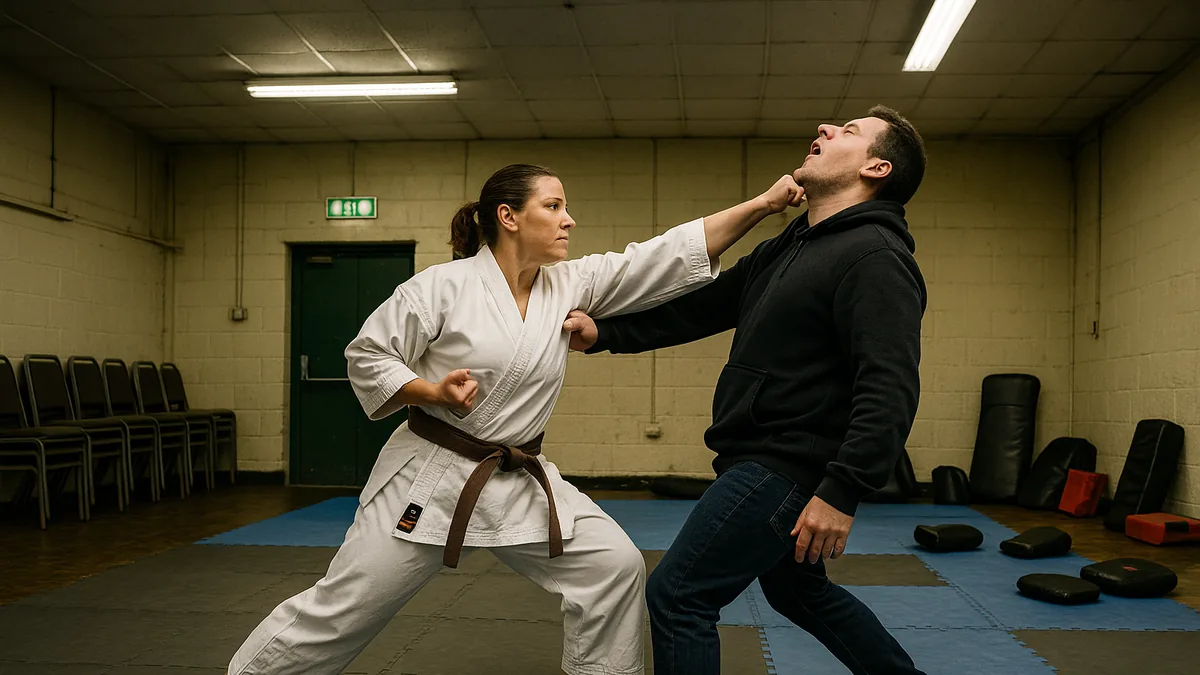
The oi-zuki that follows the first gedan barai - in bunkai, that’s a direct counter to whoever just attacked you low. You’ve deflected their kick, they’re momentarily off balance, you step in and punch. That sequence starts to make sense when you train it with a partner.
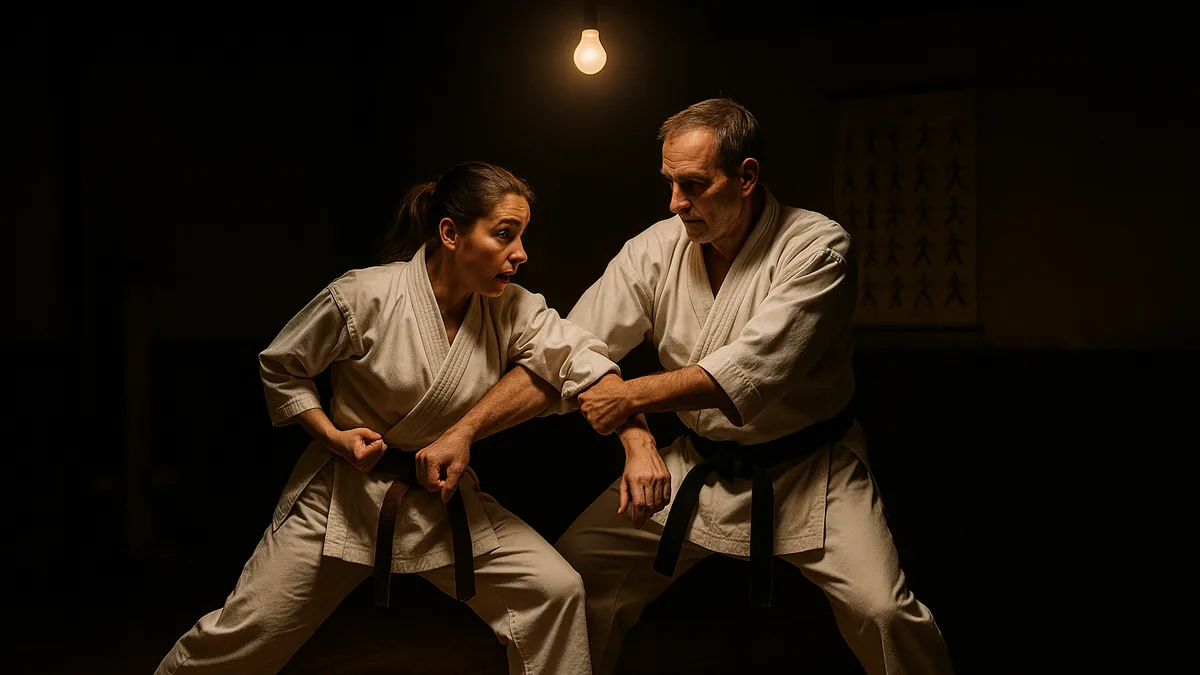
The shuto uke section has bunkai that I find genuinely interesting. The knife hand block against a grab or a strike, combined with the hikite pulling the opponent’s arm, becomes a deflect-and-pull that sets up a follow-up technique. If you want to dig into this further, What Is Bunkai? Training Kata Applications goes into the methodology in much more detail.
I think every student should be shown basic bunkai for Heian Shodan from the start. Not deep analysis - just the idea that each technique has a purpose against an opponent. It changes how you perform the kata. The techniques have intention rather than shape.
If you’re interested in how kata training connects to actual sparring performance, Does Kata Actually Help Your Sparring? is worth reading, because the answer is more nuanced than most people expect.
Community Perspective
There’s a genuine split in how different dojos and associations approach Heian Shodan, and it’s worth being honest about it.
Some instructors teach it as a foundation kata and move students through it quickly, treating it as a stepping stone to the more complex kata in the series. Others - and I fall into this camp - treat it as something you should return to throughout your training, because the fundamentals it contains never stop being relevant.
There’s also disagreement about how much bunkai should be taught at early grades. Some traditional schools hold the applications back until students have a certain level of physical competence. The argument is that beginners can’t execute the applications properly, so teaching them too early builds bad habits. I understand that argument, but I don’t fully agree with it. I’ve seen beginners light up when they understand what they’re doing and why. That understanding improves their kata, not the other way around.
The depth of stance is another point of genuine disagreement between styles. Shotokan tends toward deeper stances than Shito-ryu or Wado-ryu. Neither is wrong - they reflect different strategic priorities. If you’re cross-training or grading under a different association, know that what your home dojo considers correct may not match what the examiner expects.
Key Takeaways
- The most important correction in Heian Shodan is timing - block and stance should complete simultaneously, not sequentially. If you fix nothing else, fix this.
- Your hikite is as important as your striking or blocking hand. A weak pulling hand costs you power and looks sloppy. Train them equally.
- Head turn before body turn. Every time. This is one of the first things examiners notice.
- Learn at least basic bunkai for each technique. You don’t need deep applications - just the concept that each movement has a purpose against an opponent. It changes how the kata feels to perform.
- Zanshin doesn’t end when the last technique does. Hold the final position with the same intention you brought to the first move.
- Practise your stances statically before you practise moving in them. You can’t build good movement on a foundation you haven’t established yet.
The weekly digest
New karate articles, once a week
One email every week with everything new on Karate Lifestyle. No spam; unsubscribe in one click.
We'll email you to confirm. See our privacy policy.