Shotokan Kata List: Every Form in the Syllabus, Its Origin, and Why Funakoshi's Original Set Keeps Getting Debated
Most Shotokan practitioners can name the kata on their syllabus. Far fewer can tell you where those kata came from, why Funakoshi included them, or why the question of what actually belongs in the “original” Shotokan set still generates arguments in dojos and online forums more than a century later. That gap matters - not just for historical curiosity, but because understanding a kata’s lineage changes how you practise it.
The Shotokan Kata List: What’s Actually on the Syllabus
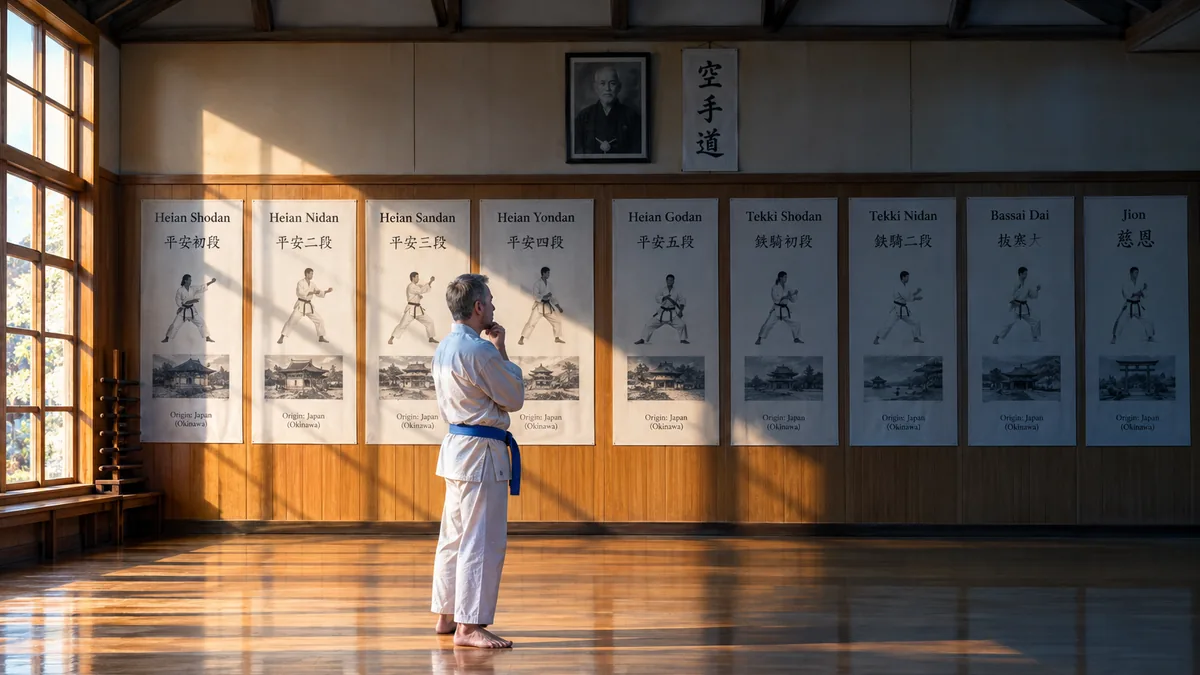
Shotokan has 26 official kata. The Japan Karate Association (JKA) codified this 26-kata curriculum from the 1950s onward under Chief Instructor Masatoshi Nakayama, who standardised form performance in his 11-volume Best Karate series. The JKA syllabus is the most widely referenced standard and includes the following:
Kihon Group
- Taikyoku Shodan (sometimes excluded from formal competition lists)
Heian Series
- Heian Shodan
- Heian Nidan
- Heian Sandan
- Heian Yondan
- Heian Godan
Tekki Series
- Tekki Shodan
- Tekki Nidan
- Tekki Sandan
Intermediate and Advanced Kata
- Bassai Dai
- Bassai Sho
- Kanku Dai
- Kanku Sho
- Empi
- Jion
- Ji’in
- Jitte
- Hangetsu
- Gankaku
- Nijushiho
- Sochin
- Meikyo
- Chinte
- Wankan
- Unsu
- Gojushiho Dai
- Gojushiho Sho
The 26 kata comprise the five Heian, three Tekki, and eighteen advanced or black-belt forms. Some schools also teach one to three Taikyoku forms as an introduction, but those are not usually counted among the 26.
Where These Kata Actually Come From
The honest answer is that Shotokan is a synthesis. Gichin Funakoshi brought kata from Okinawa to Japan, but the forms themselves came from multiple Okinawan masters and, before them, from Chinese martial arts traditions.
The Heian series (called Pinan in Okinawan styles) were not Funakoshi’s invention. Karate was modified to fit the public school physical education programme in 1901 when it was first introduced as part of the curriculum at Shuri’s Jinjo elementary school. In 1905, Itosu Anko created the five Pinan kata to further facilitate this process. He created and introduced the Pinan forms as learning steps for students, because he felt the older forms were too difficult for schoolchildren to learn. The five Pinan forms were created by drawing from two older forms: Kusanku and Chiang Nan. When Gichin Funakoshi brought karate to Japan, he renamed the kata to Heian. His stated reason, set out in Karate-Do Kyohan, was that the older Okinawan names were of ambiguous Chinese origin and unsuitable for a Japanese martial art.1
Bassai Dai and Kanku Dai are among the oldest kata in the Shotokan set. Originally, Kanku Dai was called Kushanku, named after a Chinese diplomat and kung fu expert. Known in older Okinawan traditions as Kushanku, the kata is named after a Chinese military official who reportedly stayed in Okinawa from 1756 to 1762 and taught martial arts to local practitioners. Funakoshi renamed it Kanku Dai when standardising karate terminology in Japan.2 Funakoshi considered Kanku Dai a model kata and central to Shotokan, sometimes teaching it before the Heian series.2 We have a full breakdown of what Kanku Dai is actually teaching you if you want to go deeper.
The Tekki series (Naihanchi in Okinawan traditions) represent a different lineage entirely - a close-range, rooted fighting system whose horse-stance-heavy structure reflects specific tactical priorities rather than a limitation. The linear embusen (performance line) of Tekki is not a limitation; it reflects a specific tactical context that becomes clearer once you stop thinking of kata as scripted fights and start reading them as training tools for particular ranges and body mechanics.
Several of the advanced forms - Gojushiho Dai and Sho, Unsu, Sochin, Nijushiho and Chinte - trace back to Okinawan kata that predate Shotokan as a named style. Yoshitaka Funakoshi (1906 to 1945), also known as Gigo, was the third son of Gichin Funakoshi and is credited with playing a pivotal role in shaping the modern technical aspects of the Shotokan style. While his father, Gichin Funakoshi, was his primary teacher, Yoshitaka actively sought to broaden his martial arts knowledge and was sent by his father to study kata under Kenwa Mabuni, the founder of Shito-ryu. This is a point that gets glossed over in some tellings: Shotokan as practised today reflects Yoshitaka’s influence as much as Gichin’s. Some of the changes introduced by Yoshitaka Funakoshi can be seen in the Shotokan karate practised today, including longer and deeper stances. He also introduced side kicks into the Shotokan syllabus. Those changes in stance and range distinguish JKA Shotokan from earlier photographs of Gichin’s own practice, though the picture is contested: a film from 1924 shows Funakoshi’s stances as long and deep as any present-day Japanese master - probably as he aged and developed hip problems, his stances became shorter and higher.
The Debate About Funakoshi’s “Original” Set
Here is where things get genuinely contested.
Karate-Do Kyohan (1935) states that instruction is given in the following nineteen kata: Taikyoku Shodan, Nidan and Sandan as forms for beginners; Heian Shodan, Nidan, Sandan, Yodan and Godan, Bassai, Kwanku, Empi and Gankaku, all of the Shorin school; and Jutte, Hangetsu, Jion, Tekki Shodan, Nidan and Sandan, all of the Shorei school - plus Ten no Kata as a kumite form.1 That figure of 19 is often simplified in dojo discussions to 15 (excluding the Taikyoku group) or misquoted as 16. What matters is that Funakoshi taught only 15 out of the standard 26 Shotokan kata taught today (not counting the Taikyoku forms he also introduced). The question practitioners argue about is whether the expansion to 26 represents legitimate development or a departure from Funakoshi’s vision.
The kata in Karate-Do Kyohan - the Heian series, the Tekki series, Bassai, Kanku, Empi, Hangetsu, Jion and Gankaku - form the core of what most Shotokan practitioners today would recognise as the “standard” syllabus. The additional kata - Nijushiho, Sochin, Unsu, Gojushiho Dai and Sho, Meikyo, Chinte, Wankan, Bassai Sho, Kanku Sho, Ji’in, Jitte - were integrated into the JKA curriculum largely through the work of Nakayama and the senior instructors he trained. The JKA codified its 26-kata curriculum from the 1950s onward, with Nakayama’s 11-volume Best Karate series (Kodansha International, 1977 to 1986) providing the canonical photographic and textual documentation used by JKA-affiliated schools globally.
Funakoshi himself was known to downplay the importance of practising many kata. He wrote that “it should be sufficient for one to become familiar with the following nineteen kata and to continue to train in them exclusively.”1 Whether the expanded JKA list contradicts or simply extends his approach is a question that Shotokan associations still do not agree on.
Community Perspective
The debate about Funakoshi’s original set tends to follow predictable fault lines. Traditional practitioners - particularly those in associations that trace lineage directly through Funakoshi’s students - sometimes view the expanded JKA syllabus as a post-Funakoshi rationalisation. JKA-aligned practitioners tend to argue that the expanded list represents legitimate codification of material Funakoshi taught but did not formally publish.
Neither position is wrong, exactly. They reflect different ideas about what makes a syllabus authoritative: the founder’s published record, or the accumulated practice of the senior students he trained.
A related disagreement involves Taikyoku Shodan. The Taikyoku kata were developed by Yoshitaka Funakoshi and introduced by Gichin Funakoshi as a beginner series. Some associations treat Taikyoku Shodan as the true starting point of the syllabus. Others exclude it from formal kata lists on the grounds that it was never intended as a kata to master, only as an introductory movement exercise. The JKA largely dropped it from competition use.
This connects to a broader question about what Shotokan’s kata list is actually for. If you want to compare how other styles handle this problem - particularly styles with very different attitudes to syllabus size - the contrast with Kyokushin’s minimal kata set and Shito-ryu’s unusually large one is instructive. Uechi-ryu’s approach is different again.
What Beginners Miss, and What Changes Later
Most beginners approach the Heian series as obstacle courses - sequences of techniques to memorise and reproduce cleanly for grading. That is a reasonable starting point, but it is not what the kata are for.
The correction that makes the biggest difference at intermediate level is not technical - it is conceptual. The Heian kata are not five separate things. They are a progressive curriculum for developing a specific set of body mechanics: hip rotation, weight transfer, transition between stances, and the relationship between blocking and counterattacking. Many movements in the Heian kata appear in Kanku Dai, as Itosu used it as a foundational source when creating the Pinan forms.2 Heian Shodan establishes the basics. By Heian Godan, you are dealing with jumping techniques, simultaneous block-and-strike, and complex directional changes. The progression is deliberate.
A common mistake across the intermediate kata - Bassai Dai, Kanku Dai, Empi - is performing the fast and slow sections at the same rhythm. The fast and slow techniques are among the cardinal points of kata performance.1 The contrast between slow, controlled movements and explosive fast sequences is not stylistic decoration. You will feel the difference when you get it right: the slow sections build tension and precision, and the fast sections release that accumulated focus. When that contrast collapses into uniform medium pace, the kata loses its structure entirely.
The Tekki series catches people out because the lateral movement feels wrong at first. Most karate training emphasises forward and backward lines. Tekki forces you to generate power while moving sideways, which exposes weaknesses in hip engagement that forward movement can hide. Many instructors cue this as “push the floor away” rather than “step sideways” - the distinction matters because it keeps the hips driving the movement rather than the feet leading it.
The Advanced Kata: Why Sequence Matters Less Than You Think
The advanced kata - Unsu, Gojushiho Dai and Sho, Sochin, Nijushiho - are frequently treated as prestige items, practised because they look impressive or appear in senior competitions. That is the wrong reason to practise them.
Unsu contains the most technically demanding movement in the Shotokan syllabus: a 360-degree jumping kick sequence. Most practitioners who include it in competition focus heavily on that section. The correction that actually improves the kata is usually found in the slow, low sections that precede it - the floor-level techniques that most competitors rush through. The jumping sequence only reads as powerful if the preceding movements have established the right quality of tension and control.
Sochin’s value is in its stances. Sochin features diagonal footwork and fudo-dachi (the asymmetric, rooted stance sometimes called sochin-dachi), which demands a specific kind of stability. If your weight distribution is wrong, you will feel it immediately as instability on the directional changes. Getting comfortable in that stance changes how you understand stability in all your other kata.
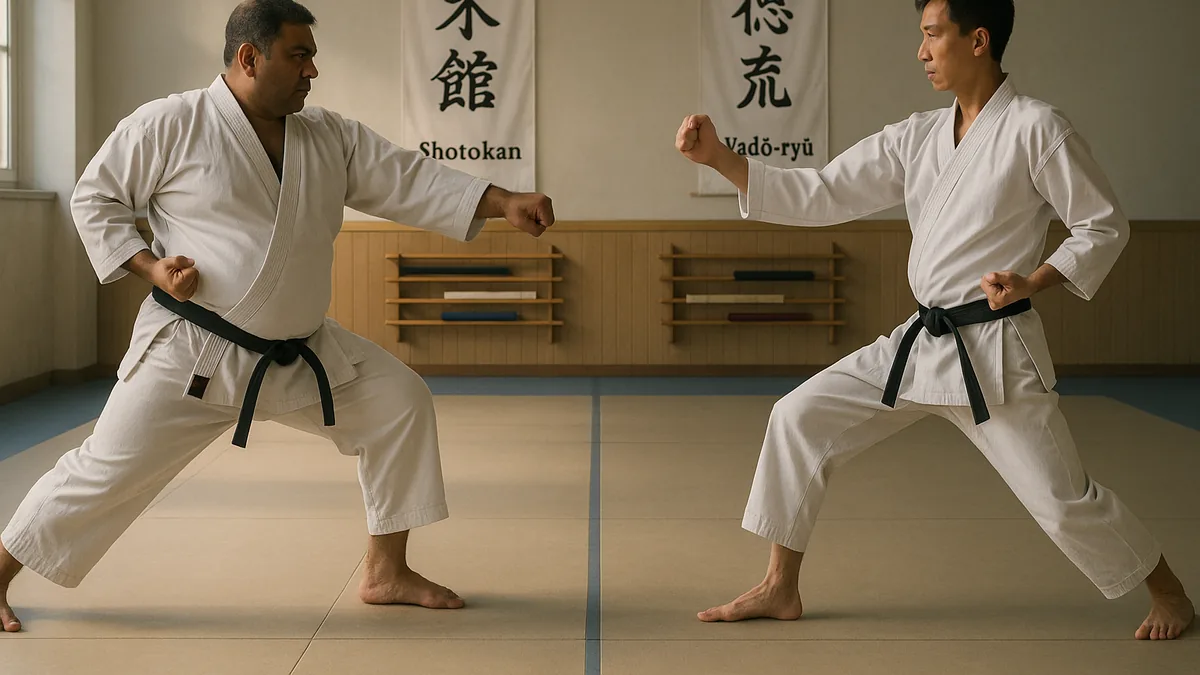
Performing the same kata across different styles reveals how much of what feels like “the kata” is actually association-specific convention. Bassai Dai exists in Shotokan, Shito-ryu and several Okinawan styles - and the differences in timing, stance depth and application emphasis are significant. That is not a problem; it is useful information about what each system values.
Key Takeaways
- The 26-kata JKA syllabus is a post-Funakoshi codification, not Funakoshi’s own published list. Knowing this does not make the syllabus less valid, but it should change how you think about “authenticity” arguments.
- Practise fewer kata more deeply rather than accumulating forms you cannot perform with genuine understanding. Funakoshi’s own position on this was consistent, even if the syllabus that bears his style’s name grew beyond what he published.
- The Heian series is a complete progressive curriculum, not a beginner warm-up. If your Heian kata feel easy, you are not performing them at the right level of precision and intent.
- In the Tekki series, the correction that unlocks the power is hip engagement on lateral movement - if the hips are passive, the techniques have no structural foundation regardless of how clean the arm positions look.
- The fast-slow contrast in intermediate and advanced kata is structural, not decorative. Losing that contrast is the single most common mistake that reduces a technically correct kata to a flat performance.
- Understanding where each kata came from - Itosu, Chinese transmission, Yoshitaka Funakoshi’s influence - gives you a better framework for interpreting what you are practising than treating the syllabus as a single unified system designed by one person.
References
Checked by the KarateLifestyle editorial team against official karate association records, the primary text of Funakoshi's Karate-Do Kyohan, historical martial arts research, and published secondary sources in November 2026. The early history of several kata origins relies on oral tradition and cannot be verified against contemporaneous written records.
- Funakoshi, Gichin. Karate-Do Kyohan: The Master Text. Gichin Funakoshi. Kodansha International, 1973 (English translation of original 1935 edition). Translated by Tsutomu Ohshima.
- Kata Step by Step: Kanku Dai. Kata Step by Step. Accessed November 2026.
The weekly digest
New karate articles, once a week
One email every week with everything new on Karate Lifestyle. No spam; unsubscribe in one click.
We'll email you to confirm. See our privacy policy.