Kanku Dai Breakdown: What the Kata Is Actually Teaching You
Most people who train Kanku Dai for the first time treat it like a performance piece. They learn the sequence, they hit the shapes, and they think they’re doing the kata. I’ve seen this at every level - coloured belts rushing through the opening to get to the “good bits,” brown belts who can perform it cleanly but have no idea what it’s teaching them, even the occasional shodan who’s passed their grading on Kanku Dai but still hasn’t found the kata’s actual rhythm.
The opening movement tells you everything. That slow raise of the hands, framing the sun through the circle of your fingers - most students treat it as a ceremonial gesture, something to get through before the real work starts. My instructor used to stop us right there, every single time, and say “you haven’t started yet.” I didn’t understand what he meant for about two years. Then one day I felt it - the breath dropping, the weight settling into the floor, the whole body organising itself around that one slow movement - and I understood that the opening isn’t a greeting. It’s a diagnostic. If you’re rushing it, you’re not ready to do the kata.
That’s what Kanku Dai is actually teaching you. Not techniques. Not sequences. Balance, fluidity, and breath - and the three are so interconnected in this kata that you can’t fix one without addressing the other two.
What the History Tells You About How to Train It
Kanku Dai is one of the foundational kata of Shotokan, and its lineage runs back through Itosu to the older Kushanku forms. Understanding that lineage actually changes how you train it - not in a historical curiosity way, but in a practical way.
Kushanku was reportedly a Chinese martial arts envoy, and the kata attributed to him emphasises response to multiple attackers, transitions through different heights and directions, and movements that don’t telegraph. When you know that context, the low sections of Kanku Dai stop looking like floor work and start looking like what they are - level changes designed to disrupt an attacker’s targeting. The jump isn’t a flourish. The ground sequences aren’t gymnastics. They’re tactical.
I’d recommend reading about performing the same kata in different styles if you train across associations, because Kanku Dai looks genuinely different in different Shotokan lineages, and understanding why helps you understand what’s core versus what’s stylistic. The core is always the same: breath, balance, and a very specific relationship between stillness and explosive movement.
Balance: The Thing Nobody Talks About Enough
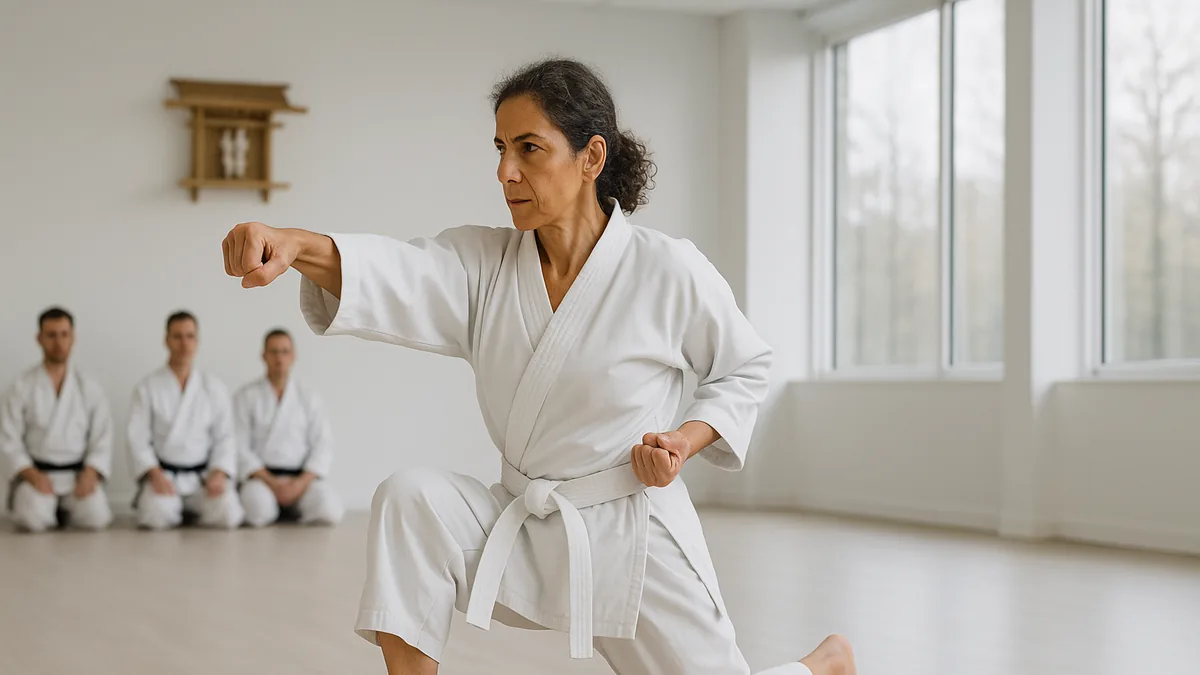
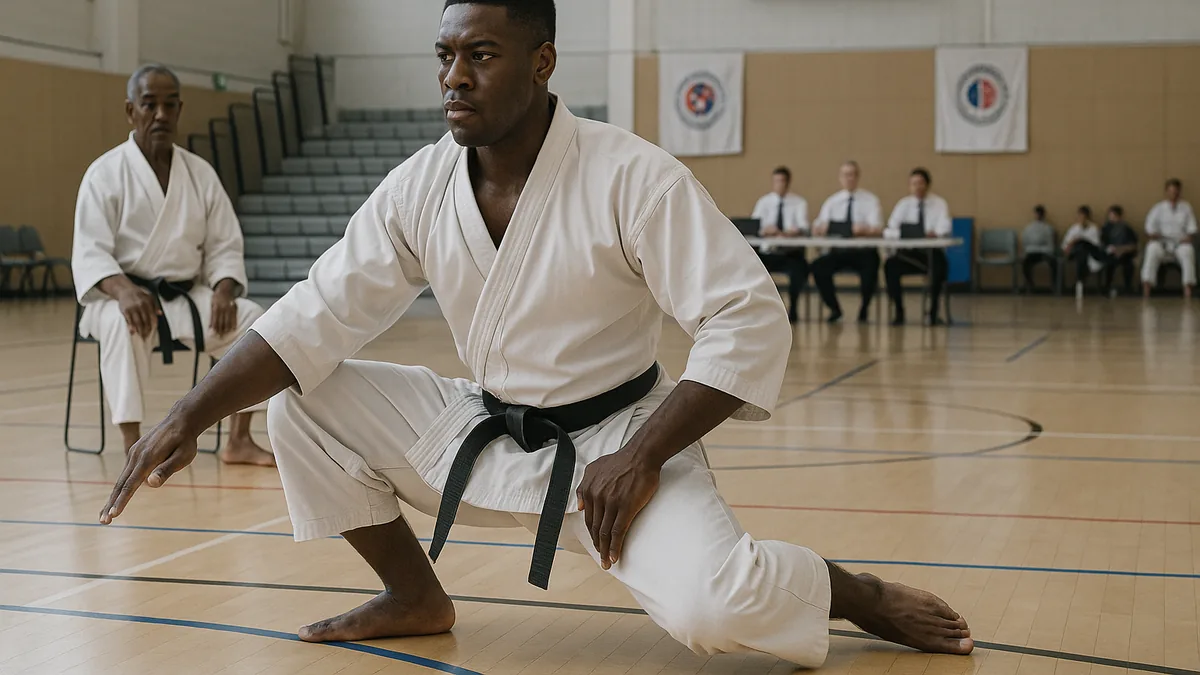
The mistake I see most often with Kanku Dai’s balance is that students try to stay balanced throughout. That sounds right, but it’s wrong. The kata deliberately takes you through moments of imbalance - the deep lunges, the low stances, the transitions through shiko-dachi - and what it’s actually training is your ability to recover balance while continuing to move and apply technique.
The Single-Leg Transition Drill
This is the drill I use more than any other for Kanku Dai specifically, and I think it’s more important than full kata repetitions for students under brown belt.
Why it matters: Several of Kanku Dai’s most significant techniques happen while you’re transitioning between stances, not while you’re settled in them. If you can only execute technique when you’re already balanced, you’ll be a step behind.
Setup: Work in pairs or alone with a wall nearby for reference. Pick any transition in the kata that passes through a single-leg moment - the step through before the uraken sequence works well, as does the movement into the low section.
Execution:
- Move into the single-leg moment and stop completely. Hold it for five seconds.
- Notice where your weight is sitting - is it stacked over the standing leg, or are you compensating with your upper body?
- Now perform the technique that follows from that position, without putting the foot down first.
- Complete the stance, then reset and repeat.
What to feel for: When your weight is properly stacked, the standing leg feels like a post in the ground - you’re not gripping with it, it’s just there. When it’s wrong, you’ll feel a subtle tension across your hip flexor on the standing side as your body tries to compensate.
What most people get wrong: They rush through the single-leg moment because it feels unstable, which means they never develop stability there. The correction that works is simply stopping. Hold the position until it stops feeling like a problem and starts feeling like a choice.
Fluidity: It Isn’t Smoothness
Beginners think fluidity means smooth. It doesn’t. Kanku Dai has sharp, explosive moments built into its flow - the kiai points, the gedan barai sequences, the jump - and fluidity means those moments emerge from the flow rather than interrupting it.
My instructor used to describe it as “water with rocks in it.” The water flows, hits the rock, bursts around it, and flows again. The rock doesn’t stop the river. That image changed how I approached the kata completely.
The technical issue underneath fluidity problems is almost always the same: students are thinking about the next technique before they’ve finished the current one. The body follows the mind, so the current technique gets abbreviated and the transition gets rushed. The whole kata starts to look like a series of gestures rather than a connected sequence.
The Pause-and-Breathe Drill
This feels wrong at first, but trust the mechanics.
Why it matters: Forced pauses break the habit of rushing transitions and teach you where the kata’s natural rest points are.
Setup: Full kata, alone, at about half speed.
Execution:
- Perform each technique to completion - not to the point where you’re moving to the next one, but to actual completion, where the energy of the technique has resolved.
- At each pause point, take one breath before initiating the next movement.
- Notice which transitions feel natural to pause and which feel forced. The forced ones are where you’re cutting technique short.
What to feel for: When you’re genuinely completing a technique before moving, there’s a brief moment where the body feels settled - not tense, not reaching forward. It’s like a comma in a sentence. When you’re rushing, that comma disappears and everything runs together.
What most people get wrong: They insert the pause mechanically, like a rest beat in music. The pause should be a breath, not a count. There’s a difference - the breath is connected to the technique, the count is just waiting.
For more on how this kind of detail shows up under pressure, Does Kata Actually Help Your Sparring? covers the transfer from kata training to live practice better than I can here.
Breath Control: The Actual Architecture of the Kata
I think breath is the most undercoached element of Kanku Dai, and I’d argue it’s the most important. The kata is roughly two and a half minutes of continuous movement with significant physical demands - the jump alone requires genuine power output - and if your breathing isn’t structured, you’ll be managing fatigue by the midpoint instead of executing technique.
But beyond the physical management, breath is what connects the slow sections to the fast ones. The opening is slow because you’re breathing deeply. The explosive sequences are fast because the breath is sharp and short. The kata teaches you to shift between those two states, which is genuinely one of the most useful things you can develop as a karate practitioner.
The Breath Mapping Drill
Why it matters: Most students have never thought about when they breathe in Kanku Dai. They just breathe when they need to. The kata has an architecture, and once you find it, the physical demands become significantly more manageable.
Setup: Perform the kata very slowly, at maybe 30% speed, with no concern for power or snap.
Execution:
- Identify every movement that involves drawing in or expanding - rising movements, chamber positions, preparatory stances. These are your inhale moments.
- Identify every movement that involves compression or extension - strikes, blocks, transitions into deep stances. These are your exhale moments.
- Perform the kata again at normal speed, now breathing to that map.
What to feel for: When the breath matches the movement, the kata stops feeling like effort and starts feeling like it’s carrying you. The jump, which most students brace for, becomes much more accessible when the breath is driving the takeoff rather than being held through it.
What most people get wrong: Holding the breath at the kiai points before releasing it. The kiai isn’t the breath - the kiai is the sound of the breath that’s already been committed to the technique. I’ve seen students treat the kiai like a shout they add on top of the movement, and the technique suffers every time. The breath is the technique.
For grading context, Kata for Grading: What Examiners Look For is worth reading - examiners notice breath control more than most students realise, and it shows up in the quality of technique even when the examiner can’t specifically name what they’re seeing.
Community Perspective
There’s a genuine split in how different Shotokan associations approach Kanku Dai’s timing, and it’s worth acknowledging rather than pretending there’s one correct answer.
Some lineages emphasise the contrast between slow and fast as the defining characteristic of the kata - the slow sections are very slow, the fast sections are very fast, and the contrast is the point. Other lineages smooth that contrast out, treating the kata as more continuously flowing with variations in power rather than variations in speed.
I’ve trained both approaches, and I think the contrast version teaches something the smooth version doesn’t - specifically, it forces you to genuinely commit to stillness, which is harder than it sounds and more useful than most people expect. But I’ve also seen the contrast version performed as a kind of showing-off, where the slow sections become theatrical and lose their martial content.
The Kata vs Kumite debate touches on some of this - how you interpret kata often reflects how you think about what karate is for, and that’s a question worth sitting with rather than resolving quickly.
Key Takeaways
- The opening movement isn’t ceremonial - it’s diagnostic. If you’re rushing it, you’re not in the kata yet.
- Balance in Kanku Dai means recovering balance while moving, not maintaining it throughout. Train the single-leg transitions in isolation until they stop feeling unstable.
- Fluidity is not smoothness. Sharp techniques should emerge from flow, not interrupt it. The pause-and-breathe drill fixes more fluidity problems than any amount of full-speed repetition.
- Map your breath to the kata’s architecture - inhale on expansion, exhale on compression. When it’s right, the kata carries you.
- The kiai is not a shout you add to the technique. It’s the sound of breath that’s already committed. If you’re bracing before the kiai, the technique is already compromised.
- The historical context of Kushanku - multiple attackers, level changes as tactics, movements that don’t telegraph - changes how you interpret the kata’s more unusual sequences. Understanding what bunkai is and how it applies here will unlock sections of the kata that otherwise look like choreography.
The weekly digest
New karate articles, once a week
One email every week with everything new on Karate Lifestyle. No spam; unsubscribe in one click.
We'll email you to confirm. See our privacy policy.