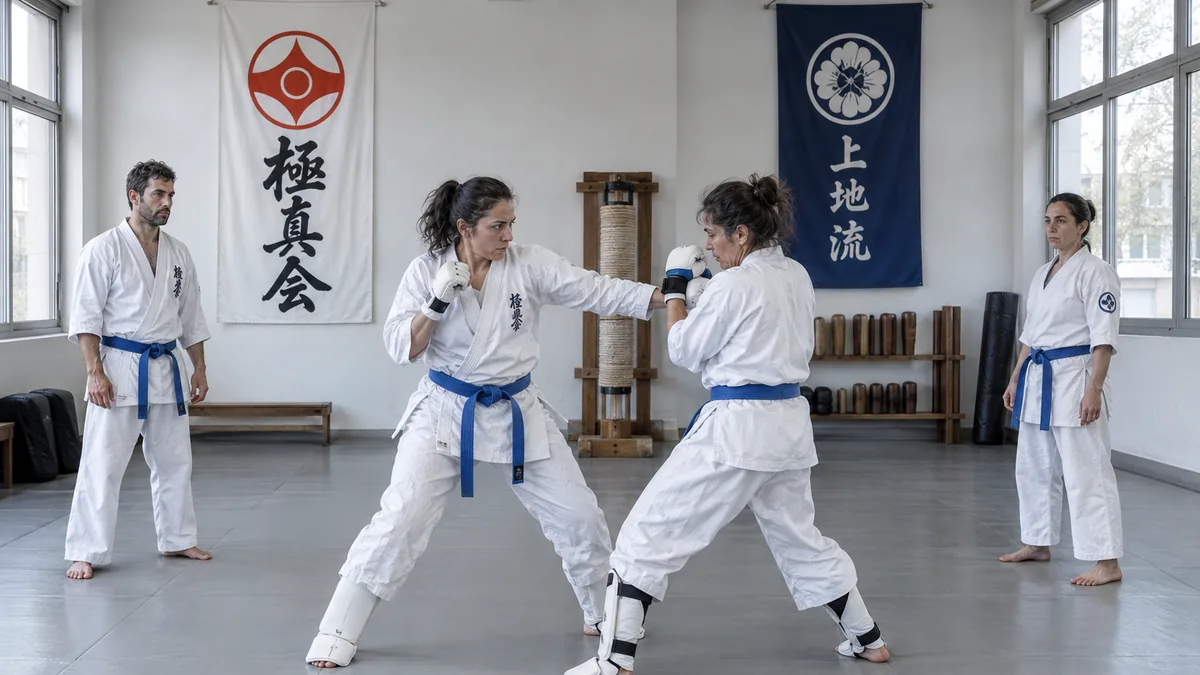
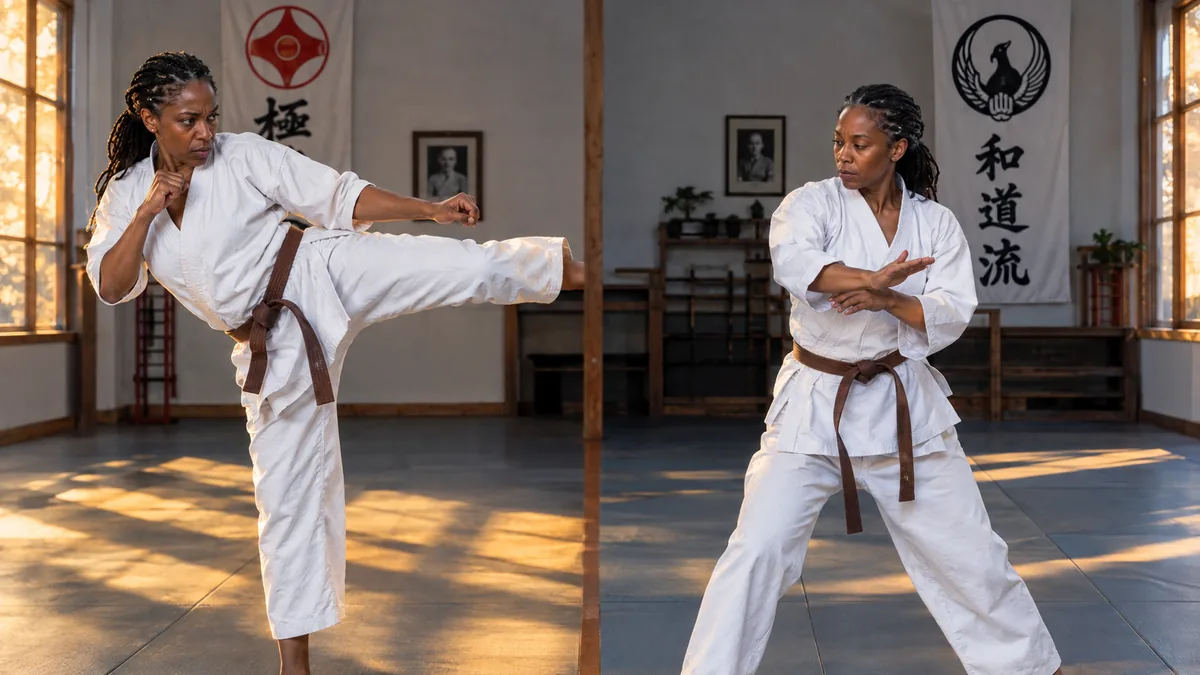
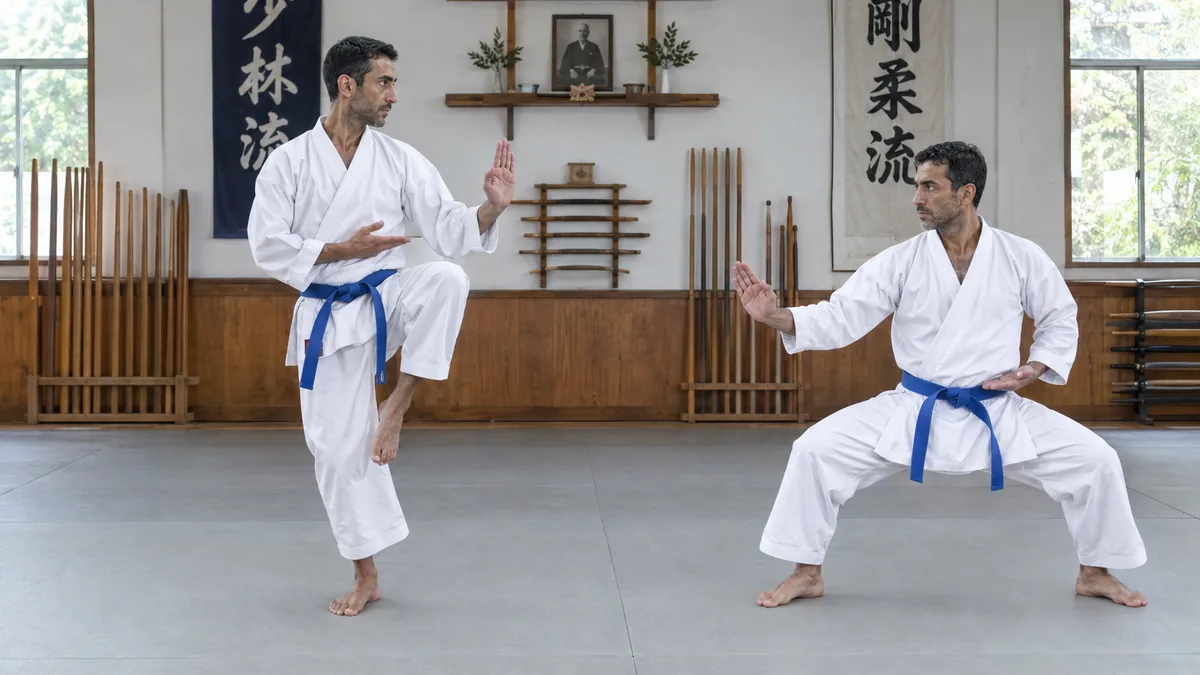
Uechi-Ryu vs Wado-Ryu: Why a Chinese-Rooted Okinawan Style and a Jujutsu-Influenced Japanese Style Represent Two Completely Different Theories of What Karate Is For
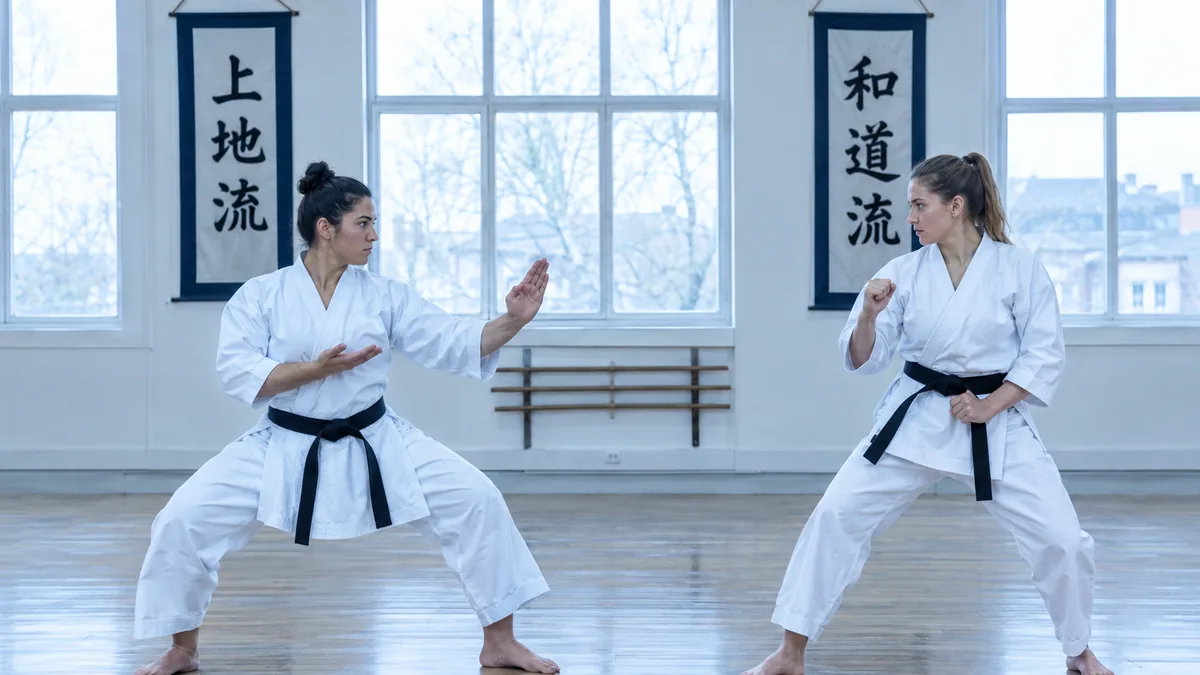
Put two styles side by side and the differences are immediately visible. Uechi-Ryu practitioners stand upright with their fingers extended into spear-hand formations, absorbing strikes on conditioned forearms and driving short, circular punches into the body. Wado-Ryu practitioners slip, pivot and redirect, using minimal contact to unbalance an opponent before applying a lock or a controlled finish. Both are karate. Both produce capable fighters. But they are built on completely different answers to the question: what does karate actually need to do?
That disagreement is not a minor technical detail. It runs through every kata, every drill, every sparring session in both traditions. Understanding it properly will change how you evaluate not just these two styles, but every style you encounter.
Two Completely Different Theories
Uechi-Ryu is Okinawan, rooted in the Chinese martial arts that Kanbun Uechi studied in Fuzhou, Fujian Province, China, beginning in 1897, at the age of 19 or 20 depending on the counting convention used. His teacher was Zhou Zihe (1874 to 1926), known in Japanese as Shu Shiwa. The Uechi-Ryu Karate-do Association records that Kanbun trained with Zhou Zihe for 13 years, mastering the three original kata Sanchin, Seisan and Sanseiryu, as well as learning kote kitae, forearm tempering. The style he eventually formalised after returning to Okinawa and later teaching in Japan carries that Chinese lineage in its structure. The body is the weapon and the shield simultaneously.
Wado-Ryu was founded by Hironori Otsuka. On 1 June 1921, Otsuka received from his teacher Tatsusaburo Nakayama a Menkyo Kaiden certificate of full proficiency in Shindo Yoshin-Ryu jujutsu. He had studied Shindo Yoshin-Ryu from 1905, and in 1922 began training under Gichin Funakoshi in karate, becoming one of Funakoshi’s first students promoted to black belt in 1924. Otsuka’s core argument was that karate should integrate the jujutsu principles of tai sabaki (body evasion), nagashi (flowing deflection) and joint manipulation. When Otsuka initially registered his style with the Dai Nippon Butoku-kai in 1938, he named it “Shinshu Wado-Ryu Karate-Jujutsu,” explicitly acknowledging its hybrid jujutsu heritage. In 1939 all karate styles were asked to register their systems with the Dai Nippon Butoku-kai, at which point Otsuka named his style Wado-Ryu. Blocking hard is inefficient; moving your body so the attack misses, or barely grazes you, is smarter.
These are not two paths to the same destination. They are two different destinations. Uechi-Ryu says: condition the body to take and deliver damage at close range. Wado-Ryu says: avoid the damage in the first place by being somewhere else when it arrives.
What Uechi-Ryu Actually Trains
The entry point for every Uechi-Ryu student is Sanchin kata, performed with slow, deliberate tension and often checked by an instructor applying firm pressure to test structural integrity. If you have trained Sanchin seriously, you know what it feels like to have your stance, your core and your breathing tested simultaneously - it is uncomfortable in a way that builds genuine body awareness. The tension is not rigidity; it is organised resistance, the body learning to receive force without collapsing.
The style’s signature weapons - the shoken (one-knuckle punch), the nukite (spear hand) and the boshiken (thumb knuckle) - are designed for anatomically vulnerable targets: the throat, the solar plexus, the floating ribs. These are not competition weapons. They are tools built for the assumption that the person in front of you is trying to do serious harm.
Circular movement in Uechi-Ryu is not decorative. The forearm blocks are designed to redirect rather than clash, but the redirection stays tight and close. Where Goju-Ryu (which shares some Chinese lineage) tends toward rounder, larger circular motions, Uechi-Ryu keeps its circles compact. The difference matters in a close-quarters exchange: a large sweeping block gives an opponent room to recover; a tight circular parry closes the gap and sets up the counter in the same motion.
A common mistake among practitioners new to Uechi-Ryu is treating the circular movements as soft. They are not. The fluidity is a delivery mechanism for short, penetrating strikes. The correction that usually helps is to think of the circle as a path, not a destination - the power arrives at the end of it, not throughout it.
For a comparison of how Uechi-Ryu’s conditioning approach sits alongside another full-contact tradition, see our article on Kyokushin vs Uechi-Ryu: Why Two Full-Body-Contact Traditions With Completely Different Origins Produce Surprisingly Similar Fighters.
What Wado-Ryu Actually Trains
Wado-Ryu’s most important technical concept is inasu - a yielding, redirecting evasion that uses the attacker’s momentum against them.1 This is where the jujutsu background becomes tangible. Rather than meeting force with force, a Wado practitioner moves at an angle, allowing the attack to pass while positioning for a counter or a throw.
In free sparring, this feels counterintuitive at first. Most beginners want to block and then counter - two separate actions. Wado asks you to make them one action by moving before the block lands. You’ll feel the difference when it works: instead of absorbing impact on your guard, you feel almost nothing, because you were not quite there. The attacker’s weight has shifted forward into empty space, and you are already at their side.
The kata registered with the Dai Nihon Butokukai in 1940 included the five Pinan kata, Naihanchi, Kusanku, Niseishi, Passai, Chinto, Jion, Jitte, Rohai, Wanshu, Seisan and Suparempei. These contain a significant number of throws, takedowns and joint-lock applications that most students only discover when they study the bunkai seriously. This is not accidental. Otsuka embedded jujutsu responses throughout the kata precisely because he believed karate’s striking tradition needed that dimension to be complete.1
Key principles that distinguish Wado-Ryu technique from other styles:
- Tai sabaki - whole-body evasion that changes the angle of engagement, not just the guard position
- Nagashi-uke - deflecting blocks that redirect rather than stop incoming force
- Kuzushi - breaking the opponent’s balance as part of the entry, not as a separate phase1
- Atemi into locks - strikes used to create openings for joint manipulation, not as standalone finishers1
The biggest difference between a Wado beginner and a senior Wado practitioner is not speed or power. It is the senior practitioner’s ability to read the attack early enough to move before it arrives. That timing cannot be rushed; it develops through years of controlled partner work.
For context on how Wado-Ryu compares to its closest stylistic relative, our article on Shotokan vs Wado-Ryu: Why Two Styles With Shared Roots Produce Such Different Stances, Movement, and Kumite covers the divergence from Funakoshi’s teaching in detail.
Where Each Style’s Theory Gets Tested
Put both styles into a practical scenario: a committed mid-section punch at close range.
The Uechi-Ryu response is likely a tight circular parry with the forearm, a simultaneous or near-simultaneous counter to the body, and continued pressure at close range. The body absorbs any partial contact because it has been conditioned to. The entire exchange happens at the same distance the attack came from.
The Wado-Ryu response is a diagonal step offline - typically at 45 degrees - that takes the practitioner out of the direct line of force while the deflecting hand guides the attack past. The counter might be a strike to the now-exposed head or ribs, or it might be an entry to a lock or takedown. The practitioner has not absorbed any force because they were not in the way of it.
Neither response is universally superior. The Uechi-Ryu approach requires genuine body conditioning and comfort at close range; it fails if the practitioner flinches or the conditioning is incomplete. The Wado-Ryu approach requires precise timing and early reading of the attack; it fails if the practitioner moves too late, which in a real exchange means moving into the strike rather than away from it.
We would argue that for pure self-defence application, Wado-Ryu’s evasion model is more accessible to a wider range of body types and ages, because it does not depend on physical conditioning to the same degree. But Uechi-Ryu’s close-range structure is more forgiving of timing errors - if you are already conditioned and already close, the margin for error is smaller. Both positions are defensible; the honest answer is that the better choice depends on the practitioner.
The Philosophical Gap Is Wider Than It Looks
Uechi-Ryu is heavily influenced by the Chinese martial arts, specifically the Crane, Dragon and Tiger boxing styles that Kanbun Uechi studied in Fuzhou. That lineage shaped a tradition that treated karate as a complete system for surviving violence, with the body as both the primary weapon and the primary target. The conditioning work - makiwara training, the formal forearm conditioning exercise known as kote kitae (forearm tempering), which involves variations of striking a partner’s forearms - is not supplementary. It is the point. The style assumes you may be hit and prepares you for that reality.
Wado-Ryu’s name, meaning “Way of Harmony,” reflects a founding philosophy that yielding is sometimes more effective than brute strength. Otsuka’s background in Shindo Yoshin-Ryu jujutsu heavily influenced Wado-Ryu’s development; the style integrates jujutsu-derived joint locks and throws alongside striking, distinguishing its lineage from purely Okinawan karate traditions. This is a different moral framework, not just a different technical one.
That gap matters when you are choosing where to train. If you are drawn to the idea of the body as a tool to be forged - conditioned, tested, made reliable under pressure - Uechi-Ryu’s approach will resonate. If you are drawn to the idea of skill as economy of motion, of making an attacker’s force irrelevant through movement and timing, Wado-Ryu’s framework is the more natural fit.
For further context on how Wado-Ryu sits within the broader landscape of Japanese karate competition, the comparison at Kyokushin vs Wado-Ryu: Why the Two Styles Represent Opposite Ends of What Karate Training Can Look Like is worth reading alongside this one.
Community Perspective
Within the karate community, the debate around these two styles often centres on a question that sounds simple but is not: does conditioning make you safer, or does it make you willing to take risks you should be avoiding?
Uechi-Ryu practitioners generally argue that no amount of evasion skill is reliable under genuine stress, and that a body that has absorbed thousands of controlled impacts is a body that will not panic when contact happens. This view tends to strengthen with experience - practitioners who have trained Sanchin seriously for years often describe a quality of physical confidence that is hard to explain to someone who has not felt it.
Wado-Ryu practitioners counter that conditioning is a crutch that teaches the wrong lesson: that impact is inevitable. If the technique is good enough, impact is not inevitable. Senior Wado practitioners frequently describe a shift in understanding around shodan or nidan level, where the evasion principles that seemed abstract at white belt start to feel genuinely reliable under pressure.
Both positions have merit. What changes with experience is less which position you hold and more how much respect you develop for the difficulty of the other one.
Key Takeaways
-
Uechi-Ryu’s circular movements are power delivery systems, not soft deflections. The fluidity is the path to the strike, not the strike itself. Treating them as gentle will produce weak technique.
-
Wado-Ryu’s evasion only works with early timing. The correction that most beginners need is to move at the moment of commitment in the attack, not at the moment of impact. Moving late turns a deflection into a collision.
-
Sanchin kata is Uechi-Ryu’s foundation, not a warm-up. If you are cross-training or evaluating the style, the quality of a school’s Sanchin practice tells you almost everything about the quality of the school.
-
Wado-Ryu’s kata contain jujutsu applications that most students miss. If your bunkai training does not include throws, locks and kuzushi, you are training half the system.1
-
Body conditioning in Uechi-Ryu is cumulative and cannot be shortcut. The forearm and body conditioning that makes the style’s close-range model viable takes years of consistent work. Arriving at a seminar and trying to replicate it in a session is how injuries happen.
-
Both styles reward serious kata study more than most. The original three kata from Pangainoon - Sanchin, Seisan and Sanseiryu - form the technical core of Uechi-Ryu, while Wado-Ryu’s full kata set carries dense jujutsu content. Practitioners who treat kata as a grading requirement rather than a technical library will miss most of what each style actually contains.
References
Checked by the KarateLifestyle editorial team against official governing body histories (Uechi-Ryu Karate-do Association, British Wadokai, Wado-Ryu Karate-Do Renmei affiliates), primary lineage documentation and practitioner association sources in November 2026. Historical dates for Wado-Ryu's naming and registration vary slightly across sources; the article follows the consensus of the most primary-adjacent accounts.
- Wado-Ryu Tradition and Culture. Wado-Ryu USA (Renmei affiliate), accessed November 2026
The weekly digest
New karate articles, once a week
One email every week with everything new on Karate Lifestyle. No spam; unsubscribe in one click.
We'll email you to confirm. See our privacy policy.