Shotokan vs Wado-Ryu: Why Two Styles With Shared Roots Produce Such Different Stances, Movement, and Kumite
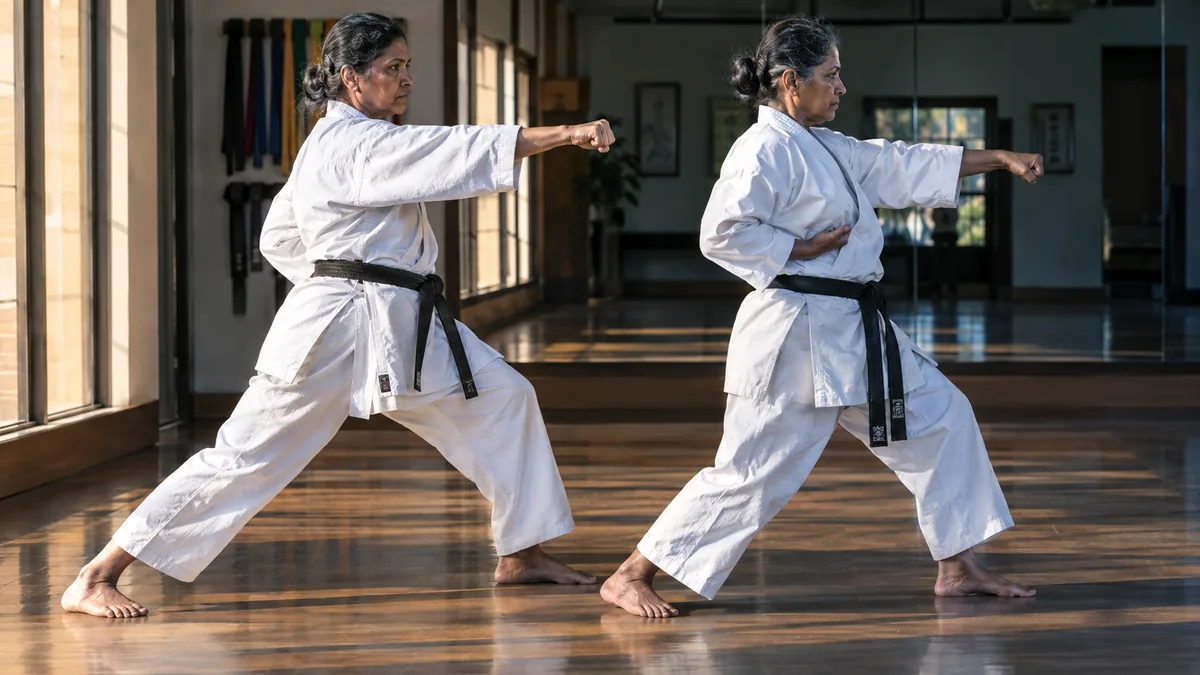
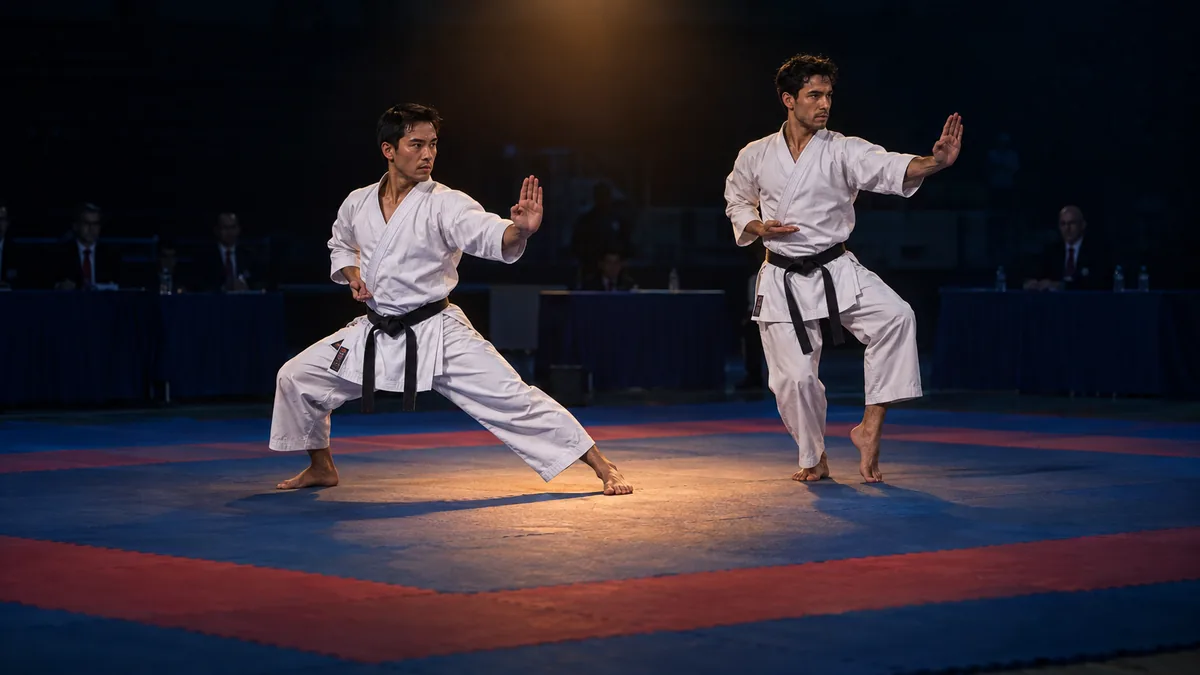
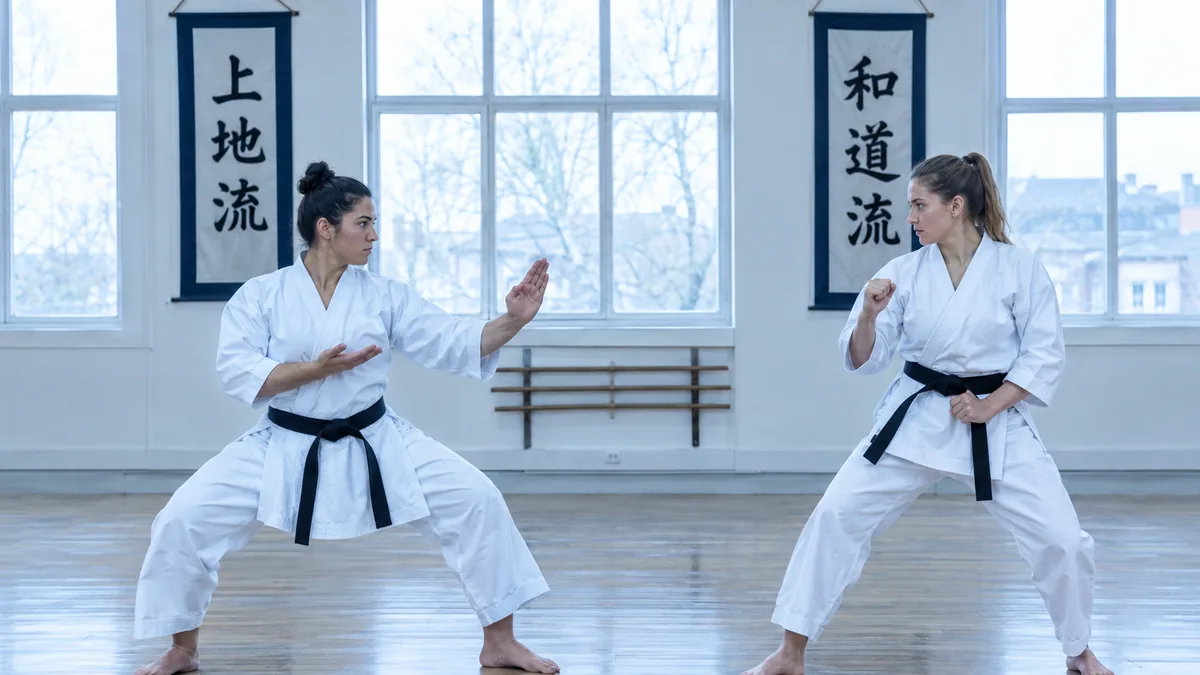
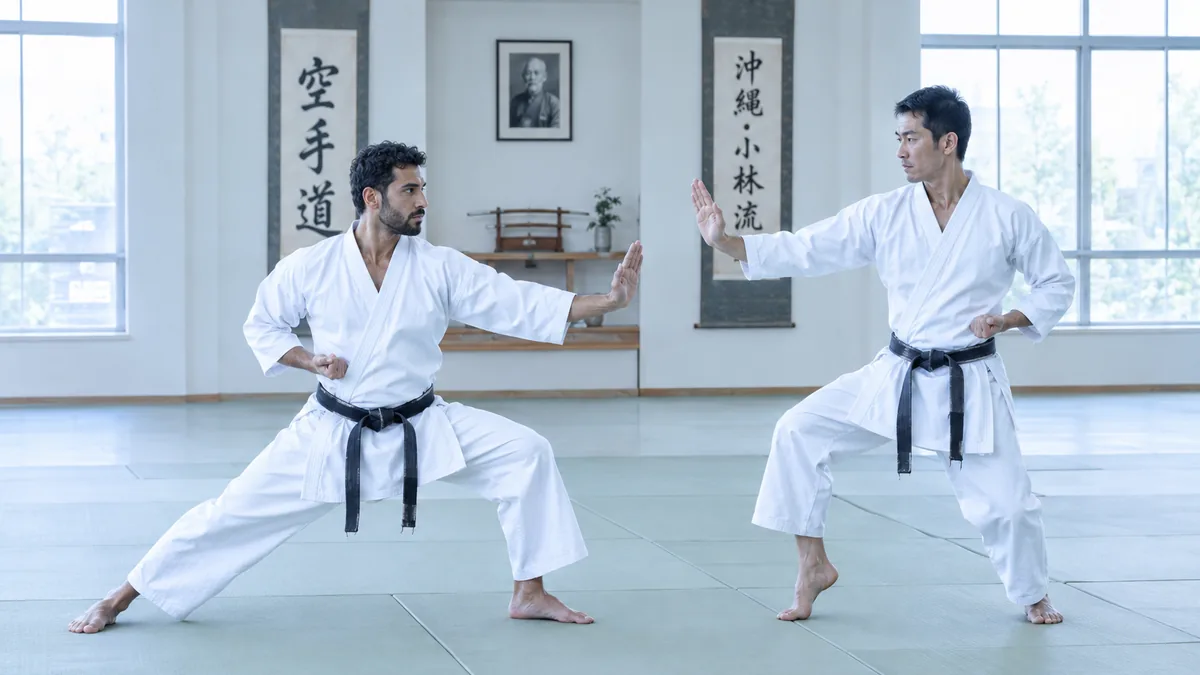
If you put a Shotokan practitioner and a Wado-Ryu practitioner side by side and ask them both to throw a gyaku-zuki, you will see two techniques that share a name and almost nothing else. The Shotokan karateka drops weight, drives from a deep zenkutsu-dachi, and delivers force through a committed, grounded structure. The Wado practitioner stays higher, shifts offline, and delivers the punch as part of a movement - not the end of one. Both are correct within their own systems. Understanding why they look so different is not just an academic exercise; it changes how you train, how you spar, and what you prioritise on the floor.
These two styles share direct lineage. Hironori Ohtsuka began studying Okinawan karate in 1922, including training under Gichin Funakoshi.1 By 1920, Ohtsuka had been awarded the highest degree of Shindo Yoshin-Ryu jujutsu, succeeding his master’s position as fourth Grand Master of that style.1 He had therefore attained full mastery of jujutsu before he encountered karate, and that background is the whole explanation for Wado-Ryu. His experience in jujutsu gave him a distinctive perspective on karate, emphasising timing, positioning, balance, and efficient use of the body, and drawing on these traditions he formally established Wado-Ryu in 1934.1 Ohtsuka did not simply modify Shotokan; he filtered karate through a jujutsu framework and arrived somewhere genuinely different. Gichin Funakoshi (1868 to 1957) is revered as the founder of modern karate and the creator of the Shotokan style. If you want to understand the Funakoshi lineage more broadly, our comparison of Funakoshi vs Mabuni covers how two students of the same masters diverged in equally significant ways.
The Stance Question: Why Shotokan Goes Deep
Shotokan’s zenkutsu-dachi is long and low by design. The front knee tracks over the front foot, the rear leg drives into the ground, and the whole structure is built to generate linear power. When you first drop into a correct Shotokan front stance, it should feel like the floor is pulling you down - your centre of gravity is genuinely lower, and your legs are doing real work just to hold the position. That is not a mistake; it is the point.
The reasoning is mechanical. Funakoshi and his successors - particularly Masatoshi Nakayama, who codified much of modern Shotokan through the JKA - emphasised that power in a technique comes from the ground up. Nakayama served as JKA Chief Instructor until his death in 1987, and under his direction the JKA systematised the Shotokan curriculum into a formal grading structure. His eleven-volume “Best Karate” series, published 1977 to 1986 by Kodansha International, provided the canonical photographic and textual documentation of the kata, creating the reference standard used by JKA-affiliated schools globally. A deep stance increases the distance your hips can travel as they rotate, which increases the rotational force transferred into the technique. The long stance also creates a stable platform for absorbing and returning force. In basics practice and kata, this pays off visibly. In kumite, it requires intelligent adaptation.
A common mistake in Shotokan stances is not going too deep - it is going wide. Many practitioners, especially early on, step out to the side rather than forward when forming zenkutsu-dachi, creating a stance that is unstable laterally and hard to move from efficiently. The correction that works is to think of the stance as a railway track, not a tightrope: feet on parallel lines, not the same line, but not excessively wide either. The hip width gives you stability; excess width beyond that gives you nothing except slower transitions.
Wado-Ryu’s Higher Stance: Not a Shortcut
A common misreading of Wado-Ryu is that its higher, shorter stances represent a less demanding or less committed approach. This is wrong, and it misunderstands what the stances are for.
Wado-Ryu uses a natural, upright posture - closer to shizentai - because the style requires constant, rapid weight transfer and body evasion (tai sabaki). If you are rooted to the floor in a deep stance, you cannot move your body offline in time to make Wado’s defensive strategy work. The stances are higher because the movement is the technique. You do not block and then move; you move as the block. The evasion and the deflection happen simultaneously, and that requires a body position from which you can actually shift.
What this feels like in practice: in Wado kumite, when you receive an attack correctly, you should feel the opponent’s force pass beside you rather than meeting it head-on. Achieving that feeling requires the higher, more mobile stance. A Shotokan practitioner who tries Wado-Ryu kumite without adjusting their stance will often find they are half a beat late on the evasion, because they are fighting their own structure to move.
Linear vs. Triangular: Movement Principles in Kumite
This is where the philosophical difference becomes most visible under pressure.
Shotokan kumite - particularly in its traditional JKA form - favours linear attacking lines. You close distance, you commit, you score. The classic sanbon-kumite and ippon-kumite drills reinforce this: you step in on a direct line, and the defender steps back on a direct line. Power is generated by driving forward, and the mental model is one of direct confrontation. Even in jiyu-kumite, the preferred attacking pattern tends to be a direct entry followed by a committed combination.
Wado-Ryu’s movement is triangular. Rather than stepping back from an attack, the defender steps to the side and slightly forward - into the attack’s blind spot. This is nagashi, and it is central to Wado’s kumite logic. The idea, drawn directly from jujutsu, is that you do not oppose force with force; you redirect it. In jiyu-kumite, this becomes your fastest counter off a failed attack: as the opponent’s technique overextends, you are already beside them and throwing your counter from a position they cannot easily defend.
The biggest difference between a practitioner who understands Wado-Ryu kumite and one who is just doing karate in a Wado dojo is whether they are actually evading or just blocking from a higher stance. Real Wado evasion means your body has moved offline before the technique lands - not that you raised your guard and hoped. That distinction takes time to internalise, and most beginners do not feel it until they have drilled ohyo-kumite (the Wado free-application exercises) enough times that the body shift becomes instinctive.
Kata: Where the Differences Are Encoded
Both styles share some kata names - Pinan/Heian, Kushanku/Kanku, Naihanchi/Tekki - but perform them differently enough that a Wado practitioner doing Shotokan kata would be marked down in either style’s grading, and vice versa.
Shotokan kata are characterised by:
- Pronounced kime (focus) at the end of each technique, with a visible and physical snap
- Deep stances held through transitions
- Clear distinction between tension and relaxation - the contrast is part of the aesthetic and the training method
- Linear embusen (performance line) in many kata, reflecting the direct movement philosophy
Wado-Ryu kata carry the jujutsu influence more openly:
- Techniques flow into each other with less hard stopping
- Body evasion is built into the kata sequences in ways that only make sense when you understand the self-defence application
- The stances are shallower and transitions faster
- Within a year of meeting Funakoshi, Ohtsuka had studied all the kata Funakoshi had brought from Okinawa, and this led him to practise kata with Mabuni Sensei, the founder of Shito-Ryu, to deepen his understanding.1 That Okinawan breadth is visible in some Wado kata in ways that the JKA’s later standardisation moved away from.
The Pinan series is a useful comparison point. In Shotokan (where they are called Heian), each technique has a distinct pause and focus point. In Wado-Ryu, the Pinan kata flow more continuously - the emphasis is on the transition as much as the arrival. Neither approach is decorative; both reflect a genuine training priority.
Kumite Philosophy: Commitment vs. Adaptability
Shotokan’s kumite ideal, at its best, is one committed technique delivered with total conviction. The traditional JKA approach to ippon kumite reflects this: one clean technique, fully committed, properly withdrawn. The risk of this approach is that it can train practitioners to over-commit, and a missed attack in jiyu-kumite leaves you exposed in ways that Wado’s movement-based system is specifically designed to exploit. In WKF competition, points are scored by a traditional karate technique with the hand or foot executed with control to the scoring area, and only the first correctly executed technique of an exchange scores, with the highest scoring technique counting in an effective combination.2 Scoring is graduated: a yuko (punch or strike to a scoring area) earns one point, a waza-ari (chudan kick) two points, and an ippon (jodan kick, or any technique on a thrown or fallen opponent) three points.2 Both styles have produced WKF champions under these rules.
Wado-Ryu’s kumite ideal is responsiveness. The practitioner who has trained Wado well does not have a fixed plan; they have a set of responses that emerge from the opponent’s attack. The evasion creates the counter-attack opportunity, and the counter-attack emerges from the evasion. This is harder to teach and harder to drill, because it requires genuine sensitivity to what the opponent is doing rather than executing a pre-planned sequence.
We would argue that Wado’s kumite philosophy is more sophisticated for self-defence application, while Shotokan’s directness is more reliably trainable for competition. That is not a criticism of either style; it is an honest assessment of what each system optimises for. For a broader look at how Wado compares against another technically diverse style, see our piece on Shito-Ryu vs Wado-Ryu.
Community Perspective
This comparison generates real disagreement, particularly around which approach produces better kumite practitioners. Shotokan practitioners often argue that the deep-stance training builds a physical foundation that higher-stance styles cannot replicate - the leg strength, the hip flexibility, the grounded power. Wado practitioners counter that this foundation is only useful if you can actually move from it, and that Shotokan’s linear movement habits become liabilities against a mobile opponent.
Both positions have merit, and the honest answer is that it depends what you mean by “better.” In WKF competition, where the rules reward controlled, well-timed techniques, both styles have produced champions. In self-defence contexts, the argument for Wado’s evasive approach is harder to dismiss - being offline when a punch arrives is more reliable than blocking it.
What tends to happen with experienced practitioners is that the debate softens. A senior Shotokan karateka who has trained for twenty years usually moves better than their style’s reputation suggests, because they have learned to adapt. A senior Wado practitioner usually hits harder than the “soft style” label implies, because real kime is present in Wado - it just looks different. The styles are further apart in their first five years of training than they are in their second twenty.
For comparison with how other major styles handle similar questions, the Shotokan vs Shito-Ryu article covers overlapping ground on stance depth and competition strategy.
Key Takeaways
-
Shotokan’s deep stances are a training tool, not just a tradition. The depth builds hip flexibility and ground-force transfer. The mistake is making them wide rather than long; wide stances are unstable and unmoveable.
-
Wado’s higher stances are not laziness - they are a prerequisite. The evasive movement that defines Wado kumite is physically impossible from a rooted Shotokan structure. If you train Wado, your stance height should reflect your movement requirement.
-
The correction that most Wado beginners need is to actually move their body offline, not just raise their guard. Real nagashi means the attack misses because you are not there, not because you deflected it from the same spot.
-
In Shotokan jiyu-kumite, over-commitment is the most common tactical error. A missed oi-zuki that leaves you extended is exactly the situation Wado’s counter-attack system is built to punish. Commit fully, but withdraw fully.
-
Kata from both styles encode the movement principles - you cannot understand Wado kata without understanding tai sabaki, and you cannot understand Shotokan kata without understanding kime. Learning one style’s kata in the other style’s manner produces something that satisfies neither system.
-
If you cross-train between these styles, treat them as separate languages. Trying to merge them mid-training produces a hybrid that loses the internal logic of both. Train Shotokan as Shotokan, Wado as Wado, and let the comparison happen in your understanding rather than in your technique.
References
Checked by the KarateLifestyle editorial team against official governing-body records (WIKF, SKIF, WKF), published martial arts histories, and the JKA/Nakayama technical canon in November 2026. Founding-date sources for Wado-Ryu give varying years (1934 for first independent recognition, 1938 for formal Butoku Kai registration); the article uses 1934, which is consistent with the WIKF's own account.
- Wado International Karate Federation – Hironori Ohtsuka biography. Wado International Karate Federation (WIKF) official website, accessed November 2026
- World Karate Federation – Kumite Competition Rules Version 2026.01. World Karate Federation official rules document, Rules Version 2026.01
The weekly digest
New karate articles, once a week
One email every week with everything new on Karate Lifestyle. No spam; unsubscribe in one click.
We'll email you to confirm. See our privacy policy.