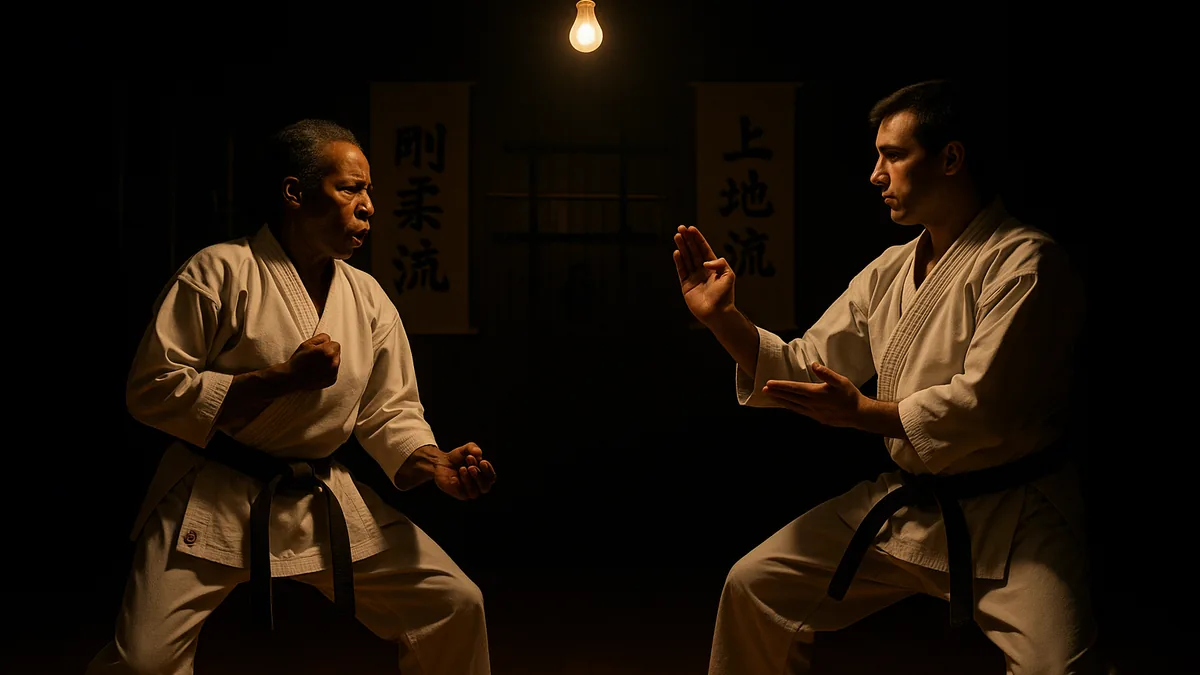
Funakoshi vs Mabuni: How Two Students of the Same Masters Built Completely Different Styles
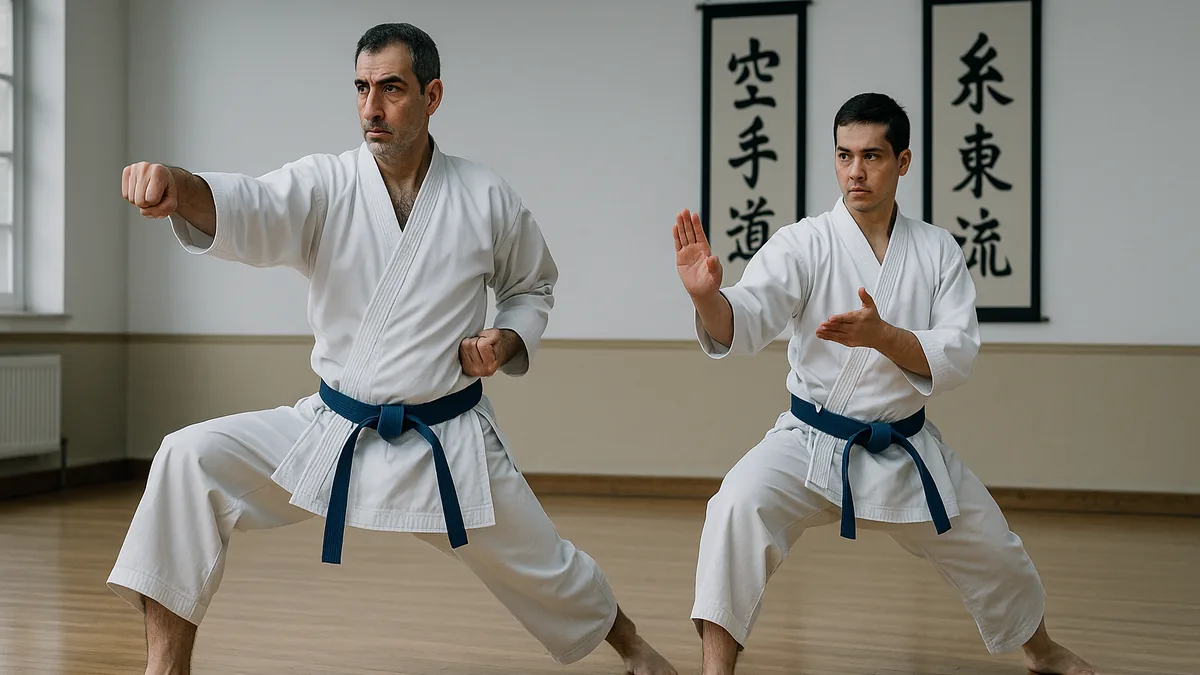
Most karate practitioners know that Shotokan and Shito-Ryu both trace back to the same two Okinawan masters - Itosu Anko and Higaonna Kanryo. What fewer people think about is what that actually means: two men trained in overlapping systems, absorbed much of the same kata, and then went in completely different directions when they brought karate to mainland Japan. That divergence tells you a great deal about how a style is shaped not just by technique, but by the philosophy of the person transmitting it.
Gichin Funakoshi and Kenwa Mabuni were contemporaries, colleagues, and in some respects rivals. Both were serious Okinawan practitioners who had studied under Anko Itosu. Both wanted karate recognised as a legitimate martial art. But what they built looks different, trains differently, and asks different things of its practitioners.
The Same Foundation, Two Different Questions
Funakoshi was born in 1868 in Yamakawa, Shuri. His two principal teachers were Itosu Anko and Yasutsune Azato, both leading figures of the Shuri-te tradition. In 1901, Itosu achieved a breakthrough when he succeeded in introducing karate into the physical education curriculum at Shuri Jinjo Elementary School - the first formal school instruction of karate in Okinawa. Most importantly, he created the Pinan series of kata - five kata designed to be easier to learn, introducing fundamental movements and transitions, with the purpose of helping students build confidence and skill before moving to advanced forms. The Pinan kata later became known in Japan as the Heian series.
Mabuni initially studied from 1902 under Itosu of Shuri, Okinawa, from the age of 13.1 In 1908, Mabuni’s friend Chojun Miyagi recommended he come and also learn from his teacher Kanryo Higaonna of Naha.1 While both Itosu and Higaonna taught a “hard-soft” style of Okinawan “Te”, their methods and emphases were quite distinct: the Itosu syllabus included straight and powerful techniques as exemplified in the Naihanchi and Bassai kata; the Higaonna syllabus stressed circular motion and shorter fighting methods as seen in the kata Seipai and Kururunfa. On paper, Mabuni had the broader technical inheritance.
What each man chose to do with that inheritance is where the story gets interesting.
Funakoshi’s guiding question was: what does karate make of a person? He laid out the Twenty Precepts of Karate - the Niju Kun - which form the foundations of the art; within these twenty principles, based heavily on Bushido and Zen, lies the philosophy of Shotokan. The maxim “Karate ni sente nashi” - there is no first attack in karate - became known primarily through the teachings of Funakoshi, who made it the second of his Niju Kun, following only the directive that “karate begins and ends with courtesy”. In a 1935 magazine article he stated that he viewed it as expressing the essence of karate-do. It is a philosophical position about who a karateka should be, not a purely tactical instruction.
Mabuni’s guiding question was different: what does this technique actually do? Mabuni was noted for his encyclopaedic knowledge of kata and their bunkai applications.1 He trained with multiple masters, cross-referenced applications, and built a style - Shito-Ryu - that preserved a wider technical vocabulary than any other major Japanese style. The name Shito-Ryu was derived from the first kanji character from the names of his two primary teachers, Itosu and Higaonna (also called Higashionna).1
What Funakoshi Actually Emphasised - and What Gets Lost
The common mistake when discussing Shotokan is to describe it purely in terms of its visual characteristics: long, deep stances, big linear movements, powerful basics. Those are real features, but they are downstream of something more fundamental. Funakoshi wanted karate to function as a form of physical and moral education. When Funakoshi gave a demonstration at the 1st National Athletic Exhibition in Tokyo in 1922, the demonstration caught the attention of Jigoro Kano, the founder of judo, who invited Funakoshi to demonstrate at the Kodokan. That connection with Kano - a man who had already successfully embedded judo into Japanese educational institutions - helped Funakoshi gain a foothold in mainland Japan.
This matters for how Shotokan trains. The emphasis on kihon - long sequences of basics performed with maximum commitment - is not just about building power. It is about building a particular kind of attention and discipline. You are supposed to feel the effort, sustain it, and not cut corners. The correction that works in Shotokan basics is usually about commitment rather than efficiency: drive through the stance, extend fully, kime (focus) at the point of impact. You should feel that moment of total muscular tension through your whole body, not just your arm.
In 1929, Funakoshi changed the first character used to write Karate from one meaning “Chinese” to one meaning “empty”, adopted the suffix “do” (way) so that Karate-jutsu became Karate-do, and gave many kata Japanese names instead of their Chinese and Okinawan ones. Some Okinawan traditionalists have never forgiven this. The argument is that in making karate palatable to Japanese institutions, Funakoshi stripped out practical application - bunkai - in favour of aesthetic form.
That argument has some merit. The bunkai taught in many Shotokan dojos is notoriously thin. Many instructors cue the kata movements as abstract form rather than working through what each sequence is actually defending against. This is a real gap, and it is worth naming honestly.
What Mabuni Was Trying to Preserve
Modern Shito-Ryu stresses speed and economy of movement, and fighting is generally initiated from a higher, more upright stance than Shotokan employs. Because the style has so many kata, a great deal of time is spent perfecting any one of its 40 to 60 forms.1 That breadth was deliberate. Mabuni believed the kata were technical libraries, and that losing a kata meant losing the knowledge encoded in it.
His approach to bunkai was correspondingly more rigorous. Shito-Ryu practitioners are expected to understand what they are doing and why - not just to perform the sequence correctly, but to be able to demonstrate the application. This makes Shito-Ryu grading and teaching more demanding in a specific way: you cannot hide behind a well-executed form if you cannot explain the technique.
The stances in Shito-Ryu tend to be higher and more mobile than Shotokan’s, which reflects the Naha-te influence from Higaonna’s lineage. If you have trained in Shotokan and then step into a Shito-Ryu class, the first thing you will feel is that the distances are different. Shito-Ryu closes range faster. The footwork feels more immediate, less ceremonial.
This is not a coincidence. Mabuni was not building a system for character development or physical education. Perhaps more than any other master in the last century, Mabuni was steeped in the traditions and history of Karate-do, yet forward thinking enough to realise that it could spread throughout the world. He was preserving a fighting art and making sure the technical content did not get diluted in translation.
Community Perspective
The question of which approach is more “authentic” generates genuine disagreement, and it is worth being honest about where practitioners land.
Many Shotokan practitioners - particularly those who have trained for decades - would argue that the philosophical dimension Funakoshi built in is not a weakness but the whole point. The discipline of kihon, the commitment to form, the dojo etiquette: these are features, not bugs. The view that Shotokan stripped out practical application often comes from people who trained in a poor Shotokan dojo, not from the style itself.
Shito-Ryu practitioners, particularly those in the Itosu-kai or Seishinkai lineages, tend to push back on the idea that technical breadth means anything without depth. Knowing forty kata means nothing if you cannot apply ten of them under pressure.
There is also a generational shift happening. Younger practitioners across both styles are increasingly interested in bunkai research - looking at the work of people like Iain Abernethy, who has written and presented extensively on practical kata application, or the Okinawan masters who never accepted the idea that kata were purely formal exercises. This is pulling both styles back toward something closer to what Mabuni was doing, regardless of which style you train in.
If you are thinking about which environment suits you better, the practical advice is to visit dojos rather than read about styles. The variation within any style is enormous. How to Find a New Karate Club When You Move or Change Styles covers what to look for when you walk through the door.
The Philosophical Divergence in Practice
Here is where we will take a position: Funakoshi’s philosophical emphasis was not a mistake, but it created a vulnerability that many Shotokan organisations have failed to address. When you build a style around character development and spiritual growth, the technical content becomes secondary - and in many dojos, it has stayed secondary for generations. Kata are performed beautifully and understood poorly. Kumite is sport-focused. Bunkai is an afterthought.
Mabuni’s approach was harder to teach at scale but more technically honest. If your style is built around preserving and transmitting practical technique, there is less room for drift. The kata are supposed to mean something, and that expectation creates accountability.
That said, the Shotokan model succeeded in spreading karate globally in a way that Shito-Ryu, despite its technical richness, has not matched. Funakoshi was a schoolteacher, poet and scholar rather than a fighter by temperament, and he turned a little-known Okinawan art into a recognised Japanese budo; the style that grew from his teaching, Shotokan, is today the most widely practised form of traditional karate. His decisions to align with Japanese educational institutions, to simplify, and to emphasise character over combat made karate accessible to millions of people who would never have encountered it otherwise. Whether that was a worthwhile trade-off depends on what you think karate is for.
For context on how other Okinawan styles handled the same tension between preservation and accessibility, the comparison between Goju-Ryu and Uechi-Ryu is worth reading - two Naha-te descended systems that made very different choices about what to prioritise.
What This Means for Your Training
Understanding this divergence is not just historical trivia. It changes how you approach your own practice.
If you train Shotokan, the honest question is whether your dojo treats bunkai as a serious subject or as a formality. If it is the latter, you are training Funakoshi’s philosophical model without the philosophical depth - which leaves you with impressive basics and limited understanding of what you are actually doing. The correction that usually helps here is to find a seminar, a training partner, or a resource that takes kata application seriously and bring that back into your regular practice.
If you train Shito-Ryu, the challenge is different. The technical vocabulary is there, but forty or more kata can become a collection exercise rather than a training tool. Most beginners in Shito-Ryu underestimate how long it takes to genuinely internalise even a small number of kata to the level where the applications become instinctive. Breadth without depth is its own trap.
Both styles reward serious long-term practitioners. The biggest difference is what the style asks of you in the early and middle years. Shotokan asks for commitment to form and character. Shito-Ryu asks for technical curiosity and patience with complexity. Neither is easier - they are just difficult in different ways.
Good training partners matter enormously in both contexts, because the gap between kata performance and practical understanding only closes through regular, honest partner work.
Key Takeaways
-
Funakoshi and Mabuni trained under the same primary Okinawan teachers but built styles around different central questions. Funakoshi asked what karate does to a person; Mabuni asked what the techniques actually do. Both questions are legitimate, but they produce different training environments.
-
Shotokan has 26 official kata, codified by the JKA. Shito-Ryu carries a much larger syllabus - a great deal of time is spent perfecting any one of its 40 to 60 forms.1
-
Shotokan’s philosophical emphasis is a genuine strength that many Shotokan dojos fail to deliver on. If your dojo cannot explain its kata applications, that is a dojo problem, not a style problem - but it is common enough to be worth checking before you commit.
-
Shito-Ryu’s technical breadth is only an advantage if the depth is there to match it. Knowing more kata than you understand is not a mark of advanced training.
-
The correction that works in both styles is the same: take bunkai seriously. Kata performed without understanding of application is exercise, not karate.
-
If you are grading in either style, the expectation around application is different. Shito-Ryu gradings often demand more explicit demonstration of understanding. How to Run a Karate Grading outlines what structured assessment should look like at any level.
-
If you are returning to training after a gap and considering switching styles, the philosophical difference between these two systems is worth factoring in. The technical adjustment is manageable; the shift in what the style asks of you is less obvious and takes longer to navigate. Returning to Karate After a Long Break covers what that transition actually involves.
References
Checked by the KarateLifestyle editorial team against official style association websites, karate governing body sources, published primary texts (Funakoshi's Niju Kun, 1938; Nakayama's Best Karate series), and specialist karate history research in October 2026. Historical karate lineage is well attested across primary sources, though some dates and biographical details vary slightly between accounts.
- Shito-Ryu History - shitokaiusa.com (JKF Shitokai USA). JKF Shitokai KARATEDO USA, official US affiliate of Japan Karatedo Federation Shitokai, accessed October 2026
The weekly digest
New karate articles, once a week
One email every week with everything new on Karate Lifestyle. No spam; unsubscribe in one click.
We'll email you to confirm. See our privacy policy.