Training Partners: How to Find, Keep, and Be a Good One
The best training partner I ever had was a guy who made me feel genuinely uncomfortable every single class. Not because he was aggressive or careless - but because he pushed just hard enough that I couldn’t coast. He’d notice when my guard dropped in the third round and call it out. He’d ask why I kept telegraphing my gyaku-zuki instead of just letting it go. After six months training with him, I graded and my examiner said my sparring had a quality she hadn’t seen from me before. I didn’t tell her it was because someone had been quietly holding me accountable twice a week for half a year.
That’s what a good training partner actually does. And it’s rarer than it should be.
Why Most Training Partnerships Stay Shallow
I’ve noticed that most people in a dojo pair up with whoever they’re comfortable with, then stay comfortable indefinitely. You find someone your size, your grade, your general level of intensity - and you settle in. Nothing wrong with that as a starting point. But I’ve watched partnerships like that run for years without either person actually improving much. They’re drilling together, not training together.
The difference is friction. Not conflict - friction. The kind that comes from honest feedback, from someone raising the pace when you’re cruising, from a partner who says “you’re pulling that kick again” instead of just letting it go because the session’s nearly over.
The mistake I see most often is people confusing politeness with support. You let your partner’s technique slide because you don’t want to make it awkward. They do the same for you. Everyone bows at the end and feels good about the session. But nobody improved. What you’ve done is protect each other from the discomfort that actually drives development.
What Good Partners Actually Do for Each Other
I think the most underrated quality in a training partner is consistency of honesty. Not the person who tears apart every rep, and not the person who says “yeah, that looked good” to everything. The one who tracks what you’re working on and notices whether you’re getting there.
I had an instructor who used to say: “Your partner is your mirror.” I didn’t really understand that as a junior grade. I thought it meant watching each other’s form. By the time I was brown belt, I understood it meant something more direct - your partner reflects back what you’re actually doing, not what you think you’re doing. You feel like your oi-zuki is sharp and committed. Your partner feels a hesitation in the contact that you can’t perceive from inside the technique. That feedback is priceless if they give it to you.
Good partners also push the pace at the right moments. There’s a specific feeling when someone raises the intensity just slightly above where you’re comfortable - you’ll feel it in your reaction speed, in the way your body starts making decisions before your brain catches up. That’s the zone you want to train in regularly. A partner who keeps the pressure just above your baseline is doing more for your development than any number of solo repetitions.
- Call out recurring errors without turning it into a lecture
- Match your intensity to what your partner needs, not just what you feel like doing that session
- Remember what they’re working on from week to week
- Know when to push and when to back off - especially after injury or a rough session
Finding the Right Partner
If you’re in a dojo with a decent size class, you have options. I’d recommend actively rotating rather than defaulting to the same person every session. You learn different things from different partners. Someone lighter than you teaches you about distance and timing. Someone stronger teaches you about structure and commitment. Someone more experienced shows you what efficiency looks like up close - you’ll feel the difference in how little effort their technique seems to require compared to yours.
If you’re new to a club, especially if you’ve recently moved or changed styles (and if that’s where you are, How to Find a New Karate Club When You Move or Change Styles is worth reading), be patient about finding your people. It takes a few months to work out who trains seriously and who’s just going through the motions. Don’t force a training partnership early - let it develop through repeated pairing in class before you start seeking someone out specifically.
One honest observation: the best training partners I’ve had were not always the most technically gifted. Some of the most valuable people I’ve trained with were a grade or two below me but had an intensity and a willingness to be honest that made every session worth showing up for. Grade isn’t a reliable indicator of partnership quality.
Communication: The Part Nobody Talks About
Most karate practitioners are not great at talking about training. We bow, we drill, we spar, we bow again. Verbal communication between partners is minimal by default, and I think that’s actually a problem.
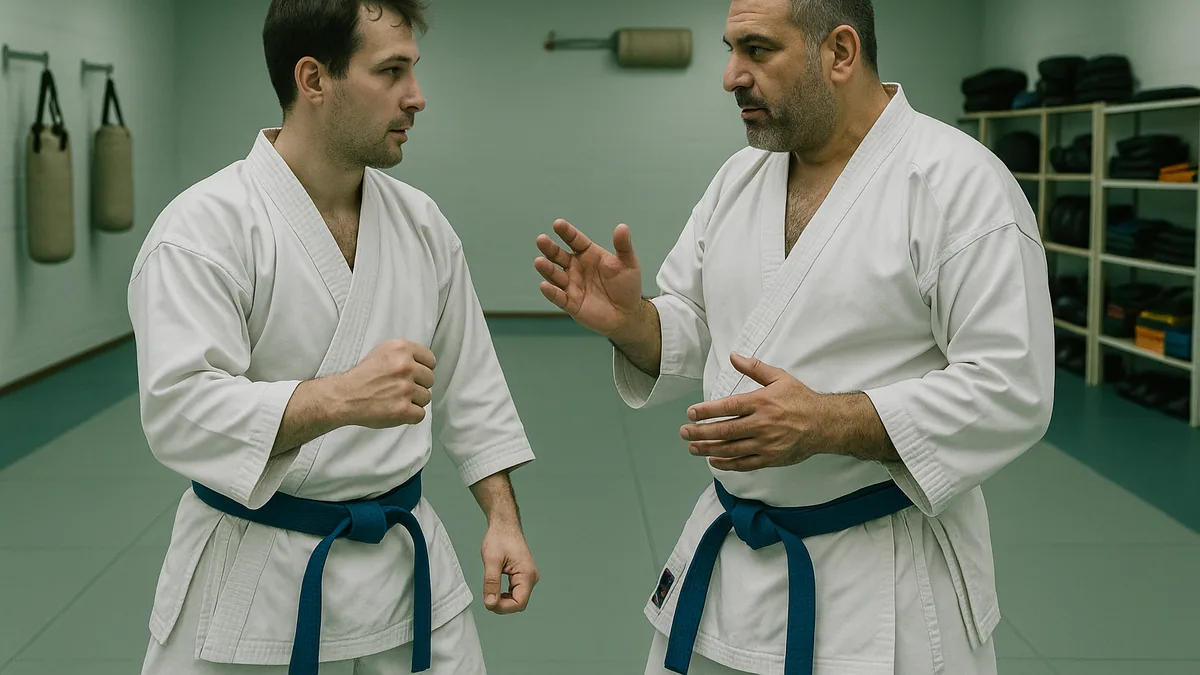
What I tell students is: before you start a heavy sparring session with a regular partner, take thirty seconds to say what you’re working on. “I’m trying to get my lead hand faster tonight” or “I want to work on not telegraphing my combinations.” That’s it. Now your partner knows what to notice, knows what to push, and can give you useful feedback at the end of the round instead of generic encouragement.
The correction that works for most people here is simple: treat feedback like a two-way obligation. You owe your partner honesty, and you owe yourself the willingness to hear it. I’ve seen people get defensive when a training partner points out a recurring flaw - and I understand it, because nobody likes being told the thing they’ve been working on still isn’t right. But the alternative is staying stuck. Your ego is not your training partner’s problem to manage.
Receiving feedback well is its own skill. When someone tells you your guard drops after a combination, the useful response is “when does it drop?” not “I don’t think it does.” Even if you disagree, try the adjustment. You’ll either feel the correction work - that moment when something clicks and the technique suddenly feels more connected through your body - or you’ll gather information that helps you have a better conversation about it.
Community Perspective
There’s genuine disagreement in the karate community about how much partners should intervene in each other’s technique, especially when grades differ significantly. Some instructors take the position that correction should only come from the sensei - that a junior correcting a senior, or even a senior offering unsolicited feedback to a junior, disrupts the dojo hierarchy. I’ve trained in clubs where this was the explicit culture.
I don’t agree with that position, but I understand where it comes from. In a large class with a single instructor, unsolicited peer feedback can become noise - everyone offering opinions, contradicting each other, undermining what the sensei just said. That’s a real problem.
What I think works better is the middle ground: check with your partner first. “Do you want feedback on this?” is a two-second question that changes everything. It respects their autonomy, it signals your intention, and it opens a door rather than forcing one. Most people, when asked directly, say yes.
The other disagreement I hear often is about intensity in partner work - particularly in jiyu-kumite. Some practitioners believe that light, controlled sparring builds bad habits. Others argue that going too hard creates tension and kills technical development. I’ve been on both sides of this debate over fifteen years, and my honest position now is that the answer changes depending on what you’re trying to develop. If you’re preparing for your first competition (and if that’s coming up, Competing in Karate for the First Time: What Nobody Tells You covers things your instructor probably won’t) you need different pressure than if you’re working on a specific technical problem.
Being the Partner Someone Wants to Train With
This is the part people overlook. Everyone wants a good training partner. Fewer people actively work on being one.
Most beginners focus entirely on their own development - which is natural and appropriate early on. But I’ve noticed that the practitioners who grow fastest past a certain point are the ones who start investing in their partners’ development as well. There’s something about the attention you give to someone else’s technique that sharpens your own understanding. When you’re trying to explain why a partner’s back stance feels unstable, you’re forced to articulate something you might only have understood intuitively. That articulation deepens your own grasp of it.
Being a good partner also means showing up consistently. Not just to class - but consistently prepared, consistently focused, consistently willing to work. The biggest difference between the training partnerships that produce real improvement and the ones that plateau is reliability. Your partner needs to know that when they’re working on something specific, you’re going to bring the same focus to helping them develop it that you’d want them to bring to yours.
If you’ve been away from training for a while and you’re coming back to rebuild those partnerships, Returning to Karate After a Long Break: What to Expect covers the social and technical side of re-integrating into a dojo - including how to re-establish training relationships without making it awkward.
Key Takeaways
- Rotate partners regularly - different training partners teach you different things, and staying too comfortable with one person limits your development
- Before sparring or heavy partner work, tell your partner what you’re working on - thirty seconds of communication changes the quality of the whole session
- When giving feedback, be specific and brief - “your guard drops after the combination” is useful, a five-minute technical analysis mid-session is not
- Receiving feedback is a skill - your first response to correction should be to try the adjustment, not to explain why you don’t think you need it
- Match your intensity to what your partner needs, not just what you feel like - a good partner reads the session and adapts
- Work on being the partner someone wants to train with, not just on finding one - the two things are more connected than most people realise
The weekly digest
New karate articles, once a week
One email every week with everything new on Karate Lifestyle. No spam; unsubscribe in one click.
We'll email you to confirm. See our privacy policy.