Shitō-ryū vs Wado-Ryu: How the Two Most Technically Diverse Competition Styles Differ in Kata Interpretation and Kumite Strategy
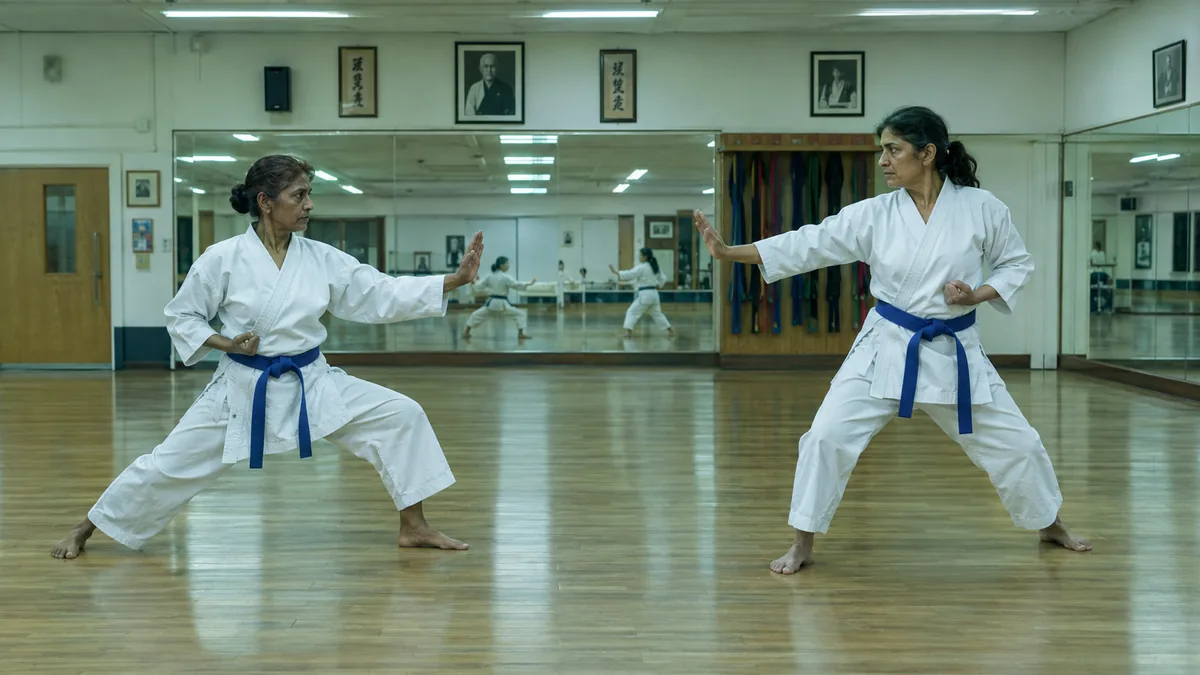
The Kata Question: What “Interpretation” Actually Means
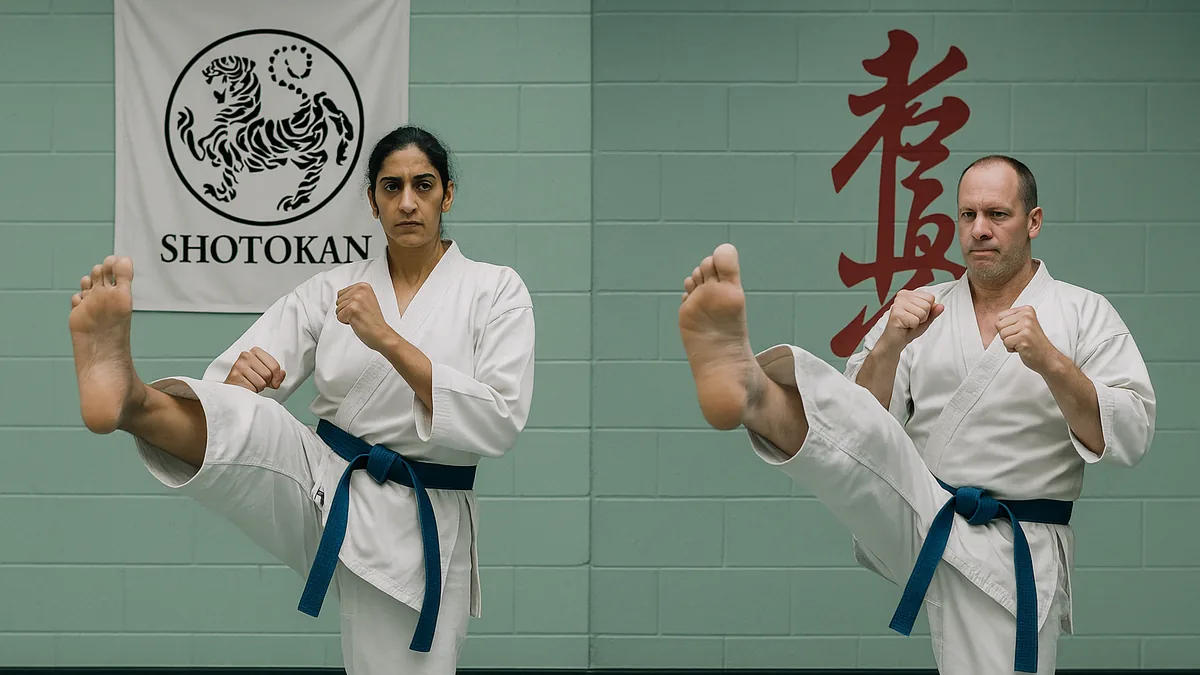
When people say Shito-ryu has a more diverse kata syllabus, they usually mean it in a numerical sense. That is accurate. Kenwa Mabuni (1889 to 1952) founded the style by deliberately synthesising two distinct Okinawan lineages: the Shuri-te he learned under Anko Itosu and the Naha-te he learned under Kanryo Higaonna.1, 2 The result was one of the largest syllabuses in competitive karate, and one that retains the technical character of each source tradition rather than blending them into a single uniform approach. If you want the full picture of what that syllabus contains and where each form comes from, the Shito-ryu Kata List covers it in detail. And to understand why Mabuni collected so broadly in the first place, the article on Kenwa Mabuni himself is worth reading.
The more important point is not the number of kata - it is what having forms from multiple lineages demands of the performer. A Shito-ryu practitioner performing Seienchin needs to embody the heavy, rooted quality of Naha-te. The same practitioner performing Bassai Dai should shift into something sharper and more linear. The style does not smooth these differences out. It asks you to carry them both and switch between them cleanly.
The correction that most Shito-ryu students need is not technical in the narrow sense - it is not about hand position or stance depth. It is about character. Many instructors in this style cue performers to find the “feel” of each kata’s source tradition. If your Seienchin looks like a faster version of Bassai Dai with different moves, you have not understood what Shito-ryu kata interpretation actually requires.
Wado-ryu Kata: Fewer Forms, Deeper Integration
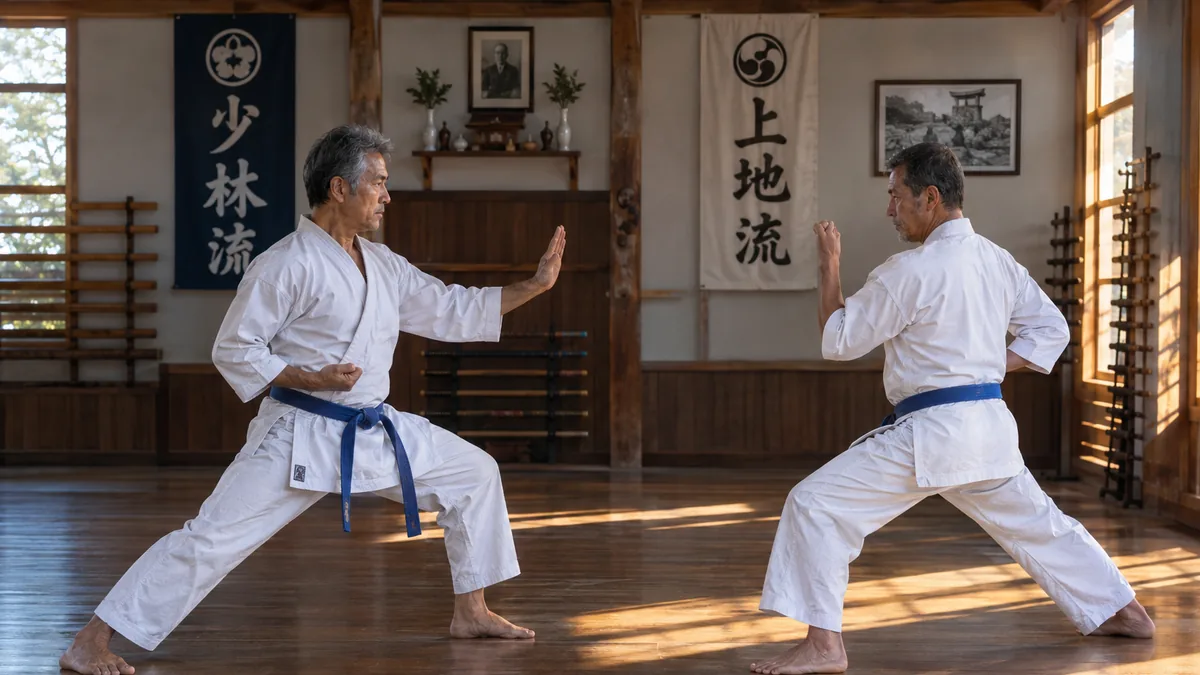
Wado-ryu works from a substantially smaller set of kata. Hironori Ohtsuka (1892 to 1982), who founded the style, specified only nine official kata in his published curriculum: the five Pinan, Kushanku, Naihanchi, Seishan, and Chinto. Most schools today teach a broader syllabus of around fifteen forms, drawing on additional kata that Ohtsuka taught but did not formally designate as core to the style. Ohtsuka had learned karate from Gichin Funakoshi beginning in 1922, taking on the Okinawan forms Funakoshi had brought to Japan, then supplementing his knowledge through study with Kenwa Mabuni and Choki Motobu. He then filtered all of this through his deep background in Shindo Yoshin-ryu jujutsu, in which he had attained the highest degree by 1920. The result is kata that share ancestry with Shotokan equivalents but feel markedly different in execution.
It is worth being precise here: Ohtsuka did not learn “Shotokan” kata, since Shotokan was not formalised until after Ohtsuka had already established Wado-ryu independently in 1934. What he took was the Okinawan Shuri-te material Funakoshi had transmitted, then reshaped it through his jujutsu principles.
The biggest difference from other styles is in how transitions work. In Wado-ryu kata, the movement between techniques is not a reset. It is part of the technique. You will feel this most clearly in the hip action: rather than sharp, driving hip rotation, Wado-ryu uses a more continuous, rotational quality that carries momentum from one movement into the next. When it is working correctly, the kata feels like it flows from a single connected impulse rather than a sequence of separate events.
A common mistake in Wado-ryu kata is treating each technique as a stopping point. Students complete a technique, pause to reset, then begin the next. This is natural - it is how most people learn to isolate movements - but it produces kata that looks mechanical and loses the style’s defining character. The correction that works is to think of the entire sequence as one long movement with changes of direction and emphasis, not a series of individual blocks and strikes.
Kumite: Where the Philosophical Gap Becomes Most Visible
If kata shows you the stylistic difference intellectually, kumite is where you feel it in your body under pressure.
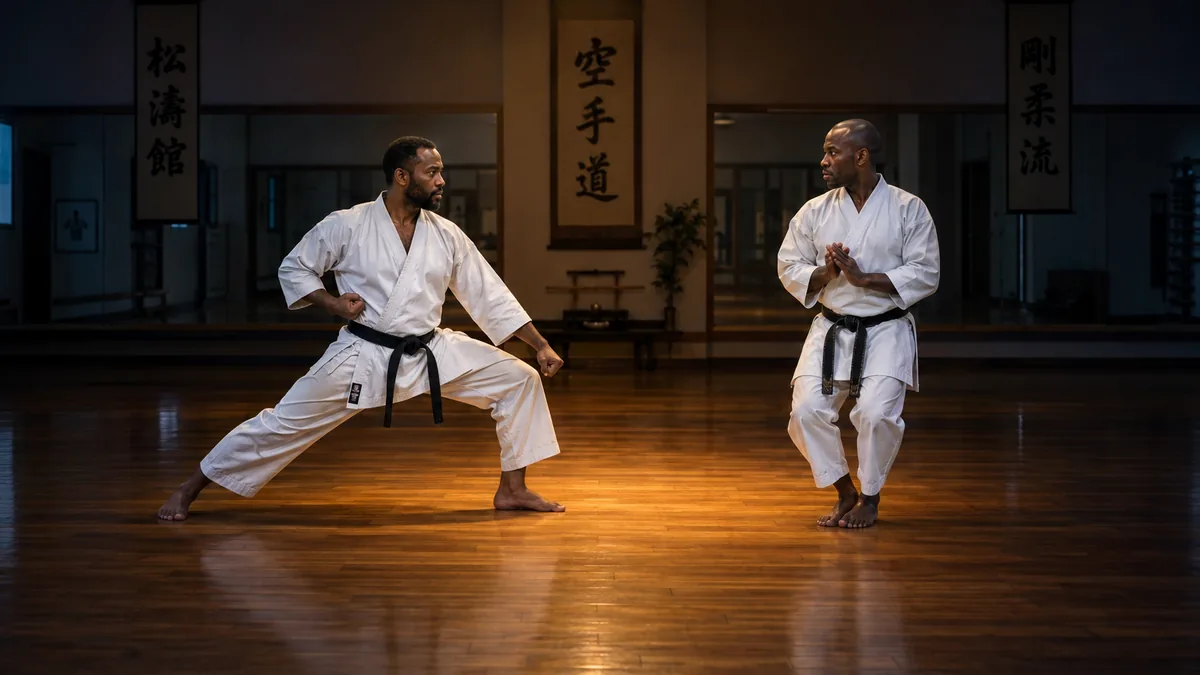
Shito-ryu kumite tends toward a direct, committed approach. Attacks are sharp and decisive. The style rewards practitioners who can generate power efficiently from compact positions, and the footwork tends to be linear with clear offensive intent. This suits the style’s kata character: precision, commitment, and technical clarity.
Wado-ryu kumite is built on a different premise entirely. The core concepts are tai sabaki (body evasion or body management) and nagasu (letting an attack flow past or redirecting it rather than blocking it head-on). Rather than blocking and countering as two separate actions, Wado-ryu aims to evade and counter as a single movement. In jiyu-kumite, this becomes your fastest counter off a failed attack: as your opponent overcommits, you are already offline and responding before they can recover.
This is the aspect of Wado-ryu that practitioners from other styles find hardest to absorb. The instinct when someone attacks is to block - to meet force with force. Wado-ryu asks you to trust that moving off the line is enough, and that your counter should arrive before your opponent’s attack has fully extended. It feels wrong at first. You are not stopping the attack; you are making it miss. The confidence to do that under pressure takes time to build, and many practitioners understand the concept long before they can execute it when someone is actually trying to hit them.
The Evasion Trap
Here is a position worth taking: Wado-ryu’s evasion-first philosophy is technically well suited to close-range fighting, but it is frequently taught in a way that produces passive competitors rather than effective fighters.
The problem is that tai sabaki without offensive intent becomes retreating. A common mistake in Wado-ryu kumite training is practising the evasion without committing equally hard to the counter. You move offline, your opponent misses, and then you hesitate because you have not trained the counter to be automatic. In competition, that hesitation costs you the point. In a self-defence context, it is worse.
The correction that actually works is to train the counter first and build the evasion around it. Know exactly what you are going to do offensively, then work backward to where you need to be to do it. This is the opposite of how evasion is often introduced, but it produces practitioners who move to attack rather than practitioners who move to avoid.
How They Compare in WKF Competition
Both styles compete under WKF rules, which govern both kata and kumite events at all official WKF-sanctioned championships.3 They tend to produce different competitive profiles.
Shito-ryu kata competitors are often strong in technical variety - the ability to perform multiple kata with distinctly different characters is an asset in a format where you perform different forms across rounds.4 The style’s emphasis on adapting to the character of each kata suits the multi-round structure well. For a comparison of how Shito-ryu’s competitive approach differs from Shotokan’s, the Shotokan vs Shito-ryu article covers the key distinctions.
Wado-ryu kumite competitors, when the style is well-trained, tend to be difficult to read. The evasive footwork and the commitment to countering off the opponent’s attack means they often appear reactive - which at lower levels can look passive to judges, but at higher levels is recognised as tactical control. The style rewards patience and timing over aggression, which is a genuine competitive advantage against opponents who are powerful but predictable.
What neither style does particularly well, relative to contact-based styles like Kyokushin, is condition practitioners to absorb impact. WKF rules do not require it, so this is not a competition disadvantage - but it is worth knowing if you are evaluating either style for broader martial arts development.
Community Perspective
There is a genuine disagreement in the karate community about whether Wado-ryu’s jujutsu influence makes it a “purer” form of karate or a hybrid that has drifted from Okinawan roots. Practitioners within the style tend to see the jujutsu integration as a strength - it preserves the self-defence application of techniques that other styles have reduced to pure sport. Critics, particularly from Okinawan-lineage styles, argue that the integration has changed the fundamental character of the techniques.
There is a similar debate about Shito-ryu’s breadth. Some practitioners see the large kata syllabus as a strength - a comprehensive technical education, in keeping with Mabuni’s reputation as a preservationist who gathered knowledge from masters across Okinawa before it was lost. Others argue that attempting to master kata from two distinct lineages produces students who are competent in many forms but deeply skilled in none. This is a legitimate tension. The honest answer is that it depends entirely on the quality of instruction and the seriousness of the student. A well-taught Shito-ryu practitioner can genuinely embody both lineages. A poorly taught one will perform all the kata with the same undifferentiated energy.
Both debates tend to resolve differently as practitioners gain experience. Many who start in one style and cross-train in the other report that the exposure clarifies what their home style is actually trying to do - which is probably the most useful outcome of comparative study.
Key Takeaways
- Shito-ryu kata interpretation demands that you change character between forms, not just change movements. If your Naha-te kata looks like your Shuri-te kata with different techniques, that is the first problem to fix.
- In Wado-ryu kata, the transition between techniques carries the style’s identity. Train the transitions, not just the techniques.
- Wado-ryu’s tai sabaki only works in kumite if the counter is already committed. Train the counter first; build the evasion around it.
- Shito-ryu’s direct kumite approach rewards technical precision and compact power generation - work on generating force from short distances, not just from big wind-ups.
- If you compete under WKF rules in kata, Shito-ryu’s multi-lineage syllabus is a genuine asset across multiple rounds. Use it deliberately rather than defaulting to the same character for every form.
- Cross-training between these two styles is more productive than most practitioners expect. What feels alien about the other style usually identifies a gap in your own training.
References
Checked by the KarateLifestyle editorial team against official WKF rules documents, governing body and association pages, and karate history sources in November 2026. The Wado-ryu kata count varies across organisations; Ohtsuka formally designated nine, while modern schools typically teach fifteen.
- Shito-ryu History and Kenwa Mabuni - Shito-ryu.net. Shito-ryu.net historical overview, accessed November 2026
- Kenwa Mabuni and the Beginning of Shito Ryu Karate - Shito-ryu Senshinkai. Shito-ryu Senshinkai lineage article, accessed November 2026
- World Karate Federation Kumite Competition Rules 2024. WKF official rules document, valid from 1 January 2024
- World Karate Federation Kata Competition Rules 2024. WKF official rules document, valid from 1 January 2024
The weekly digest
New karate articles, once a week
One email every week with everything new on Karate Lifestyle. No spam; unsubscribe in one click.
We'll email you to confirm. See our privacy policy.