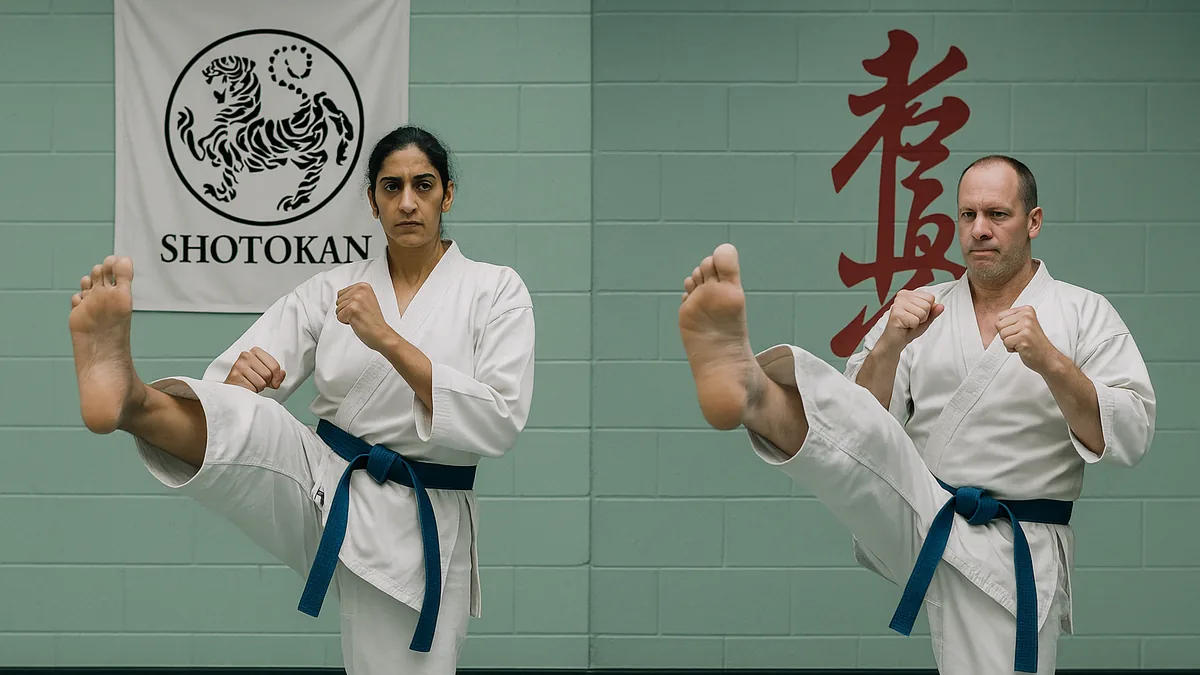
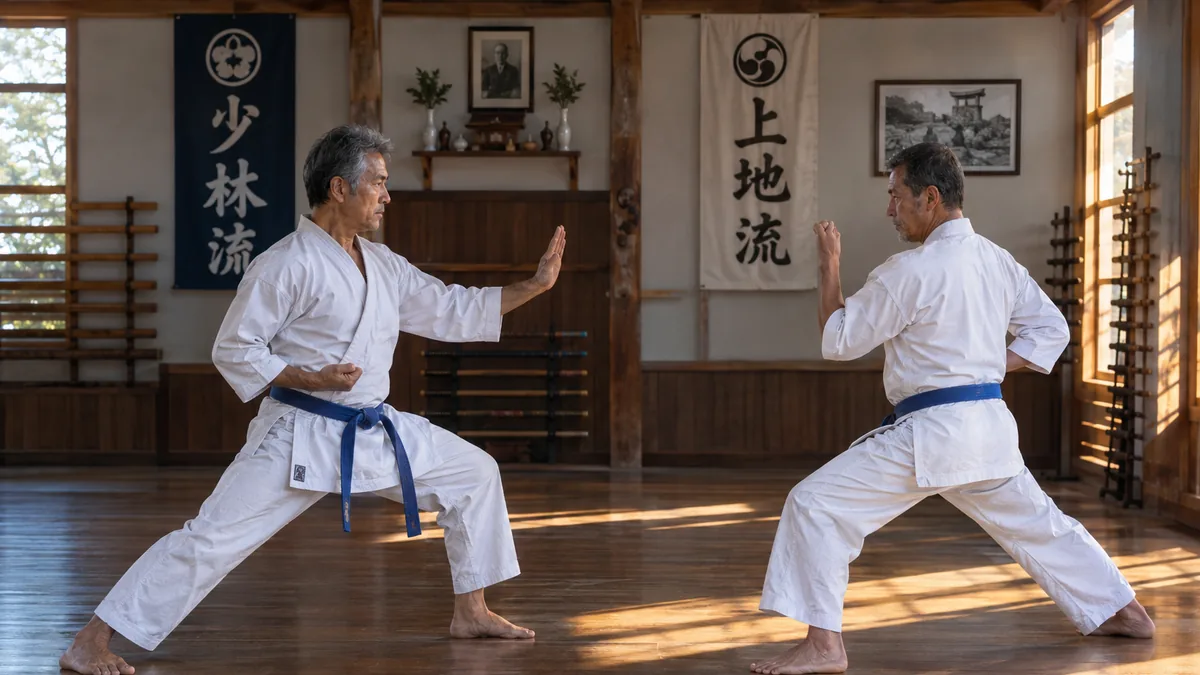
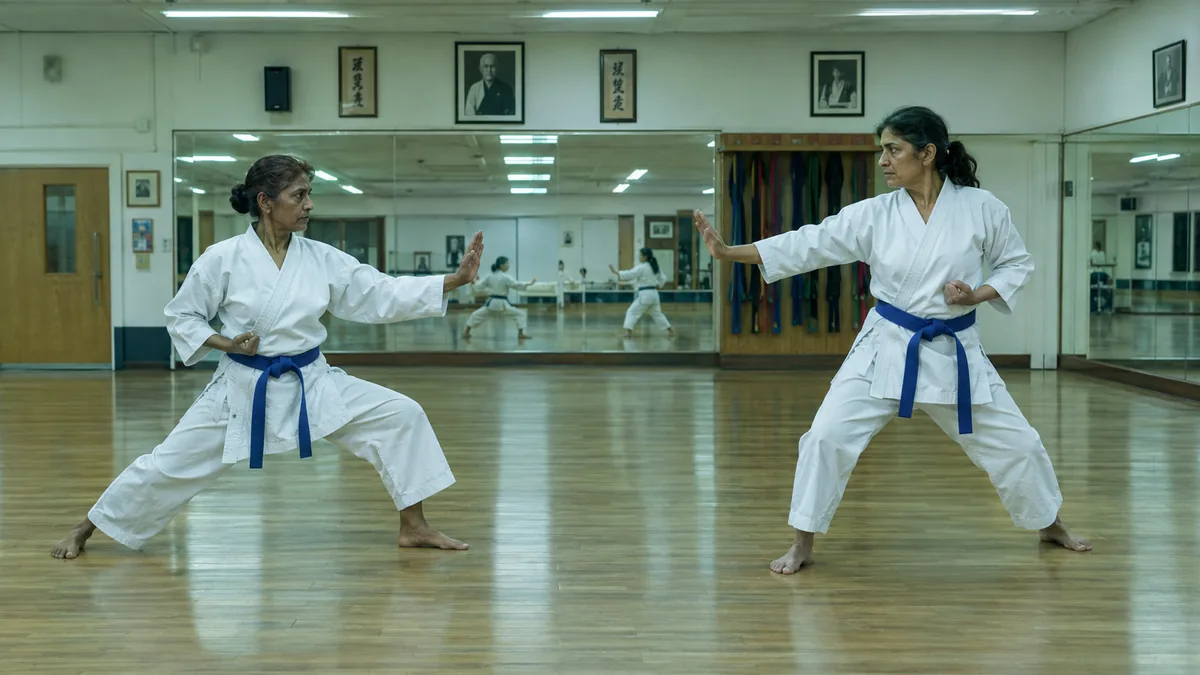
Goju-Ryu vs Shotokan: Why the Two Most Widely Practised Traditional Styles Disagree on Almost Every Fundamental Principle
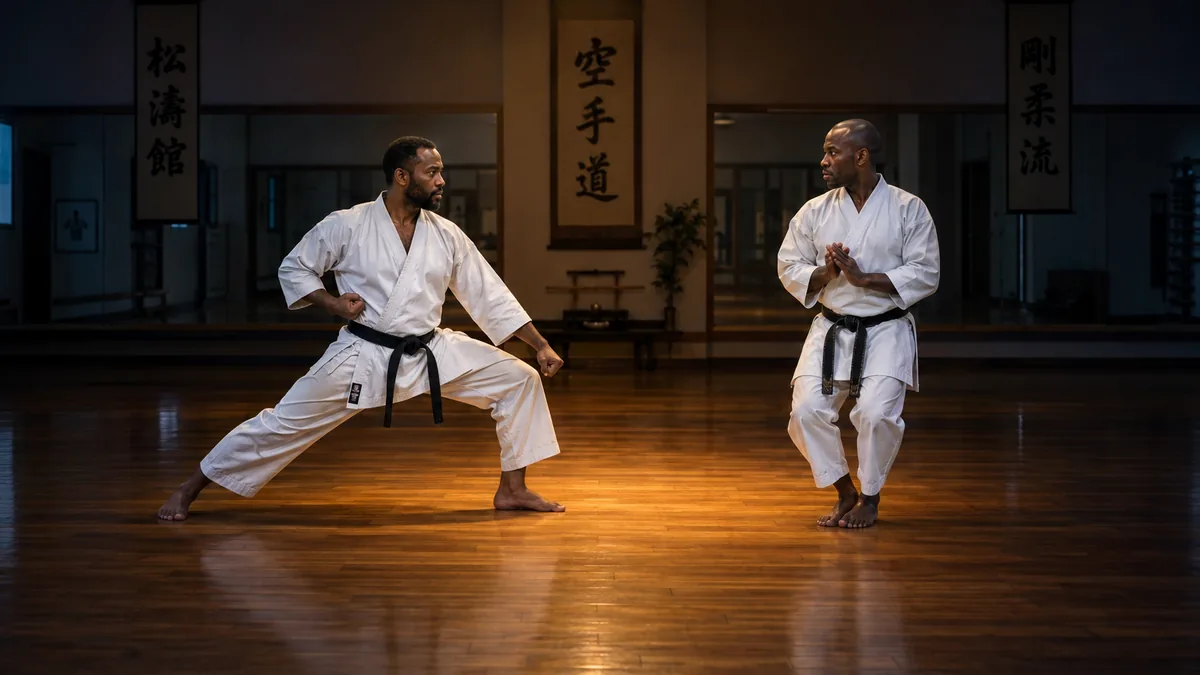
Most practitioners who cross-train between Goju-Ryu and Shotokan describe the same experience: they feel like they are learning karate from scratch. Not because the techniques are unrecognisable, but because the underlying logic is almost entirely reversed. The distance is different, the timing is different, the way power is generated is different, and what counts as a good position in one style actively gets you into trouble in the other.
That disagreement is not accidental. It runs all the way down to how each style understands what fighting is, and it is worth understanding clearly rather than glossing over with vague talk of “different approaches.”
Where the Disagreement Actually Starts
Shotokan traces its development through Gichin Funakoshi (1868 to 1957), who trained under Anko Azato and Anko Itosu in Okinawa before bringing karate to mainland Japan - his landmark Tokyo demonstration took place in May 1922, at a physical education exhibition organised by the Ministry of Education. Goju-Ryu traces its lineage through Chojun Miyagi (1888 to 1953), who trained under Kanryo Higaonna and named the style Goju-Ryu around 1929 to 1930, drawing the name from the Bubishi, a classical Chinese martial arts text.1 Specifically, Miyagi took the name from the third precept of the Hakku Kenpo (“eight laws of the fist”) within the Bubishi, a line that reads in translation: “the way of inhaling and exhaling is hardness and softness.”1 “Go” means hard; “ju” means soft.
That etymology is not just trivia. It is a direct statement of what Goju-Ryu considers the central principle: the integration of hard and soft. Shotokan, shaped heavily by Japanese budo sensibilities and Funakoshi’s emphasis on character development, moved toward powerful, linear technique delivered from stable, deep stances. Both styles share Okinawan roots, but they drew very different conclusions from them. For a deeper look at how two students of the same masters built such different systems, see our article on Funakoshi vs Mabuni: How Two Students of the Same Masters Built Completely Different Styles.
Stances and Structure: Deep vs Upright
The most immediately visible difference is the stance. Shotokan practitioners train extensively in zenkutsu-dachi (front stance), which is long, low, and wide. The back leg is straight, the front knee is bent forward over the toes, and the hips are typically square or angled depending on the technique.2 This stance creates a stable platform for linear power delivery. It feels planted - heavy and grounded in a way that is immediately satisfying when you are driving a reverse punch into a pad.
Goju-Ryu’s characteristic stance is sanchin-dachi: feet roughly shoulder-width apart with the heel of the front foot aligned with the toes of the back foot, toes turned slightly inward, and knees bent and pulled inward, creating a structure that is compact, rooted and mobile in all directions. It feels nothing like zenkutsu-dachi. Where Shotokan’s front stance feels like a loaded spring aimed in one direction, sanchin-dachi feels like a compressed coil that can release in any direction. Mobility is the point.
A common mistake when Shotokan practitioners first encounter sanchin-dachi is to treat it as a shorter, less committed version of what they already know. It is not. The inward rotation of the knees and the contraction through the lower body are active, not passive. Senior Goju-Ryu instructors typically test sanchin-dachi by striking or pushing the student from multiple angles - if the structure collapses, the stance is not yet understood. The correction that usually works is to cue the practitioner to “grip the floor with the feet and draw the knees inward simultaneously.” Once that muscular tension is established, the stance feels stable in a way that is qualitatively different from width or depth alone.
Power Generation: Hip Rotation vs Whole-Body Contraction
Shotokan’s power model is built on hip rotation and the sequential transfer of force from the ground up through a long kinetic chain. The hip drives the shoulder, the shoulder drives the arm, and the punch arrives with the full mass of the body behind it. This is why the reverse punch (gyaku-zuki) from zenkutsu-dachi is so central to Shotokan - it is the purest expression of that principle.
Goju-Ryu generates power differently. The whole body contracts simultaneously at the moment of impact - a concept sometimes described as “muchimi” (heavy, sticky force) or expressed through the tension patterns trained in sanchin kata. Rather than a long rotational whip, the power feels more like a sudden compression from all directions at once. When it works, a short Goju-Ryu punch does not feel like it travelled far - it feels like it arrived from everywhere.
This is a genuine philosophical difference, not just a matter of style preference. Shotokan’s long-range power model rewards distance management and timing. Goju-Ryu’s close-range compression model rewards sensitivity and positioning. Neither is universally superior - but they are genuinely incompatible if you try to use the wrong model at the wrong range.
Breathing as a Technical Tool
Goju-Ryu’s approach to breathing has no real equivalent in Shotokan, and it is one of the most underestimated technical elements for practitioners encountering it for the first time.
In sanchin kata - arguably the most important kata in Goju-Ryu - breathing is not background noise. It is the technique. The practitioner inhales to prepare, contracts the whole body, and exhales with an audible, controlled breath (ibuki) timed precisely to each movement. The exhalation is not just about tension - it creates intra-abdominal pressure that stiffens the core, protects the organs, and anchors the structure of every technique. You will feel this as a kind of internal bracing that runs from the floor of the pelvis upward through the torso.
The biggest mistake practitioners make with ibuki breathing is treating it as a sound to produce rather than a physical state to achieve. The audible breath is a consequence of the correct contraction, not the goal. Many instructors cue this by focusing on the body first: “Compress inward, close the throat slightly, let the breath happen.” When students chase the sound, the body stays loose and the whole point is lost.
Shotokan does use a kiai at the moment of technique, and breath control matters in kata, but it is not systematised to the same degree. Goju-Ryu treats breathing as a technical discipline on par with striking or blocking.
Range and Fighting Strategy
This is where the practical consequences of everything above become most obvious.
Shotokan’s preferred fighting range is long. The deep stance, long punches, and emphasis on the front kick (mae-geri) and reverse punch are all calibrated for a distance at which the opponent’s limbs are almost fully extended. In jiyu-kumite, this creates a game of distance management - you are either in range to attack or deliberately out of range to be safe, and the transition between those two states is the contest. The fastest counter off a failed Shotokan attack is typically a step-in gyaku-zuki, exploiting the moment the opponent’s weight is forward and their guard is open.
Goju-Ryu operates primarily at close range. Techniques like the two-handed blocks and trapping actions in kata such as Seipai and Kururunfa assume that the opponent is close enough to touch. The style’s circular blocks are designed to redirect and close distance simultaneously, not to create space. At Goju-Ryu’s preferred range, Shotokan’s long punches are mechanically useless - you cannot fully extend a reverse punch when someone is already inside your elbow.
We would argue that Goju-Ryu’s close-range emphasis is more realistic for the distances at which most real confrontations happen, but Shotokan’s long-range model produces faster, cleaner technique under controlled conditions. Both observations are true, and which matters more depends entirely on what you are training for.
Community Perspective
The question of whether these two styles can be meaningfully cross-trained is one that generates genuine disagreement among experienced practitioners. Some instructors take the position that training both simultaneously creates confusion - you are trying to internalise two conflicting sets of body mechanics, and neither gets properly embedded. Others argue that the contrast is the point: training Goju-Ryu teaches Shotokan practitioners to function at close range, and training Shotokan teaches Goju-Ryu practitioners to manage distance with precision.
There is also a long-running debate about which style’s kata are more “authentic” to Okinawan karate. Shotokan kata were significantly modified by Funakoshi and his successors for Japanese audiences - Funakoshi changed the names of many kata from their Okinawan or Chinese-derived originals to Japanese equivalents, among them Pinan to Heian, Naihanchi to Tekki, and Wanshu to Empi. Goju-Ryu kata, particularly the classical ones like Sanchin and Tensho, are generally considered closer to their Chinese-influenced origins. Whether that matters for your training is a different question.
Opinions also tend to shift with experience. Many practitioners who start in Shotokan and later train Goju-Ryu report that the Goju-Ryu close-range work retroactively made sense of techniques in their Shotokan kata that had never been satisfactorily explained. The bunkai becomes clearer when you understand the range it was designed for.
For further comparison within the Okinawan tradition, see our article on Goju-Ryu vs Uechi-Ryu: Two Naha-te Styles That Look Similar and Train Very Differently. If you are interested in how Shotokan compares with other Japanese-influenced styles, Shotokan vs Shito-ryu: Why the Two Largest Competition Styles Produce Such Different Fighters and Kata Performers covers similar ground from a competition angle. And for the story of how Kyokushin emerged from Goju-Ryu and ended up looking almost nothing like it, see Kyokushin vs Goju-Ryu: Why a Style Born from Goju-Ryu Ended Up Looking So Different From Its Parent.
Key Takeaways
-
Sanchin-dachi is not a shorter zenkutsu-dachi. It requires active muscular contraction with the knees pulled inward and toes turned inward, creating whole-body tension. Test it by having a partner push you from different angles.
-
Goju-Ryu’s breathing is a structural technique, not a stylistic quirk. If you are training ibuki, focus on the internal compression first. The audible breath follows from correct body mechanics - chasing the sound produces nothing useful.
-
Shotokan’s power model works at long range; Goju-Ryu’s works at close range. Trying to use either model at the wrong distance is a common mistake when cross-training. Identify the range, then apply the appropriate mechanics.
-
In jiyu-kumite, range management is the primary skill in Shotokan. The moment to counter is when the opponent has committed their attack and their weight is forward. In Goju-Ryu kumite, the priority is positioning inside the opponent’s guard, not the distance at entry.
-
Kata bunkai from both styles makes more sense when you understand the intended range. If a Shotokan kata application looks impractical at close range, it probably is - and that is a clue about the distance it was designed for, not a flaw in the kata.
-
Cross-training these styles is valuable but requires discipline. The body mechanics genuinely conflict. We would recommend completing at least one grading cycle in your primary style before adding the other - otherwise you risk ingraining neither correctly.
References
Checked by the KarateLifestyle editorial team against official governing-body pages (IOGKF, British Karate Federation, Shotokai, Goju-ryu Bujutsukan), a peer-reviewed biomechanics paper (PubMed Central), and primary-lineage dojo sources in November 2026. The 1929 versus 1930 date for Miyagi's naming of Goju-Ryu varies slightly across sources; we use 'around 1929 to 1930' to reflect that range accurately.
- Karate Academy of Japan Goju-Ryu: History of Goju-Ryu Karate. Karate Academy of Japan Goju-Ryu India. 1930 naming, Bubishi passage cited.
- Applying Principles of Biomechanics of the Spine to Martial Arts: A Review on Balance of Stances in Goju-Ryu Karate-Do. Peer-reviewed journal article, PubMed Central (PMC). Confirms sanchin-dachi geometry: feet shoulder-width, heel-toe alignment, toes inward.
The weekly digest
New karate articles, once a week
One email every week with everything new on Karate Lifestyle. No spam; unsubscribe in one click.
We'll email you to confirm. See our privacy policy.