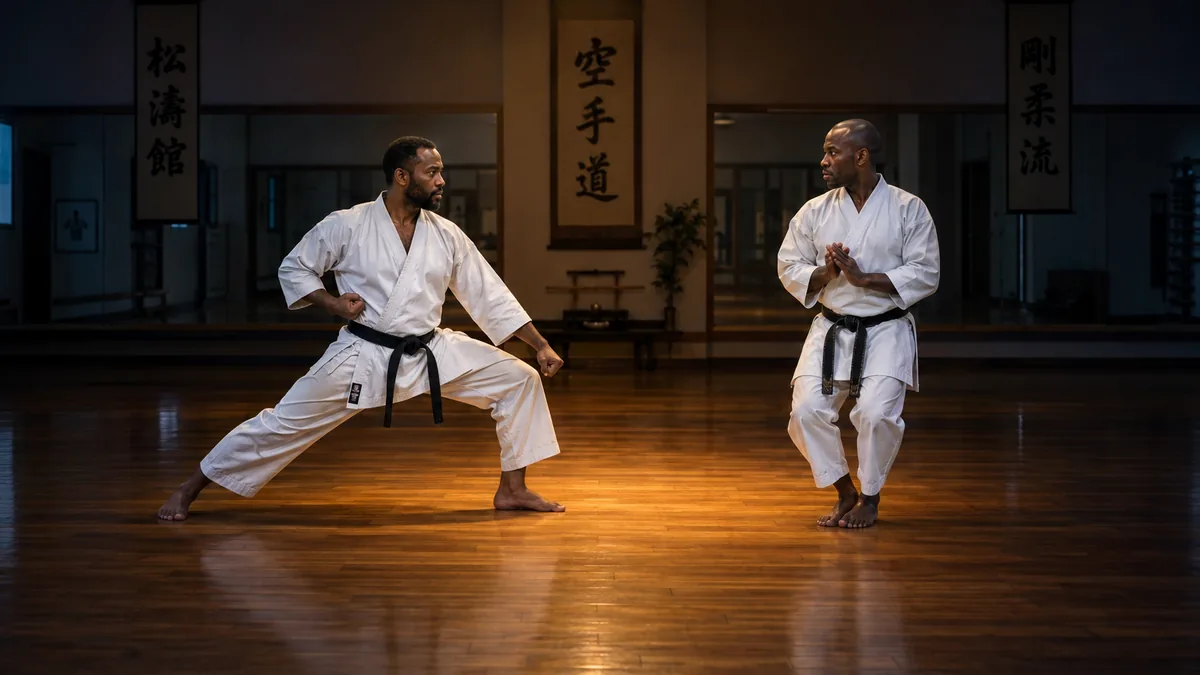
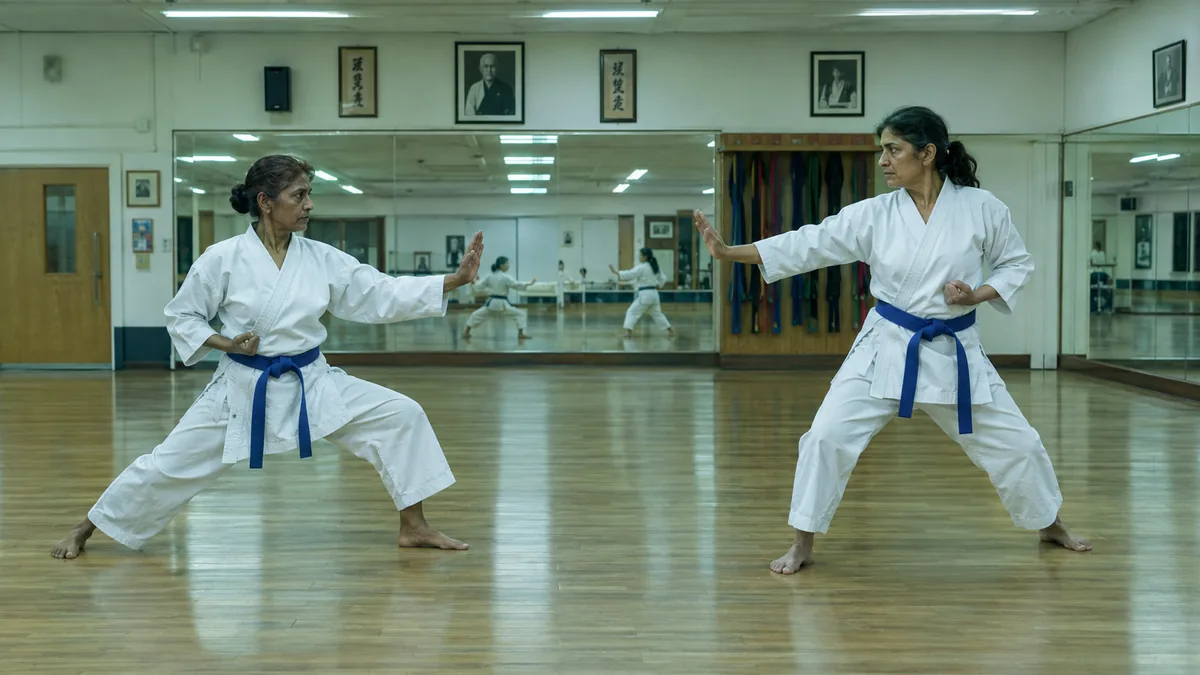
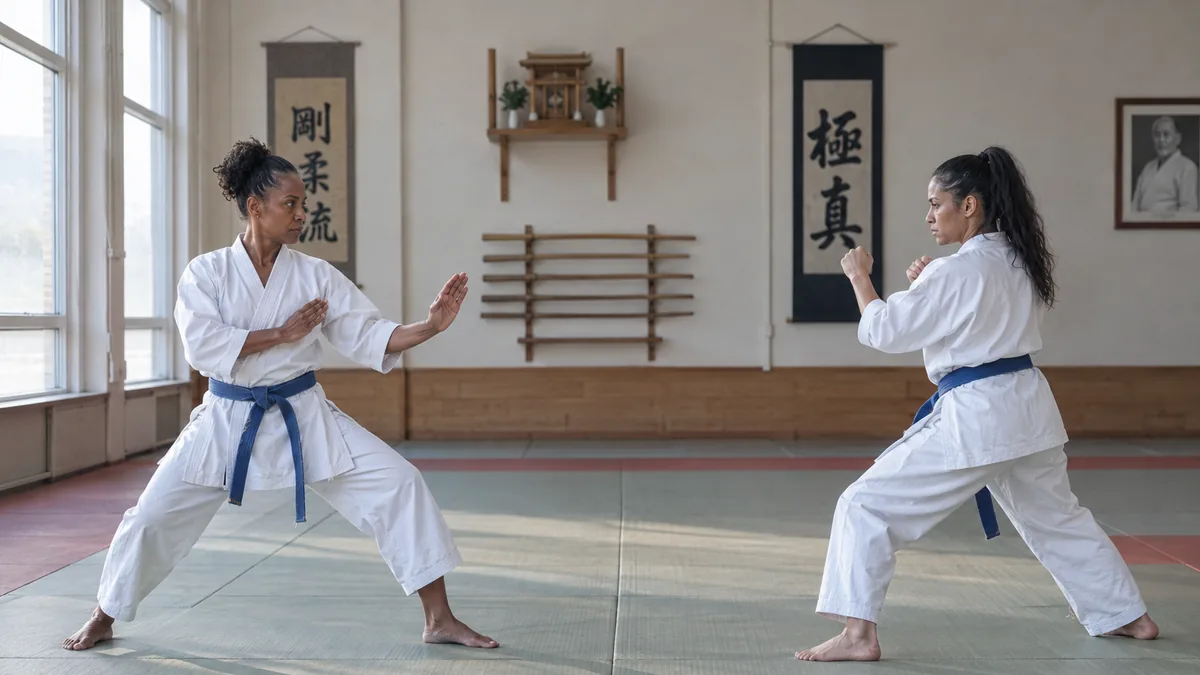
Shorin-Ryu vs Uechi-Ryu: How Two Okinawan Styles With Completely Different Roots Ended Up Sharing the Same Island and Almost Nothing Else
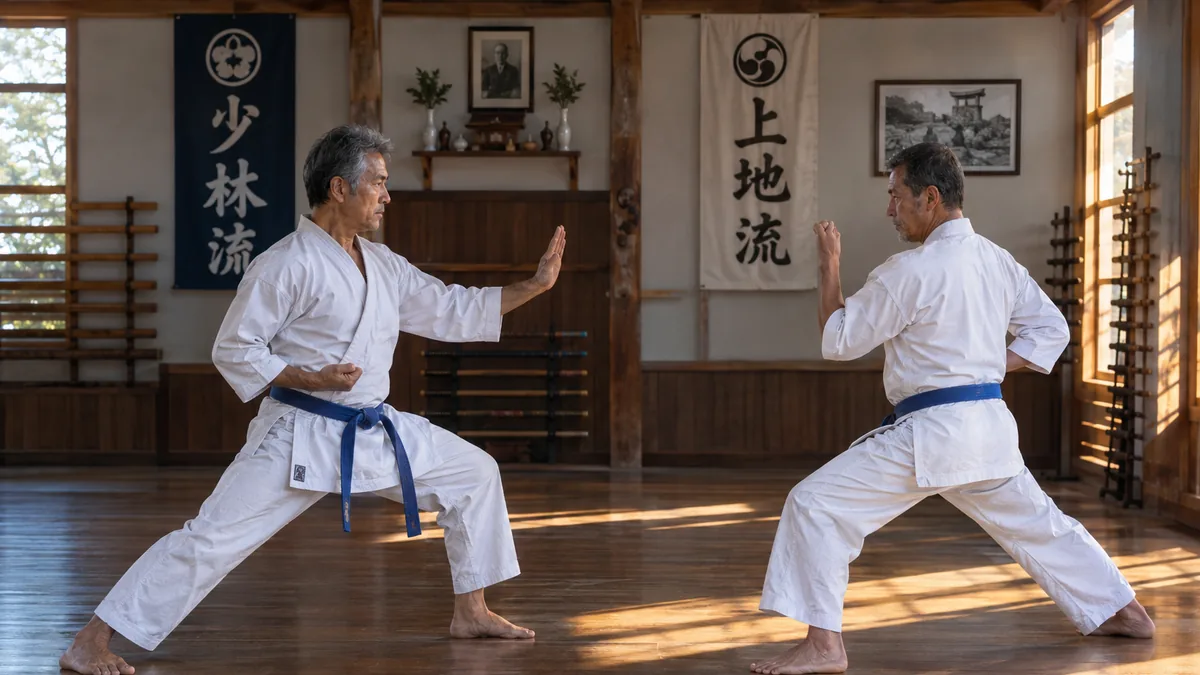
Put two styles side by side and the differences are usually cosmetic - a different kata name here, a slightly different chamber there. Shorin-Ryu and Uechi-Ryu are not like that. These two Okinawan traditions disagree at the level of first principles: what a punch is for, how a body should be conditioned, what a kata is actually training, and whether speed or structural hardness is the more reliable foundation for fighting. The fact that they share an island and a century of parallel development makes the contrast sharper, not softer.
If you train in one and cross the floor to try the other, you will not feel like you are doing a variation of the same thing. You will feel like you have changed sports.
Different Roots, Different Answers
Shorin-Ryu traces its lineage through the Shuri-te tradition - the karate associated with the Shuri castle district of Okinawa, shaped heavily by Sokon Matsumura in the nineteenth century and later systematised by Ankō Itosu. The style that carries the Shorin-Ryu name today exists in several related branches, with Chōshin Chibana formally naming Kobayashi Shorin-Ryu in 1933 and Shōshin Nagamine establishing Matsubayashi Shorin-Ryu in 1947, among others. The lineage is well-documented and the Shuri-te roots are consistent across branches.
Uechi-Ryu has a completely different origin story. Kanbun Uechi travelled from Okinawa to Fujian Province in China in 1897, where he studied a system called Pangai-noon under a teacher named Shushiwa - though historical records on Shushiwa are limited and some details of this period remain disputed.1 Kanbun returned to Okinawa in 1910, but teaching did not follow immediately. He eventually began teaching privately in Wakayama, Japan in the mid-1920s, and only opened a formal dojo there in 1932. The style was renamed Uechi-Ryu in 1940, with some sources placing the renaming at Kanbun’s death in 1948 - the dating remains contested.
His son Kanei Uechi later formalised the system and expanded its kata curriculum beyond the original three that Kanbun taught. The style’s southern Chinese origins are consistent across all accounts.
This matters beyond historical trivia. Shorin-Ryu was shaped by Okinawan court culture, military training, and the practical concerns of people who carried weapons and needed fast, efficient striking. Uechi-Ryu was shaped by southern Chinese martial philosophy, which placed enormous emphasis on iron body conditioning, the imitation of animal movement - specifically the tiger, crane, and dragon - and the development of physical toughness as a fighting asset in itself. These are genuinely different problems being solved by genuinely different methods.
What Shorin-Ryu Actually Prioritises
The central physical quality Shorin-Ryu develops is speed through relaxation. This sounds simple and takes years to actually achieve. The style uses a relatively upright, mobile stance - compared to the deep, rooted positions you find in Goju-Ryu or Uechi-Ryu - and the techniques are designed to travel fast over short distances with minimal telegraphing.
The kata curriculum reflects this. The Pinan kata were created by Itosu specifically as a teaching tool, adapted from older forms to suit school instruction - making them among the most deliberately pedagogical kata in Okinawan karate. Beyond these, the Shorin-Ryu syllabus includes Passai (Bassai), Kushanku (Kanku), Naihanchi (Tekki), and others - all characterised by sharp directional changes, rapid combination sequences, and techniques that demand quick hip rotation rather than sustained muscular force.
The biggest difference between a beginner and an advanced Shorin-Ryu practitioner is not power - it is the absence of unnecessary tension. Most beginners grip too hard, brace too early, and fire the shoulder before the hip. The correction that works is not telling someone to relax, which is useless advice under pressure, but drilling the snap-and-release timing until the muscle memory changes. You will feel it when it happens: the technique suddenly feels almost effortless and lands with more impact than the tense version ever did. That is the moment Shorin-Ryu training is actually aiming at.
In jiyu-kumite, Shorin-Ryu’s mobile stance and light footwork make it well-suited to angular entry - slipping slightly off the line of attack and countering before the opponent can reset. The style rewards practitioners who are comfortable in motion and uncomfortable standing still.
For a direct comparison with another Okinawan tradition that takes a very different approach to these same principles, see our article on Shorin-Ryu vs Goju-Ryu.
What Uechi-Ryu Actually Prioritises
Uechi-Ryu builds a different kind of practitioner. The style’s conditioning methods are among the most demanding in Okinawan karate - systematic body hardening through partner drills (kotekitae), repeated impact training on the forearms, shins, and torso, and a stance (sanchin-dachi) that demands sustained muscular engagement throughout every technique.
Sanchin kata is the foundation of the entire system. Unlike most kata, which flow through multiple techniques and directional changes, Sanchin is a short, slow, intensely demanding form focused almost entirely on structural integrity. Every step, every breath, every technique in Sanchin is an exercise in generating and sustaining full-body tension at the right moment. Instructors commonly test this by pushing, pulling, and striking the practitioner while they move through the form - a practice called shime testing. If you are doing it correctly, a strike to the abdomen during Sanchin feels like hitting a wall. If you are not, you will know immediately.
The other two kata in the original Kanbun curriculum - Seisan and Sanseiryu - build on this foundation with more complex movement, but the structural principles from Sanchin run through everything. Kanei Uechi added further kata including Kanshiwa, Kanshu, Seichin, Seiryu, and Kanchin, which expanded the system’s range considerably.
Uechi-Ryu also uses a distinctive hand formation - the boshiken (one-knuckle punch using the thumb joint) and nukite (spear hand) appear regularly in kata and application work. These are not decorative. They are designed for targeting specific anatomical points, and they require their own conditioning to use safely and effectively. A common mistake is treating these as standard punches with a different hand shape. The targeting logic is different, and without understanding that, the technique makes no sense.
The style’s kumite, particularly in the Okinawan tradition, tends to be close-range and contact-oriented. Uechi-Ryu practitioners are generally comfortable being hit and expect to absorb impact rather than avoid it entirely. This is a different psychological contract with fighting than Shorin-Ryu proposes. For a look at how this contact-oriented approach compares to another full-contact tradition, the article on Kyokushin vs Uechi-Ryu is worth reading.
Where the Two Styles Actually Conflict
The philosophical disagreement between these styles is real and worth naming directly.
Shorin-Ryu, broadly speaking, bets on not being there when the strike arrives. The mobile stance, the angular footwork, the emphasis on speed - all of it is oriented toward making you a difficult target. The assumption is that a technique you avoid costs the opponent more than a technique you absorb.
Uechi-Ryu, broadly speaking, bets on being able to take the hit and still function. The conditioning, the structural training, the close-range preference - all of it is oriented toward building a body that does not break under impact. The assumption is that in a real altercation, you will get hit, and what matters is whether you can continue.
Both positions have merit. Neither is naive. But they produce practitioners who move differently, train differently, and think about fighting differently. A Shorin-Ryu practitioner who has never done Uechi-Ryu conditioning will find the first kotekitae session genuinely shocking. A Uechi-Ryu practitioner who has never done Shorin-Ryu footwork drills will find the mobility demands equally unfamiliar.
We would argue that the Shorin-Ryu approach is more immediately accessible to most beginners, because it works with athleticism people already have. The Uechi-Ryu approach builds qualities that take longer to develop but are arguably more durable - a conditioned body does not lose its conditioning in the way that speed can fade with age or injury. This is a position worth considering if you are thinking long-term about your training.
Common Mistakes When Crossing Between These Styles
If you have a background in one and are exploring the other, there are predictable errors.
Coming from Shorin-Ryu into Uechi-Ryu:
- Rushing through Sanchin. The kata is not slow because it is easy - it is slow because sustained tension under correct breathing is genuinely hard. Speeding through it defeats the entire purpose.
- Treating the conditioning work as optional. It is not supplementary to Uechi-Ryu - it is the point.
- Using Shorin-Ryu’s mobile stance in Uechi-Ryu sparring. The rooted structure of Uechi-Ryu kumite requires a different weight distribution. You will feel unstable until you commit to it.
Coming from Uechi-Ryu into Shorin-Ryu:
- Carrying too much tension into techniques. Uechi-Ryu builds the habit of sustained engagement; Shorin-Ryu needs snap-and-release. The tension that protects you in Sanchin will slow your gyaku-zuki.
- Standing too flat-footed. Uechi-Ryu’s rooted stance is an asset in that context; in Shorin-Ryu’s faster-paced kumite, it becomes a liability.
- Underestimating the kata. Shorin-Ryu kata look simpler than Uechi-Ryu’s intensity-focused forms. They are not. The application depth in Passai or Kushanku is substantial.
Community Perspective
One debate that surfaces regularly among Okinawan karate practitioners is whether these two styles are more compatible than they appear - whether a practitioner could meaningfully train both and benefit from the contrast, or whether the underlying principles are too different to combine without diluting both.
The honest answer is that it depends what you are training for. Practitioners who cross-train seriously in both traditions report that Uechi-Ryu’s conditioning work genuinely improves their ability to absorb impact, while Shorin-Ryu’s mobility work genuinely improves their footwork. But combining them is not straightforward, and the muscle memory conflicts are real.
There is also a generational shift in how Uechi-Ryu is practised outside Okinawa. Some Western Uechi-Ryu organisations have reduced the emphasis on conditioning and body hardening, either for safety reasons or to make the style more accessible. Traditionalists within the system view this as a fundamental error - the argument being that removing the conditioning removes the style’s core logic. This is a live debate, not a settled one.1
Shorin-Ryu faces its own version of this tension. The style’s competition-oriented branches have adapted kata performance toward WKF standards, which prioritises visual clarity and athleticism over application fidelity. Whether this represents evolution or dilution is something Shorin-Ryu practitioners argue about with some intensity.
If the broader landscape of Okinawan style comparisons interests you, our articles on Goju-Ryu vs Shotokan and Kyokushin vs Goju-Ryu cover related ground on how Japanese derivatives of Okinawan traditions have diverged from their sources.
Key Takeaways
-
Shorin-Ryu builds speed through relaxation. The correction that works is not telling students to relax but drilling the snap-and-release timing until tension stops being the default. You will feel the difference when it clicks - the technique becomes lighter and lands harder simultaneously.
-
Uechi-Ryu’s Sanchin kata is not a warm-up or a formality. It is the structural foundation of the entire system. Training it correctly means sustaining full-body engagement under breathing and movement pressure. Most beginners underestimate how demanding this actually is.
-
The conditioning work in Uechi-Ryu is not optional. Kotekitae and body hardening are load-bearing parts of the system’s fighting logic. A version of Uechi-Ryu that removes this has changed what the style is for.
-
Shorin-Ryu’s mobile stance is a tactical commitment, not just a preference. It bets on angular movement and speed as the primary defence. This works well in motion; it requires you to actually stay in motion rather than defaulting to a rooted exchange.
-
Crossing between these styles reveals assumptions you did not know you had. Uechi-Ryu practitioners carrying tension into Shorin-Ryu techniques, and Shorin-Ryu practitioners rushing through Sanchin - both mistakes come from applying one style’s logic to the other’s training. Recognising which assumptions you are carrying is the first useful step.
-
Both styles are worth taking seriously on their own terms. Shorin-Ryu works better than Uechi-Ryu for practitioners who want to develop fast, mobile, evasion-based fighting. Uechi-Ryu works better for practitioners who want to build structural toughness and close-range durability. Neither is a diluted version of something else - they are answers to different questions.
References
Checked by the KarateLifestyle editorial team against official governing-body and dojo association websites, karate lineage histories from recognised style associations, and primary historical sources in November 2026. The dating of the Uechi-Ryu renaming (1940 vs 1948) is a genuinely contested point in the historical record and has been flagged accordingly in the text.
- The History of Uechi-ryu Karate - uechi-ryu.com. Uechi-Ryu Karate-Do Association website. Confirms Kanbun's China period 1897 to 1910 and return to Okinawa.
The weekly digest
New karate articles, once a week
One email every week with everything new on Karate Lifestyle. No spam; unsubscribe in one click.
We'll email you to confirm. See our privacy policy.