Striking Surfaces and What You Should Actually Be Conditioning: Knuckles, Shuto, and the Risks Most Clubs Don't Explain
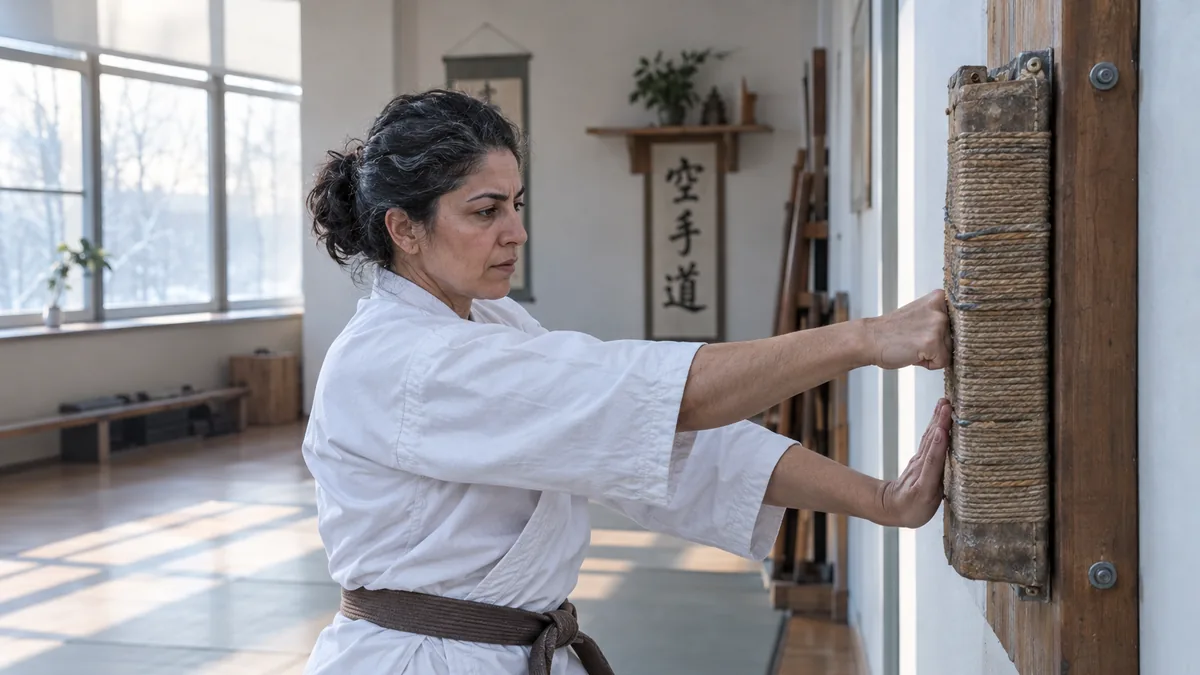
Most clubs treat conditioning as an afterthought - something you do on a makiwara if one happens to be bolted to the wall, or something you pick up naturally over years of training. Neither approach is good enough. Conditioning striking surfaces incorrectly does not just slow your progress; it creates cumulative damage that compounds quietly until you have a problem that does not go away.
The bigger issue is that different striking surfaces need different conditioning approaches, and treating them all the same is where most practitioners go wrong. Knuckle conditioning for seiken is not the same process as preparing the blade of the hand for shuto. The risks are not the same. The timelines are not the same. And the consequences of getting it wrong are not the same.
Here is what you actually need to know.
Why Conditioning Matters - and What It Is Actually Doing
Conditioning is not about toughening skin so you can impress people at the dojo. It is about preparing the specific tissue - bone, cartilage, ligament, and skin - to handle repeated impact without breaking down.
The physiological basis is well-established: controlled, progressive mechanical stress stimulates bone remodelling. Wolff’s Law, articulated by the German surgeon Julius Wolff in the 19th century, states that bone remodels itself to adapt to the mechanical stresses it experiences.1 Osteoblasts are the cells that build new bone; when mechanical stress signals that bone needs reinforcement, osteoblast activity rises in the areas receiving the load. What matters practically is the word “progressive” - the stress has to increase gradually, the tissue needs recovery time, and starting too hard too fast causes injury rather than adaptation.
Skin callusing is a separate process. A callus is a diffuse, non-painful thickening of the stratum corneum - the outermost layer of skin - resulting from prolonged shear or compressive forces. This is useful, but it is not the main goal. A practitioner with thick calluses but poorly aligned knuckles is not well-conditioned; they are just rough-skinned and still vulnerable to fracture.
The conditioning that actually protects you happens deeper than the skin.
Seiken: The Knuckles Most Practitioners Condition Wrong
Understanding the Target Surface
Seiken - the fore-fist - contacts with the first two knuckles: the index and middle finger metacarpophalangeal joints. This is not a large surface. When you make a proper fist and look at the knuckle line, those two prominent points are what you are conditioning. Everything else - the ring finger knuckle, the little finger knuckle - should not be taking primary impact.
The most common mistake is punching with a flat fist that distributes force across all four knuckles. This feels safer because it spreads the load, but it means you are conditioning the wrong surface and training an alignment that will fail under real impact. When the timing is right and the fist is correctly aligned, you feel the force travel through those first two knuckles, up through the wrist, and into the forearm - a direct line. A misaligned punch feels diffuse and unstable at the wrist.
Makiwara Work: The Foundation Drill
The makiwara remains the most effective tool for knuckle conditioning because it provides progressive resistance with feedback. A punching bag does not push back the same way; it absorbs and swings. A properly tensioned makiwara resists, which forces correct alignment.
Why it matters: The resistance of the makiwara immediately exposes alignment errors. A bent wrist buckles. A dropped elbow shows up as a weak contact. You cannot hide poor mechanics the way you can on a heavy bag.
Setup: Use a wall-mounted or post-mounted makiwara with enough tension that it does not swing freely but has some give. Wrap it with canvas or use a commercial pad. Stand at a natural punching distance - close enough that full extension lands correctly, not so close you are jamming the punch.
Execution:
- Form your fist correctly before you start - thumb locked across the middle two fingers, wrist flat, first two knuckles prominent.
- Begin with controlled, moderate-force strikes - not full power. The goal is alignment and adaptation, not maximum impact.
- Strike and hold contact for a second before withdrawing. This is not standard punching rhythm, but it helps you feel whether the wrist is holding straight under load.
- Work in sets of 10 to 20 repetitions per hand. Rest. Do not grind through fatigue.
- Increase force gradually over weeks, not sessions.
What to feel for: When alignment is correct, you feel a solid, connected impact - almost like the punch has nowhere to go but through. When it is wrong, you feel a slight collapse or twist at the wrist, or the impact spreads across more of the hand than it should.
The most common mistake: Starting too hard, too soon. Beginners see senior practitioners hitting the makiwara with serious force and try to match it immediately. Reduce force to the point where you can hold the contact point without pain, then build from there. Two or three months of light-to-moderate work builds more useful adaptation than two weeks of aggressive striking that inflames the joints.
What changes with experience: Beginners focus on whether it hurts. Senior practitioners focus on the quality of the contact - whether it feels clean, direct, and consistent. The goal shifts from “can I do this” to “is this exactly right every time.”
Shuto: The Most Underestimated Risk in Karate Conditioning
Why the Blade of the Hand Is Different
Shuto - the knife hand - contacts with the fleshy edge of the hand, roughly from the base of the little finger to the wrist. The underlying structure is the fifth metacarpal, and this is where the risk concentrates.
Fifth metacarpal injuries account for 20% of all hand fractures and usually affect the young and active.2 The term “boxer’s fracture” is used clinically for a specific injury pattern: a fracture of the 5th metacarpal neck, named for the classic injury mechanism involving direct trauma to a clenched fist.2 The risk in shuto conditioning is distinct from that mechanism - repeated blunt impact along the shaft and body of the fifth metacarpal - but the bone’s relative slenderness and exposure make it vulnerable nonetheless. Conditioning it requires more patience than knuckle work, and the margin between “usefully conditioned” and “damaged” is narrower.
Many clubs do not explain this clearly. Shuto conditioning gets treated like knuckle conditioning with a different surface, and that is wrong.
Progressive Edge-of-Hand Conditioning
Why it matters: Unconditioned shuto on a hard surface risks injury to the fifth metacarpal. This is not a theoretical concern - it is a documented injury pattern in striking sports. Conditioning the edge of the hand properly means building density and tolerance gradually, not repeatedly striking hard surfaces before the tissue is ready.
Setup: Start with a folded towel or foam pad before progressing to a canvas makiwara surface. The progression to harder surfaces should take months, not weeks.
Execution:
- Begin with light, repetitive strikes to a soft surface - a folded towel on a table is appropriate for the first weeks.
- Focus on the contact point: the fleshy pad along the little finger side, not the bony edge of the wrist and not the little finger itself.
- Keep the fingers extended and held together firmly. A loose hand on contact risks finger injury.
- Strike with a slight downward angle - the natural arc of a shuto strike - rather than a flat, lateral impact.
- Progress to a canvas pad or light makiwara only after several weeks of consistent soft-surface work with no soreness between sessions.
What to feel for: Correct shuto contact feels like a clean, contained impact on the pad of muscle along the hand edge. If you feel it in the bone directly, you are either striking too hard for your current conditioning level or your contact point is wrong.
The most common mistake: Striking with the wrist edge or the little finger itself instead of the muscular pad. This happens because the little finger side of the hand looks like the striking surface when you hold it up, but the actual contact zone sits slightly further toward the palm. The correction is to pronate the hand slightly on contact so the fleshy pad - not the bony ridge - makes first contact.
Surfaces Most Clubs Skip: Teisho, Uraken, and Haito
Teisho (palm heel), uraken (back-fist), and haito (ridge hand) all have specific conditioning needs that rarely get addressed systematically.
Teisho is the most forgiving surface to condition - the palm heel is well-padded and the underlying carpals are robust. The risk with teisho is wrist alignment, not bone density. Conditioning here is mostly about training the wrist to remain stable under impact, which means slow, controlled palm-heel pushes against a wall or bag before progressing to strikes.
Uraken conditioning is often skipped entirely because the back-fist is used as a fast, snapping technique and practitioners assume it does not need the same preparation. The mistake is that the back of the hand - the dorsal metacarpal surface - is not naturally padded. Light, progressive conditioning on a canvas surface matters here, particularly for practitioners who use uraken as a close-range counter in jiyu-kumite.
Haito - the ridge hand, using the inside edge near the index finger - is the most neglected. The metacarpophalangeal joint of the index finger is vulnerable if the technique is executed with a poorly aligned hand. Conditioning haito requires correct hand position first: the index finger pulled back so the ridge, not the finger, makes contact.
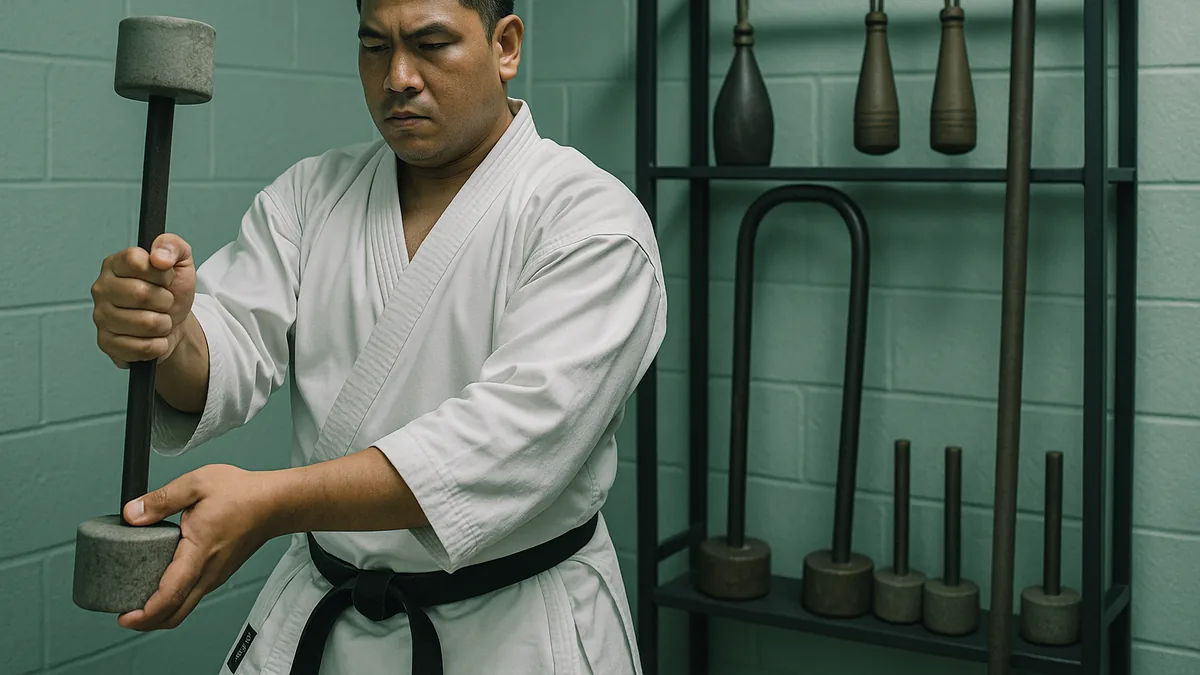
For training tools that support this kind of surface-specific work, the nigiri game and chi-ishi discussed in our training weapons guide are worth understanding - particularly nigiri game, which develops grip and wrist stability relevant to several of these surfaces.
The Risks Clubs Do Not Explain Clearly Enough
Growth plate damage in younger practitioners is the most serious risk that gets inadequately communicated. Growth plates close as teens reach late adolescence, a little earlier for girls than boys; because adults do not have growth plates, these injuries happen in children and teenagers. Hand growth plates - the metacarpals in particular - are among the earlier-closing sites in the skeleton, but they remain open through mid-adolescence and vulnerable to repetitive loading damage. Aggressive knuckle conditioning in children and young teenagers risks injuring these plates, which can cause permanent deformity. Many traditional clubs condition young students on makiwara without this caveat. We consider this a clear error.
Arthritis risk from excessive conditioning is sometimes cited as a concern, but the research on repeated joint trauma from striking sports is limited and should not be overstated. Studies on habitual knuckle-cracking - a different but related form of repeated joint stress - have consistently found no significant association with hand arthritis. The hypothesis that knuckle cracking causes or increases the risk of arthritis is not supported by scientific evidence; longitudinal studies and clinical evaluations consistently indicate that habitual knuckle cracking does not increase risk. This does not mean that repetitive high-force impact on poorly conditioned joints is harmless - it means the specific arthritis claim is not well-evidenced, and moderate, well-structured conditioning over years is a different matter from aggressive overloading.
Nerve damage is a real risk with shuto conditioning on hard surfaces. The ulnar nerve courses along the medial aspect of the arm and forearm, then innervates the wrist, hand, and digits.3 Affected patients often experience numbness and tingling along the little finger and the ulnar half of the ring finger; this discomfort is often accompanied by grip weakness. Repeated trauma to the ulnar aspect of the hand during shuto conditioning can irritate or compress this nerve. If you experience any of these symptoms during or after conditioning work, stop and seek medical assessment.
Community Perspective
The conditioning debate splits roughly along traditional and pragmatic lines. Traditional practitioners - particularly those from Okinawan lineages - often argue that makiwara work is non-negotiable and that modern practitioners are too cautious about it. The pragmatic argument is that most karateka in a sport or recreational context will never need the level of conditioning that full-contact practitioners require, and that the cumulative joint cost is not worth it for a hobbyist.
Both positions have merit. The honest answer is that the appropriate level of conditioning depends on what you are training for. A competitor in full-contact knockdown karate needs genuinely conditioned striking surfaces. A practitioner focused on kata and light kumite does not need to condition to the same standard - and probably should not, given the long-term joint implications.
What most experienced practitioners agree on, regardless of style, is that the progression matters more than the destination. Rushed conditioning causes injury. Patient, progressive conditioning builds real adaptation. The disagreement is about how far to take it, not whether the process works.
Key Takeaways
- Condition the correct contact surface, not just the general area. Seiken means the first two knuckles specifically. Shuto means the fleshy pad along the hand edge, not the bony ridge.
- The fifth metacarpal is the most vulnerable structure in shuto conditioning. Progress more slowly here than you think you need to, and do not skip the soft-surface phase.
- Do not condition young practitioners aggressively on hard surfaces. Hand growth plates remain open through mid-adolescence; damage before closure can be permanent.
- If you feel numbness or tingling in the fingers after edge-of-hand conditioning, stop. Ulnar nerve irritation is a warning, not something to train through.
- Alignment and mechanics come before surface hardness. A well-aligned, moderately conditioned hand handles impact better than a heavily callused hand with poor wrist alignment.
- Match your conditioning level to your actual training goals. The level required for knockdown competition is not the level required for kata or light sparring - and the joint cost of over-conditioning is real.
References
Checked by the KarateLifestyle editorial team against peer-reviewed clinical sources (PubMed/StatPearls, Medscape), orthopaedic and anatomical references, and musculoskeletal science literature in October 2026. Evidence on long-term joint effects of striking conditioning in karate specifically is sparse; the article's advice is therefore grounded in general orthopaedic and sports-medicine principles rather than karate-specific trials.
- Wolff's Law: Bone Remodeling and Mechanical Loading. Grasp.study educational module, 2025
- Fifth Metacarpal Fracture – StatPearls. StatPearls, NCBI Bookshelf; peer-reviewed clinical reference
- Anatomy, Shoulder and Upper Limb, Ulnar Nerve – StatPearls. StatPearls, NCBI Bookshelf; peer-reviewed clinical reference
The weekly digest
New karate articles, once a week
One email every week with everything new on Karate Lifestyle. No spam; unsubscribe in one click.
We'll email you to confirm. See our privacy policy.