Training Weapons for Karate Conditioning: How Practitioners Actually Use Kongoken, Chi-Ishi, and Nigiri Game and Whether You Need Any of Them
Most people training in a modern dojo have never touched a kongoken. A lot of them have never even seen one outside of a YouTube video. That’s not necessarily a problem - but it does mean there’s a gap between what people think traditional conditioning tools are for and what they actually do when you put them in your hands.
I’ve trained in dojos where chi-ishi were used every single class, and dojos where they sat in a corner gathering dust while everyone did push-ups on their knuckles. I’ve seen both extremes, and I have opinions about where the truth sits. This isn’t a catalogue description of these tools. It’s what I’ve actually learned from using them, watching others use them badly, and occasionally being the one using them badly.
What These Tools Actually Do (And What They Don’t)
Here’s the thing people get wrong from the start: these aren’t strength tools in the way a dumbbell is a strength tool. When someone picks up a chi-ishi for the first time and immediately starts doing curls with it, I know they’ve missed the point entirely. The weight is almost secondary. What these tools develop is connection - the ability to transmit force through your whole body rather than isolating a muscle group.
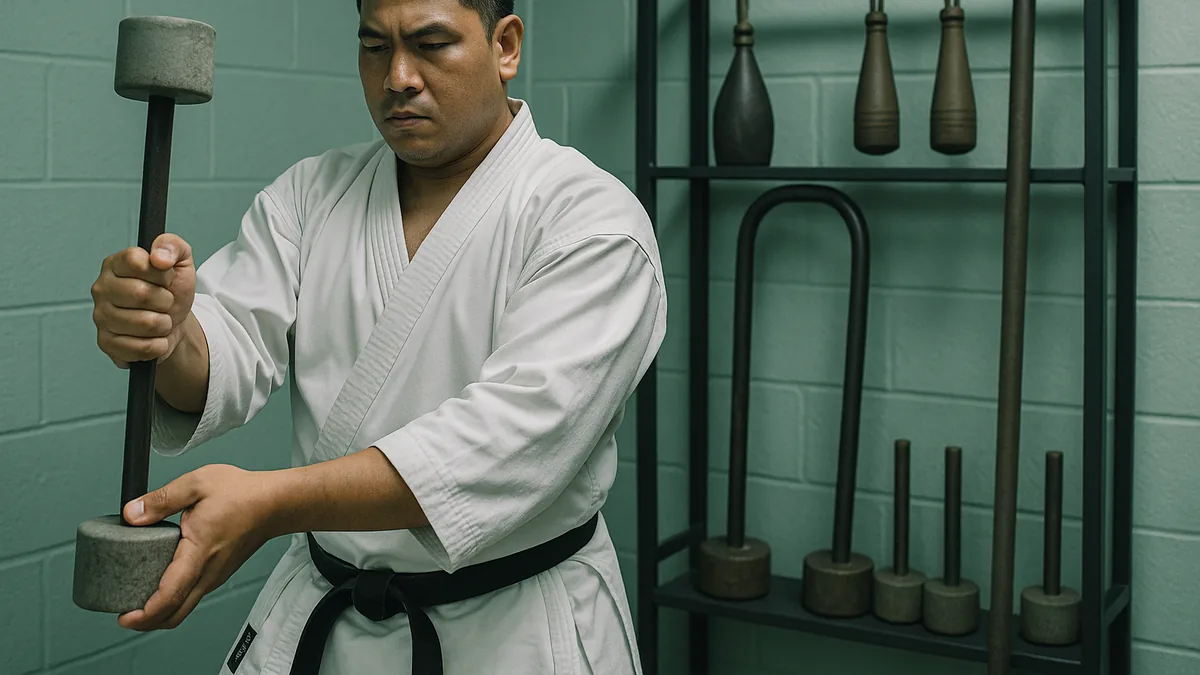
Chi-ishi is probably the most misunderstood. It’s a concrete or stone weight fixed to the end of a wooden handle, and it looks simple enough that people underestimate it. The first time I used one properly - not just swinging it around, but doing the slow rotational work the way my instructor demonstrated - my forearm and wrist were cooked within a few minutes. Not from lifting the weight. From controlling it. That distinction matters.
The chi-ishi teaches you to feel where your structure breaks down. When the weight is moving at the end of that lever and you’re trying to maintain a stable wrist and elbow through a punching or blocking motion, you’ll feel immediately if your alignment is off. There’s no hiding it. The weight exposes you.
Chi-Ishi: The One I’d Actually Recommend Starting With
I’d recommend chi-ishi as the entry point for most practitioners because the learning curve is forgiving and the feedback is immediate. You don’t need a lot of space, you don’t need a partner, and you can scale the weight and the complexity of the exercises as you develop.
What I tell students is to start lighter than you think you need to. Most people grab something that’s too heavy for the rotational work and end up compensating with their shoulder instead of developing the forearm and wrist strength the tool is designed to build. I’ve noticed this pattern consistently - the students who grab the heaviest chi-ishi in the rack are usually the ones who get the least out of it in the first few months.
The exercises that actually carry over to your karate are the ones that mirror your technique. Slow rotation through a punch, a block, a knife-hand - these develop the muscular endurance and joint stability that makes your technique feel solid when you’re tired. Not bigger or faster, necessarily. More reliable. That’s the word I’d use. After consistent chi-ishi work, your techniques start to feel like they’re coming from somewhere rather than just happening at the end of your arm.
One mistake I see often with chi-ishi is rushing through the movements. People treat it like a cardio drill. The whole value of slow, controlled rotation under load is that it forces you to feel where your body is. If you’re moving fast, you’re not learning anything - you’re just fatiguing yourself. Slow it down. Feel where the weight wants to pull you off-centre, and resist that pull with correct structure.
Nigiri Game: Grip Strength With a Purpose
Nigiri game are ceramic or clay jars you grip by the lip and use for carrying, swinging, and static holds. They’re awkward by design. The grip you use isn’t a natural gripping position, and that’s the point.
I used to think these were basically just a fancy grip trainer. My instructor corrected that view pretty directly. He had me hold the nigiri game in a static position with arms extended while he watched my shoulders. The moment my grip started to fail, my shoulders crept up, my elbows bent, and my whole upper body started compensating. He wasn’t watching my hands at all - he was watching what the rest of my body did when my grip was under stress.
That’s what nigiri game actually train: not just your fingers and forearms, but your ability to maintain structural integrity under a specific kind of sustained stress. The carry-over to grabbing, pulling, and controlling in kumite is real, but it’s indirect. You’re not training a specific technique. You’re building the kind of grip that doesn’t give out when you need it.
The most common mistake with nigiri game is gripping too tight from the start. You’ll feel the urge to white-knuckle them immediately, especially as your forearms start to burn. What actually works is learning to grip with just enough tension to control the jar, and then maintaining that through the duration of the exercise. It’s similar to the tension management in kata - you’re not supposed to be maximally tense throughout, you’re supposed to be appropriately tense at the right moments.
If you’re serious about grip development and you train in a style that includes any kind of grappling or grabbing, nigiri game are worth the investment. If your training is purely sport kumite and kata, they’re further down the priority list.
Kongoken: The One That Requires Commitment
The kongoken is a large oval iron ring, typically somewhere between 10 and 30 kilograms, and it’s the most demanding of the three tools to use well. I’ll be honest - I’ve seen more people injure themselves with a kongoken through carelessness than with any other piece of traditional conditioning equipment.
It’s not that it’s inherently dangerous. It’s that the weight and the shape make it easy to get into positions where your spine and shoulders are under load in ways they’re not prepared for. The first time I used one in a structured session, I was surprised by how much core stability it demanded. It’s not a tool you swing around. The exercises involve pressing, rolling it across your body, carrying it in different positions - and the constant shifting of that weight challenges your ability to stay braced and connected in a way that’s genuinely different from anything else I’ve trained with.
The carry-over to karate is real but takes longer to feel than with chi-ishi. What I’ve noticed in practitioners who train with kongoken consistently is a different quality of body tension - not stiffness, but a kind of settled density when they move. Their strikes feel like they’re coming from a heavier person than they are. Whether that’s the kongoken specifically or just the general conditioning that goes with serious training, I can’t say with certainty. But I’ve seen the pattern enough times to believe it’s not coincidental.
My honest position: unless you have access to proper instruction on kongoken use, don’t buy one and figure it out from videos. The chi-ishi and nigiri game are forgiving enough that you can self-correct through feel. The kongoken isn’t. Get someone who knows what they’re doing to show you the foundational exercises first.
Do You Actually Need Any of Them?
This is where I’ll probably get pushback, but here’s my honest take: no, you don’t need them. Plenty of excellent karateka have developed outstanding technique and conditioning without ever touching traditional Okinawan tools. If your training is consistent, your kihon is honest, and you’re doing the physical work - you’ll develop.
What these tools offer is specificity and feedback that’s hard to replicate otherwise. The chi-ishi in particular gives you information about your technique that even a good training partner might miss. The weight doesn’t lie. If your structure is wrong, you’ll feel it immediately.
I think the bigger question isn’t whether you need them - it’s whether you’ll actually use them consistently. A chi-ishi sitting in the corner of your training space does nothing. If you’re the kind of practitioner who will commit to 15-20 minutes of deliberate chi-ishi work several times a week, it will pay off. If you’re buying it because it looks traditional and you want to feel connected to the old ways, you’ll use it twice and forget about it.
This connects to a broader point about equipment and conditioning - the same logic applies to jump ropes for karate training, where most people buy the tool but never develop the discipline to use it in a way that actually transfers to their karate. The tool isn’t the training.
Community Perspective
There’s a genuine split in the karate community on traditional conditioning tools, and it mostly falls along stylistic lines. Goju-ryu and Uechi-ryu practitioners tend to treat chi-ishi and nigiri game as fundamental - not optional extras but core parts of the curriculum. In those dojos, you’ll see them used in class, not just recommended for home practice.
In Shotokan and sport-oriented dojos, you’ll rarely see them at all. The conditioning approach there tends to be more conventional - weights, plyometrics, circuit training. I’ve trained in both environments and I don’t think either is wrong. The question is what the conditioning is supposed to develop, and the answer differs depending on what kind of karate you’re doing.
Where I’ve seen the most interesting disagreements is among senior practitioners who started in one tradition and crossed into another. A lot of Shotokan practitioners who’ve trained seriously in Goju-ryu later in their development come back with a different view of what body conditioning means. Not better or worse, necessarily - but different. The tools change what you pay attention to.
There’s also a generational divide. Older instructors who trained before sports science was part of martial arts education tend to have more reverence for traditional tools. Younger instructors who came up through competition systems are more likely to treat them as supplementary at best. Both groups have produced excellent practitioners, which tells you something about how much the specific tools matter relative to the quality of the training.
Buying Considerations If You Do Go This Route
Chi-ishi can be bought commercially or made relatively easily - there are practitioners who cast their own using a wooden handle and concrete. The weight that works for most people starting out is somewhere around 2-4 kilograms. Go lighter than you think you need.
Nigiri game need to be the right size for your hands. If the lip of the jar is too wide or too narrow, you won’t be able to grip correctly and you’ll develop compensations that defeat the purpose. If you can, handle them before you buy.
Kongoken - buy from a reputable supplier, make sure the ring is solid with no weak joints, and get instruction before you use it. This is not a tool to experiment with unsupervised.
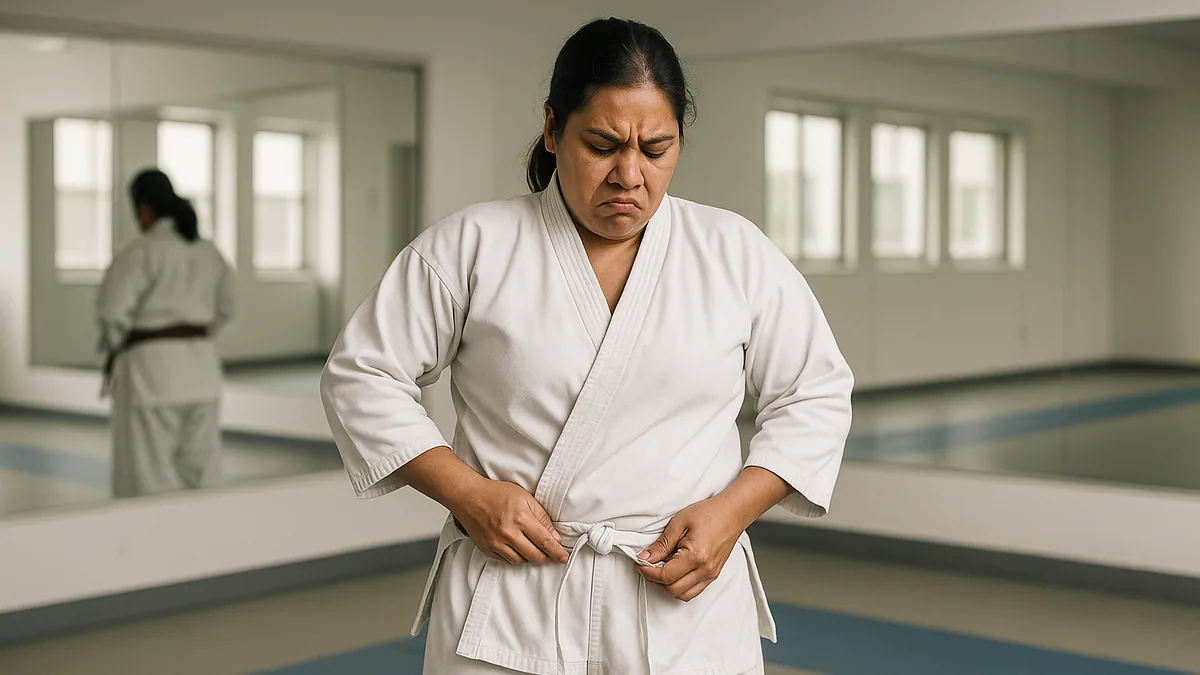
None of these are cheap if you’re buying quality. That’s worth factoring in alongside your other equipment decisions. If you’re still sorting out fundamentals like your gi fit - and if you’ve ever had trouble with gi pants that won’t stay up during training you’ll know how distracting that is - get those things sorted first before adding conditioning tools to the mix.
Key Takeaways
-
Chi-ishi is the most accessible starting point - use it slowly and lightly before you increase weight or speed. The feedback it gives you about your structure is the whole point.
-
Nigiri game develop grip integrity under sustained load, not just raw grip strength. The value is in what happens to the rest of your body when your grip is challenged.
-
Kongoken requires proper instruction before use. Don’t self-teach from videos. The weight and shape create loading positions that can cause real injury if you don’t know what you’re doing.
-
None of these tools replace good kihon. They amplify what’s already there - which means if your technique has structural problems, they’ll make those problems more obvious, not fix them.
-
Consistency matters more than the tool. A chi-ishi used three times a week for six months will change your technique. One bought and used twice won’t.
-
If you train in Goju-ryu, Uechi-ryu, or any Okinawan style that incorporates these tools formally, treat them as curriculum, not optional. If you’re in a different tradition, assess honestly whether you’ll actually commit to using them before spending the money.
The weekly digest
New karate articles, once a week
One email every week with everything new on Karate Lifestyle. No spam; unsubscribe in one click.
We'll email you to confirm. See our privacy policy.