Jump Ropes for Karate Training: Why Most Practitioners Use Them Wrong and What to Actually Work On
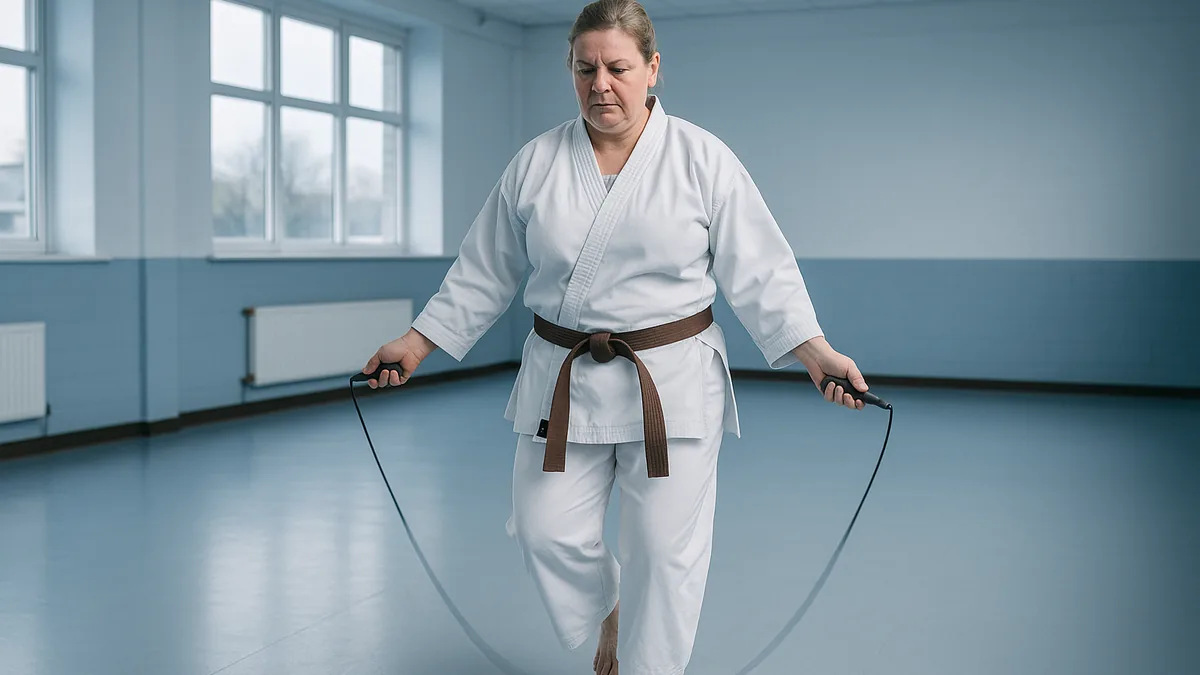
Most practitioners pick up a jump rope, go as fast as they can for two minutes, and call it conditioning. I’ve seen this in every dojo I’ve ever trained in. The rope becomes a cardio tool and nothing else - which is fine if cardio is all you want, but it means you’re leaving the most useful training benefit on the table completely.
The jump rope is one of the best footwork and timing tools available to a karate practitioner. Not because of the aerobic load. Because of what it forces your nervous system to do when you use it correctly. The rhythm, the weight transfer, the micro-adjustments to stay in time - these are exactly the qualities that make your zanshin sharp and your movement in kumite feel effortless rather than effortful.
The problem is that nobody teaches rope work in the context of karate. You pick it up from boxing culture, where the goals are different. Boxers use it to build rhythm for combination work and to stay light on the balls of their feet. Those qualities transfer, but the application in karate needs to be deliberate, not accidental.
Here’s what I’ve actually used, what I teach, and where most people go wrong.
Why Footwork and Timing Are the Point - Not Speed
I used to think jump rope was about getting faster. My instructor would watch me blast through two minutes at maximum speed, nod, and say nothing. Then one day during jiyu-kumite he stopped the round and said, “Your feet are loud. You’re landing, not moving.” I didn’t connect that to the rope work until months later.
When you jump rope purely for speed, you train yourself to prioritise turnover. The rope comes around fast, your feet come up fast, and the whole thing becomes a race against the rope. What you’re not training is where your weight is, how quickly you can redirect, or whether your feet are ready to push off in any direction.
In kumite, that matters enormously. The practitioner who can shift weight smoothly and change direction without a preparatory step is dangerous. The one who is fast but predictable is not. Rope work, done right, is one of the best ways to train that quality because the rope gives you immediate feedback. If your weight is back when the rope comes under, you clip it. The rope doesn’t lie.
I’d rather see a student do five minutes of deliberate, rhythmic rope work with full attention on weight distribution than ten minutes of maximum-speed spinning that they’re not thinking about at all.
The Drills That Actually Transfer to Karate
Drill 1: The Rhythm Reset - Basic Bounce with Weight Awareness
Why it matters: This is the foundation. Before you do anything fancy, you need to establish what correct weight distribution feels like under the rope. Most people skip this and go straight to tricks. Don’t.
Setup: Standard rope length, feet hip-width apart. You’re going to jump at a pace where you could hold a conversation. Slow enough to think.
Execution:
- Start jumping with a consistent two-foot bounce, nothing else.
- Every five jumps, consciously check where your weight is. Are you on your heels? On the balls of your feet? Are you landing flat?
- Aim to land with weight on the balls of your feet, not flat-footed. Each landing should feel springy, not thudding.
- After two minutes, stop and stand in your fighting stance. Notice how your feet feel. That’s the feeling you’re looking for in kumite - ready, not planted.
What to feel for: When you get this right, each landing feels like a coiled spring rather than a full stop. You’ll feel the contact through the ball of the foot and the calf, not through the heel and knee. If your shins are getting tired, you’re on the right part of your foot.
The mistake I see most often: Students jump from their ankles only, keeping their knees almost straight. This looks fine from the outside but it means every landing is absorbed entirely by the lower leg. The correction is to let the knees bend slightly on each landing - not a squat, just a small give. It feels wrong at first because it seems slower, but it’s what keeps the weight forward and the legs ready.
Drill 2: Lateral Shift Jumping
Why it matters: In karate, linear movement is easy to read. The ability to move laterally off a technique - to exit the line of attack - is what separates good movers from great ones. This drill trains exactly that quality.
Setup: Same rope, same basic rhythm established from Drill 1. You need enough floor space to move two or three feet either side.
Execution:
- Begin with your basic two-foot bounce for 30 seconds to find the rhythm.
- On a count of four jumps, shift your entire body two feet to the right. Not a hop - a shift. Your feet stay under your hips.
- Four jumps. Shift two feet to the left. Return to centre.
- Continue for two minutes. The rope keeps turning. The rhythm doesn’t break.
- Once comfortable, make the shifts less predictable - right, right, left, centre. You’re making decisions under the constraint of the rope timing.
What to feel for: The shift should feel like it happens during a jump, not between jumps. When you get the timing right, the lateral movement is almost invisible - you just appear somewhere different. When you get it wrong, you feel the rope catch because your feet weren’t ready.
Common mistake: Students stop the rope rhythm to make the shift, treating it as two separate tasks. The whole point is that the shift happens within the rhythm. What I tell students is to think of the rope as a metronome and the movement as something that happens to the music, not instead of it.
Drill 3: Alternating Foot Step with Directional Change
Why it matters: This is the most directly transferable drill to kumite footwork. The alternating step mimics the weight shift pattern of advancing and retreating, and the directional change trains you to reverse momentum quickly.
Setup: Rope, basic alternating foot step (like running in place). Start slow.
Execution:
- Establish the alternating foot rhythm - left, right, left, right - at a comfortable pace.
- After eight counts, switch to a backward step pattern. Same rhythm, same rope speed, but now each step is slightly behind you rather than in place.
- After eight counts, return to neutral.
- Progress to adding a 45-degree pivot on the direction change. Step forward-right on the diagonal, then back-left. You’re changing the angle, not just the direction.
What to feel for: The pivot should happen on the ball of the foot, not the heel. You’ll feel the difference immediately - pivoting on the heel feels unstable and slow. On the ball of the foot, the direction change happens almost before you’ve decided to do it.
Using the Rope as a Coordination Warm-Up
This is where I think the jump rope is genuinely underused in karate training. Not as conditioning. As a coordination primer before technical work.
Five minutes of deliberate rope work before kihon does something to your nervous system that jogging doesn’t. The bilateral coordination required - hands turning, feet timing, eyes soft - activates the kind of whole-body awareness that makes your technique feel connected rather than assembled piece by piece.
What I do with my students is run eight minutes of structured rope work at the start of a technical session. Not hard. Not fast. Rhythmic and deliberate. By the time we pick up the first kata, their feet are already talking to the rest of their body.
The specific sequence I use: two minutes of basic bounce, two minutes of lateral shifts, two minutes of alternating step, two minutes of free choice. The free choice minute is where you start to see who has actually internalised the footwork principles and who is just executing the pattern they were told.
If you’re interested in how other equipment fits into your warm-up and coordination work, the article on speed bags, double-end bags, and wall targets covers which tools actually develop karate-specific timing versus which ones are borrowed from boxing without much translation.
Progression: Making It Harder Without Losing the Point
Once the basic drills feel automatic - and by automatic I mean you can have a conversation while doing them - here’s how to progress:
Add a visual cue. Have a partner hold up a hand signal during your rope work. One finger means shift right, two means shift left, fist means pivot. Now your footwork is responding to external information rather than a predetermined pattern. This is much closer to what kumite actually demands.
Reduce the rope speed, increase the decision complexity. Counterintuitive, but slowing the rope down and making the footwork pattern more complex is harder than speeding everything up. It forces you to be precise rather than just reactive.
Transition directly into a technique. Stop the rope on a signal and immediately throw a gyaku-zuki or a mae-geri. What you’re training is the transition from movement to technique - the ability to generate power from a position of dynamic balance rather than a planted stance. This is where rope work starts to feel like karate rather than conditioning.
For practitioners working on lower body conditioning alongside footwork, the article on resistance bands for karate training covers how to develop hip and leg strength without compromising the kind of mobility that rope work is building.
Community Perspective
There’s a genuine split in how different dojos approach supplementary tools like the jump rope. Traditional schools - particularly those with a strong Shotokan or Goju-Ryu lineage - sometimes push back on rope work entirely, viewing it as boxing crossover that dilutes karate-specific training. The argument is that time spent on the rope is time not spent on kata or kihon, and that footwork is better developed through the art itself.
I’ve heard this argument, and I partially agree with the underlying principle. Rope work is not a replacement for karate training. If your kihon footwork is poor, no amount of jump rope will fix it.
Where I disagree is on the either/or framing. Five to eight minutes of deliberate rope work at the start of a session costs almost nothing in terms of time and adds a quality of coordination awareness that I’ve consistently seen transfer into cleaner footwork during kata and more responsive movement in kumite. The practitioners I’ve trained with who had the best natural-looking movement - the ones who seemed to flow rather than step - almost all had some background in rhythm-based training, whether that was rope work, dance, or another art.
The disagreement usually resolves itself with experience. Senior practitioners who were initially sceptical often come around when they see the coordination benefit, even if they’d never frame it that way out loud.
Key Takeaways
-
Jump rope for footwork and timing, not speed. If you’re going as fast as you can, you’re probably not thinking about where your weight is. Slow it down until you can.
-
The lateral shift drill is the most directly transferable to kumite. Practise changing direction within the rope rhythm without breaking the pattern - that quality is exactly what makes your movement hard to read in sparring.
-
Use the rope as a coordination primer before technical work, not just as cardio at the end of a session. Eight minutes before kihon does more than twenty minutes after.
-
The correction that makes the biggest difference for most students is getting them off their heels. If your landings are loud, your weight is wrong. Land springy, not thudding.
-
Progress by adding external cues, not just speed. Responding to a partner’s signals while maintaining rope rhythm is harder and more useful than going faster.
-
The transition drill - stopping the rope and immediately executing a technique - is where you’ll find out whether your footwork is actually ready or just practised. The first few times, it will feel disjointed. That gap is exactly what you’re training to close.
The weekly digest
New karate articles, once a week
One email every week with everything new on Karate Lifestyle. No spam; unsubscribe in one click.
We'll email you to confirm. See our privacy policy.