Karate Timer Apps and Interval Training Devices: Which Tools Actually Improve Your Solo Sessions
Most solo karate training fails not because the practitioner lacks effort, but because there is no structure to contain the effort. You finish a session feeling like you worked hard, but you cannot say whether you actually improved your speed, your endurance, or your kata timing. A timer changes that. The question is which type of timer, and what you use it for.
Why Structure Matters More Than Duration
Turning up and training for an hour is not the same as training for an hour with purpose. Without time markers, most practitioners drift. Kata repetitions slow down as fatigue sets in, rest periods extend unconsciously, and the session becomes a comfortable habit rather than a productive one. This is not laziness - it is what the brain does when there is no external reference point.
Interval training addresses this directly. The principle behind it is not complicated: alternating between high-intensity work and controlled rest periods produces better conditioning adaptations than steady-state effort at moderate intensity. The Tabata protocol - 20 seconds of maximum effort, 10 seconds of rest, repeated eight times - was developed by Dr Izumi Tabata at the National Institute of Fitness and Sports in Kanoya, Japan, and published in the journal Medicine and Science in Sports and Exercise in 1996 (Tabata et al., Vol. 28, No. 10, pp. 1327-1330).1 The research found a 14% improvement in aerobic capacity (VO2max) and a 28% improvement in anaerobic capacity over six weeks - gains that a steady-state endurance group, training for 60 minutes per session, could not match on the anaerobic side.1 The protocol has since been applied widely in martial arts conditioning, and for good reason.
What matters for karate is not just cardiovascular fitness but the ability to produce explosive technique repeatedly and recover fast enough to stay sharp. That is exactly what interval work trains, and a timer is what makes it honest.
Timer Apps: What They Do Well and Where They Fall Short
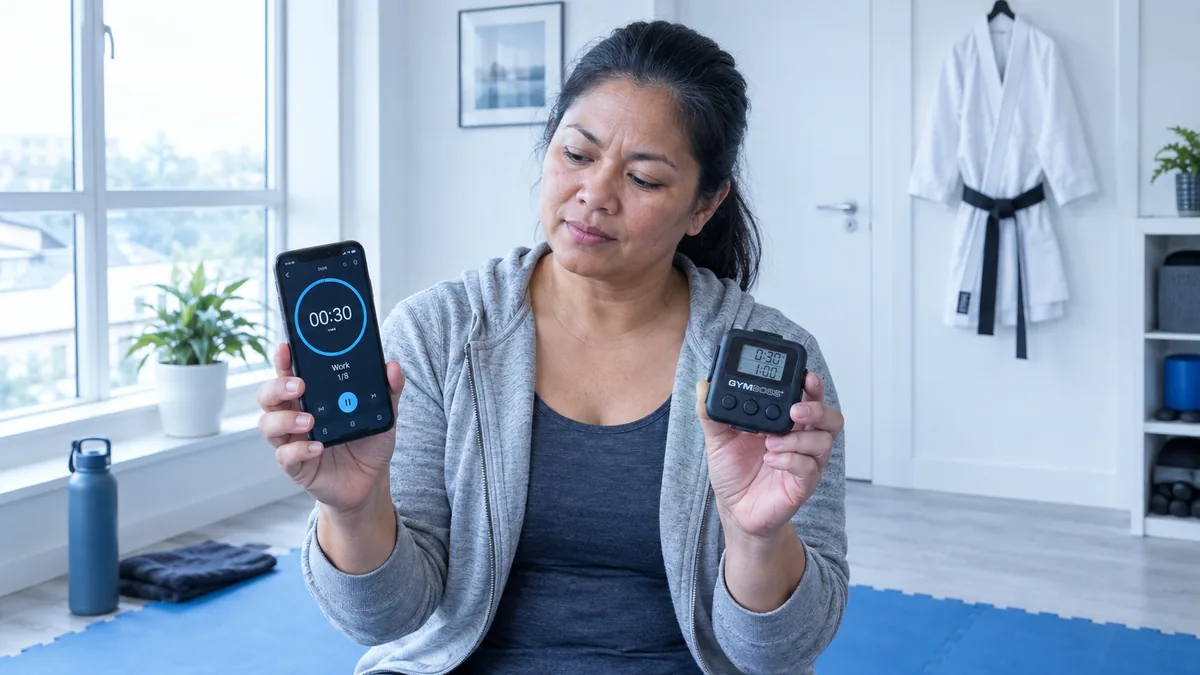
The most accessible option is a smartphone app. There are dozens available, and most of the useful ones are free or cheap. The ones worth using for karate training share a few characteristics: they allow you to set multiple interval types (work, rest, prepare), they have audible signals that are distinct enough to hear over your own breathing, and they allow you to save custom protocols so you are not rebuilding your session every time.
Apps worth looking at include Seconds Pro (iOS and Android), which allows you to build complex interval sequences with named rounds, and purpose-built Tabata timer apps for that specific protocol. For kata training specifically, a simple countdown timer works well - set it for the approximate duration of the kata and use it to track whether your pacing is consistent across repetitions.
The limitation of phone-based timers is practical rather than technical. Your phone is on the floor, or propped against a wall, and glancing at it breaks your focus. The audible cues solve most of this, but if you train in a garden or shared space with background noise, you will miss signals. Some practitioners solve this with Bluetooth earbuds, which works reasonably well for interval training but feels intrusive during kata.
A common mistake is building overly complicated interval sequences in an app and then spending the first five minutes of every session adjusting them. Keep your protocols simple and saved. If you are changing your timer settings mid-session, your training has already lost structure.
Dedicated Interval Devices: Worth the Investment?
Gymboss interval timers have been a staple of martial arts conditioning for years. They are small, clip to your clothing, and vibrate as well as beep - which solves the noise problem entirely. The original Gymboss is simple to the point of being slightly frustrating to programme, but once it is set, it works without distraction. The Gymboss Minimax adds more interval options and a slightly better interface.
For practitioners who do heavy bag work alongside their solo drills, a dedicated device is genuinely more useful than a phone. You are not going to pick up your phone between rounds on a bag, but a device clipped to your waistband gives you a vibration cue without breaking your flow. If you are doing a session that combines bag work with kihon intervals, a dedicated timer earns its cost. We have covered the heavy bag question separately in our heavy bag vs free-standing bag comparison - the timer you use matters less than having consistent round structures to train against.
The case against dedicated devices is simple: a good app on a phone you already own does 90% of what a Gymboss does. Unless you are training in conditions where the vibration feature is essential, the app is the more practical choice for most people.
Interval timers designed for CrossFit gyms - large LED display units like the Rogue Echo Timer or similar - are worth considering if you have a permanent home training space. They are visible from across a room, loud enough to hear clearly, and straightforward to programme. They are not portable and they are not cheap, but for a dedicated dojo space, they are the cleanest solution.
Building Karate-Specific Interval Protocols
The biggest difference between generic interval training and karate-specific interval training is that karate technique degrades in specific ways under fatigue. Your hip rotation goes first. Then your guard drops. Then your footwork shortens. Interval protocols for karate should be designed to expose and address these weaknesses, not just to get you breathing hard.
A practical structure for a solo session might look like this:
- 2 minutes: Kata at competition pace, full commitment on every technique
- 45 seconds: Rest - use it to check your posture, not to collapse
- Repeat four to six times
The rest period is not optional and it is not a reward. It is part of the training. What you do in those 45 seconds matters: stand upright, breathe deliberately, and note where the kata broke down. Many practitioners use rest periods to recover passively. The aim is to reset technically so the next round starts clean.
For kihon interval work:
- 30 seconds: Maximum speed oi-zuki combinations, full hip engagement on every punch
- 15 seconds: Rest
- 8 rounds
You will feel the difference between rounds one and eight in your hips before you feel it in your arms. That is the useful information. The timer forces you to confront it rather than slow down and pretend it is not happening.
For kata timing specifically, recording your times across multiple repetitions and comparing them is more useful than any single metric. If your Heian Shodan takes 35 seconds fresh and 48 seconds in round six, you have identified a real conditioning gap. No timer app gives you that analysis automatically - you have to track it yourself - but the raw data is there if you use the timer consistently.
What Actually Works for Different Training Goals
If your priority is kata grading preparation: A simple countdown timer is your most useful tool. Set it to the expected duration of your kata and practise hitting your finishing position at exactly the right moment. Timing consistency is a mark of genuine control, and grading panels notice when a kata rushes or drags at the end.
If your priority is kumite conditioning: Interval work structured around realistic exchange durations is more valuable than general fitness protocols. Time-motion research on elite kumite shows that high-intensity actions typically last well under two seconds, with active effort periods of roughly 6 to 18 seconds separated by similar or shorter rest intervals - depending on whether bouts are simulated or official.2 Training with work periods of 10 to 15 seconds at maximum effort, followed by active recovery (moving, not standing still), is closer to the actual demands of a match than a standard Tabata block. The WKF competition format sets the senior category bout at three minutes effective time for both men and women, so your conditioning work should reflect that total duration.3
If your priority is general conditioning: Tabata or similar high-intensity protocols work. Any reliable timer handles this. Do not overcomplicate it.
The mistake that derails most solo training plans is choosing a protocol that sounds impressive rather than one that targets your actual weakness. If your kata breaks down technically under fatigue, more cardiovascular work will not fix it. You need to practise the technique under controlled fatigue conditions - which means shorter intervals with higher technical demands, not longer ones.
Community Perspective
There is a genuine split in how traditional karate practitioners view timer-based training. Some instructors regard it as incompatible with the internal focus that kata requires - the argument being that watching the clock pulls attention outward when it should be directed inward. This is not an unreasonable position. Kata training at its most serious is about developing sensitivity to your own body, and an external beep every 30 seconds can interrupt that.
The counter-argument, which we find more persuasive for most practitioners, is that structure enables depth rather than preventing it. You cannot develop internal focus if your session is shapeless. A timer removes the cognitive load of tracking time and lets you direct attention to technique. The two goals are not in conflict.
Where this debate becomes more interesting is in how experience changes the answer. Many practitioners report that they used timers heavily when building their conditioning base and gradually moved away from them as their training became more intuitive. That progression makes sense. The timer is a scaffolding tool - useful while you are building, less necessary once the structure is solid.
The equipment question is also worth contextualising alongside other solo training tools. If you are investing in your home training setup, a good timer sits alongside tools like chi-ishi and nigiri game as a conditioning aid with a specific and measurable purpose - not a luxury, but not a substitute for quality instruction either.
Key Takeaways
- A saved, simple protocol beats a complicated one you rebuild every session. Set your intervals once, test them across two or three sessions, and adjust from there.
- The rest period is part of the training. Use it to reset technically, not just to recover physically. What you do in the rest shapes the quality of the next round.
- Match your interval structure to your actual goal. Kata grading needs timing consistency work, not Tabata. Kumite conditioning needs work periods that reflect real exchange durations.
- Dedicated devices earn their cost if you train in noisy conditions or combine bag work with kihon drills. For most home sessions, a well-chosen app is sufficient.
- Track your kata times across rounds. The gap between your first and last repetition is more useful diagnostic information than any single performance metric.
- If your technique degrades under fatigue, more cardio is not the fix. Train the technique under controlled fatigue with shorter, more demanding intervals - not longer ones.
References
Checked by the KarateLifestyle editorial team against peer-reviewed exercise science literature (PubMed), WKF official competition rules, and time-motion analysis research in October 2026. The time-motion data on kumite exchange durations draws on simulated rather than exclusively official competition conditions, and figures vary across studies.
- Effects of moderate-intensity endurance and high-intensity intermittent training on anaerobic capacity and VO2max. Tabata I, Nishimura K, Kouzaki M, Hirai Y, Ogita F, Miyachi M, Yamamoto K. Medicine and Science in Sports and Exercise, 1996; 28(10): 1327-1330. National Institute of Fitness and Sports, Kanoya, Japan. PubMed ID: 8897392.
- Strength and Conditioning for Karate Kumite. Cree J et al. Published on ResearchGate, 2018. Peer-reviewed synthesis of time-motion analysis research on karate kumite, citing Iide et al. (2008), Beneke et al. (2004), and Chaabene et al. (2014).
- WKF Kumite Competition Rules, Version 2026.01. World Karate Federation. Rules in force from 1 January 2026, with amendments of 13 April 2026. Article 5: Duration of Bout.
The weekly digest
New karate articles, once a week
One email every week with everything new on Karate Lifestyle. No spam; unsubscribe in one click.
We'll email you to confirm. See our privacy policy.