Setting Up a Home Dojo
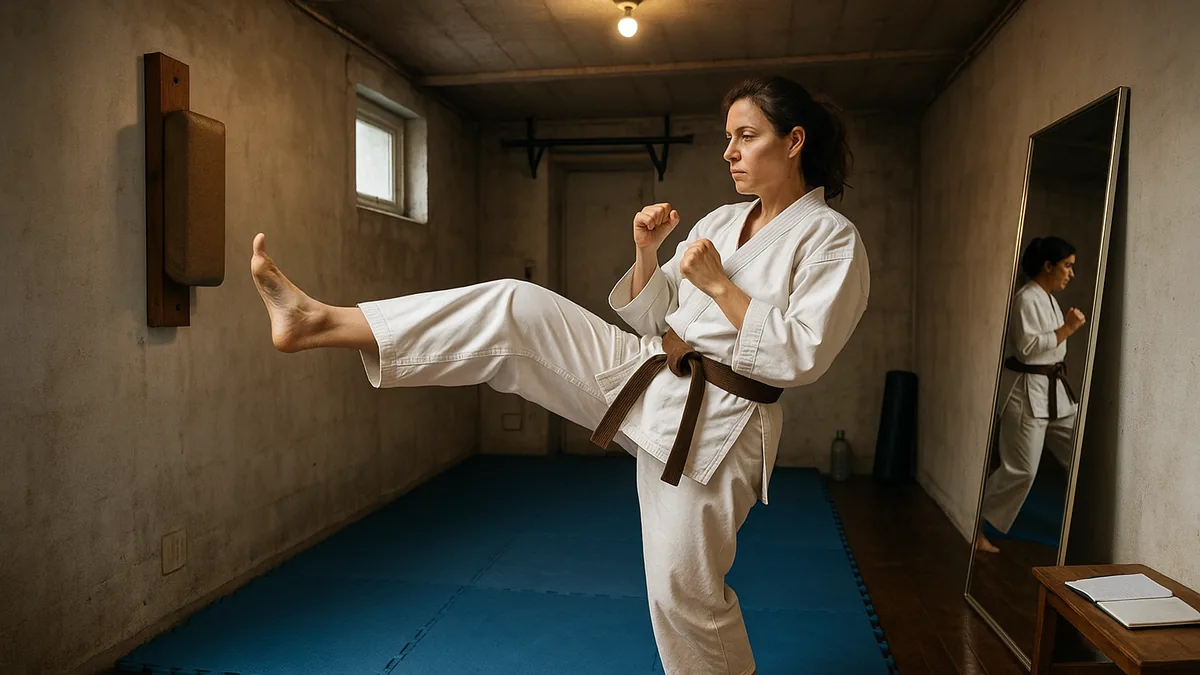
Most people who set up a home dojo spend money on the wrong things first. I’ve seen it happen enough times to recognise the pattern: someone gets serious about training, buys a full-length mirror, a foam tile floor, and a fancy equipment stand, then wonders six months later why their technique hasn’t improved. The space looks great on Instagram. But they never got the fundamentals right.
What actually matters in a home training space is simpler and cheaper than most people expect. Let me tell you what I’ve learned from setting up my own space, helping students sort theirs, and making enough expensive mistakes along the way.
Space: What You Actually Need
The minimum workable space for solo kata training is roughly 3 metres by 4 metres. That’s tight, but it’s doable if you’re smart about it. I trained in a space that size for two years in my early thirties and it forced me to clean up my movement - you can’t drift or be sloppy with your stances when you’re three steps from a wall.
What I tell students is this: measure your longest kata first. Heian Shodan in a full dojo with full-size steps will cover more ground than you think. Walk through it before you commit to a space. You’ll quickly find out whether you’re working with enough room or whether you need to modify your approach.
Ceiling height matters more than floor space for a lot of practitioners, and it’s the one thing people consistently overlook. If you’re throwing any kind of jodan technique, or working with a bo, you need height. My own garage has a lower beam at one end and I caught my knuckles on it twice before I stopped pretending it wasn’t a problem. 2.4 metres is the practical minimum. More is better.
What you don’t need is a dedicated room. A cleared garage, a section of garden in decent weather, a basement - all of these work. The best home training space I’ve ever trained in belonged to a shodan I know who cleared out half his garage, put down proper flooring, and trained there every morning before work for four years. Nothing fancy. Completely functional.
Flooring: Where Most People Go Wrong
One mistake I see constantly is people buying interlocking foam puzzle tiles - the kind you find at discount sports shops - and thinking they’ve sorted the flooring problem. They haven’t. Those tiles compress under repeated impact, shift when you pivot, and give you a false sense of cushioning that actually disrupts your grounding.
The thing that actually changed my understanding of flooring was training on proper tatami for the first time. It has a firmness to it that foam doesn’t. When you land a technique correctly on tatami, you feel it through your whole body in a way that foam absorbs and hides. That feedback is part of training. Foam steals it from you.
For a home dojo, here’s what actually works by budget:
Budget option: Rubber gym flooring tiles, 15-20mm thickness. Not glamorous, but firm, durable, and honest. You’ll feel your stances. You’ll feel when you’re off-balance. They grip without sticking. Around £3-5 per square foot depending on where you buy.
Mid-range: Martial arts tatami tiles. Proper ones, not the foam-core imitations. These run £8-12 per square foot but they last years and they feel right. If you’re training seriously, this is what I’d recommend.
What to avoid: Carpet (you can’t pivot cleanly and it hides your foot position), bare concrete (too hard for any extended training, and the impact accumulates over time - worth reading about if you’re training long-term, especially the point I make in Training Karate After 40 about cumulative joint stress), and those foam tiles I mentioned above.
Don’t put flooring over a soft carpet base either. The instability underneath defeats the purpose of any firm surface on top.
Mirrors: Useful Tool or Vanity Project?
I have a complicated relationship with mirrors in home training spaces. Here’s my honest position: one mirror, positioned correctly, is genuinely useful. A wall full of mirrors is a distraction that teaches you to train for appearance rather than feel.
The correction that makes the biggest difference when students start using a mirror is getting them to stop watching themselves mid-technique. I’ve seen students who’ve trained in front of mirrors for months and they’re constantly checking their reflection at the point of impact. That split-second glance shifts your focus outward when it needs to be inward. You learn to look good rather than feel correct.
What a mirror is actually useful for is checking your starting position, your kamae, and your weight distribution before you begin. Stance check. Kamae check. Then you look away and you train. After the sequence, you check again.
If budget is a concern, one large mirror on a single wall is plenty. Position it at the end of your main training direction so you’re looking at yourself head-on, not at an angle. IKEA’s larger mirrors work fine - I’ve seen plenty of home dojos running on a £60 mirror and it does everything you need.
Equipment: What’s Useful vs What Looks Good
Let me be direct here: most home equipment purchases are aspirational rather than functional. People buy things because they imagine the training they’ll do, not the training they actually do.
What actually gets used:
A makiwara - if you build or buy one properly - is the single most valuable piece of equipment you can add to a home dojo. I’ll come back to this in a moment because it deserves its own section.
A heavy bag is useful if you’re working combinations and want impact feedback, but it’s secondary to the makiwara for traditional karate training. If you have room for both, great. If you’re choosing, get the makiwara working first.
Focus mitts are useless without a partner. I’ve seen them hanging in home dojos gathering dust for years. Don’t buy them for solo training.
A timing rope or skip rope is cheap and genuinely useful for footwork and conditioning.
What looks good but rarely gets used:
Weapon racks (unless you’re actively training kobudo - be honest with yourself). Resistance bands on wall mounts. Striking dummies that cost £200 and get used for a week. Elaborate storage systems for equipment you don’t own yet.
If you’re kitting out your space and need to think about your actual training gear, the Karate Sparring Gear Guide covers what’s worth buying and what isn’t - the same logic applies here.
The Makiwara
I’ve trained with practitioners who’ve never used a makiwara and practitioners who’ve been hitting one for twenty years, and the difference in their punching is not subtle. The makiwara teaches you things that air punching and bag work simply don’t.
When you hit a makiwara correctly - full hip rotation, full body connection, proper fist alignment - you feel it as a single unified impact through your whole body. When something is wrong, the makiwara tells you immediately. Your wrist buckles slightly, or you feel the impact only in your arm, or the board barely moves. There’s no hiding from it.
As a white belt I thought makiwara training was about toughening your knuckles. By brown belt I realised it’s about honest feedback on structure. The knuckle conditioning is a side effect. The real value is that you can’t fake a correct punch on a makiwara.
For a home dojo, you have two practical options:
Floor-mounted makiwara: The traditional option. You need to be able to fix it properly - either into a concrete floor or a heavy weighted base. A poorly fixed makiwara that wobbles teaches you nothing. I’ve seen too many home setups where the board flexes sideways instead of straight back, and the person training on it has developed a push rather than a strike.
Wall-mounted striking board: Easier to install in most home spaces. Mount it at solar plexus height for chudan, shoulder height for jodan. Make sure the wall fixing can take repeated impact - use proper wall anchors into masonry, not plasterboard fixings.
You can build a basic makiwara for under £50 with the right wood and some rope. There are decent ones available commercially from £80-120. I’d rather you spent money here than on a mirror.
Budget Reality Check
A functional home dojo does not require a large budget. Here’s what I’d prioritise if I was starting from scratch:
- Rubber flooring for your training area: £150-300 depending on size
- One decent mirror: £60-100
- Makiwara or wall-mounted striking board: £50-120
- Skip rope: £10
- Total: £270-530
That’s it. Everything else is optional. The space, the floor, and something honest to hit - that’s a training environment.
What I’d skip entirely unless budget is no concern: foam tiles, full mirror walls, timing systems, anything that requires electricity, equipment you don’t currently have the skill to use properly.
Community Perspective
There’s genuine disagreement in the karate community about whether home training is worth doing at all. Some instructors - and I’ve trained under a few with this view - believe that training alone without correction is worse than not training, because you’re just reinforcing your own mistakes with no one to catch them.
I understand that position. I’ve seen students develop habits in home training that took months to undo. But I’ve also seen students who trained seriously at home between classes and progressed faster than anyone else in the dojo. The difference wasn’t the home training itself - it was whether they were training the right things.
My position: home training is valuable for conditioning, kata repetition, and makiwara work. It is not a substitute for regular dojo training with a qualified instructor. Use it to reinforce what you’ve been taught, not to experiment with things you haven’t had corrected yet.
Key Takeaways
- Prioritise firm flooring over cushioned flooring - you need the ground feedback, not the comfort
- A makiwara is more valuable than any bag, dummy, or mirror for improving your technique; if you can only add one piece of equipment, make it that
- Measure your kata footprint before committing to a space - you’ll be surprised how much room Heian Shodan actually needs
- One mirror used correctly beats a wall of mirrors used badly; check your starting position, then train by feel
- Budget for what gets used, not what looks like a dojo - flooring, one mirror, something to hit, and a skip rope covers everything most practitioners actually need
- Home training reinforces what you’ve learned in class; it doesn’t replace having your technique corrected by someone who knows what they’re looking at
The weekly digest
New karate articles, once a week
One email every week with everything new on Karate Lifestyle. No spam; unsubscribe in one click.
We'll email you to confirm. See our privacy policy.