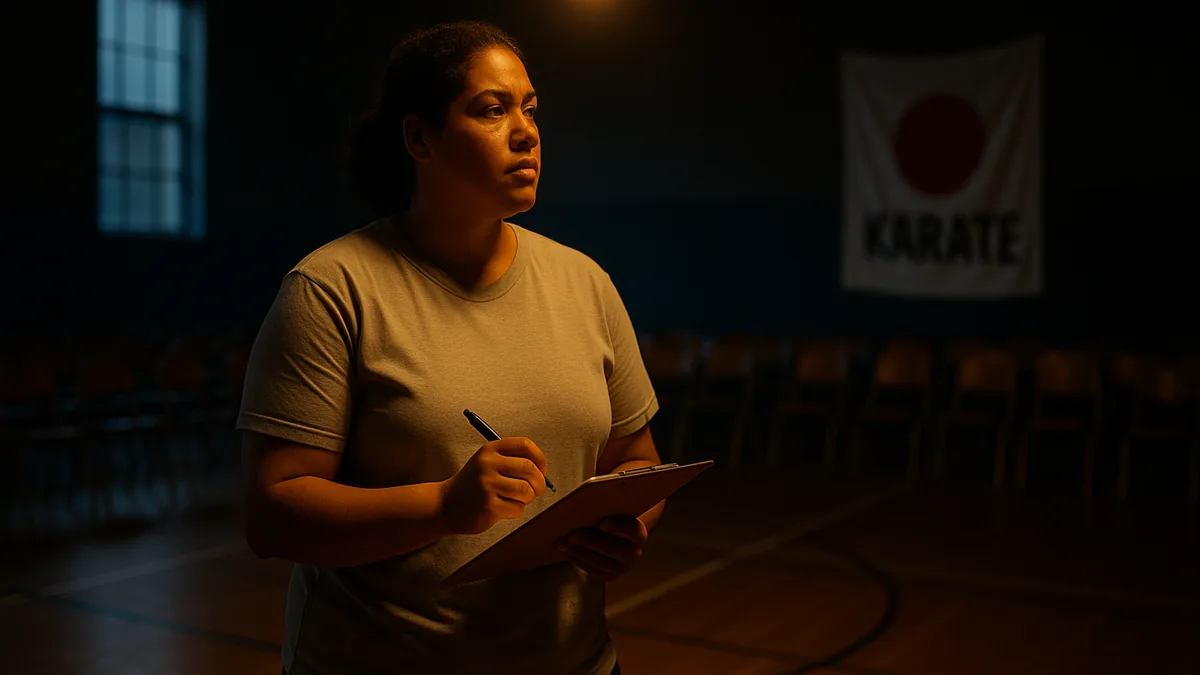
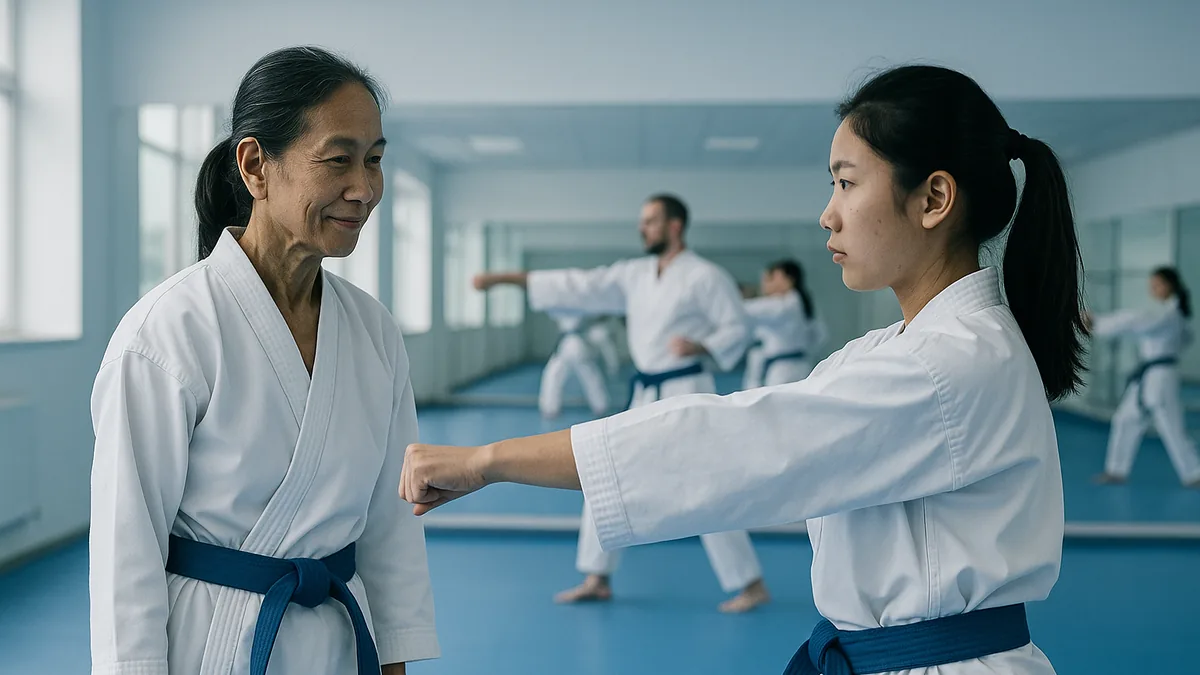
How to Welcome a New Student Into an Established Karate Club: What the First Four Weeks Should Look Like and Who Is Responsible
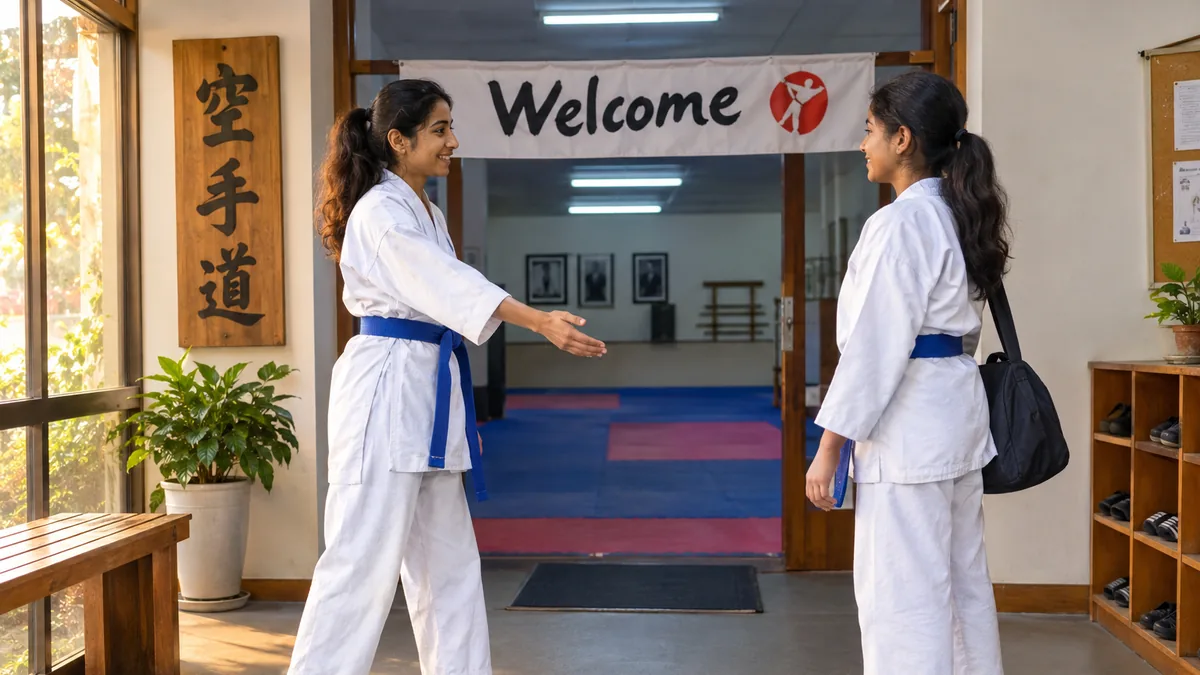
Most new students who quit do so within their first few months - research on fitness and martial arts clubs consistently identifies the earliest weeks of membership as the highest-risk period for dropout.1 Not because the training was too hard, not because they disliked karate - but because nobody made them feel like they belonged. That is a club failure, not a student failure. And it is entirely preventable.
Welcoming a new student is not about being friendly at the door and pointing them to a spare gi. It is a structured process that runs for at least four weeks, involves multiple people in the dojo, and has a clear purpose at each stage. If your club does not have that process, you are leaving retention to chance.
Week One: Orientation Is Not Optional
The first session is not about how much a new student can learn. It is about whether they want to come back.
A common mistake is treating the first lesson like any other lesson - new student arrives, joins the line, gets corrected repeatedly, leaves confused and slightly embarrassed. The intention is usually good: treat everyone the same, no special treatment. The result is that the new student spends an hour feeling publicly incompetent in front of people who have been training for years.
The approach that actually works is to pull the new student aside before class begins - five minutes is enough - and give them a brief, honest picture of what is about to happen. Tell them what the warm-up looks like, what the basic commands mean, and that they are not expected to keep up. That small act of preparation changes everything about how the session feels from the inside.
During week one, the curriculum should be deliberately narrow:
- Natural stance (shizentai) and ready stance (yoi)2
- A single downward block (gedan barai) or a single rising block (age uke)2
- A single straight punch (choku-zuki) or stepping punch (oi-zuki)2
- Basic dojo etiquette: bowing (rei), and moving correctly on the floor2
That is enough. The temptation to introduce more - especially if the student seems capable - almost always backfires. Overloading a new student does not accelerate their progress; it makes them feel like they are failing. Confidence built on a narrow foundation is more durable than confusion built on a wide one.
One instructor responsibility that gets overlooked: make the introduction formal. At the start of class, acknowledge the new student by name, welcome them to the dojo, and briefly introduce them to the group. This takes thirty seconds and signals to everyone in the room that this person matters.
Who Is Responsible - and It Is Not Just the Instructor
The instructor sets the tone and holds ultimate responsibility. But the practical work of integration should not fall entirely on the instructor’s shoulders, and relying on it to do so is one of the structural mistakes that undermines retention in otherwise good clubs.
Senior students - from around brown belt upwards - have a specific role here that goes beyond being polite. Assigning a named senior student as a point of contact for each new student is one of the most effective things a club can do. Not a vague “look after them”, but a specific brief: check in before class, answer questions the new student might feel awkward asking the instructor, and give feedback after sessions in plain language.
We would recommend choosing that senior student carefully. The most technically advanced student is not always the right choice. The right choice is someone who communicates clearly, remembers what it felt like to be new, and will not overwhelm a beginner with unsolicited corrections. For more on what this role actually looks like in practice, Mentoring Junior Karateka: What Senior Grades Actually Owe the Club and How to Do It Without Overstepping covers the boundaries and responsibilities in detail.
Weeks Two and Three: Building the Foundation Without Losing the Person
By the second week, the new student should be starting to feel the shape of the dojo - the rhythm of training, who the regulars are, what the culture expects. This is the moment to expand the technical content slightly and to start connecting them to the wider group.
The technical priority in weeks two and three is stance and movement. This is where most beginners struggle in ways they do not fully understand. A common mistake is that new students focus almost entirely on the arm techniques they have been shown, and treat their footwork and stance as an afterthought. This happens because arms are visible and punches feel like the point. Instructors repeat “fix your stance” constantly for a reason - it usually does not land until a student tries to generate power and realises nothing is connecting.
What correct stance feels like is worth describing explicitly to new students: in zenkutsu-dachi (front stance), the rear leg should feel engaged and slightly resistant, not slack.2 When the hip drives forward into a technique, there should be a sense of the whole body behind it rather than just the arm moving. When that connection is missing - when the punch feels like it is coming only from the shoulder - the stance is almost always the cause.
Pairing new students with mid-grades (around green to purple belt) for some basic partner work in weeks two and three serves a dual purpose. The mid-grade gets to consolidate their own understanding by explaining it, and the new student gets attention from someone whose experience is close enough to their own to be relatable. The gap between a new student and a black belt can feel so wide that feedback from a senior grade sometimes lands as discouraging rather than helpful.
The social dimension matters here too. A new student who only ever interacts with club members during formal training is much more likely to drift. Even small things - a brief conversation after class, being included in the group that goes for coffee - build the sense of belonging that keeps people coming back. This is not soft or peripheral; it is directly connected to retention. Self-determination theory, developed by Deci and Ryan, identifies relatedness - a sense of belonging and connection to others - as one of three fundamental psychological needs that sustain intrinsic motivation. Belonging is not a bonus; it is one of the primary reasons people stay. Karate Club Socials and Off-Mat Culture: Why They Matter More Than Most Instructors Admit makes the case for why this deserves deliberate attention rather than being left to chance.
Week Four: Assessment and the Path Forward
By the end of week four, the instructor should have a clear picture of the new student’s starting point - their coordination, their fitness, their attitude to correction, and any physical considerations that will affect their training. This does not need to be formal or documented, but it needs to be intentional.
The biggest mistake at this stage is failing to have a direct conversation with the new student about what comes next. Many new students arrive with no framework for how karate progression works - they do not know what their first grading looks like, how long it typically takes, or what they should be working on between classes. Leaving that ambiguity in place breeds uncertainty, and uncertainty makes it easy to quietly stop coming. Research on retention in martial arts and fitness contexts consistently shows that students who understand what they are working toward are more likely to remain engaged.
Week four is the moment to sit down, even briefly, and cover:
- What the first grading syllabus looks like and approximately when it becomes relevant
- What they should practise at home and how (even ten minutes of stance work daily makes a measurable difference)
- Whether there are any aspects of club culture - gradings, seminars, interclub events - they should know about
For clubs that run interclub training days, mentioning these early is worth doing. Seeing karate practised in a different environment, with different students, is genuinely useful for a new student’s understanding of where they sit. Interclub Training Days: How to Organise One, What to Expect, and Why More Clubs Should Do It is worth pointing newer students toward when the time is right.
Common Mistakes Clubs Make - and What to Do Instead
Assuming enthusiasm is enough. A new student who arrives eager and trains hard in week one is not guaranteed to stay. Enthusiasm without structure and connection fades quickly. The clubs that retain students are the ones that treat integration as an active process, not a passive one.
Correcting too much, too soon. The correction that makes the biggest difference in week one is often the only correction - pick the single most important thing and leave everything else. Most beginners can absorb one meaningful piece of feedback per session. Piling on corrections feels like failure, even when it is well-intentioned.
Treating the first grading as the integration milestone. Some instructors operate on the assumption that if a student makes it to their first grading, they are in. The evidence from general sports and fitness club research does not support this: dropout is front-loaded, with the highest risk sitting in the first weeks before training has become a habit. The decision to stay or leave is usually made long before any grading is relevant.
Forgetting the non-training support network. For younger students especially, parents and partners shape the decision to continue. A parent who feels welcomed and informed is far more likely to keep bringing their child. How to Support a Karate Club Without Being on the Mat is worth sharing with families who want to understand how they fit into the club environment.
Community Perspective
There is genuine disagreement among instructors about how much structure new students actually need. One school of thought holds that throwing a new student into a regular class and letting them find their feet is the right approach - that karate has always required students to observe, absorb and persevere, and that over-managing the early experience softens something that should have an edge to it.
That position is not without merit. There is a real risk of creating an environment so cushioned that students never develop the resilience that karate training is supposed to build. And some students do respond better to being treated as equals from day one rather than being handled carefully.
The counter-argument - and where we land - is that the traditional sink-or-swim approach made more sense when clubs had a waiting list and could afford to lose students who did not fit. Most clubs today do not have that luxury, and more importantly, the students being lost to poor onboarding are not always the ones who lack resilience. They are often exactly the students a club should want: serious, capable people who simply did not get enough of a foothold in the first month to understand what they were committing to.
Structured onboarding does not mean lowering standards. It means giving new students enough orientation to actually meet them.
New habits of any kind take longer to form than most people assume: research by Lally and colleagues at UCL found that the time for a new behaviour to become automatic ranged from 18 to 254 days, with a median of 66 days.3 For the first two months at least, a new student is running largely on intention - and intention is fragile. A structured first four weeks does not solve this entirely, but it gives that intention somewhere solid to land.
Key Takeaways
- Assign a named senior student as a point of contact for every new student from day one - not a vague responsibility, a specific brief with clear expectations.
- Keep the technical content of week one deliberately narrow: two or three techniques, basic etiquette, and the shape of a class. Depth comes later; confidence comes first.
- Have an explicit conversation at the end of week four about what progression looks like. New students who do not know what they are working toward are much more likely to drift.
- Correct sparingly in the first month. The correction that makes the biggest difference is the one that lands - one clear piece of feedback per session is more useful than five.
- Treat the social dimension as part of the curriculum. Connection to other students is not a bonus; it is one of the primary reasons people stay.
- Review your onboarding process annually. If students are leaving in the first month and you do not know why, the process is not working - and “they just weren’t committed enough” is rarely the honest answer.
References
Checked by the KarateLifestyle editorial team against peer-reviewed exercise adherence research, self-determination theory literature (APA and primary sources), karate terminology glossaries from UK and international clubs, and fitness industry retention data in October 2026. No peer-reviewed study exists reporting dropout rates specific to karate or martial arts; retention figures cited are from the broader fitness and sport literature.
- Motives and barriers to initiation and sustained exercise adherence in a fitness club setting - a one-year follow-up study. Fortier et al., Scandinavian Journal of Medicine and Science in Sports, 2020. PubMed Central. Prospective longitudinal study, n=250 fitness club new members followed 12 months.
- Shotokan Karate Terminology Glossary (Kobukan Karate Club). Kobukan Karate Club (UK club primary source). Terminology reference listing shizentai, yoi, zenkutsu-dachi, gedan barai (down block), age uke (rising block), choku-zuki (straight punch), oi-zuki (stepping punch).
- How are habits formed: Modelling habit formation in the real world. Lally P, van Jaarsveld CHM, Potts HWW, Wardle J. European Journal of Social Psychology, 2010, 40(6):998-1009. DOI:10.1002/ejsp.674. UCL. Time to automaticity ranged 18 to 254 days, median 66 days.
The weekly digest
New karate articles, once a week
One email every week with everything new on Karate Lifestyle. No spam; unsubscribe in one click.
We'll email you to confirm. See our privacy policy.