Who Was Mas Oyama? The Founder of Kyokushin and How His Training Methods Became the Style's Identity
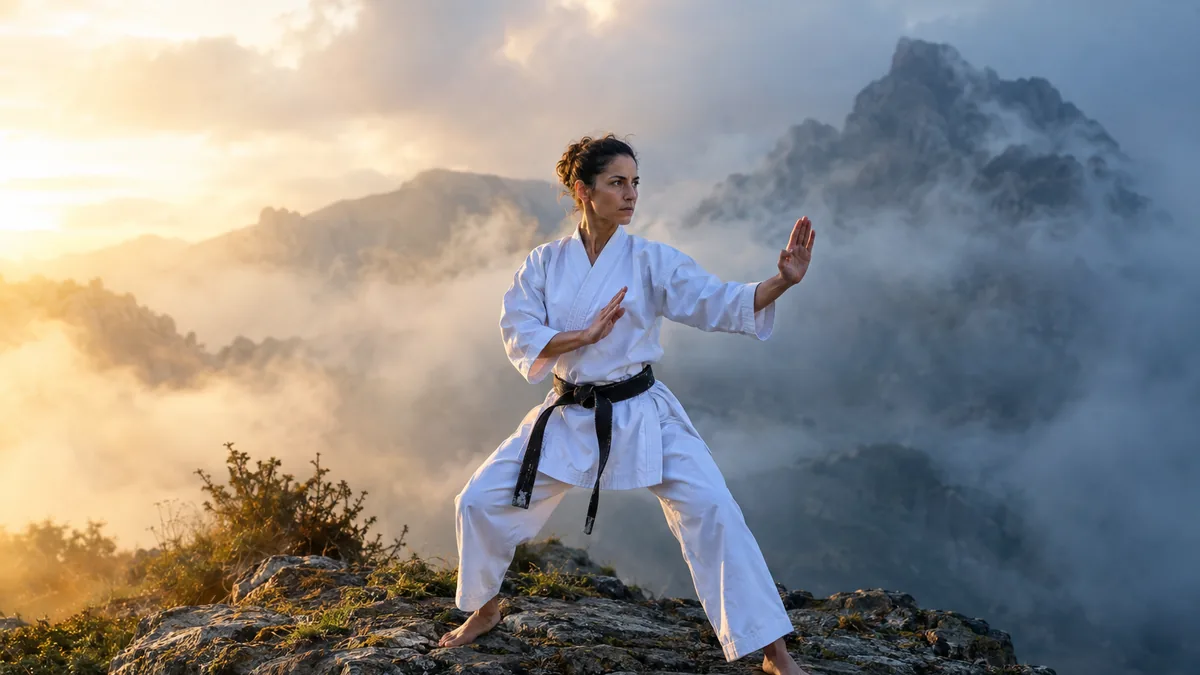
Mas Oyama trained alone in the mountains for periods of solitary isolation - fourteen months at Mount Minobu, in Yamanashi Prefecture, and later eighteen months at Mount Kiyosumi in Chiba Prefecture.1 No sparring partners. No dojo. No grading schedule. Just him, the cold, the repetition, and whatever he could find to break. When he came back down, he fought bulls. Not as a stunt - as a test of whether the training had worked.1
That is not a metaphor for Kyokushin. That is its founding logic, made literal.
Understanding who Mas Oyama was matters because Kyokushin is not simply a style that happens to have full-contact rules and heavy conditioning. It is a style that was built backwards from a specific question: what does it take to produce a fighter who cannot be broken? Everything in Kyokushin - the knockdown rules, the tameshiwari, the thousand-day training cycles, the emphasis on leg kicks and body punches - flows from how Oyama answered that question.
The Man Before the Legend
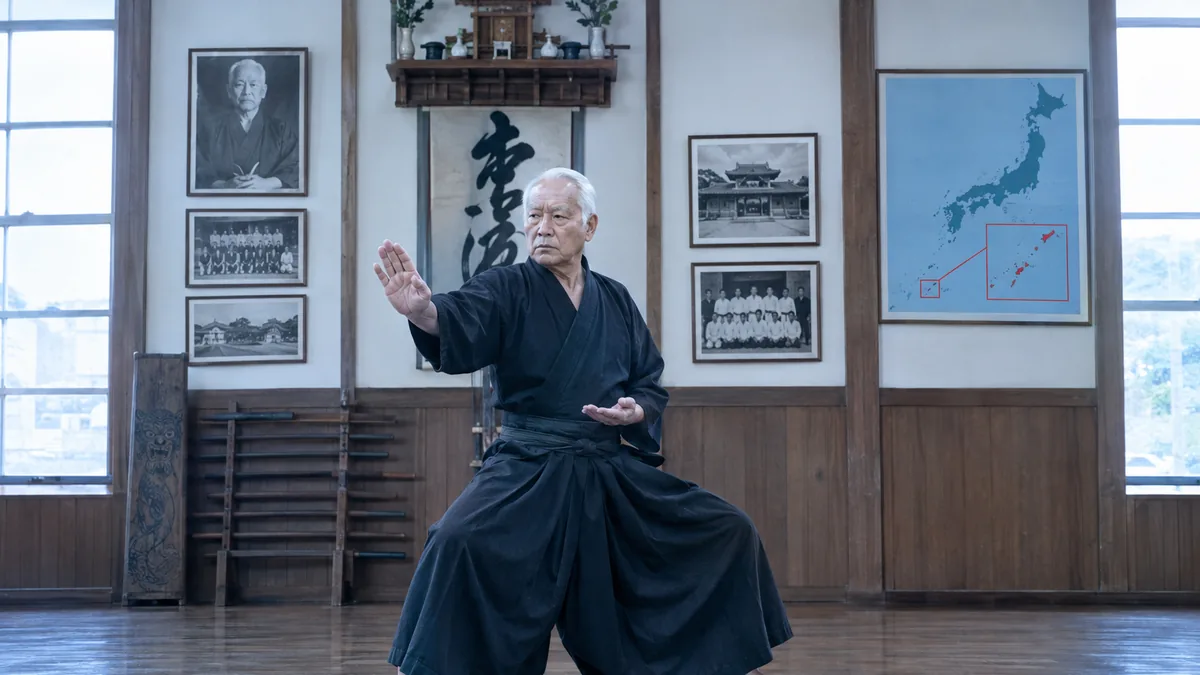
Masutatsu Oyama was born Choi Yeong-eui in Korea in 1923. He moved to Japan as a young man and trained in Shotokan karate under Gichin Funakoshi and his family, before studying Goju-ryu with So Nei-chu (also written Nei-Chu So), a fellow Korean from his home province who was a senior student of Goju-ryu’s founder, Chojun Miyagi. He also studied judo.
This matters for understanding Kyokushin’s technical character. Oyama was not building from a single lineage. He was synthesising - taking Shotokan’s linear power and commitment, Goju-ryu’s close-range body mechanics and breathing methods, and his own conclusions about what worked when contact was real and full. The style that emerged was not a compromise. It was a deliberate construction.
Oyama founded the International Karate Organisation Kyokushinkaikan in 1964 in Ikebukuro, Tokyo, though he had been teaching and developing the system for years before that date, opening his first dojo in 1953. He died on 26 April 1994, of lung cancer. The organisational splits that followed his death - primarily between Shokei Matsui’s group (IKO-1) and the group that became IKO-2 under Yukio Nishida - are a matter of documented record and ongoing debate within the Kyokushin community. We are not going to pretend that one side is correct. What is not disputed is what Oyama built and why.
The Mountain Training and What It Actually Meant
The famous periods of mountain isolation are often treated as mythology. They should not be. They were a deliberate training methodology with a specific purpose.
According to the IKO Kyokushinkaikan’s own account, Oyama secluded himself first at Mount Minobu (Yamanashi Prefecture) and then, from April 1948, at Mount Kiyosumi in Chiba Prefecture for eighteen months.1 These were not the same location, and the second period is the better-documented one. Oyama was attempting to solve a problem that most martial artists avoid: the gap between controlled dojo training and the psychological reality of genuine physical confrontation. His answer was to remove the control. No partners meant no accommodation. No dojo meant no ritual comfort. Extended solitude under physical hardship was intended to strip away the mental habits that make training feel productive but leave you unprepared when it counts.
The correction that most training environments never make is this one. Comfort is not neutral. A dojo where training is always manageable, where partners are always cooperative, where the environment is always familiar - that dojo is quietly training you to need those conditions. Oyama’s mountain periods were a deliberate inoculation against comfort dependency.
This is not an argument that everyone should go and live in a forest. It is an argument that your training should regularly include conditions that are not comfortable, not convenient, and not designed to make you feel good about yourself.
How the Philosophy Became the Curriculum
The three elements that define Kyokushin training - knockdown kumite, extreme physical conditioning, and tameshiwari (breaking) - are not separate traditions bolted together. They are three expressions of the same underlying principle.
Knockdown kumite removes the scoring game. In WKF sport karate, a controlled technique to the head scores. In Kyokushin knockdown rules, you win by putting your opponent on the floor, or by accumulating clean body shots and leg kicks that visibly affect them. Punches to the head are not permitted in competition, which is the most commonly misunderstood rule in Kyokushin. This is not a safety compromise that weakens the system - it is a deliberate design choice that forces competitors to develop genuine body-punching power and to absorb punishment rather than avoid it. You cannot win a Kyokushin tournament by being elusive. You have to be able to hit hard enough to matter and take hits hard enough to stay standing.
Conditioning in Kyokushin is not supplementary. The 100-man kumite - fighting 100 opponents in succession, each round lasting between one and a half and two minutes - was devised by Oyama and completed by him first, reportedly three times over three consecutive days in the 1950s. The second person to complete the challenge was Steve Arneil, in May 1965, with Tadashi Nakamura following in October of the same year; Miyuki Miura completed it in 1973. The point is not the number. The point is that the training culture treats physical limits as negotiable rather than fixed. Most people stop training when it becomes uncomfortable. Kyokushin, at its best, trains you to treat that moment as the beginning of the session rather than the end.
Tameshiwari is the element that looks most like performance but functions as feedback. When you break correctly - when the kime is genuine, when the hip and shoulder and wrist arrive together at the point of impact - you feel it through your whole body as a single connected event rather than an arm movement that happened to hit something. When it goes wrong, the board does not break, and your hand hurts. There is no ambiguity. That immediate, honest feedback is exactly why Oyama used it and why it remains in the curriculum.
The Mistake Most People Make When They Encounter Kyokushin
The most common misreading of Oyama’s philosophy is to focus on the hardness and miss the precision underneath it.
Kyokushin training looks brutal from the outside, and some of it is. But the conditioning is not the point - it is the vehicle. Oyama’s stated view, documented in his written works including “This Is Karate” (1965) and “Advanced Karate” (1970), was that the mind leads the body, and the body must be trained to follow without hesitation. The physical conditioning exists to build a body that does not flinch, does not quit, and does not give the mind an excuse to stop.
The mistake that comes up constantly in dojos that adopt Kyokushin aesthetics without the underlying logic is this: training hard as a substitute for training well. Doing 500 press-ups is not Kyokushin philosophy. Doing 500 press-ups while maintaining precise technique, while pushing through the point where your form wants to collapse, while keeping your mind focused rather than dissociated - that is closer to what Oyama was after.
A common observation among experienced practitioners is that beginners notice the conditioning first. By the time you are working at an advanced level, the conditioning was always about attention under pressure. The physical difficulty is a delivery mechanism for a mental training problem.
What This Means for Your Training, Regardless of Style
We favour taking Oyama’s core insight seriously even if you train in Shotokan, Goju-ryu, or any other system. The insight is this: you will perform under pressure approximately as well as you have trained under pressure. Not better. The gap between controlled practice and genuine pressure is not closed by more controlled practice - it is closed by introducing pressure deliberately and systematically into training.
Practically, this means:
- If your sparring always has the same familiar partners who know your habits, you are training a specific comfort zone, not a general capability. Visiting other clubs - see our guide to training at another club as a guest - is one of the most direct ways to address this.
- If your conditioning always stops when it becomes genuinely hard, you are training yourself to stop when things become hard.
- If your technique is only clean when you are fresh, it is not your technique yet.
The correction that makes the biggest difference is not technical - it is attitudinal. Treat the moment of discomfort as the start of the useful training, not the signal to ease off.
Community Perspective
Oyama’s legacy is genuinely contested within the Kyokushin community, and it would be dishonest to pretend otherwise.
The organisational splits after his death in 1994 reflect real disagreements about what Kyokushin is and should be. Before he died, Oyama reportedly named Shokei Matsui as his successor; that will was later contested by Oyama’s family and ruled invalid by Japanese courts, leading to the IKO fracturing into several rival groups. Some practitioners believe the knockdown rules are fundamental and that any move towards padded gloves or head punching betrays the style’s identity. Others argue that Kyokushin’s evolution - including the development of K-1 kickboxing, which drew heavily on Kyokushin fighters - shows that Oyama’s philosophy was always about effectiveness, not about preserving specific rules.
There is also an honest debate about the physical cost of traditional Kyokushin training. The cumulative damage from years of full-contact body sparring without head protection is real. Instructors who have trained in the system for decades sometimes arrive at different conclusions about what they would do differently, and what they would keep exactly as it was. That tension does not have a clean resolution, and anyone who tells you it does is probably selling something.
What most experienced Kyokushin practitioners agree on - and this is worth taking seriously - is that the style’s culture of not quitting is both its most valuable product and its most dangerous tendency. Knowing when to push through and when to stop is a skill, and it takes time to develop. The dojo environment matters enormously here. A club that welcomes new students properly and builds a culture of intelligent toughness rather than performative suffering is doing Oyama’s philosophy more justice than one that simply makes training painful.
Key Takeaways
- Oyama’s mountain training was not mythology - it was a deliberate method for closing the gap between comfortable practice and genuine pressure. He undertook at least two separate periods of solitary training in the mountains: the better-documented second period lasted eighteen months at Mount Kiyosumi in Chiba. Apply the same logic: your training should regularly include conditions that are unfamiliar, uncomfortable, and not designed to flatter you.1
- The knockdown ruleset is not a compromise. It is a design choice that forces real power development and genuine physical resilience. Understand why the rules are what they are before you judge them.
- The biggest difference between beginners and advanced Kyokushin practitioners is not strength or technique - it is what they do at the moment training becomes genuinely hard. Train that moment specifically.
- Tameshiwari works as feedback because it is honest. Build feedback mechanisms into your training that cannot be gamed by cooperative partners or generous judges.
- Oyama’s written works - particularly “This Is Karate” - are worth reading as primary sources. Do not rely entirely on secondhand accounts of what he believed.
- Physical conditioning without mental discipline is just fitness. The conditioning in Kyokushin was always intended as a vehicle for developing a mind that does not give up. If your hard training is not also teaching you something about your own psychology, you are missing half the curriculum.
References
Checked by the KarateLifestyle editorial team against IKO official records, martial arts biographical sources, and geographical references in October 2026. The 100-man kumite legends and some mountain-training details rest on organisational and practitioner sources rather than independent contemporary records.
- IKO Kyokushinkaikan: Sosai Masutatsu Oyama (official founder profile). IKO Kyokushinkaikan official website, retrieved October 2026
The weekly digest
New karate articles, once a week
One email every week with everything new on Karate Lifestyle. No spam; unsubscribe in one click.
We'll email you to confirm. See our privacy policy.