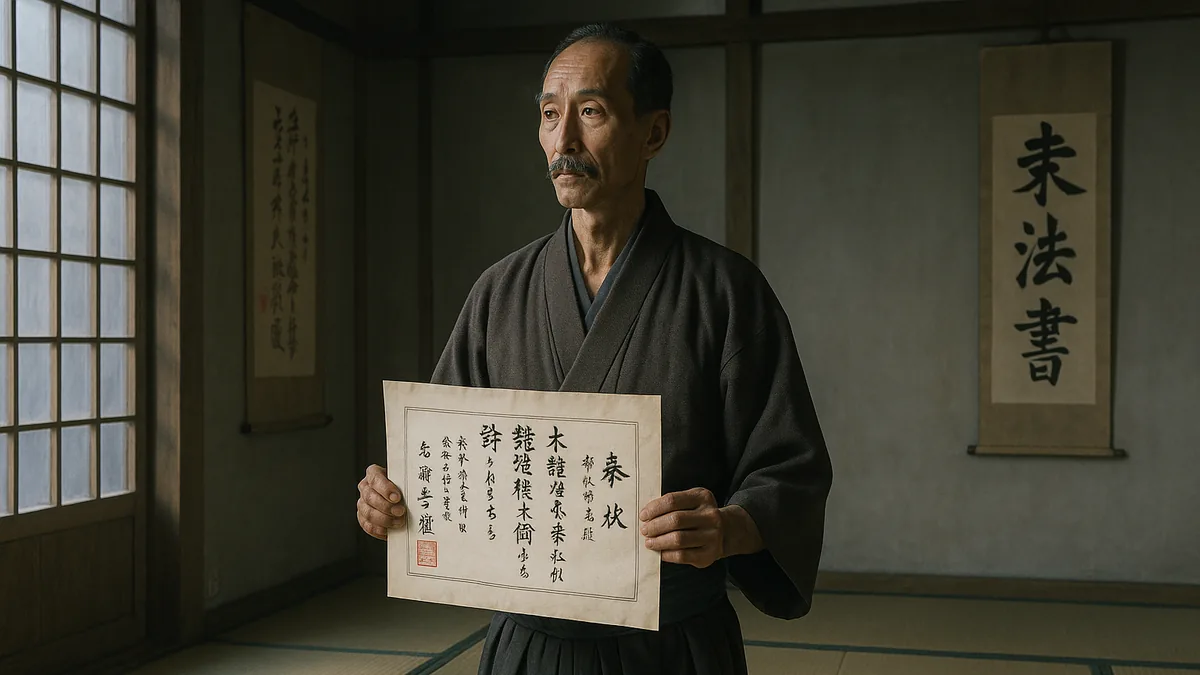
Who Was Gichin Funakoshi? The Founder of Shotokan and How His Okinawan Background Shaped Modern Karate
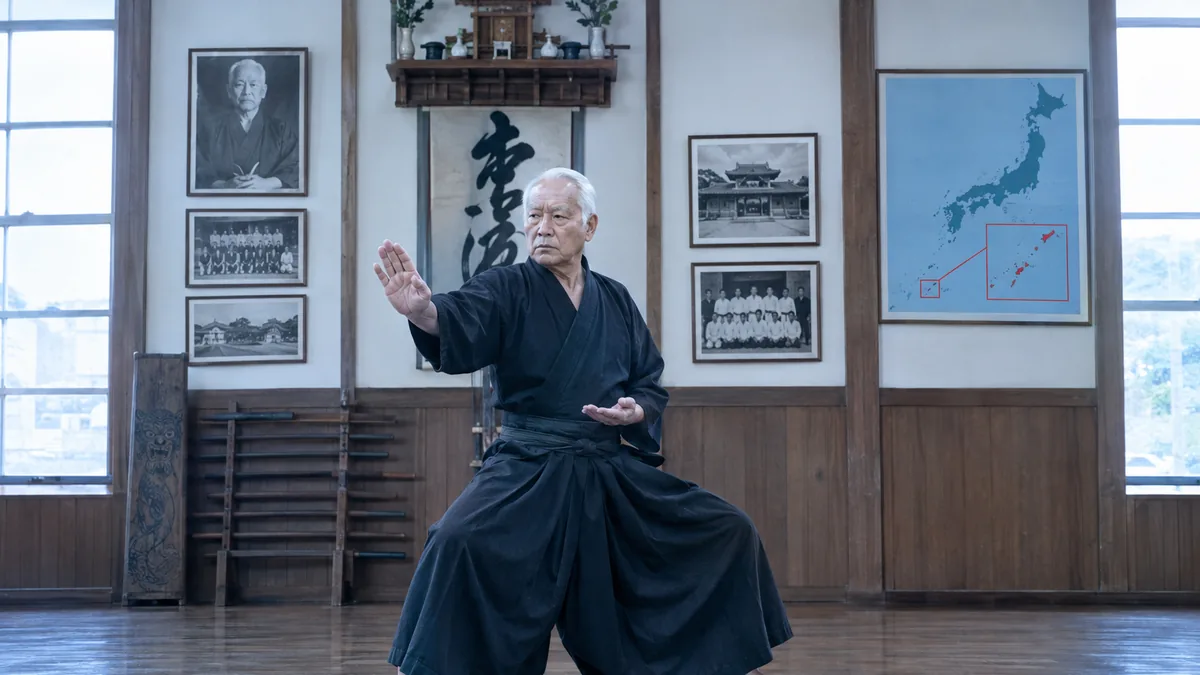
Most people who train Shotokan have heard Funakoshi’s name hundreds of times before they really understand what he actually did - or why it still matters to how you train today. He is not just a historical figure to acknowledge at gradings. The decisions he made, the compromises he accepted, and the philosophy he refused to abandon shaped the style you are practising right now, down to the stances you hold and the kata you drill.
Understanding where Funakoshi came from, and what he was trying to do, changes how you read his system. It explains why Shotokan looks the way it does, why certain principles get repeated until they feel like mantras, and why some things that seem contradictory in the syllabus actually make sense once you know the context.
The Okinawan Foundation You Cannot Ignore
Gichin Funakoshi was born in Shuri, Okinawa, in 1868.1 He began training as a child, studying under two of the most significant figures in Okinawan martial arts: Anko Itosu and Anko Azato.2 Both men were themselves products of a long tradition of what was then called te - an Okinawan fighting system that had developed in relative secrecy, shaped by trade and cultural contact with China.
This is where the common mistake starts. Many practitioners assume Shotokan is essentially a Japanese martial art that happened to be invented by an Okinawan. It is more accurate to say that Funakoshi brought an Okinawan system to Japan and then spent the rest of his life navigating the tension between preserving that system and making it legible to a Japanese audience.
Itosu was a transformative figure in his own right. In 1901, he introduced karate into the Okinawan school physical education curriculum, which meant simplifying and systematising what had previously been a more private, individualised transmission. The Pinan kata - known in Shotokan as the Heian series - are widely attributed to Itosu as pedagogical tools: structured sequences designed to teach foundational principles to students who were not receiving the intensive one-to-one instruction of an earlier era. Funakoshi began training under Itosu from around the age of eleven, and that pedagogical approach - karate as something that could be taught systematically to large groups - stayed with him.2
Azato, by contrast, emphasised depth over breadth. He reportedly trained Funakoshi in a smaller number of kata but with an intensity that prioritised genuine understanding over catalogue knowledge. The contrast between these two teachers maps onto a tension that still runs through Shotokan today: breadth of syllabus versus depth of understanding. Most senior Shotokan practitioners would argue you need both, but the emphasis shifts as you progress.
The 1922 Demonstration and What It Actually Changed
Funakoshi first brought karate to mainland Japan in 1922, when he gave a demonstration at the First National Athletic Exhibition in Tokyo, organised by the Ministry of Education. Jigoro Kano, the founder of judo, was among those in the martial arts community who witnessed the demonstration and was so impressed that he strongly urged Funakoshi to remain in Japan.
That moment is often presented as the birth of modern karate, and in institutional terms it was. But what changed was not the techniques - it was the framing. Japan in 1922 had a highly developed culture of martial arts as character-forming disciplines, shaped by the budo tradition. Kano had already successfully positioned judo within that framework, and Funakoshi understood that karate would only find a permanent home in Japan if it could be understood in similar terms.
This is where Funakoshi made choices that still divide opinion. He changed the written character for kara - from the character meaning “China” or “Tang dynasty” to the character meaning “empty.” Karate shifted from “Chinese hand” to “empty hand.” He also restructured the names of many kata to make them sound less Chinese and more accessible to Japanese practitioners. Seisan became Hangetsu. Pinan became Heian. Chinto became Gankaku.
Some Okinawan practitioners and historians view these changes as an erasure of karate’s Chinese and Okinawan roots. That is a legitimate position. Funakoshi’s counter-argument, implicit in his writing, was that the art’s survival required adaptation. Both views are defensible. What is not defensible is pretending the changes were purely cosmetic - they shaped how generations of practitioners understood what they were training.
For a detailed comparison of how two students of the same Okinawan masters built very different systems from the same raw material, see our article on Funakoshi vs Mabuni: How Two Students of the Same Masters Built Completely Different Styles.
The Philosophy Was Not Marketing
Funakoshi’s twenty precepts - the Niju Kun - are sometimes treated as inspirational slogans to put on dojo walls. That undersells them. They are a coherent statement of what he believed karate was for.
The most quoted is probably the first: Karate ni sente nashi - “There is no first attack in karate.” This is not a rule about competition. It is a philosophical position about the purpose of training. The point is not that you never strike first in a self-defence situation; the point is that karate as a discipline is not oriented toward aggression. You train to be capable, not to be dangerous.
The correction that matters here is one that instructors repeat constantly but beginners often misread: the goal of kata training is not to memorise sequences. It is to internalise principles until they become instinctive. A white belt learns where to put their feet. A brown belt starts to feel why the feet go there - what the stance actually loads, what the hip position enables, what the timing of the technique requires. By the time a practitioner reaches dan grade, the kata should feel less like a choreographed routine and more like a conversation with a principle.
Funakoshi wrote two major books that remain essential reading. The first was Ryukyu Kempo: Karate (1922), the first formal exposition of the art published in Japan.3 The second was his autobiography Karate-Do: My Way of Life, written in Japanese in 1956 and first published in English by Kodansha International in 1975.4 The autobiography is worth reading not as a technical manual but as a window into how he understood the relationship between physical training and personal development. He was explicit that he saw karate as a lifelong discipline, not a fighting system you mastered and then deployed. The training was the point.
How Shotokan’s Technical Identity Came From Okinawa
The characteristic features of Shotokan - deep stances, linear movement, emphasis on powerful single techniques - are not arbitrary stylistic choices. They reflect Funakoshi’s training background and the pedagogical decisions he made for teaching large groups.
Deep stances like zenkutsu-dachi and kiba-dachi are training tools. They build leg strength, develop hip stability, and make the structural requirements of technique visible and correctable. When you are low in a proper zenkutsu-dachi, you feel the load through your front quad and the stretch through your rear hip flexor. If the stance is shallow, the technique built on top of it loses its structural base - the punch or block becomes an arm movement rather than a whole-body action.
A common mistake at kyu grades is treating deep stances as an end in themselves - holding them statically as if the depth is the achievement. The depth is a training environment, not a fighting position. Senior practitioners understand that the strength and body awareness developed in deep stances is what enables faster, more adaptive movement in kumite. The stance teaches you what the body needs to do; application requires you to do it at a different scale and speed.
The emphasis on ikken hissatsu - the concept of finishing with a single decisive technique - also comes directly from the Okinawan tradition Funakoshi trained in. This was not sport karate; it was a system developed in a context where encounters were potentially lethal. The training philosophy that followed from this was that every technique should be trained as if it needed to work completely, not as one exchange in a points-scoring sequence.
This puts Shotokan in interesting tension with full-contact approaches. For a direct comparison of how Shotokan and Kyokushin diverged on exactly this question, see Shotokan vs Kyokushin: Why Two of the World’s Biggest Styles Disagree on Almost Everything That Matters.
What Funakoshi Did Not Control
One thing that gets overlooked is how much of modern Shotokan was shaped by people other than Funakoshi, sometimes in directions he actively opposed.
His son Yoshitaka Funakoshi (also known as Gigo, 1906 to 1945), who taught at the Shotokan dojo in Tokyo, significantly developed the technical syllabus. He pushed the style toward longer, lower stances than had previously been emphasised, and introduced or refined kicking techniques including mawashi-geri (roundhouse kick) and yoko-geri (side kick). Yoshitaka’s influence is substantial and sometimes underacknowledged, though it is worth noting that the postwar development of Shotokan by instructors who had not trained with him - including Masatoshi Nakayama - means the style’s technical character was shaped by multiple hands across two distinct eras.
Funakoshi himself was reportedly uneasy about the direction competitive karate was taking in his later years. He died in 1957, before the Japan Karate Association fully systematised the tournament format that would become standard. The JKA was formed in 1949 by Funakoshi’s senior students, with Funakoshi as its honorary head and Masatoshi Nakayama as Chief Instructor.3 It went on to produce some of the most technically rigorous Shotokan instruction ever documented - through Nakayama’s Best Karate series - but it developed a competitive culture that Funakoshi’s philosophy had not envisioned.
This is not a criticism of competitive Shotokan. It is an observation that the style as it exists today is the product of multiple hands, and understanding that helps you read the system more clearly.
Community Perspective
There is a genuine disagreement within Shotokan circles - and between Shotokan and other Okinawan-derived styles - about how much of the original intent survived the transition to Japan.
Practitioners who train in styles that maintained closer ties to Okinawa, such as Goju-Ryu (see Who Was Chojun Miyagi? The Founder of Goju-Ryu and How His Trips to China Shaped the Style), sometimes argue that Funakoshi’s adaptations stripped out close-range grappling, joint manipulation, and the more practical self-defence applications that were embedded in the original kata. This view has gained traction through the bunkai revival of recent decades, where researchers like Iain Abernethy have argued that many kata contain applications that standard Shotokan training does not address.
The counter-position, held by many senior JKA-lineage instructors, is that the kata applications were never the whole point - that Funakoshi’s emphasis on fundamental technique, character development, and the refinement of basic movement is itself the core of what he was transmitting, and that chasing bunkai can distract from that deeper work.
Both positions reflect something real. Where you land probably depends on what you are training karate for.
Key Takeaways
- Funakoshi’s philosophical framework - character development through disciplined training - was not decoration added to a fighting system. It was his central argument for what karate was. Train the kata with that in mind and they read differently.
- The deep stances of Shotokan are training tools, not combat positions. The correction that makes the biggest difference is understanding what they are building: structural load, hip stability, and whole-body integration. Once you feel a punch that comes from a properly loaded stance, you understand why the stance matters.
- Funakoshi changed kata names and the written character for “kara” deliberately. Knowing this does not diminish the style, but it does help you understand that Shotokan is an adapted transmission, not a perfectly preserved original - and that is true of every style.
- The Niju Kun are worth reading as a coherent document, not as individual slogans. They describe a practitioner’s relationship to training, to opponents, and to daily life in ways that bear on how you approach the dojo.
- Modern Shotokan was shaped significantly by Yoshitaka Funakoshi and the JKA’s technical development, not only by Gichin. Understanding the lineage helps you understand why different Shotokan associations sometimes look and feel quite different from each other.
- If Funakoshi’s approach interests you, the comparison with Hironori Otsuka - another student of the same era who made very different choices - is illuminating. See Who Was Hironori Otsuka? The Founder of Wado-Ryu and Why His Jujutsu Background Still Defines the Style.
References
Checked by the KarateLifestyle editorial team against official governing body pages (JKA, SKIF, SKA), established karate association histories, and primary bibliographic records in November 2026. Many coaching and philosophical points in this article are matters of transmitted practice rather than citable fact and are presented without sources accordingly.
- Supreme Master Funakoshi Gichin. Japan Karate Association (JKA) official website, biographical page on Gichin Funakoshi
- Gichin Funakoshi (1868-1957). Shotokan Karate-Do International Federation (SKIF), official biographical page
- Ryukyu Kempo Karate (1922) - first publication. JKA WF America, historical overview confirming title and date of Funakoshi's first book
- Karate-Do: My Way of Life. Internet Archive holding: Funakoshi, Gichin; originally published San Francisco: Kodansha International Ltd., 1975 (English translation)
The weekly digest
New karate articles, once a week
One email every week with everything new on Karate Lifestyle. No spam; unsubscribe in one click.
We'll email you to confirm. See our privacy policy.