How to Develop a Dominant Back Leg in Kumite: Why Most Karateka Neglect It and What You Are Leaving on the Table
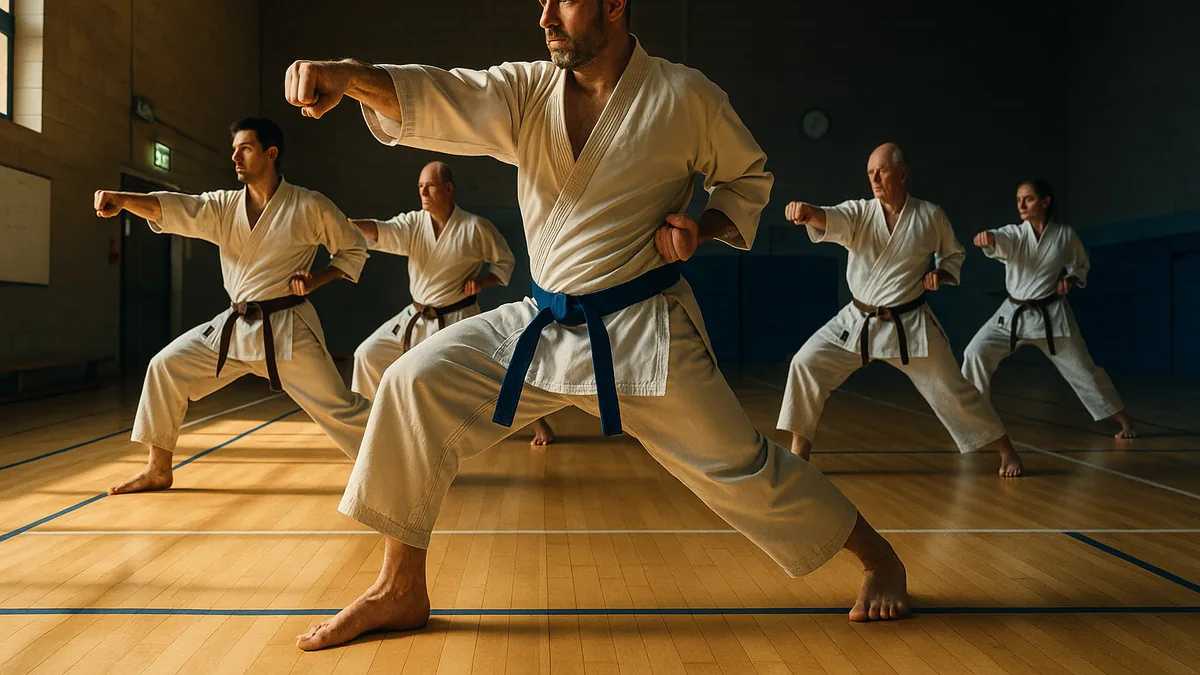
Most karateka treat the back leg like a passenger. It sits there, holds the stance, and waits for the front leg to do something interesting. That is a significant mistake, and it is costing you power, stability, and scoring opportunities you probably do not even realise you are missing.
The front leg gets all the attention - kizami-zuki, mae-geri, ashi-barai. If you want to understand why front-leg development matters, we cover that in detail here. But the back leg is where your gyaku-zuki lives, where your explosive forward drive originates, and where your ability to hold ground under pressure is decided. Neglect it and you will always be slightly slower, slightly less powerful, and slightly easier to unbalance than you should be.
This is not about adding leg presses to your gym routine. It is about understanding what the back leg is actually supposed to do in kumite, and then training it specifically to do that.
Why the Back Leg Gets Neglected
The honest reason is visibility. In kumite, attacks come from the front. Naturally, attention goes to the front. Most beginners focus on what their hands are doing, then their front leg, then - eventually - their back leg. By the time they get there, bad habits are already embedded.
There is also a misunderstanding about how power works in gyaku-zuki. Many practitioners think the punch comes from the shoulder or the hip. The hip rotation is real and important, but the hip does not generate its own power - it transfers force that originates from the back leg pushing into the floor. Research on karate punching confirms this: during hand strikes, the lower body contributes primarily because ground reaction force is generated from the legs and transmitted to the upper body, enabling a powerful movement.1 The kinetic chain in gyaku-zuki includes the ankle of the back leg, knee, hip, shoulder, elbow, and wrist of the punching fist.2 The moment that push from the back leg is weak, late, or misdirected, the punch loses its foundation. You end up rotating around nothing.
A common coaching cue is “drive from the back foot.” Most students hear it, nod, and carry on doing exactly what they were doing before. It only makes sense once you feel the difference - and that difference is measurable. Punching performance in karate can be predicted from lower limb maximal power, with significant correlations between lower limb maximal relative power and punch speed (r = 0.66 to 0.80).3 When the back leg drives correctly, the punch feels like it comes through your whole body. When it does not, the punch feels like it comes from your arm, and it does.
What the Back Leg Actually Does in Kumite
Before drilling anything, understand the three functions:
Power generation - The back leg pushes into the floor to initiate hip rotation for gyaku-zuki. This is the primary source of punching power in a rear-hand technique. Without it, the punch is arm-only. Hip rotation supports energy efficiency and generates greater force during gyaku-zuki compared to movements without rotation.4
Explosive forward drive - In a lunge or oi-zuki attack, the back leg provides the push that closes distance. The front leg lands and stabilises; the back leg is what launched you. A weak push means a slow, short advance.
Stability under pressure - When an opponent attacks, your back leg is what keeps you from being pushed backwards. A practitioner with a loaded, active back leg absorbs pressure and counters. One with a passive back leg gets shifted off-line and loses position.
Controlling the centre in kumite is partly a back-leg problem. Practitioners who cannot hold their ground under pressure often have a passive back leg rather than a positional problem.
The Drills That Actually Develop It
We rank these in order of importance. If you only have time for two, do the first two.
1. Resistance Band Gyaku-Zuki Drive
This is the most direct way to isolate and feel the back leg’s contribution to gyaku-zuki. It is not complicated, but it exposes the weakness immediately.
Why it matters: The resistance band creates feedback. Without it, you can punch with a passive back leg and not notice. With it, you cannot fake it. A meta-analysis found a statistically significant positive effect of elastic band training on lower limb explosive power (SMD = 1.43) and change of direction performance, concluding that elastic band training is a highly effective and practical method for improving explosive power in athletes.5
Setup: Attach a resistance band around your waist, anchor it behind you at hip height. Take your fighting stance. The band should be pulling you backwards with moderate tension.
Execution:
- Load into your back leg - feel your weight shift slightly toward it, knee tracking over the toes, heel flat.
- Without moving your feet, throw gyaku-zuki against the band’s resistance.
- Drive through the back foot as you rotate - the push should happen before the hip moves, not after.
- Hold the extended position for one second. Your back foot should still be largely flat. If your heel has fully risen before impact, the push was misdirected.
- Return to stance. Reset. Repeat 10 to 15 reps per side.
What to feel for: When the timing is right, the punch feels like it comes from the floor up. You will feel load in your back glute and hamstring as you drive, not just your shoulder. The resistance band should feel like it is being overcome by your whole body, not just resisted by your arm.
The most common mistake: Rotating the hip first and then pushing. This reverses the sequence. The push initiates the rotation - it is not a separate event that follows it. The correction that usually works is to think of pushing the floor away with your back foot before you think about the punch at all. Do this slowly until the sequence is correct, then build speed.
2. Explosive Back-Leg Push: Stance Jumps
This targets the fast-twitch contribution of the back leg - the explosive drive that closes distance or generates power in a single movement.
Why it matters: Under WKF rules, good timing and correct distance are both explicit scoring criteria.6 A slow advance telegraphs your intention. The back leg has to be capable of producing explosive force on demand, not just steady force over time. Lower limb maximal power is a good and consistent predictor of punching speed across different punching actions in karate.3
Setup: Stand in fighting stance on a sprung floor or mat. No equipment needed.
Execution:
- Lower your centre of gravity slightly - not a full squat, just a subtle drop into the stance.
- Drive explosively from the back leg only, pushing forward so your front foot advances roughly half a metre.
- Land in fighting stance - front foot lands first, back foot follows immediately.
- The movement should feel like a controlled lunge, not a jump. Your head stays level throughout.
- Reset. Pause two seconds between reps to avoid building momentum. Do 8 to 10 reps.
What to feel for: The drive should feel like it comes from the hip and glute of the back leg, not the calf. If your calf is doing most of the work, you are pushing from the wrong part of the foot. The push should go through the whole foot, with the heel involved at initiation.
The most common mistake: Leaning forward before pushing. This is a balance compensation - the practitioner is afraid of falling, so they move their weight forward first. It kills the explosiveness. The correction is to stay upright and trust the push. This feels wrong at first, but trust the mechanics - the forward lean happens as a result of the drive, not before it.
3. Wall-Supported Hip Drive
This drill is less dramatic but solves a specific problem: practitioners who rotate their hip but do not actually load the back leg as part of that rotation.
Why it matters: Hip rotation without back-leg drive is a common intermediate-level problem. The rotation looks correct visually but lacks power because the leg is not contributing. This drill makes the connection explicit.
Setup: Stand facing a wall, roughly an arm’s length away, in a wide zenkutsu-dachi. Place both hands flat on the wall at shoulder height.
Execution:
- Push both hands into the wall - this is your resistance.
- Rotate your hips as if throwing gyaku-zuki, driving from the back foot.
- The wall does not move. Your job is to feel the force path from back foot through hip to hands.
- Hold the rotated position for three seconds. Feel where the effort is.
- Return slowly. Repeat 10 reps.
What to feel for: You should feel the back leg working. Specifically, you should feel the inside of the back thigh and glute engaging as you drive. If you only feel your core or your shoulder, you are not connecting the back leg into the chain.
The most common mistake: Allowing the back heel to rise. Once the heel comes up, you lose the ground connection and the force path breaks. Keep the heel down throughout the entire rotation.
4. Partner Resistance Advance
This drill develops the back leg’s role in forward drive against actual resistance - which is closer to kumite than any solo drill.
Why it matters: Against a resisting partner, your back-leg drive is either sufficient or it is not. There is no ambiguity.
Setup: Both partners in fighting stance. Partner A places both hands on Partner B’s shoulders. Partner B attempts to advance using explosive back-leg drive while Partner A provides moderate forward resistance.
Execution:
- Partner B loads the back leg and drives forward - not a slow push, but a sharp explosive effort.
- Partner A resists but allows movement if the drive is genuinely explosive.
- Partner B advances one step and holds the new stance position.
- Switch roles. 5 reps each.
The most common mistake: Partner B using upper body to push through instead of back-leg drive. The correction is for Partner A to watch the back foot - if the heel rises immediately, the drive is coming from the wrong place.
How Understanding Develops Over Time
Most beginners think the back leg is about strength. By intermediate level, most practitioners realise it is about timing. The strength matters, but a well-timed back-leg push from a lighter practitioner will generate more power than a poorly timed push from a stronger one.
What senior practitioners do differently is maintain the back leg in a state of readiness throughout the exchange - not tense, not passive, but loaded and available. A beginner’s back leg relaxes between techniques. A senior practitioner’s back leg stays coiled. This is why experienced karateka can generate power from very small movements. The back leg never fully disengages.
This connects directly to reaction speed. A loaded back leg means you can respond faster because you are not starting from zero. Slow reactions in kumite are sometimes a physical problem, but they are often a readiness problem - and the back leg is a significant part of readiness.
Progression
Once the basic drills are solid, make them harder in these specific ways:
Add fatigue: Do 30 seconds of fast stepping in place, then immediately perform resistance band gyaku-zuki. The back leg has to function under fatigue, because kumite does not pause for recovery.
Add unpredictability: Have a partner call “gyaku” at random intervals during light pad work. Your back leg has to be ready at all times, not just when you decide to punch.
Reduce stance width: As back-leg strength and awareness improves, practice the same drills from a narrower, more mobile fighting stance. The mechanics are the same but the margin for error is smaller.
Community Perspective
There is genuine disagreement between traditional and sport-focused coaches about how much stance depth should be used in modern kumite. Traditional Shotokan training emphasises deep zenkutsu-dachi, which loads the back leg heavily and builds significant strength. Sport kumite fighters often use a narrower, higher stance for mobility.
Both have merit. A deeper stance builds the back-leg strength and awareness faster. A narrower stance is more practical in competition. The sensible approach - and we would recommend this - is to train the deeper stance in kihon and drilling, then apply the developed strength to a competition-appropriate stance. Using only a narrow stance from the beginning means the back leg never gets the load it needs to develop properly.
The debate about whether gyaku-zuki or kizami-zuki is more effective in competition is also relevant here. Both score YUKO (1 point) under current WKF rules, so the question of which is more effective comes down to percentage and risk rather than point value.6 If your training is shifting toward kizami-zuki as a primary scoring tool, back-leg development becomes even more important - because without a strong back leg, your kizami-zuki has no credible threat behind it, and experienced opponents will not respect it.
Key Takeaways
- The back leg drives gyaku-zuki from the floor up. The hip rotates because the leg pushes, not the other way around. Get this sequence wrong and the punch is arm-only regardless of how it looks.
- A passive back leg is not neutral - it actively costs you stability, power, and reaction speed. Keeping it loaded throughout an exchange is a skill that takes deliberate training to develop.
- The resistance band gyaku-zuki drill is the most direct diagnostic tool available. If the punch feels weak against resistance, the back leg is not contributing correctly.
- The correction that works best for most practitioners is to think “push the floor” before thinking “punch.” This reorients the sequence without requiring a complete technical overhaul.
- You will feel the difference between a connected and disconnected back leg before you see it. When it connects, the punch feels solid through your whole body. When it does not, the impact feels like it stops at your shoulder.
- Do not wait until your front-leg game is complete before developing the back leg. They develop together, and a strong back leg makes your front-leg techniques more credible because opponents have to respect the threat behind them.
References
Checked by the KarateLifestyle editorial team against peer-reviewed sports science and biomechanics literature (PubMed, ResearchGate, ScienceDirect), and the World Karate Federation's official competition rules, in October 2026. Biomechanical studies on karate punching are generally conducted on small samples of competitive athletes and findings should be interpreted accordingly.
- Changes in muscle activity during karate gyaku-zuki-punch and kiza-mawashi-giri-kick after specific training in elite athletes. ResearchGate preprint/abstract; multiple authors; confirms lower body GRF contribution to hand strikes in karate
- Metrical characteristics and the reliability of kinematic sensor devices applied in different modalities of reverse punch in karate athletes. Peer-reviewed journal article, ScienceDirect; confirms kinetic chain from back-leg ankle through to punching wrist in gyaku-zuki
- Lower Limb Maximal Power Predicts Punching Speed in Different Static and Dynamic Attacking Techniques in Karate. Quinzi F, Rosellini G, Sbriccoli P; Journal of Strength and Conditioning Research; 2020; University of Rome Foro Italico
- Biomechanics of Kumite Style Gyaku tsuki in Karate. ResearchGate; peer-reviewed; confirms hip rotation generates greater force in gyaku-zuki versus no-rotation condition
- Effects of Elastic Band Training on Physical Performance in Team Sports: A Systematic Review and Meta-Analysis. PMC/PubMed; Xu et al.; 2026; systematic review and meta-analysis of elastic band training on explosive power (SMD = 1.43)
- World Karate Federation Kumite Competition Rules, Version 2024.00. World Karate Federation official rules document; 2024; confirms YUKO scoring for tsuki/uchi and scoring criteria including timing and distance
The weekly digest
New karate articles, once a week
One email every week with everything new on Karate Lifestyle. No spam; unsubscribe in one click.
We'll email you to confirm. See our privacy policy.