Controlling the Centre in Kumite: What It Means and Why Most Practitioners Ignore It
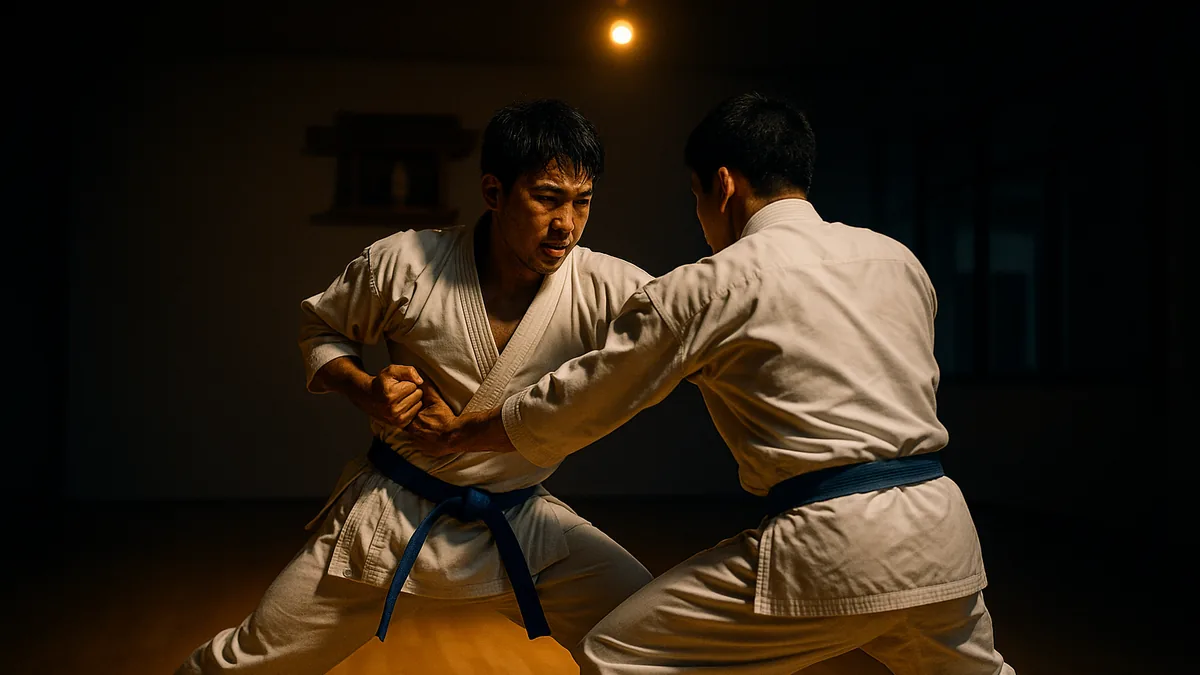
Most people treat kumite like a game of tag. Move forward, throw a technique, move back. Repeat. And if you watch a lot of club-level sparring, that’s exactly what you see - two people taking turns throwing punches from the same patch of floor, neither one really threatening the other, both wondering why their attacks keep getting blocked or why they can’t close the distance cleanly.
The answer, almost every time, is centre control. Or rather, the complete absence of it.
I spent probably the first four or five years of my training not understanding what my instructor meant when he talked about “owning the space.” I thought it was something abstract - a mindset thing, like confidence. It took getting repeatedly walked down by a senior brown belt during jiyu-kumite one evening to understand it was entirely physical. He wasn’t faster than me. He wasn’t stronger. But every time I tried to attack, I was already off-balance. Every time I tried to retreat, I had nowhere useful to go. He had taken the centre before I’d even decided to move.
That was the session that changed how I think about kumite.
What Centre Control Actually Means on the Floor
It’s not about standing in the middle of the dojo. That’s the mistake most people make when they first hear the concept - they think it means occupying a specific point in the room. It doesn’t.
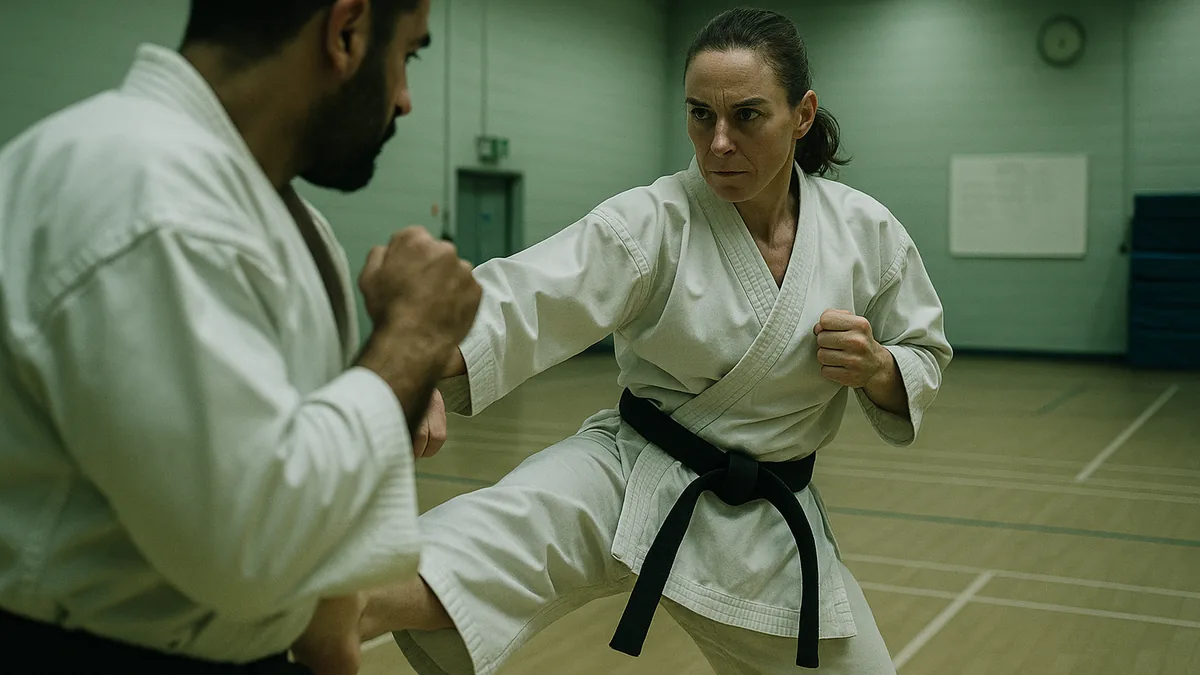
Centre control is about your position relative to your opponent. It means being positioned so that you have a direct, unobstructed line to your opponent’s target areas, while they don’t have the same line to yours. When you control the centre, your attacks travel the shortest possible distance. Theirs have to travel further, angle awkwardly, or get blocked by your structure before they arrive.
The physical sensation of being in the centre is actually quite distinct once you’ve felt it. You feel settled - grounded but mobile, like you could move in any direction without reorganising yourself first. You’re not leaning forward or back. Your weight is genuinely distributed. When you’re out of the centre, you’ll feel a kind of urgency, a low-level tension like you’re trying to hold position on a slope. Most beginners live in that feeling and assume it’s just what kumite feels like.
It isn’t. That feeling is the signal that someone else has the centre.
Why Most Practitioners Ignore It
I’ve noticed that the problem isn’t awareness - most students have heard the concept explained. The problem is that footwork is boring to train and immediately gratifying to skip. Throwing a gyaku-zuki feels productive. Shuffling laterally for five minutes feels like you’re not doing anything.
There’s also a deeper misunderstanding underneath it. Most beginners - and I was guilty of this - think kumite is about technique. You win by having better techniques than the other person. So training time goes into punching harder, kicking higher, making the waza cleaner. The footwork that would actually make those techniques land gets ignored because it doesn’t feel like fighting.
What I tell students is this: your technique is only as good as the position you’re in when you throw it. A gyaku-zuki from a compromised position is not a gyaku-zuki - it’s a shove. The technique is the same. The position is everything.
One mistake I see constantly, especially in students around the 6th to 4th kyu range, is what I’d call “chasing the target.” The opponent moves - maybe a small shuffle to the side - and the student pivots and chases them, often stepping directly into the opponent’s strongest line. They’re so focused on keeping the target in front of them that they’ve handed over the centre without realising it. The correction that makes the biggest difference here is teaching students to move the centre rather than follow it. Instead of pivoting to face a moving opponent, you step to reclaim the angle. Small difference in description, massive difference in what it feels like and what it allows you to do.
The Offensive Advantage You’re Leaving on the Table
When you genuinely control the centre in jiyu-kumite, attacking becomes almost simple. Your opponent has to deal with the geometry before they can deal with your technique. You’re already inside their ideal response distance. Their block has to travel further to intercept you. Their counter has to navigate around your position.
I’ve had sessions where I’ve landed clean chudan-zuki repeatedly against training partners who were technically better than me, purely because I’d taken the centre early and maintained it. The technique itself was ordinary. The position made it work.
The flip side is equally true. When you’re out of the centre - when your opponent has the angle on you - even good technique fails. I’ve seen students land what looked like a solid oi-zuki and score nothing because they were slightly off-axis and the power had nowhere to go. The punch arrived but the position meant it glanced rather than drove through.
If you’re finding that your attacks aren’t converting, before you look at your technique, look at your position when you throw. If you’re attacking from a compromised angle, technique refinement won’t fix it. This connects directly to the reaction problem - if you want to understand why your attacks feel slow or telegraphed even when you think you’re moving well, the guide on fixing slow reactions in kumite goes into the mechanics of how positional awareness affects perceived speed.
The Defensive Advantage Is Just as Important
Most people think about centre control offensively. The defensive application is actually where I think it earns its value most clearly.
When you control the centre, you’re rarely in a position where you need a large, committed block. You’re already at an angle where the attack has to travel further or adjust direction to reach you. Small movements - a slight shift of weight, a minor angle change - are enough to make an incoming technique miss or arrive without power.
When you don’t control the centre, you’re always defending reactively. You’re waiting to see the attack and then trying to intercept it. That’s a losing game against anyone with reasonable speed, and it’s exhausting. I’d rather spend energy maintaining position than spend it blocking.
My instructor used to say “the best block is not being there.” I thought that was about evasion - slipping punches, ducking kicks. By brown belt I realised it was about positioning before the attack even launches. If you’re in the right place before they throw, you’re already not there.
Drills That Actually Build This Skill
Talking about centre control is easy. Building it into your movement patterns takes specific practice, and free sparring alone won’t do it - there’s too much happening for most students to isolate footwork as a variable.
The angle drill: Two people face off in fighting stance. One person moves - just footwork, no techniques - and the other person’s only job is to maintain the centre angle. No attacking, no defending. Just footwork. Do this for two or three minutes and you’ll immediately see who understands the concept and who is just chasing. The person who keeps ending up at a bad angle is telegraphing their footwork, reacting too late, or moving in straight lines. This drill makes it obvious.
Restricted sparring: One person can only move forward and back. The other can move in any direction. The person with full movement has to try to control the centre while the restricted partner keeps pressing. This forces the mobile person to actually use lateral movement with purpose rather than just shuffling around randomly.
The pressure line drill: Mark a line on the floor (or use the edge of the mat). One person defends the line, the other attacks. The defender can’t step back over the line - they have to use footwork and positioning to maintain the centre without retreating. This is uncomfortable at first and that discomfort is the point. Most students discover they’ve been using backward movement as a substitute for actual centre control.
These drills work best when they’re regular and short - five minutes at the end of every kumite session rather than a one-off focus. The pressure testing article on controlled sparring drills covers how to structure this kind of constrained practice if you want to build a more systematic approach.
How This Changes Depending on Your Build
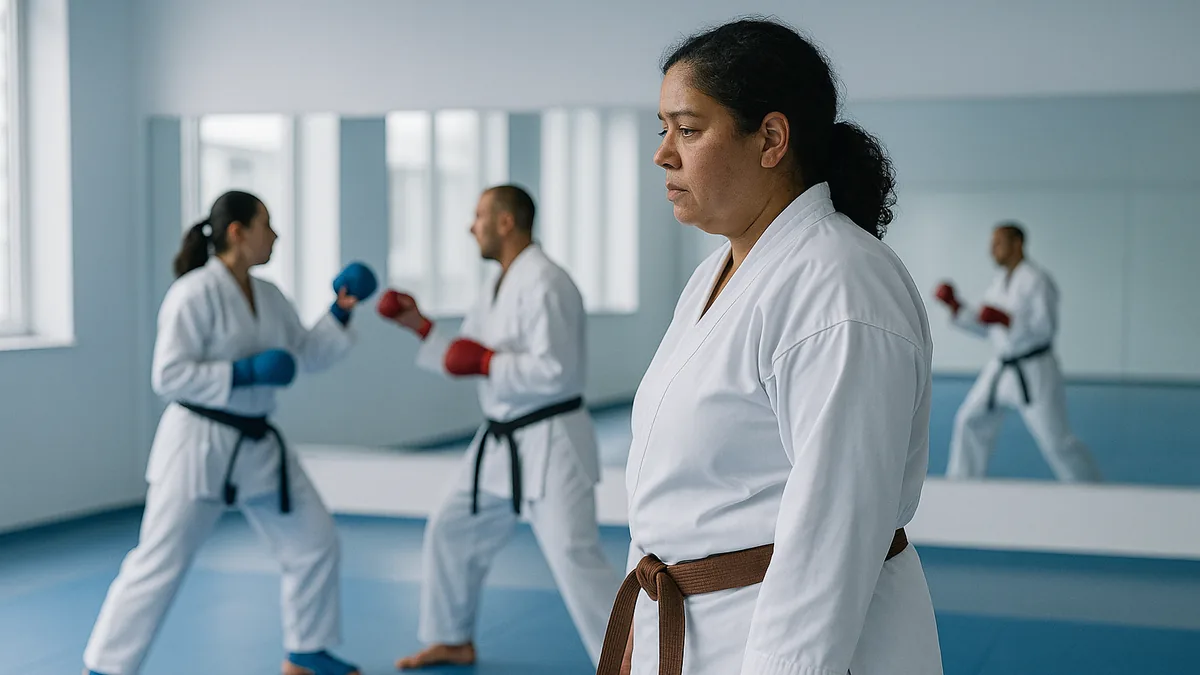
I should be honest here: centre control doesn’t look identical for everyone, and I’ve seen instructors teach it in a way that implicitly assumes a specific body type. Taller practitioners can often maintain the centre with less lateral movement because their reach creates the angle advantage without them having to move as much. Shorter or heavier practitioners need to be more deliberate about using footwork to create that geometry.
If you’re on the shorter or heavier side, the principles are exactly the same but the execution is different - you’re often working harder to close distance and establish the centre before your opponent can use their reach to neutralise your position. The kumite guide for heavier or shorter karateka goes into this specifically, and I’d say centre control is one of the areas where build makes the biggest practical difference.
Community Perspective
There’s a genuine split in how different dojos prioritise this. Traditional Shotokan training tends to emphasise it through kata application and kihon - the geometry of hanmi, the angles in the kata, the way hikite creates the centre line. Students who’ve trained that way often develop centre control implicitly before they can articulate it.
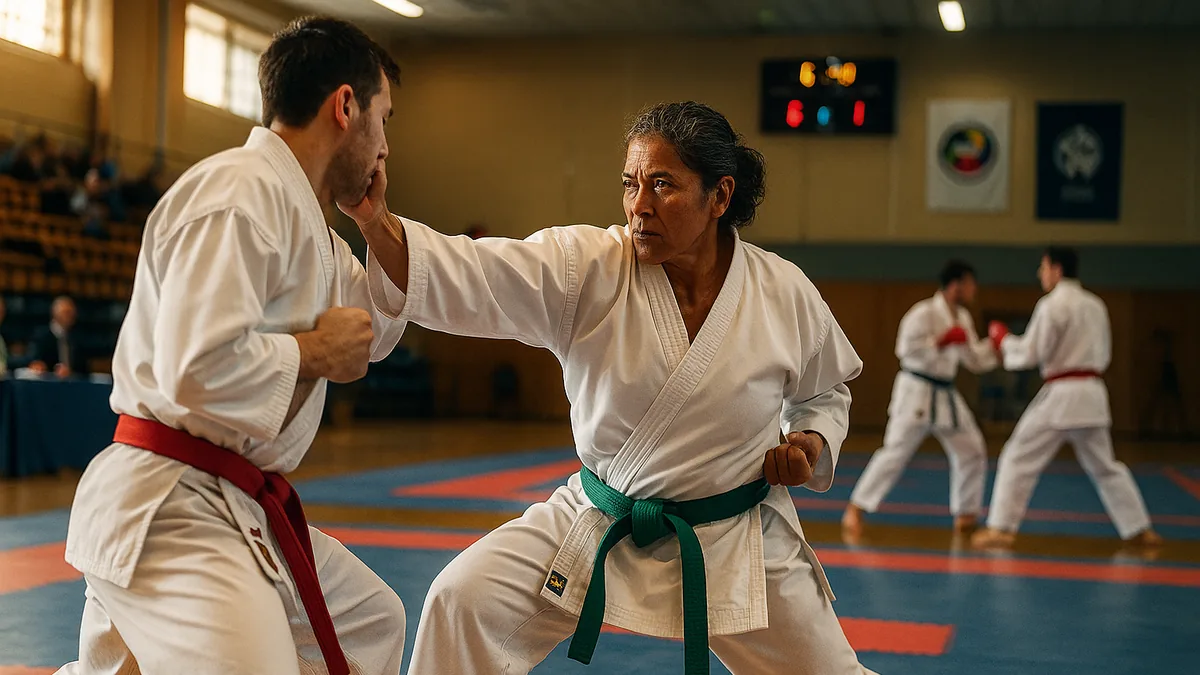
Sport-focused kumite training, particularly in WKF-style competition, often teaches it more explicitly through footwork drills, because the scoring system rewards the kind of clean, angled attacks that centre control enables. The techniques are different but the underlying principle is the same.
Where I’ve seen the sharpest disagreement is around how much to teach it consciously versus letting it develop through volume of sparring. Some very experienced instructors I respect genuinely believe that drilling it explicitly creates overthinking - that students should just spar more and the positioning will emerge naturally. I don’t agree with that, especially not below black belt. I’ve seen too many students spar for years and never develop it because they were reinforcing bad habits. Explicit drilling accelerates the learning considerably. You still need the sparring volume, but you need the drills to give the sparring something to work with.
The feinting article touches on something related - a lot of what makes feinting work is that it disrupts the opponent’s centre control, not just their attention. If you’re working on both simultaneously, they start to reinforce each other in ways that become difficult for opponents to read.
Key Takeaways
- Centre control is positional, not spatial - it’s about your angle relative to your opponent, not where you stand in the room. If your attacks keep failing despite good technique, check your position before you change your technique.
- The feeling of being out of the centre is a specific physical sensation - urgency, slight imbalance, the sense that you need to reorganise before you can move freely. Learn to recognise it in real time.
- Most students lose the centre by chasing the target. The correction is to move the angle rather than follow it - step to reclaim position rather than pivot to face a moving opponent.
- Drilling centre control in isolation (angle drills, restricted sparring, pressure line work) builds it faster than free sparring alone. Short, regular practice beats occasional focus sessions.
- If you’re working on timing and counter-attacking, centre control is what makes those counters available - without the position, the timing doesn’t matter because the technique has nowhere clean to go.
- Improving kumite timing and improving centre control are the same project approached from different angles. You can’t fully develop one without the other.
The weekly digest
New karate articles, once a week
One email every week with everything new on Karate Lifestyle. No spam; unsubscribe in one click.
We'll email you to confirm. See our privacy policy.