Pressure Testing Your Kumite: Why Controlled Sparring Drills Beat Free-Fighting for Most Practitioners
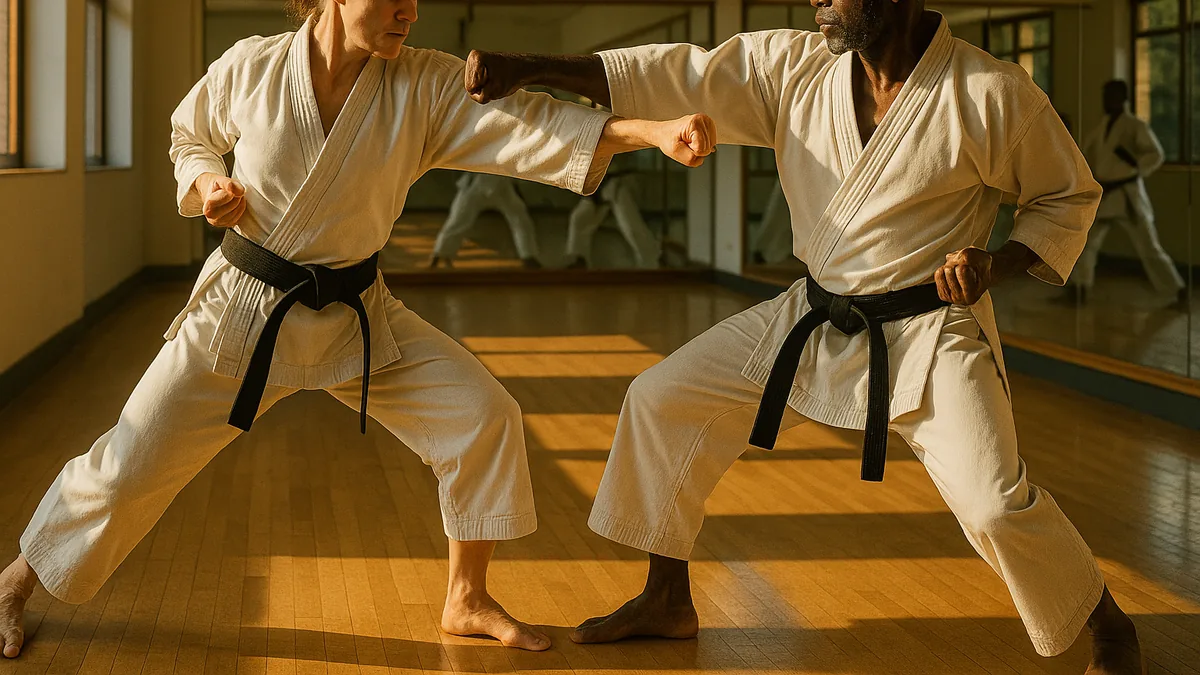
Most students treat free-fighting as the primary way to get better at kumite. They show up, bow in, and just go. No structure, no constraints, no real feedback loop. And then they wonder why they’re making the same mistakes six months later.
Free sparring has its place. I’m not dismissing it. But I’ve watched too many students spend years in jiyu-kumite without actually improving, because they were just surviving rather than training. The drills that actually move the needle are the ones with constraints - where you can’t just default to your habits, where the structure forces you to feel the problem.
That’s what this is about. Not theory. What I’ve seen work in the dojo, what I’ve corrected more times than I can count, and why controlled sparring drills are where most of us should be spending the majority of our training time.
Why Free Sparring Alone Isn’t Enough
I used to think free sparring was the ultimate test. My instructor kept pulling me back into structured drills and I’d nod along, then go straight back to jiyu-kumite at every opportunity. It wasn’t until I started teaching that I understood what he was doing.
Free sparring tests what you already have. It doesn’t build what you’re missing.
When you’re in a live round with no constraints, you default to your strongest techniques, your most comfortable distance, your existing timing. You avoid your weaknesses rather than confronting them. The student who can’t counter off a failed attack will just stop attacking in free sparring. The student who crumbles under pressure will stay on the outside and poke. They’re not getting worse - but they’re not getting better either.
Controlled drills force you into the uncomfortable places. They isolate the problem. And because the risk is lower, you can actually work on it instead of just surviving.
This connects to something I think about a lot - the difference between skill acquisition and skill testing. Free sparring is mostly testing. Structured drills are where the acquisition actually happens.
The Drills I Use Most
I’ll rank these honestly. If you only have time for two, do the first two. Everything else is valuable but these are the ones that produce the most visible improvement the fastest.
Drill 1: Single-Technique Counter Flow
This is the drill I come back to more than any other. It’s the foundation of everything.
Why it matters: Most practitioners can attack. Most can block. Very few can do both fluidly in sequence without resetting. This drill breaks that habit.
Setup: Two partners. One designated attacker, one defender. The attacker throws one pre-agreed technique - say, a chudan gyaku-zuki. The defender blocks and immediately counters with one pre-agreed technique. Then the attacker blocks that counter and throws again. It flows continuously.
Execution:
- Agree on the attack and counter before you start. Keep it simple - one technique each.
- The attacker sets the pace initially. Slow enough that the defender can feel the timing, not just react.
- After 60 seconds, switch roles. After another 60 seconds, increase pace slightly.
- Once both partners are comfortable, the attacker gets to vary the timing - not the technique, just the timing.
What to feel for: When the timing is right, the block doesn’t feel like stopping the attack. It feels like redirecting it - there’s a moment where the energy of the incoming technique actually helps you launch the counter. You’ll feel it through your forearm and into your shoulder. When you’re just absorbing the block, your shoulder takes all of it. When you’re redirecting, it almost bounces you into the counter.
The mistake I see most often: Students block first, then counter. Two separate movements. What I tell students is that the block and the counter should share a breath - one exhale, not two. The counter starts before the block finishes. This feels wrong at first because it seems like you’re rushing, but you’re not rushing, you’re connecting the movements. Trust the mechanics.
Drill 2: Restricted Zone Sparring
Why it matters: Most students have no idea how bad their distance management in kumite actually is until you constrain the space.
Setup: Mark out a small area - roughly two tatami mats. Both partners spar within it. Neither can step outside. No points, no winners, just controlled engagement at close range.
Execution:
- Start with light contact only. The goal isn’t to score, it’s to stay in the zone and keep working.
- If someone steps out, they immediately step back in. No penalty, just awareness.
- Run this for 2-minute rounds. Rest 1 minute. Three rounds minimum.
- Progression: reduce the zone size. Or add a rule - one partner can only move laterally, the other can only move forward/back.
What to feel for: You’ll notice almost immediately that your go-to evasion stops working. Students who rely on stepping back to create distance suddenly have nowhere to go. What should happen is that your footwork gets more creative - small adjustments, angles, weight shifts. When it’s working, you’ll feel like you’re always slightly off the line of attack without having moved much at all.
The mistake I see most often: Students panic and start throwing wild techniques to create space. I’ve seen this in every dojo I’ve trained in. The correction that actually works is to tell them to slow their breathing first. The panic is physical. When you control the breath, the footwork follows.
Drill 3: One-Attack, One-Counter, Freeze
This one looks simple and is harder than it sounds.
Why it matters: It forces you to evaluate what you’re actually doing, not what you think you’re doing. It’s the single best drill I know for identifying strategic weaknesses.
Setup: One partner attacks once. The other counters once. Both freeze immediately after. Then you look at where you are - distance, position, guard, weight distribution. Talk about it. Then reset.
Execution:
- No pre-agreed techniques this time. The attacker chooses. The defender responds.
- After the freeze, both partners assess out loud. “My guard dropped here.” “I was too far to make that land.” “My weight was back when I should have been forward.”
- Reset and repeat. Alternate who attacks.
- Run this for 15 minutes minimum. The conversation is part of the drill.
What to feel for: You’re looking for the moment after the counter where you feel either secure or exposed. Secure means your weight is balanced, your guard is up, you could throw another technique immediately. Exposed means something is off - you’ve over-extended, your guard is down, you’ve moved into a worse position than you started. Most students don’t know which one they’re in until they freeze and check.
The mistake I see most often: Students skip the freeze. They want to keep going. I understand the impulse - stopping feels artificial. But the whole point is the pause. The pause is where the learning is. If you skip it, you’re just doing slow free sparring.
Drill 4: Pressure-Response Timing Drill
Why it matters: Kumite timing isn’t just about speed. It’s about reading when to go and when not to. This drill trains that specifically.
Setup: One partner is the attacker and applies constant forward pressure - not attacking yet, just moving forward, changing angles, feinting. The defender moves, maintains distance, and looks for the moment to counter-attack.
Execution:
- The attacker can attack at any point. The defender can only counter-attack - no initiating.
- The attacker should vary the timing between feints and real attacks. Sometimes three feints then attack. Sometimes attack immediately.
- Run 90-second rounds. The defender’s job is to stay calm, read the pressure, and find the counter.
What to feel for: When you’re reading the pressure correctly, you’ll feel a kind of stillness inside the movement. You’re moving, adjusting, but there’s no panic. The attack comes and you’re already moving before you consciously register it. That’s the timing clicking in. When you’re behind, everything feels rushed - you’re always reacting late, always playing catch-up. The goal is to get to that still place. For more on building this into a complete counter-attacking approach, counter-attacking in karate goes deeper into the strategy behind it.
How This Changes With Experience
A beginner doing these drills is mostly trying to execute the mechanics. They’re thinking about where their hands are, whether their stance is right, whether they’re hitting the right target. That’s fine. That’s where it starts.
By intermediate level, the mechanics should be quiet enough that you can start feeling the drill - not just doing it. You’re noticing the rhythm, sensing when your partner is about to move, feeling the moment before the attack rather than just reacting to it.
Senior practitioners use these drills completely differently. I’ve noticed that the most experienced people in the dojo do the drills slower, not faster. They’re not trying to impress anyone. They’re feeling for the smallest details - the micro-adjustment in weight that telegraphs the attack, the tiny hesitation that opens the counter. The drill becomes a conversation rather than an exercise.
Making It Harder
Once the basic versions are solid, there are a few ways to raise the pressure without losing the structure.
Add a time constraint. Run the Single-Technique Counter Flow with a 30-second window and count exchanges. Suddenly the pace is self-imposed and the pressure is real.
Add a consequence. Whoever steps out of the zone in Restricted Zone Sparring does 10 push-ups. Small stakes, but it changes the mental engagement completely.
Remove the pre-agreement. In the Counter Flow drill, once both partners are comfortable, let the attacker choose their technique without telling the defender. Now the defender has to read and respond rather than prepare.
For solo work that complements these partner drills, solo training drills that transfer to kumite has specific exercises that build the same attributes without needing a partner.
Community Perspective
There’s a genuine split in how dojos approach this. Traditional clubs often prioritise kata and kihon, with structured kumite drills seen as the bridge to free sparring. Sport-focused clubs sometimes go the other direction - lots of free sparring, with structured drills used mainly to fix specific technical problems.
I’ve trained in both environments and I think the truth is somewhere in the middle, but I’ll take a position: for most practitioners below black belt, structured drills should take up more time than free sparring, not less. The free sparring is where you test what you’ve built. The drills are where you build it. Spending 80% of your time testing and 20% building is backwards.
The other common disagreement is about contact level in these drills. Some instructors insist on near-zero contact so students can move freely without fear. Others want enough contact that the techniques feel real. I prefer light contact with occasional controlled full-contact moments - enough that you know the technique landed, not so much that your partner is managing pain instead of training. But this varies enormously between styles and that’s a legitimate difference, not one camp being wrong.
Key Takeaways
- Free sparring tests what you already have. Structured drills build what you’re missing. You need both, but most practitioners underweight the drills.
- The freeze in the One-Attack, One-Counter drill is the whole point. Don’t skip it.
- When the block-counter connection is right, you’ll feel the incoming technique redirect into your counter. When it’s wrong, you’re absorbing and then throwing. Those are completely different physical experiences.
- Restricted zone sparring will expose your distance management faster than any amount of free sparring. It’s uncomfortable for a reason.
- Senior practitioners do these drills slower, not faster. Speed is a beginner’s substitute for timing.
- The conversation after the drill matters as much as the drill itself. Build in time to actually talk about what you felt.
The weekly digest
New karate articles, once a week
One email every week with everything new on Karate Lifestyle. No spam; unsubscribe in one click.
We'll email you to confirm. See our privacy policy.