How to Use Pressure and Rhythm Disruption in Kumite: Why Constant Forward Movement Is Not the Same as Effective Pressure
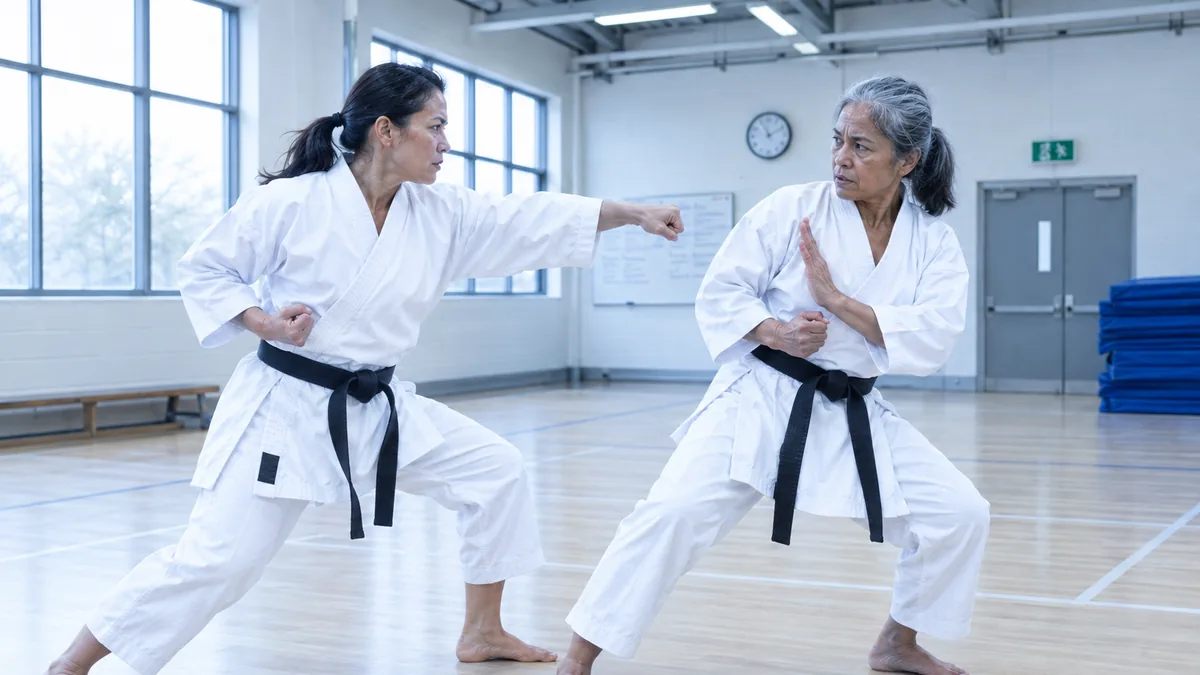
Most fighters who struggle with pressure are not struggling because they lack aggression. They are struggling because they have confused movement with intent. Walking forward is not pressure. Pressure is making your opponent feel that every position they take is wrong, that every moment they stay still is a mistake, and that the space they want is never quite available. You can do all of that without taking a single step forward.
This is one of the most consistently misunderstood areas of kumite, and it costs fighters matches they should be winning.
What Pressure Actually Is
Pressure in kumite is informational. You are telling your opponent something with every movement: that you control the distance, that you choose when exchanges happen, that their timing is off. A fighter who applies genuine pressure does not need to chase. Their opponent moves into bad positions trying to escape or reset.
The confusion comes from watching high-level fighters who happen to move forward a lot and assuming the movement is the cause of the pressure. It is not. The pressure comes from distance management, timing variation, and the credible threat of attack. The forward movement is a consequence of forcing the opponent back, not the method of doing so.
A fighter who simply walks forward with no timing variation is not applying pressure. They are giving their opponent a metronome. And a metronome is easy to score against - you know exactly when the next beat is coming.
Controlling the centre of the mat is closely related to this. Fighters who own the centre do not need to chase because they have already positioned themselves where the opponent wants to be.
Rhythm Disruption: Why It Matters More Than Pace
Rhythm disruption is not about moving unpredictably for its own sake. It is about breaking the timing your opponent is trying to establish so that their counters and attacks land in the wrong place, or not at all.
Every fighter has a default rhythm. They move at a certain pace, attack at a certain interval, and reset at a certain distance. Once you find that rhythm, you can exploit it. Rhythm disruption is what prevents your opponent from finding yours.
The practical tools are simpler than most fighters expect: vary your step length, change your breathing pattern, stall for a half-beat before attacking, move forward when your opponent expects you to reset. None of this requires exceptional athleticism. It requires awareness and deliberate practice.
Drill 1: The Broken Step Approach
Why it matters: This is the foundational drill for rhythm disruption. It teaches you to vary your approach so that your opponent cannot time your entry.
Setup: Two fighters in jiyu-kamae (free fighting stance)1, working at light contact or shadow. One designated as the attacker, one as the responder.
Execution:
- The attacker moves forward using a standard sliding step appropriate to their fighting stance - lead foot moves first, rear foot follows. The responder feels the rhythm.
- After three or four regular steps, the attacker inserts a deliberate pause - a half-beat where the foot does not follow immediately. Hold the tension.
- From that held position, attack with gyaku-zuki or kizami-zuki. The timing should feel slightly late to the responder.
- Alternate: instead of pausing, take a shorter step than expected, then immediately follow with a longer explosive entry.
- Switch roles after two minutes.
What to feel for: When the timing is right, the responder’s counter arrives fractionally too early or too late. They will either move before you attack or flinch after. That gap is what you are creating. You will feel it as a moment where you have space that was not there before.
Common mistake: Most beginners insert the pause but telegraph it - their shoulders drop, they look down, or their weight shifts visibly. The correction that usually works is to keep the head completely still and maintain eye contact through the pause. The pause should be felt, not seen.
Drill 2: Distance Anchoring
Why it matters: Effective pressure requires owning a specific distance and making your opponent uncomfortable whenever they try to change it. This drill builds that instinct.
Setup: Solo drill with a partner feeding light attacks, or with a floor marker at your preferred fighting distance.
Execution:
- Establish your preferred fighting distance - typically just outside your kizami-zuki range.
- Your partner moves randomly: forward, back, laterally. Your job is to maintain that exact distance without looking at your feet.
- When your partner steps in, you step out. When they retreat, you follow. The distance stays constant.
- After two minutes, your partner introduces attacks. Your response to an attack should not change your distance anchor - you parry or evade and return to the same position.
- Progress to: your partner tries to break the distance deliberately, crowding or retreating aggressively. You maintain position and score when they overcommit.
What to feel for: This feels claustrophobic to your partner when done correctly. They will feel like they cannot find a comfortable position. You will feel a kind of spatial control - an awareness of where the boundary is without consciously calculating it. It takes time to develop. Most fighters need several weeks of consistent practice before it becomes instinctive.
Common mistake: Fighters focus on the footwork and forget the hands. When you are managing distance, your lead hand should be active - not grabbing, but present, making your opponent aware of it. A dropped lead hand removes half the pressure you are creating.
Drill 3: Feint-and-Freeze
Why it matters: The feint is only useful if your opponent believes it. This drill trains the commitment that makes feints credible, and the control that prevents you from overcommitting.
Setup: Paired drill, light contact. Both fighters in jiyu-kamae1.
Execution:
- Initiate a feint - move your lead shoulder and hips as if launching kizami-zuki, but do not extend the arm more than halfway.
- Freeze completely for one full second. Watch what your opponent does.
- If they react (step back, raise hands, shift weight), attack into the gap they have created.
- If they do not react, reset and vary the timing of your next feint.
- Drill this for three-minute rounds, tracking how often your feint produces a reaction.
What to feel for: A feint that works feels like you have briefly taken control of your opponent’s body. They move because you made them move, not because they chose to. When that happens, the follow-up attack lands in space that was not there a moment ago. That sensation is the goal.
Common mistake: The most common error is making the feint too small. Fighters who are worried about overcommitting barely move, and the feint produces no reaction. The correction is to make the feint genuinely threatening - commit to the hip rotation and shoulder movement, just not the arm extension. A feint that does not look like an attack is not a feint. It is a twitch.
Constant Forward Movement: The Specific Problems It Creates
Walking forward continuously does three things that work against you.
First, it gives your opponent a predictable rhythm to counter. Fighters who move at a consistent pace are timing themselves for their opponent. In WKF kumite, kizami-zuki is well established as a primary counter against opponents who step in at a readable pace: research on the 2016 WKF World Championship finals found it was the most frequently scored technique overall, accounting for 32.85% of all scores2. The advancing fighter who commits to a single pace cannot adjust when a sharp counter lands between their steps.2
Second, it removes your ability to use distance as a weapon. If you are always moving in, you cannot threaten from stillness. You cannot make your opponent wonder whether you will attack or stay. The threat of movement requires the possibility of not moving.
Third, it is physically expensive. Sustained forward pressure without tactical variation burns energy quickly and often results in clinch range, where the tactical picture becomes complicated. If you are spending time at clinch range, the article on using the clinch range without getting penalised is worth reading before you drill this further.
This matters especially for fighters who are managing physical output carefully - something covered in detail in Kumite After 40.
What Changes With Experience
Beginners use pressure as a disguise for aggression. They move forward because it feels like doing something, and doing something feels safer than the stillness that experienced fighters are comfortable with.
By mid-level competition, fighters start to understand that pressure is about the threat, not the movement. They begin to use stillness deliberately - standing at distance, not attacking, making the opponent feel the weight of that unresolved tension.
At senior level, the best pressure fighters rarely look like they are doing much. They are moving slightly, pausing slightly, and the opponent is constantly adjusting and never quite comfortable. The pressure is felt rather than seen. The opponent is the one who looks busy.
The shift in understanding is usually this: beginners think pressure means attacking. Senior fighters know it means controlling when the other person attacks.
Controlling aggression in kumite addresses the mental side of this shift - the discipline required to apply pressure without tipping into reactive, uncontrolled forward movement.
Community Perspective
There is a genuine split between stylistic approaches to pressure, and it is worth acknowledging rather than papering over.
Fighters from traditions that emphasise sen-sen no sen (acting before the opponent’s attack has formed) often favour continuous forward movement as a way of denying the opponent the space to initiate3. In that framework, walking forward is not mindless - it is deliberate denial of space and time. This is distinct from sen no sen, which describes intercepting at the exact moment the opponent begins their attack3.
Fighters from traditions that emphasise go no sen (responding after the opponent has committed to their attack) tend to use stillness and distance control as their primary tools, making the opponent attack into a prepared counter3.
Both approaches produce elite competitors. The disagreement is not about which is correct in principle but about which suits a given fighter’s physical profile, reaction speed, and competition context. A physically larger fighter with strong gyaku-zuki may find that controlled forward pressure suits them well. A faster, lighter fighter may find that rhythm disruption and distance management produces better results.
The position we take here is that constant forward movement without rhythm variation is a habit, not a strategy. Whatever your stylistic preference, variation is non-negotiable. Even committed forward-pressure fighters at elite level vary their pace, pause, and step length. The ones who do not tend to get picked apart by sharp counters. The gyaku-zuki vs kizami-zuki debate is relevant here too - the technique you favour will shape how you use distance and when you choose to close.
Key Takeaways
- Pressure is the threat of attack, not the attack itself. Stillness at the right distance is more pressuring than constant movement.
- Vary your step length and timing before you vary anything else. This is the simplest and most underused tool for rhythm disruption.
- A feint that does not commit to the hip and shoulder is not a feint. Make it real enough to force a reaction.
- The correction that solves most forward-pressure problems is adding a half-beat pause. Do not remove the forward movement - interrupt it.
- Distance anchoring is a skill that needs deliberate drilling. It does not develop naturally from general sparring.
- The goal of pressure is to make your opponent move on your terms. If they are choosing when and where to attack, you are not applying pressure - you are just moving.
References
Checked by the KarateLifestyle editorial team against the official WKF Kumite Competition Rules 2024, peer-reviewed competition analysis, and authoritative karate association sources in October 2026. Technique-frequency figures reflect finals data from the 2016 WKF World Championships; patterns at other competitions and weight categories may vary.
- WKF Kumite Competition Rules 2024 (Version 2024.00). World Karate Federation, 2024. Defines bout duration (3 minutes senior male and female), 8-point clear-lead win rule, and scoring criteria.
- Scoring Techniques in Final Competitions of Karate World Championships 2016. Peer-reviewed study, ResearchGate, 2019. Analysed 70 WKF World Championship final bouts; found kizami-zuki was the most frequently scored technique (32.85% of all scores) and gyaku-zuki to the body was dominant across other analyses at 43.28%.
- Gō-no-sen, Sen-no-sen and Sensen-no-sen: Understanding the Three Timing Strategies in Shotokan Karate. Bushido Karate Club, 2025. Defines go no sen (block and counter after opponent commits), sen no sen (intercept at the exact moment attack begins), and sensen no sen (act before opponent moves).
The weekly digest
New karate articles, once a week
One email every week with everything new on Karate Lifestyle. No spam; unsubscribe in one click.
We'll email you to confirm. See our privacy policy.