How to Use the Clinch Range in Kumite Without Getting Penalised: What's Legal, What's Not, and How to Make It Work
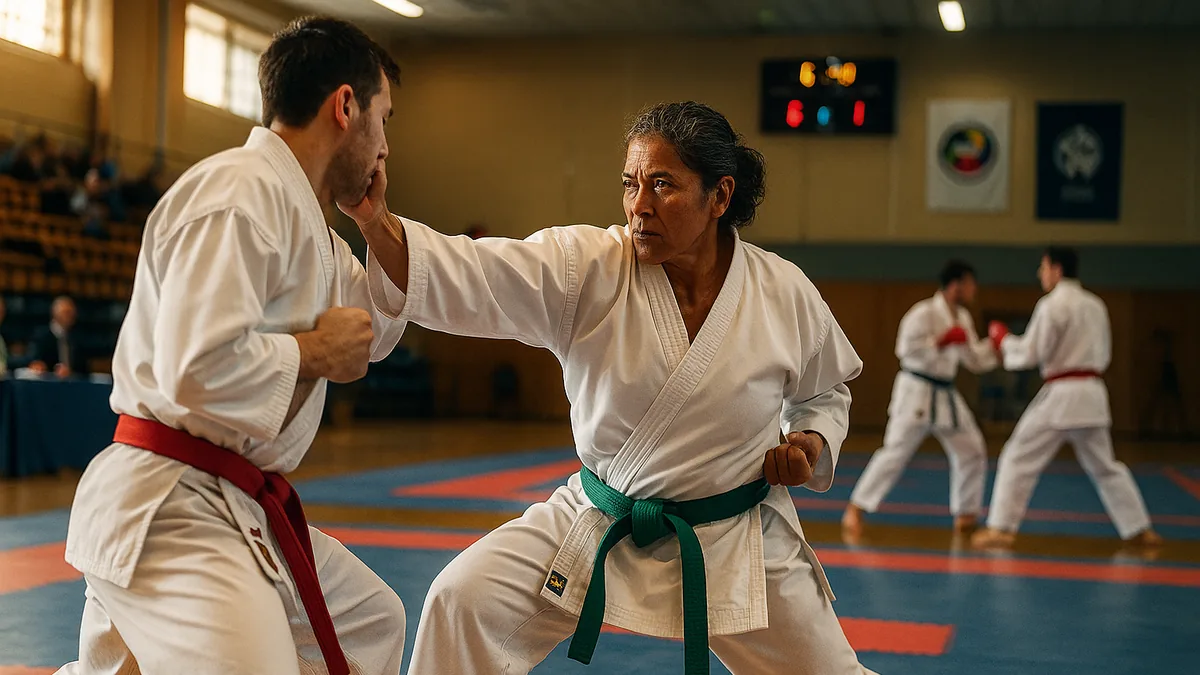
Most competitors treat the clinch range like a problem to solve - something to escape from as fast as possible before the referee blows the whistle. I used to think the same way. Get in close, panic, break apart, reset. That was my default for years, and it cost me points I didn’t even know I was leaving on the table.
The thing that actually changed my understanding was getting paired with a senior brown belt during jiyu-kumite who seemed to do nothing aggressive, but every time I crowded him, I ended up off-balance, repositioned, or already behind on the exchange. He wasn’t fighting in the clinch - he was using it. There’s a significant difference, and it took me far longer than it should have to understand what that difference actually was.
What the Rules Actually Allow (and Where People Get Confused)
Under WKF competition rules, you cannot grab and hold. That’s the clear line. But between “not grabbing” and “standing there doing nothing” there is a lot of legal territory that most competitors never explore.
What you can legally do in close range:
- Brief contact to redirect or unbalance before immediately attacking
- Using body position and weight to create angles
- Delivering legal techniques - punches, strikes, sweeps - at close range before separation occurs
- Pressing into your opponent’s guard to disrupt their posture
What gets penalised:
- Grabbing the gi, wrist, arm, or collar and holding
- Clinching without immediately attempting a technique
- Wrestling-style grips that prevent the opponent from attacking
- Persistent holding even if you’re “setting up” a technique
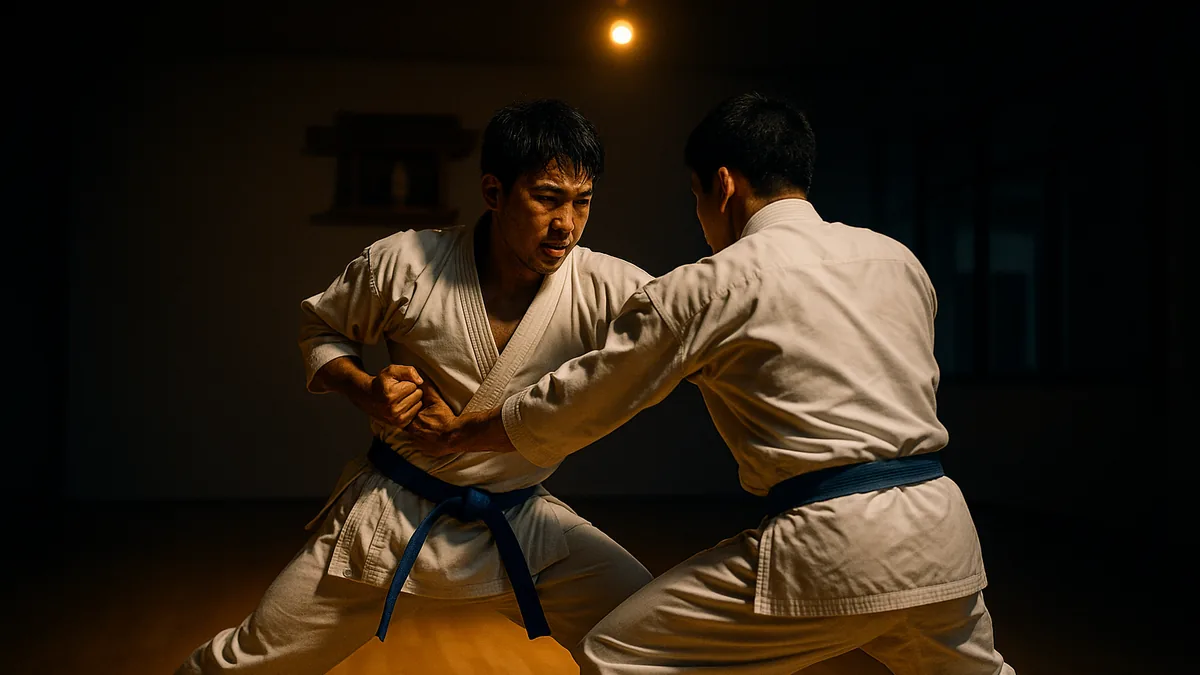
The grey area - and this is where it gets interesting - is the contact that happens in the moment before separation. Referees are watching for intent. If you make brief contact and immediately follow with a technique, you’re usually fine. If you grab and pause, even for a second, you’re getting called.
I’ve noticed that most competitors who get penalised aren’t trying to cheat. They’re hesitating because they don’t have a plan for what to do once they’re inside. The grab becomes a reflex when you don’t know what comes next.
The Physical Attributes That Actually Matter at Close Range
Speed matters everywhere in kumite, but at close range, it’s a specific kind of speed - not the explosive launch speed you need for a gyaku-zuki from distance, but the short, sharp, connected speed of someone who can generate power from a compressed position.
Endurance matters too, but differently than most people train it. The clinch range is exhausting in a way that running laps doesn’t prepare you for. It’s isometric, it’s positional, it requires constant micro-adjustments to balance and pressure. The athletes I’ve seen gas out fastest in competition are often the ones who trained cardio but neglected the specific muscular endurance of staying stable under contact pressure.
The physical attributes that actually determine who wins at close range:
- Core stability under lateral pressure - not just “strong abs” but the ability to resist being moved sideways while still generating your own movement
- Hip mobility and speed - close-range techniques live and die on how quickly you can rotate through a restricted position
- Balance under contact - the ability to stay rooted when someone is leaning into you, which is completely different from static balance drills
- Grip strength and wrist control - not for grabbing, but for deflecting and redirecting in the moment of contact
What I tell students is that the gym work needs to reflect what actually happens in the clinch. Planks don’t build the stability you need - rotational resistance work does. Landmine presses, pallof presses, single-leg exercises under load. If your strength training doesn’t involve resisting force from an angle, it’s not building what you need for this range.
Functional Strength vs Gym-Based Conditioning
I’ve seen this mistake so many times: a competitor gets serious about physical preparation, starts lifting, gets stronger on paper, and then their close-range game doesn’t improve at all. Sometimes it gets worse because they’re stiffer.
The problem is the difference between absolute strength and functional strength in a specific context. Bilateral squats build leg strength, but they don’t build the ability to drive off one leg while your upper body is engaged with an opponent. Bench press builds pushing strength, but it doesn’t build the connected pushing strength you need when your arms are partially compromised by contact.
The correction that actually works - and I’ve used this with multiple students who were training hard but not converting it - is to make the conditioning sport-specific from the start. That means:
Resistance drills with a partner - pushing and resisting against a partner in fighting stance, trying to maintain your position while they try to move you. Not wrestling, just positional resistance. You’ll feel within thirty seconds exactly which muscles you’re not training in the gym.
Single-leg stability under load - stand on one leg and have a partner push you from different angles. This is what close-range balance actually feels like, and it feels wrong at first because you’ll discover how much you rely on symmetric stance to stay rooted.
Explosive short-range pad work - pads held close, not at full extension. The goal is generating power when your arm is bent, your hip has limited rotation room, and the target is right in front of you. Most people can’t do this well initially because they’ve only ever trained power from a cocked position with full extension available.
Isometric holds in fighting stance - hold a fighting stance with someone pressing against your lead shoulder for thirty seconds, then immediately attack the pads. This mimics the actual demand of resisting pressure and then transitioning to offence.
Sport-Specific Drills That Build Clinch Range Competence
The drill I come back to most often with intermediate competitors is what I call “contact sparring at half power.” The rule is simple: you must maintain some level of physical contact with your partner at all times, and any technique must come from that contact rather than retreating to distance first. It’s not wrestling, it’s not grappling - it’s forcing both people to solve the problem of generating technique from a compromised position.
What this drill exposes immediately is who has actually internalised their hip mechanics and who has been relying on distance and run-up to generate power. When you can’t step back to load up, the hip rotation becomes the whole technique. You’ll feel the difference instantly - either the hip is doing the work and the punch has something behind it, or the hip isn’t engaged and you’re just pushing with your arm.
Another drill I’ve found genuinely useful: close-range randori with a single rule change - no penalties for brief contact, but you must attack within one second of making contact or you stop and reset. This teaches the timing that makes the clinch range legal. You’re training yourself to use contact as the trigger for technique rather than as a pause point.
For competitors who want to go deeper on how build and body type affects clinch range effectiveness, the piece on kumite for heavier or shorter karateka is worth reading. A shorter competitor with a lower centre of gravity has genuinely different options at close range than a tall one - and training as if those differences don’t exist is a mistake.
The Mistakes I See Constantly
Mistake 1: Treating close range as a defensive situation
Most competitors enter the clinch range reactively - they’ve been pressured, they’ve crowded in, and now they’re trying to survive until the referee resets. This mindset guarantees you’ll either get penalised (because you grab out of panic) or lose the exchange (because you’re not attacking).
What I tell students is to flip the frame entirely. The clinch range is an offensive opportunity, not a defensive problem. If you’re inside, you have options. If you’re not using them, that’s a training gap, not a rule problem.
Mistake 2: Waiting for separation before attacking
I’ve watched competitors get to close range, feel the contact, and then back away to attack from distance. Every single time. They’ve been conditioned to think of distance as the prerequisite for technique. It isn’t. The technique can happen in the contact - it just has to happen immediately and it has to be legal.
Mistake 3: Not understanding what “brief contact” actually means
This one’s a misunderstanding, not laziness. Competitors hear “no grabbing” and interpret it as “no contact.” So when they make contact, they release immediately, which means they’ve given up whatever positional advantage they had. Brief contact that immediately precedes a technique is legal. Use it.
Mistake 4: Ignoring sweeps
Ashi-barai and related sweeps are completely legal and devastatingly effective at close range. I’ve seen competitors train for years without ever seriously developing sweeping technique, and then wonder why they have no options when the distance closes. A well-timed sweep at close range scores, disrupts, and creates space - all without any grabbing. If you’re not training sweeps specifically for close-range situations, you’re leaving one of your best legal weapons unused.
If you’re working on managing aggression in these exchanges - because close range can get heated quickly - the article on controlling aggression in kumite covers the mental side of staying sharp without losing composure.
Community Perspective
There’s a genuine disagreement in competition karate circles about whether working the clinch range is worth the risk. Some coaches - and I’ve trained under a few who held this view strongly - teach their athletes to break range immediately, every time, no exceptions. The argument is that the penalty risk isn’t worth the reward, especially at junior or regional level where referees are less consistent.
I understand that position. I don’t fully agree with it, but I understand it.
My view is that avoiding the clinch range entirely makes you predictable, and predictable competitors get picked apart at higher levels. If your opponent knows you’ll always retreat to distance, they’ll use that. They’ll crowd you deliberately, force the reset, and use the disruption to their advantage. Being able to work briefly at close range - legally, with intent - gives you an option they can’t predict.
The disagreement also runs along style lines. Shotokan-trained competitors often have less close-range work in their base than Goju-ryu or Wado-ryu practitioners, where the distance is trained more explicitly. That’s a generalisation, but it reflects something real about how different traditions approach the problem.
What I’ve noticed is that opinions on this shift with experience. Earlier in my competitive career, I avoided the clinch range because I didn’t know what to do there. By the time I was competing at senior level, I was actively seeking it against certain opponents because I knew it disrupted their rhythm. The range you avoid is usually the range you haven’t trained enough.
For competitors thinking about how their overall style - passive or aggressive - affects their approach to close range, passive vs aggressive kumite styles is worth your time. Close-range work tends to suit more aggressive stylists, but that’s not an absolute rule.
Key Takeaways
- Train close-range technique as an offensive tool, not a defensive escape - if you’re inside and not attacking, you’re already losing the exchange
- Brief contact that immediately precedes a legal technique is allowed; the penalty comes from holding without attacking, so make contact your trigger, not your pause
- Build functional strength through partner resistance drills and single-leg stability work, not just gym-based bilateral exercises that don’t transfer to the contact pressure of actual kumite
- Sweeps are underused at close range and completely legal - if you’re not training ashi-barai specifically for inside distance, start now
- The drill that exposes the most gaps fastest is close-range randori with a one-second rule - contact must immediately precede technique, or you reset
- Your weakest range is almost always the range you’ve trained least - if close range makes you uncomfortable, that discomfort is information, not a reason to avoid it
The weekly digest
New karate articles, once a week
One email every week with everything new on Karate Lifestyle. No spam; unsubscribe in one click.
We'll email you to confirm. See our privacy policy.