Kumite Penalties Explained: What Triggers a Chukoku, Keikoku, or Hansoku and How to Stop Losing Matches on Violations
A note on the current WKF rulebook
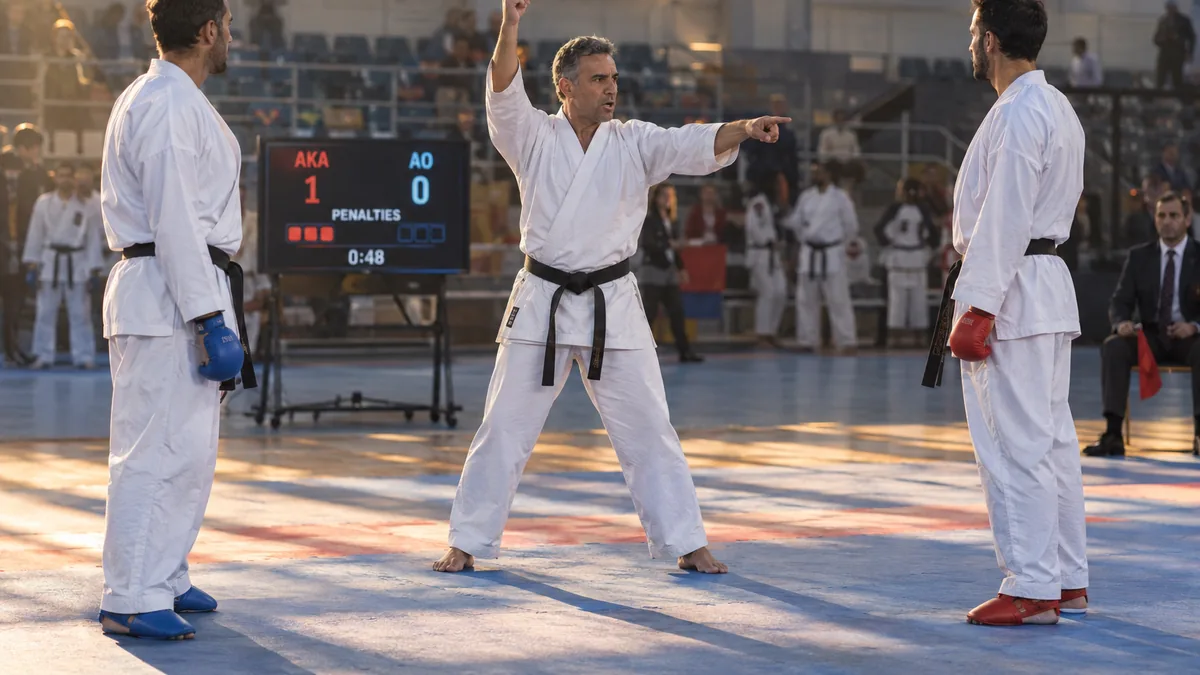
This article uses the traditional warning names - Chukoku, Keikoku, and Hansoku-Chui - that many coaches, competitors, and UK club resources still reference. It is important to know that the WKF revised its official kumite competition rules from 2024 onwards, replacing those three named warning levels with a consolidated system using Chui (a warning, issued up to three times) and Hansoku-Chui (a warning of disqualification), followed by Hansoku (disqualification).1
The older Chukoku/Keikoku terminology remains in widespread use at club, regional, and domestic level in the UK and across many associations, and is still referenced on materials held by the British Karate Federation. Where this article uses those names, treat them as shorthand for the first, second, and third Chui warnings respectively. The underlying logic - escalating warnings, category-specific accumulation, and disqualification for a serious or repeated offence - is the same. If you are preparing for a WKF-sanctioned event or reading an official referee briefing, use the current terminology.1
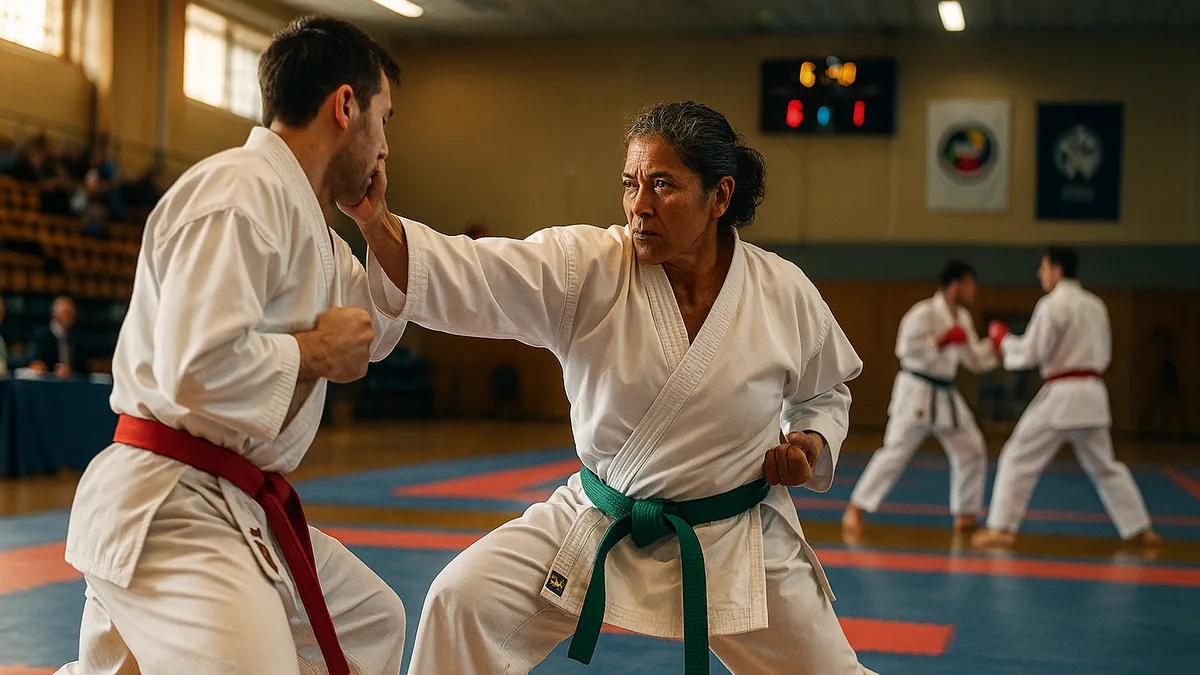
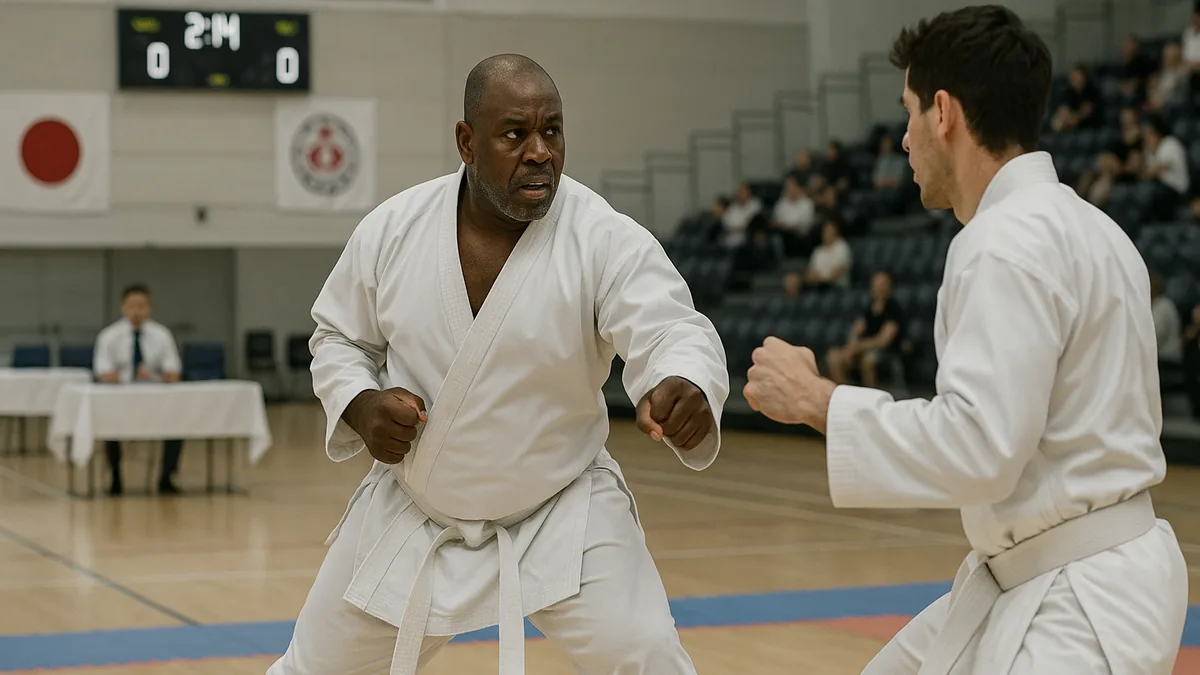
Losing a match on penalties is one of the most frustrating ways to exit a tournament. Not because you were outfought, but because you handed points to your opponent through violations you may not have fully understood. A lot of competitors know the penalty names - Chukoku, Keikoku, Hansoku - but treat them as vague warnings rather than a precise system with predictable triggers. That misunderstanding costs matches at every level of competition.
The WKF (World Karate Federation) penalty system is not arbitrary. Once you understand how it escalates and what specific behaviours trigger each stage, you can train around it deliberately rather than hoping referees are lenient on the day. The British Karate Federation (BKF) is the sole WKF-recognised national karate federation for the United Kingdom, and WKF competition rules apply at all BKF-sanctioned events.
How the Penalty System Actually Works
The system is cumulative and category-specific. That second point matters more than most competitors realise.
Under WKF rules, violations are divided into two categories:2
- Category 1 covers behaviours that risk the safety of the opponent: excessive contact, attacks to prohibited areas, dangerous throws, and similar.
- Category 2 covers behaviours that violate the spirit of the contest: passivity, clinching, avoiding combat, and unsportsmanlike conduct.
Penalties within each category escalate independently. A first warning in Category 1 and a first warning in Category 2 are tracked separately. This is the detail that catches competitors off guard - you can accumulate warnings in both categories simultaneously and reach Hansoku faster than you expect.
Chukoku (first Chui)
Chukoku - or, in current WKF terminology, the first Chui - is the entry-level official warning. In the current rules, Chui is issued for smaller infractions that do not diminish the other competitor’s chances of winning.1 In many domestic and association-level competitions, a first warning has historically been understood to award a Yuko (one point) to the opponent - confirm the exact scoring implications with your event organiser, as this treatment varies between competition formats. In a close match, a single point awarded this way can be decisive.
Chukoku is typically triggered by:
- Minor excessive contact
- Grabbing or holding without immediately attempting a scoring technique
- Passivity or avoiding combat
- Stepping out of bounds (Jogai)
- Minor unsportsmanlike behaviour
The word “minor” appears frequently in the descriptions, but do not let it mislead you. Referees have discretion in how they classify contact severity, and what feels minor to you may look deliberate from the judging position.
Keikoku (second Chui)
Keikoku - or the second Chui in current WKF terminology - is the second-level warning.1 Under the older framing still common in domestic competition, a second warning in the same category has been understood to award two points to the opponent (equivalent to a Waza-ari). A second violation in the same category, or a more serious first violation, reaches this level directly. At this stage, the match is already significantly compromised - you are chasing the score before you have landed a scoring technique of your own.
Keikoku is typically triggered by:
- Moderate excessive contact
- Persistent clinching or grabbing
- Repeated passivity after a previous warning
- Attacks to prohibited areas including the throat, groin, joints, or instep3
Hansoku-Chui (third Chui / warning of disqualification)
Hansoku-Chui is a warning of disqualification. In current WKF rules, it is issued either for more serious infractions that reduce the opponent’s chances of winning, or when a competitor has already received three Chui warnings.1 It may be imposed directly for a serious infringement that does not yet merit full Hansoku.
Hansoku
Hansoku is disqualification. It can be awarded directly for a serious violation - particularly one that injures the opponent or shows clear intent to harm - or it can result from a further infraction after Hansoku-Chui has been given.1 Under WKF rules, Hansoku results in the opponent winning the match outright, regardless of the score at the time.
Shikkaku is a separate and more severe sanction - disqualification from the entire tournament, not just the match.1 It is reserved for conduct that brings the sport into disrepute: actions considered dangerous and deliberate violations of the rules, behaviour that harms the prestige and honour of karate-do, or situations where a competitor or their coach’s conduct is deemed unacceptable.
The Violations That Trigger Penalties Most Often
Excessive Contact
A common mistake at club and regional level is confusing “controlled” with “light.” WKF kumite requires controlled contact - techniques that are focused, controlled, and demonstrate correct form.3 The standard is not that contact must be feather-light; it is that the technique must be controlled and appropriate to the target area and the age and grade of the opponent.
The correction that makes the biggest difference here is adjusting your mental calibration before the match, not during it. If you spend three months training full-contact in the dojo and then step into a controlled-contact WKF match, your default output is already miscalibrated. You will feel like you are pulling your techniques, but the referee sees something different. Practise at competition intensity in training - not harder, not softer.
Excessive contact to the head is the most common Category 1 violation at senior level. Jodan techniques require the highest degree of control because the risk of injury is greatest and the margin for error is smallest.
Clinching and Grabbing
The WKF rules do permit grabbing, but only in a very specific context: you may grab the opponent’s arm or karategi momentarily, but only if you immediately attempt a scoring technique or takedown. If you grab and do not immediately score or attempt a throw, that is a violation. If you grab and hold while the referee is waiting to see what you do, you are already in trouble.
A common mistake is treating the clinch as a neutral reset - a way to slow the match down when you are under pressure. It is not neutral. Every moment you hold without scoring is a moment the referee is deciding whether to call a violation. For a detailed breakdown of what is and is not permitted in close range, our article on how to use the clinch range in kumite without getting penalised covers the legal boundaries and how to make close-range work for you rather than against you.
Passivity
This is the violation that catches tactically cautious competitors. “Avoiding combat” refers to a situation where a competitor attempts to prevent the opponent from having the opportunity to score by using time-wasting behaviour. Running the clock, backing away repeatedly, or circling without attacking can all result in a Category 2 warning.
The trap here is that negative tactics feel like strategy when you are ahead on points. And sometimes they are - but you need to be actively moving, feinting, and creating the appearance of intent to engage, not just retreating. Referees are watching for genuine avoidance, and repeated warnings in this category will cost you the match even if your score is higher. Note that avoiding combat during the last 15 seconds of the bout (Ato Shibaraku) carries a minimum penalty of Hansoku-Chui.4
If you are exploring how to manage a lead without becoming passive, the question of aggressive versus cautious match management is worth thinking through carefully. Our piece on passive vs aggressive kumite styles addresses this directly.
Attacks to Prohibited Areas
Under the current WKF rules, prohibited attacks include techniques that make contact with the throat, attacks to the arms, legs, groin, joints, or instep, and attacks with open-hand techniques to the face.3 Dangerous or uncontrolled throwing techniques are also prohibited.3 A technique that lands in a prohibited area due to poor control or a bad angle is still a violation - intent is not the deciding factor, though deliberate or malicious attacks attract more severe sanctions.
What Penalties Actually Feel Like in a Match
This is worth addressing directly because it catches competitors who have only ever read the rules rather than experienced the penalty system in competition.
When a warning is called against you, you will feel the match shift immediately. The scoreboard changes, the referee’s body language changes, and there is a psychological pressure that was not there before. Many competitors respond by tightening up, becoming hesitant, and then either committing a second violation through over-caution (passivity) or through frustration (excessive contact). Both responses are understandable and both make the situation worse.
The correction that works is to treat the penalty as a reset point, not a crisis. Acknowledge it mentally, recalibrate your output, and re-engage. Panicking after a first warning is how the second one happens.
This is also where emotional regulation becomes a competitive skill, not just a character virtue. The ability to stay sharp and deliberate after a penalty is called is something that distinguishes experienced competitors from those who are technically capable but mentally fragile under pressure. If this is an area you want to develop, our article on controlling aggression in kumite is directly relevant.
Common Misconceptions That Lead to Violations
“The referee will warn me first.” Not always. Serious violations - particularly those involving significant contact or attacks to prohibited areas - can result in Hansoku-Chui or Hansoku without a prior first warning. Do not assume you will get a free pass.
“I was moving, so it’s not passivity.” Movement and engagement are not the same thing. Circling without attacking, retreating without countering, and feinting without committing are all things referees watch for. Movement has to have competitive intent behind it.
“I only grabbed for a second.” Duration is not the only criterion. The question is whether the grab was immediately followed by a scoring attempt or takedown. If not, the length of time is not a defence.
“It was their fault - they moved into my technique.” Possibly true, but not a complete defence under the rules. Competitors must perform all techniques with control and good form, and if they cannot, a warning or penalty must be imposed regardless of the technique used.3 If contact is excessive, the penalty goes to the attacker regardless of the defender’s movement.
Community Perspective
There is a genuine and ongoing debate in the WKF kumite community about how consistently penalties are applied across referees, countries, and competition levels. Competitors who have fought internationally often note that the threshold for excessive contact varies noticeably between panels - what gets a warning at a regional event in the UK might pass without comment at a major international tournament, and vice versa.
This is not a reason to ignore the rules or assume leniency. It is a reason to train to a standard that is clearly within bounds rather than sitting on the edge of what might be tolerated on a given day. The competitors who rarely pick up penalties are not the ones who have figured out how much they can get away with - they are the ones whose control is so consistent that the question rarely arises.
There is also a recurring discussion about whether the passivity rule is applied fairly to different build types and fighting styles. Shorter, heavier competitors who prefer close-range work sometimes report being penalised for passivity when they feel they are actively engaging, while taller, longer-range fighters who create distance are seen as using strategy. This is a real tension, and one worth being aware of if your natural style is pressure-based. Our article on kumite for heavier or shorter karateka addresses how to work within these dynamics rather than against them.
Key Takeaways
- Train at competition intensity, not harder. The most common cause of excessive contact penalties is a miscalibrated default output. Adjust this in training, not on the day.
- Know which category your penalties are in. Category 1 and Category 2 escalate independently. You can be closer to Hansoku than you think if you have warnings in both.
- Treat a first warning as a tactical moment, not a crisis. Recalibrate and re-engage. Panic leads directly to the next penalty.
- Grabbing without immediately scoring or attempting a throw is always a risk. If you use the clinch, have a technique ready to execute the moment you make contact.
- Passivity is a violation, not a safe option. If you are ahead on points, stay active - feint, pressure, create - do not simply defend your lead. Avoiding combat in the last 15 seconds carries an automatic Hansoku-Chui at minimum.4
- Jodan control is the highest-stakes skill in WKF competition. More matches are decided by head-contact penalties than by any other violation. If your jodan techniques are not reliably controlled, that is where to focus your technical work.
References
Checked by the KarateLifestyle editorial team against WKF official competition rules documents (2024 and 2026 versions), the BKF-hosted 2020 rules, and WKF official referee examination papers in October 2026. The current WKF rules (from 2024 onwards) use different warning terminology to that still in circulation at domestic level; the article notes this explicitly.
- WKF Kumite Competition Rules 2024. World Karate Federation, Version 2024.00, valid from 1 January 2024
- Olympic Games Karate competition: What is Kumite? - WKF. World Karate Federation official news release, 2021
- WKF Kumite Competition Rules 2024 (Karate Serbia mirror). World Karate Federation, Version 2024.00 - Article 9 prohibited behaviours
- WKF Examination Questions for Kumite Referees and Judges - December 2025. World Karate Federation, December 2025 - Q195 Ato Shibaraku minimum penalty
The weekly digest
New karate articles, once a week
One email every week with everything new on Karate Lifestyle. No spam; unsubscribe in one click.
We'll email you to confirm. See our privacy policy.