How to Fix Slow Reactions in Kumite: What Actually Causes Them and How to Train Out of It
Most students think slow reactions are a speed problem. They try to fix it by moving faster, drilling harder, or doing more reps. I’ve watched this play out hundreds of times, and it almost never works - because speed isn’t the issue. The issue is that they’re reacting to the wrong thing at the wrong time, or they’re hesitating because they don’t trust what they’re seeing.
Slow reactions in kumite usually come from one of three places: you’re reading the attack too late, you’re second-guessing your response, or you’ve trained your body to wait for confirmation before moving. All three are fixable. None of them respond to just “train faster.”
Here’s what I’ve actually seen work.
Why You’re Reacting Late (And It’s Not What You Think)
The mistake I see most often is students watching the technique rather than watching the person. They wait for the punch to start before they react, which means they’re already behind. By the time your eyes register the fist moving, your brain processes it, and your body responds, the attack has landed. You can’t close that gap by trying to move quicker - the gap is upstream of movement.
What senior practitioners do differently is read the body before the technique. The shoulder drops before the punch. The weight shifts before the kick. The eyes change before anything physical happens. I used to think this was some mystical awareness thing that came with black belt. My instructor used to say “watch the chest, not the hands” and I nodded along without really understanding it until I started sparring someone who had genuinely deceptive hands. His hands were a dead end. His chest told me everything.
That shift - from watching the technique to reading the person - is the single biggest difference between a practitioner with slow reactions and one who looks like they’re always ahead.
The mental block side of this is real too. If you’re afraid of getting hit, you hesitate. If you don’t trust your block, you hesitate. If you’re not sure which counter to throw, you hesitate. All of that hesitation looks like slow reactions from the outside, but training speed drills won’t fix it. You have to address the actual cause.
The Drills That Actually Move the Needle
I’ll rank these honestly. The first two are essential. The third is highly effective but needs a partner. The last one most people skip, and they shouldn’t.
Drill 1: Stimulus-Response Pairing (Solo or Partner)
This is the foundation. The goal is to take a specific stimulus and wire a specific response to it until there’s no decision-making in between. Decision-making is where the delay lives.
Why it matters: Most practitioners have a library of techniques but no automatic routing. When they see an attack, they’re still choosing. This drill eliminates the choice.
Setup: Pick one attack and one response. Just one. Gyaku-zuki to jodan, block and counter. That’s it.
Execution:
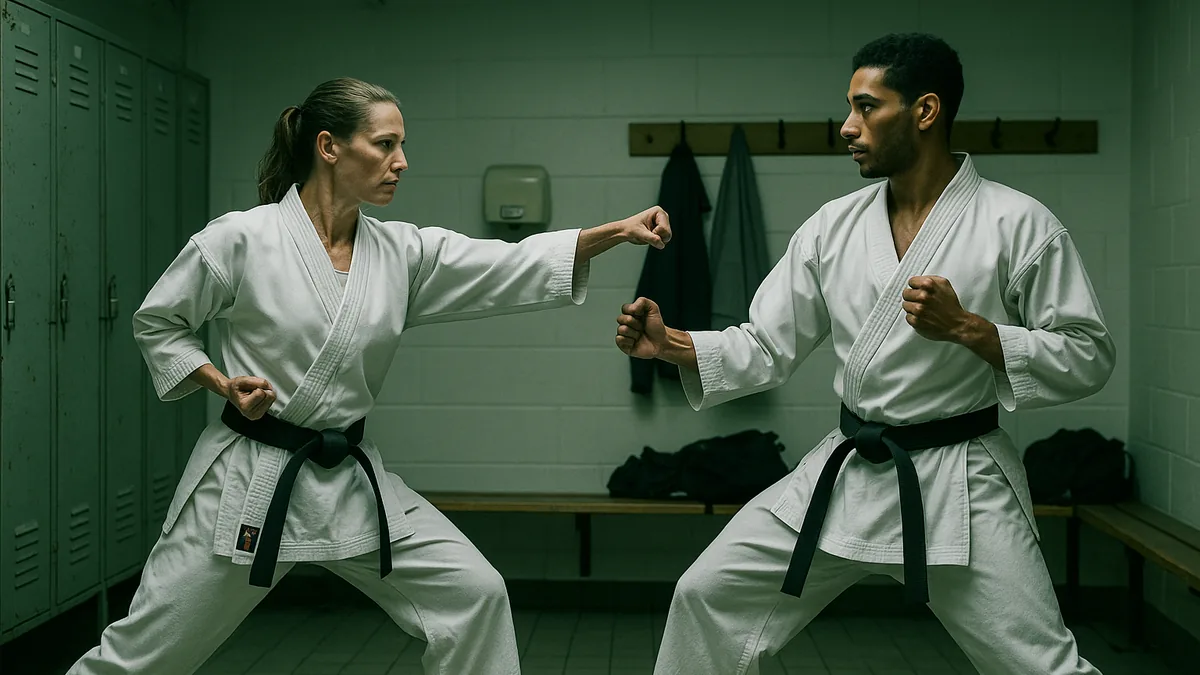
- Partner throws the same attack, same speed, same range - ten times in a row.
- Your only job is to respond with your pre-selected counter. No variation, no thinking.
- After ten clean reps, partner introduces one variation - different timing, slightly different angle.
- You still throw the same response, but now you’re adapting it to the variation.
- Add speed gradually, only after the response feels automatic at slower speed.
What to feel for: When this is working, the response starts to feel like it’s happening before you’ve consciously decided to move. That’s not an illusion - it’s the stimulus-response pathway getting shorter. You’ll know you’re there when you stop feeling like you’re reacting and start feeling like you’re just moving.
The thing most people get wrong: They add too many variations too fast. The whole point is repetition of a single pathway. If you’re switching attacks every few reps, you’re training decision-making, not reflexes. Keep it narrow for longer than feels necessary.
Drill 2: Lead-Reading from Stillness
This one is underused and I think it’s more valuable than most people realise.
Why it matters: It trains you to pick up pre-attack signals, which is where real reaction time gains come from. If you can move at the tell rather than the technique, you’re effectively tripling your reaction window.
Setup: Both partners stand in kamae, relaxed, no predetermined attack.
Execution:
- Attacker’s job is to throw a technique at any moment, with full intent.
- Defender’s job is not to block - it’s to move before the technique arrives. Step offline, shift weight, anything that creates distance or angle.
- No counter. Just the read and the movement.
- Run it for two-minute rounds. Debrief after: what did you see? What tipped you off?
What to feel for: At first, you’ll be moving late and you’ll feel like you’re always catching up. After a few sessions, you’ll start noticing that you’re moving on something - a shoulder shift, a weight transfer - without being able to articulate exactly what. That’s your nervous system learning to read patterns below conscious awareness. Trust it.
Common mistake: Defenders start to anticipate rather than read. They’re not responding to a signal - they’re guessing. You can tell because they move at random intervals, not in correlation with the attacker’s tells. The correction is to slow the attacker down and ask the defender to name what they saw before they moved. If they can’t name it, they’re guessing.
Drill 3: Broken Rhythm Pad Work
I prefer this over standard pad work for reaction training because standard pad work is too predictable. When you know the pad is coming, you’re not reacting - you’re anticipating.
Setup: Pad holder, no set pattern. The holder can present the pad at any height, any angle, any moment - or fake the presentation.
Execution:
- Pad holder presents pad with no rhythm or pattern.
- Striker responds only when the pad is presented, not before.
- Holder introduces fakes - partial presentations that don’t complete.
- Striker must not fire on fakes.
- Speed and randomness increase as accuracy improves.
What to feel for: The goal is that your response starts to feel triggered rather than chosen. When the timing is right, the technique fires before you’ve consciously registered the pad - you feel the impact and then realise you threw it. That’s the state you’re training toward.
This is also where you’ll notice hesitation caused by fear of being wrong. Students who are worried about hitting on a fake will hold back on real presentations. That hesitation is the thing to train out.
Drill 4: Sparring Footage Review
Most people skip this. It’s the most honest feedback you’ll ever get and it costs nothing except ego.
Record your sparring. Watch it back with one specific question: where am I late, and what was I looking at when I was late?
You’ll see patterns immediately. I’ve noticed that most practitioners who struggle with reactions are consistently watching the same thing - usually the hands - and missing the same tell - usually the hip or shoulder. Once you see it on video, you can’t unsee it.
Watch for:
- Moments where you react after the technique has already landed
- Moments where you flinch but don’t move (the signal registered but the response didn’t fire)
- Moments where you counter-attacked successfully - what did you actually read?
That last one is important. Most people focus on what went wrong. The corrections that actually stick come from understanding what went right and doing more of it deliberately.
If you’re training without regular sparring partners, check out How to Train Alone When You Have No Club Access - some of the solo drills there can substitute for partner work in the short term.
The Mental Block Problem
I want to be direct about this because it gets glossed over: some slow reactions are not a training problem. They’re a confidence problem.
If your block doesn’t work, you won’t commit to it. If your counter doesn’t land cleanly in practice, you’ll hesitate before throwing it in kumite. The solution isn’t more reaction drills - it’s fixing the underlying technique so you trust it.
I’ve seen students do months of reaction training with no improvement because they were hesitating before their gyaku-zuki, and they were hesitating because their gyaku-zuki was inconsistent. The moment we fixed the punch, the hesitation disappeared and the reactions improved without any additional reaction-specific work.
If your blocks are part of the problem, Blocking in Karate: Why Most Blocks Fail is worth reading. The same principle applies - if you don’t trust the block, you’ll wait too long before committing to it.
How This Changes With Experience
As a white belt, I thought fast reactions meant fast hands. Move the arm quicker, get there first. By brown belt I understood it’s about moving earlier - not faster, earlier. The technique speed matters less than when you initiate.
What I’ve noticed in senior practitioners is that they look calm. They’re not rushing. They’re not trying to be fast. They’ve trained the read so deeply that they’re already moving when the attack is just beginning, and from the outside that looks like speed. It isn’t. It’s timing.
Beginners react to what’s happening. Experienced practitioners react to what’s about to happen. That’s the whole shift, and it takes time, specific drilling, and a lot of sparring to get there.
If you’re building the training time to make this work, How Many Days a Week Should You Train Karate? is worth a read for structuring your week around it. Reaction training needs frequency more than volume - short, sharp sessions three or four times a week will outperform one long session.
Community Perspective
There’s a real split in how different dojos approach this. Traditional schools often emphasise kata as the foundation for reaction training - the argument being that if you’ve drilled a response ten thousand times in kata, it becomes available under pressure. Modern sport karate training leans heavily on partner drills and live sparring from early on.
I’ve trained in both environments. My honest take is that kata builds the movement vocabulary but doesn’t train the read. You still need live stimulus to develop the ability to pick up real attack signals. The kata practitioner who never spars is technically competent but will still be late when the attack comes from an actual person with their own timing and tells.
Where I’ve seen the best results is practitioners who use kata to ingrain the mechanics and then do a lot of controlled partner work specifically focused on reading and responding - not just drilling techniques at each other. The combination works better than either alone.
There’s also ongoing debate about whether reaction time is trainable at all, or whether you’re largely working with what you’ve got. My experience says it’s very trainable, but what you’re actually training is pattern recognition and decision speed, not raw neurological reaction time. That distinction matters for how you structure your drilling.
Key Takeaways
- Slow reactions are usually a reading problem, not a speed problem - train your eyes before you train your hands.
- Stimulus-response pairing with minimal variation is more effective than varied drills for building automatic responses.
- If you’re hesitating, check whether the underlying technique is reliable - no amount of reaction training fixes a block you don’t trust.
- Watch your sparring footage and look for what you’re reading when you get it right, not just what went wrong.
- Senior practitioners look fast because they move earlier, not because they move quicker - train the timing, not the speed.
- Frequency beats volume for reaction training - short sessions across the week outperform long occasional ones.
If you want to build this into a structured training week, How to Build a Karate Training Schedule That Actually Fits Your Life is a practical starting point. And once your reactions are sharper, How to Train Combinations in Karate: Moving Beyond Single Techniques is the natural next step - because fast reactions only matter if you know what to do with them.
The weekly digest
New karate articles, once a week
One email every week with everything new on Karate Lifestyle. No spam; unsubscribe in one click.
We'll email you to confirm. See our privacy policy.