How to Train Your Front Leg So It Actually Does Something in Kumite
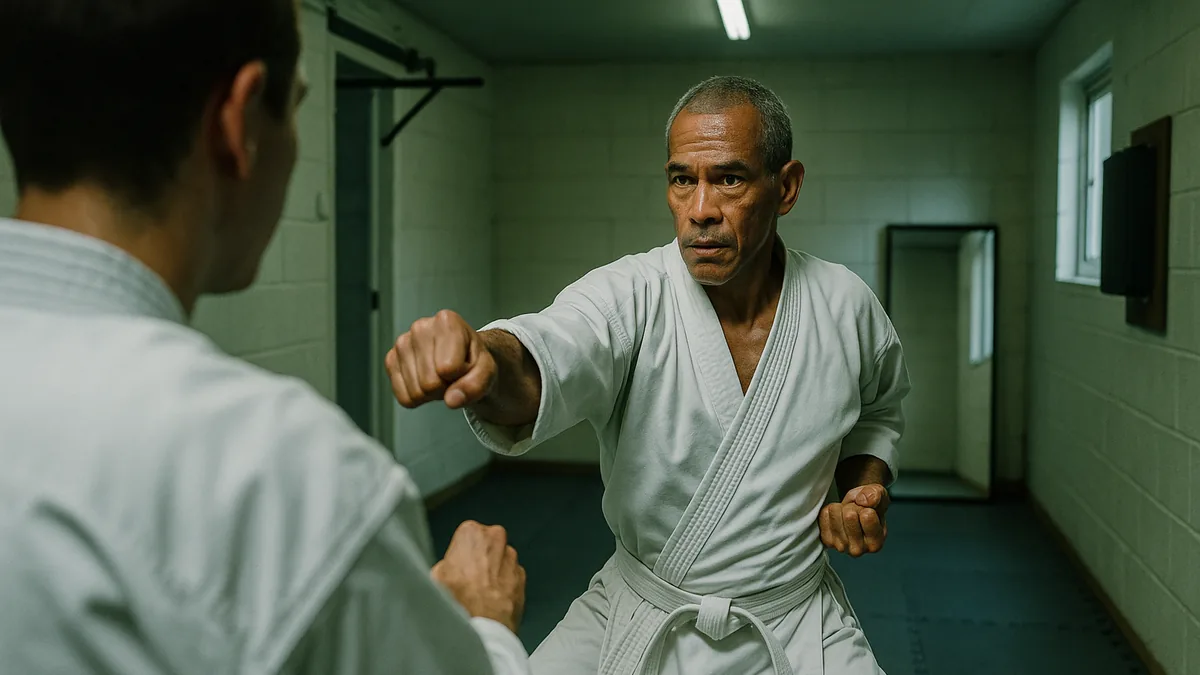
Most practitioners treat the front leg as a placeholder. It’s where your weight sits between techniques, and that’s about it. I’ve watched students spar for years with a perfectly trained rear leg - sharp gyaku-zuki, decent ashi-barai off the back foot - and a front leg that just exists. It holds position. It doesn’t threaten. It doesn’t probe. It doesn’t create anything.
That’s a massive gap in your kumite, and the frustrating part is it’s entirely fixable with focused drilling. The front leg is your fastest weapon, your primary distance manager, and your best tool for controlling the space between you and your opponent. If you’re not training it specifically, you’re fighting with one hand tied behind your back.
Here’s what I’ve learned from training it properly - and from watching what happens when you don’t.
Why the Front Leg Is Underused (And Why That’s a Skill Problem, Not a Style Problem)
The most common reason I see is that practitioners never practice front leg attacks at full intent. They drill mae-geri with the rear leg hundreds of times. The front leg gets a few half-hearted snapping kicks at the end of class. So when kumite starts, the nervous system defaults to what it knows - and the front leg just stands there.
There’s also a balance issue. Most people feel unstable generating power from the front leg because the weight distribution shifts in a way that feels unfamiliar. The correction isn’t to build more strength - it’s to train the specific mechanics of loading and releasing from that position until it feels automatic.
I’d also argue this is partly a curriculum problem in traditional training. Kihon drills almost always start from the rear leg. Front leg work tends to be an afterthought. If you’re serious about your kumite, you need to supplement what your dojo gives you.
If you want to understand how front leg control connects to the broader tactical picture, the article on controlling the centre in kumite covers the spatial awareness side of this well. Front leg activity is one of the main ways you contest that central space without committing to a full attack.
The Drills That Actually Develop It
Front Leg Mae-Geri for Speed, Not Power
This is the most important drill on this list. I’d do this before anything else, and I’d do it more than everything else combined.
The front leg snap kick isn’t about damaging your opponent. It’s about disrupting timing, creating distance, and setting up your real scoring technique. I used to think front leg kicks needed to be powerful to be useful. My instructor corrected me on this more times than I can remember: “It doesn’t need to hurt. It needs to arrive.”
Setup: Start in your fighting stance. No partner needed initially - use a focus pad held at stomach height, or just practice into space.
Execution:
- From your natural fighting stance, shift your weight slightly onto the rear leg - not a full load, just enough to free the front foot.
- Drive the knee up first. The kick comes from the knee lift, not from swinging the leg.
- Snap the foot forward and retract it immediately. The retraction is as important as the extension - faster retraction means you’re back in stance before your opponent can respond.
- Your upper body should barely move. If your shoulders are rocking back, you’re telegraphing.
What to feel for: When it’s right, the kick feels almost effortless - a quick flick that leaves you exactly where you started. You’ll feel the snap in your hip flexor, not your thigh. If your quad is doing most of the work, the kick is too slow and too big.
What most people get wrong: They load the rear leg too obviously before kicking. I see students shift their weight back like they’re winding up, and by that point any decent opponent has already moved. The weight shift should be minimal and subtle. Practice in front of a mirror and watch your shoulders - if they dip back, you’re giving it away.
Progression: Once the mechanics are clean, add a partner. Have them hold a pad loosely at stomach height and move randomly. Your job is to land the kick within 0.5 seconds of them stopping. This trains the kick as a reactive tool, not a planned one.
Front Leg Kin-Geri (Groin Kick) as a Disruption Tool
Underused in training, genuinely effective in sparring. This one targets a different angle than the straight snap kick and is harder for opponents to read because the trajectory is different.
Setup: Partner holds a pad low, angled slightly downward.
Execution:
- From fighting stance, drive the front knee upward and inward slightly.
- The striking surface is the instep or the ball of the foot, depending on your association’s rules.
- Contact the pad without any upper body lean. Stay upright.
- Retract and return to stance.
What to feel for: The kick should feel like a short, sharp flick upward. If it feels like you’re swinging, you’re using too much leg and not enough hip.
Common mistake: Students lean forward to reach the target. The correction is to let the kick come to the target, not chase it with your body. If you’re leaning, the pad is probably too far away - adjust your starting distance.
Front Leg Lateral Step and Kick Combination
This is where front leg work starts to become actual kumite movement rather than isolated technique. The idea is to use the front foot to step laterally, changing the angle, and then fire a kick or punch from the new position.
Setup: You need a partner or a heavy bag. Mark a spot on the floor as your starting position.
Execution:
- From fighting stance, step your front foot diagonally outward - 45 degrees to your left if you’re in left stance.
- As the foot lands, your weight transfers onto it. This is the load.
- From that loaded position, fire either a front leg kick or immediately follow with a gyaku-zuki.
- Reset and repeat to the other side.
What to feel for: The step and the technique should feel connected - one fluid motion, not two separate things. When it clicks, you’ll feel the ground through your front leg as you load, and the technique comes out of that connection with the floor rather than being thrown from your upper body.
What I tell students: Most beginners treat the step as a setup and the kick as the real thing. Senior practitioners treat them as one movement. That’s the difference between a combination that works and one that gets you countered.
Static Front Leg Strengthening - Single Leg Stance Holds
This one looks boring. It is boring. It also directly addresses the stability problem that makes everything else harder.
Setup: No equipment needed.
Execution:
- Stand on your front leg only, in the same hip and knee position as your fighting stance.
- Hold for 30 seconds. Stay relaxed in the upper body.
- Add small perturbations - reach forward with your hands, rotate your torso slightly - while maintaining the stance.
- Progress to closing your eyes, which dramatically increases the proprioceptive demand.
Why it matters: The instability most people feel when attacking from the front leg comes from weak single-leg stability on that side. This drill builds exactly the strength and proprioceptive awareness you need. It’s not exciting, but the correction it produces in your kumite is immediate and obvious.
What Changes With Experience
As a junior practitioner, front leg work feels mechanical. You’re thinking about the knee lift, the retraction, not telegraphing. That’s fine - that’s where it starts.
What changes is that you stop thinking about the technique and start thinking about the effect. By brown belt level, the front leg snap kick isn’t something you execute - it’s something you use. You’re reading your opponent’s rhythm, finding the gap, and the kick fills it. The mechanics are invisible because they’re automatic.
I’ve noticed that senior practitioners also use the front leg much more as a feint. A slight lift of the front knee - not even a full kick - can cause an opponent to react, and that reaction is what they’re actually after. That level of use only comes after the kick itself is completely internalised. You can’t fake something convincingly until you can do it convincingly.
This connects directly to reaction training. If you haven’t read how to fix slow reactions in kumite, the principles there apply directly to front leg speed - particularly the section on reducing decision lag.
Community Perspective
There’s genuine disagreement about how much power the front leg kick should carry. Traditional Shotokan practitioners often train it as a distance tool only - light, fast, no power intent. WKF competition coaches sometimes want more commitment behind it, particularly for scoring. Kyokushin practitioners treat it very differently again, since full contact rules change what’s viable.
My honest position: I prefer the light, fast version for kumite application, and I think training for power in the front leg kick usually produces a slower, more telegraphed technique. The exceptions are practitioners who are significantly taller than their opponents - in that case, a heavier front leg kick can be effective because the distance advantage changes the timing equation. The article on kumite for heavier or shorter karateka covers this kind of build-specific adaptation well.
There’s also a debate about how much to train front leg attacks in isolation versus always integrating them into combinations. I’ve seen both approaches produce good fighters. My preference is isolation first until the mechanics are clean, then integration. But I’ve trained with practitioners who did it entirely the other way and had excellent front leg work. This is one of those areas where the destination matters more than the route.
Key Takeaways
- The front leg snap kick doesn’t need power - it needs speed and disguise. Train the retraction as hard as the extension.
- Telegraphing through the shoulders is the single most common error. Fix it in slow practice before you try to fix it at speed.
- Single leg stability work is unglamorous but it’s the foundation. If your front leg feels unreliable in kumite, this is usually why.
- The lateral step and kick combination is where front leg work becomes real kumite movement. Don’t skip straight to it, but don’t stay in isolated drills forever either.
- Front leg feints only work after the actual kick is automatic. Build the real thing first.
- If your front leg isn’t threatening your opponent, you’re making it easier for them to control the centre and dictate the match. An active front leg is one of the cheapest ways to make yourself harder to read and harder to pressure.
The weekly digest
New karate articles, once a week
One email every week with everything new on Karate Lifestyle. No spam; unsubscribe in one click.
We'll email you to confirm. See our privacy policy.