How to Train Alone When You Have No Club Access
Most people who lose club access for any length of time come back weaker than they left - not physically, but technically. They’ve been doing push-ups and running, which is fine, but they’ve let the actual karate go quiet. I’ve seen students return after three months away and their stances have collapsed, their kata timing has drifted, and they’ve lost the sharpness in their basics that took years to build. The physical fitness comes back fast. The technical precision doesn’t.
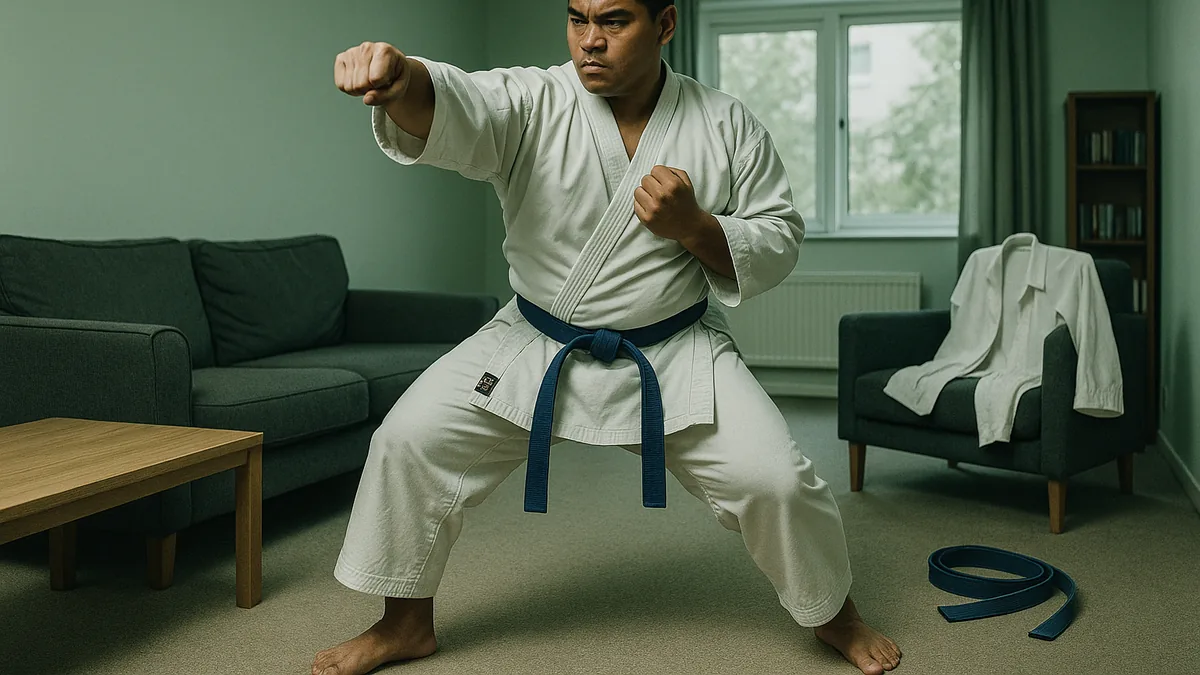
Training alone is genuinely hard. There’s no feedback loop, no partner pressure, no instructor watching your back heel lift when you punch. But it’s not hopeless - not even close. I’ve had stretches of solo training that made me better in specific ways than dojo training ever did, because I had no choice but to slow down and pay attention to things I’d been glossing over. This is what I’ve learned works, what wastes your time, and how to structure it when you’re on your own.
Shadow Karate: Not What Most People Think It Is
Shadow karate is not kata. I want to be clear about that because I’ve seen students conflate the two and end up doing neither well.
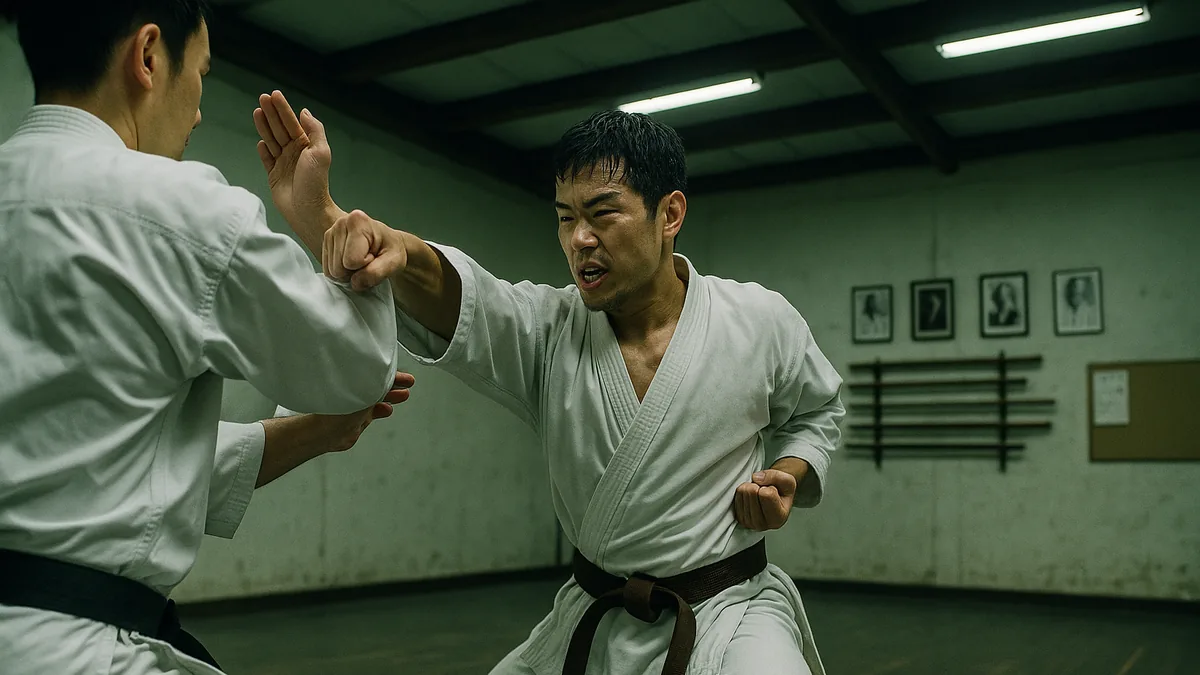
Shadow karate is free-form movement - you’re imagining an opponent, reacting to them, making decisions in real time. It’s the closest thing to sparring you can do alone, and most people do it completely wrong.
The Visualisation Problem
The mistake I see most often is that students shadow karate against a stationary target. They throw a combination, pause, throw another combination, pause. That’s not shadow karate - that’s just drilling combinations with extra steps.
What I tell students is this: your imaginary opponent has to be moving. They attack, they retreat, they circle. You have to respond to that, which means your footwork has to be live, your guard has to adjust, and your timing has to be reactive rather than pre-planned.
Here’s how to actually run it:
- Set a three-minute round on a timer.
- Start in your fighting stance. Don’t just stand there - begin with movement.
- Imagine an opponent closing distance. Respond. Don’t plan the response - react to what you’re seeing in your head.
- Change levels, change direction, change rhythm. If you’re moving in predictable patterns, your imaginary opponent has figured you out.
- Include failed attacks - you throw a gyaku-zuki, it doesn’t land, now what? This is where most people freeze.
The thing that changed my shadow training was when my instructor told me to stop trying to look good. He said “you’re performing, not fighting.” He was right. I was throwing clean combinations because they felt satisfying. Real shadow karate is messier - you abort techniques, you reset, you cover up. When you start doing that, you’ll feel the difference immediately. It stops feeling like a display and starts feeling like a conversation.
Kata: The Most Underused Solo Training Tool
I’d argue kata is the single most valuable thing you can do alone, and I’d also argue most people - including experienced practitioners - are not getting close to its full value.
Slow Kata
This is the drill I come back to more than any other during solo training periods.
Pick one kata. Run it at roughly 20% of your normal speed. Not slow-motion-performance slow, but slow enough that you can feel every transition.
What you’re looking for:
- Where does your balance actually go? Most people don’t know. At full speed, momentum carries you through the gaps. At this speed, you’ll find them.
- Where are you holding tension that you don’t need? I used to grip my own fist so hard during punching sequences that my forearm was already fatigued before the technique landed. I didn’t know until I slowed down enough to notice.
- Where does your breathing break? If you’re holding breath through transitions, you’ll feel it here. If you want to go deeper on this, Breathing in Karate: When and How is worth reading alongside this work.
The common mistake: people slow down the techniques but keep the transitions fast. That defeats the purpose. The transitions are where the information is.
Bunkai Visualisation
Once you know your kata reasonably well, run it with specific application in mind for each sequence. Not “this is a block and a punch” but “someone has grabbed my lapel with their right hand and I’m doing this.” The kata will feel completely different. Movements that seemed arbitrary will suddenly have weight behind them.
This is where kata stops being a memorisation exercise and starts being a problem-solving tool.
Kihon Without a Partner
Kihon alone is the area where I see the most wasted effort. Students drill their basics for twenty minutes and come away no better than when they started, because they’re just repeating movements without any standard to measure against.
If you want to understand why kihon matters at every level of training, Why Kihon Still Matters at Every Belt Level covers this in detail - but here’s the practical version for solo work.
The Wall Target Drill
Find a wall. Stand close enough that if you extended your punch fully, your knuckles would be about two inches from the surface. Now drill your oi-zuki down the line.
You’re not punching the wall. You’re using it as a reference point. If your punch is drifting, you’ll see it in relation to the fixed surface. If your elbow is flaring, you’ll see the trajectory change. The wall gives you the feedback loop that a partner normally provides.
What to feel for: your hip should be driving the punch, not your shoulder. When it’s right, you’ll feel the power start from your back foot, move through your hip, and arrive at your fist. When it’s wrong, you’ll feel your shoulder working hard and your hip arriving late - or not at all.
The mistake I see most often here is students punching fast to feel productive. Speed hides errors. Drill at medium pace until the mechanics feel automatic, then add speed. Never the other way around.
For a solid foundation on stance mechanics that underpin everything in kihon, Karate Stances Explained is the reference I point students to.
Strength and Conditioning That Actually Carries Over
I want to be honest here: most generic fitness advice for martial artists is not specific enough to matter. Running is fine. Push-ups are fine. But if you want your conditioning to carry over into your karate, you need to train the qualities karate actually demands.
Hip Mobility and Rotational Strength
The hip rotation is the whole punch. Without it, you’re just throwing your arm. This is not a metaphor - it’s mechanics. If your hips are stiff or weak, your punching power has a ceiling and your kicks will be compromised.
Daily work I’d recommend:
- Hip circles, 2 minutes each direction, slow and controlled. Not a warm-up exercise - a mobility drill. Feel the range increasing.
- Standing hip rotations against resistance. Stand in zanshin-dachi and practice the hip snap of a reverse punch without the arm. Just the hip. Isolating it teaches you where the power actually comes from.
- Lateral lunges with a pause at the bottom. Builds the inner thigh and hip strength that holds your stances without collapsing.
Plyometric Work for Explosiveness
Single-leg bounds, squat jumps, and lateral hops all build the fast-twitch quality that karate requires. I prefer these to heavy weight training for karate-specific conditioning because they train acceleration rather than raw strength.
One note: if you’re managing any existing issues, check Training With Injuries: When to Push, When to Rest before loading plyometric work. Jumping on a compromised knee because you’re training alone and nobody’s there to tell you to stop is exactly the kind of thing that turns a minor issue into a long one.
Using Online Resources Without Getting Lost in Them
There is more karate content online than any practitioner can absorb, and most of it is either too basic to be useful or too style-specific to translate. I’ve wasted significant time watching videos that looked impressive and taught me nothing.
What actually works: find one or two senior practitioners in your own style who post detailed technical breakdowns, and go deep on their material rather than wide across many sources. Depth beats breadth here.
Use video to check your kata against a reference performance, not to learn new kata. Learning kata from video alone is possible but risky - the details that matter most are often invisible from the camera angle available.
Record yourself. This is the single most valuable thing technology offers the solo practitioner. Watch it back the next day when you’re not still inside the movement. You will see things that surprise you.
Community Perspective
There’s a real split in the karate community about whether solo training can maintain your level or only slow the decline. Traditionalists tend to say you can’t train karate properly without a partner - and there’s truth in that, particularly for kumite. You can’t develop real timing, distance management, or pressure response without another body in front of you.
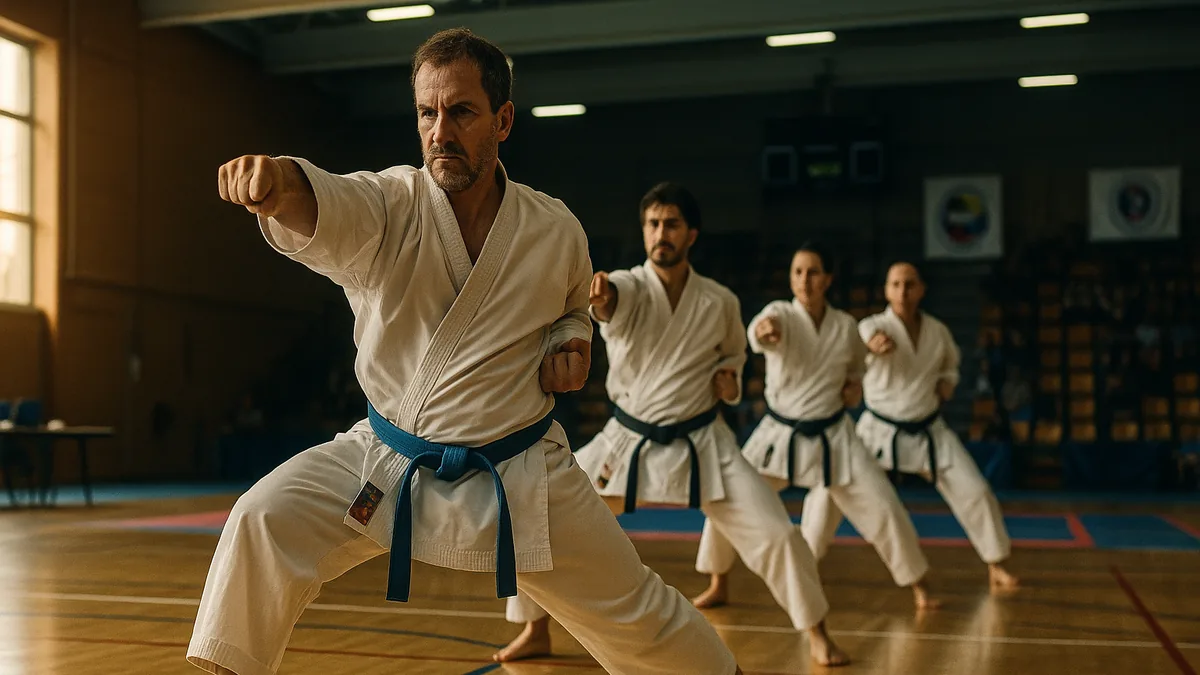
But I’ve also seen practitioners who trained intensively alone during extended periods come back sharper in specific areas - particularly kata, kihon mechanics, and body awareness - because solo training forces a different kind of attention. You’re not reacting to a partner; you’re examining yourself.
My honest position: solo training can’t replace partner training for kumite development. But for kata and kihon, I think the focused attention you can bring to solo work is genuinely difficult to replicate in a busy dojo class. The practitioners I’ve seen use solo periods well are the ones who treat it as a different kind of training rather than an inferior substitute.
Key Takeaways
- Shadow karate only works if your imaginary opponent is moving and unpredictable. Static shadow karate is just drilling with extra steps.
- Slow kata is not a beginner exercise - it’s where senior practitioners find the details they’ve been glossing over. Run it at 20% speed and pay attention to what your balance is actually doing.
- Kihon without a feedback reference is mostly wasted effort. Use a wall, use video, use something that shows you what you can’t feel.
- Hip mobility and rotational strength are the conditioning priorities that carry over most directly into karate technique. Don’t just run.
- Record yourself and watch it back the next day. You’ll see more than you expect to.
- Recovery matters as much when you’re training alone as it does in the dojo. If you’re unsure how to structure rest, How Long Should You Rest Between Karate Training Sessions? is worth reading before you build your weekly schedule.
The weekly digest
New karate articles, once a week
One email every week with everything new on Karate Lifestyle. No spam; unsubscribe in one click.
We'll email you to confirm. See our privacy policy.