How to Build a 12-Week Solo Training Block When Club Sessions Are Your Only Structured Practice: A Framework for Self-Directed Improvement
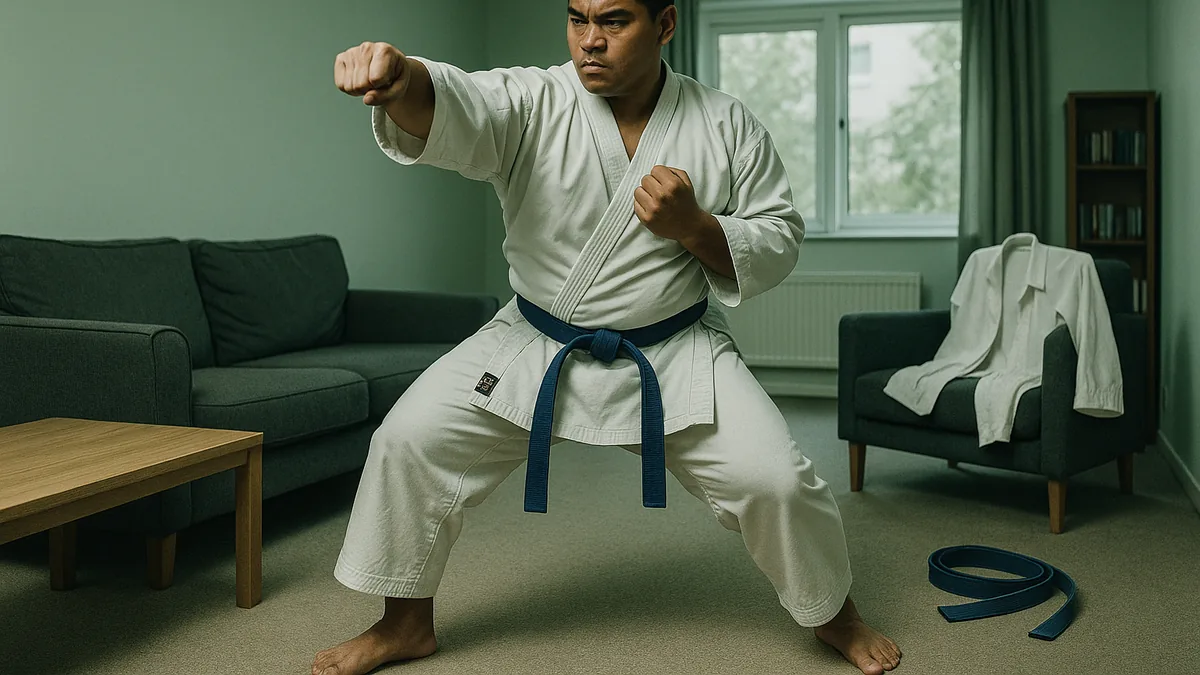
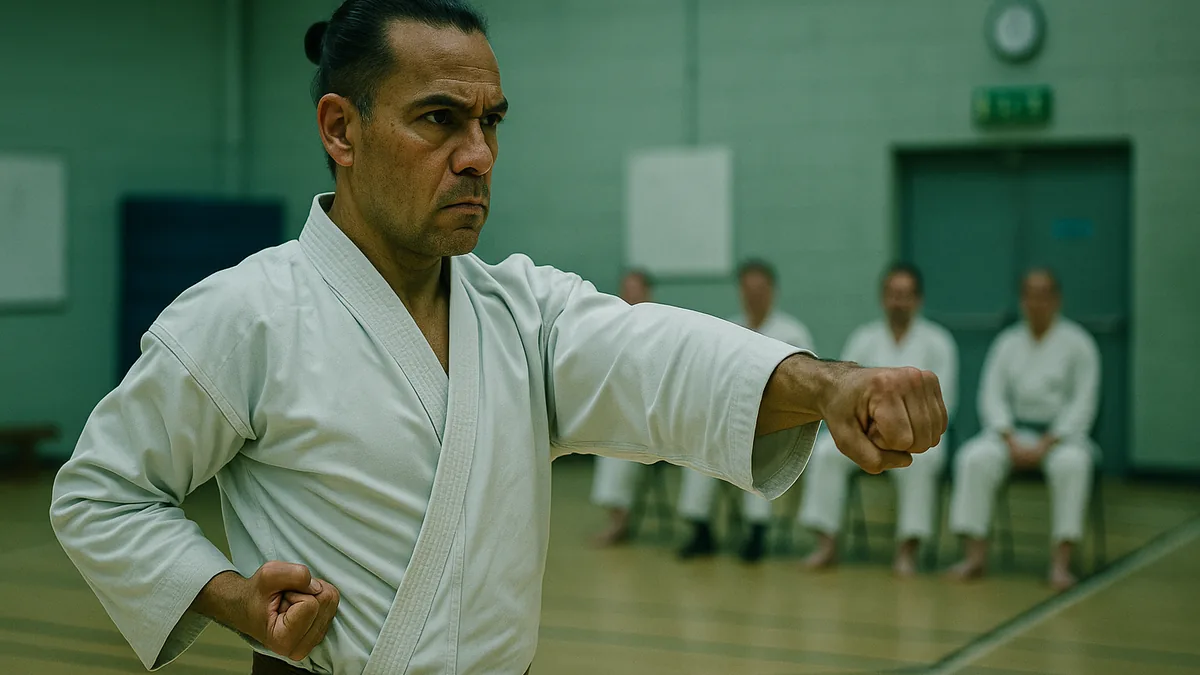
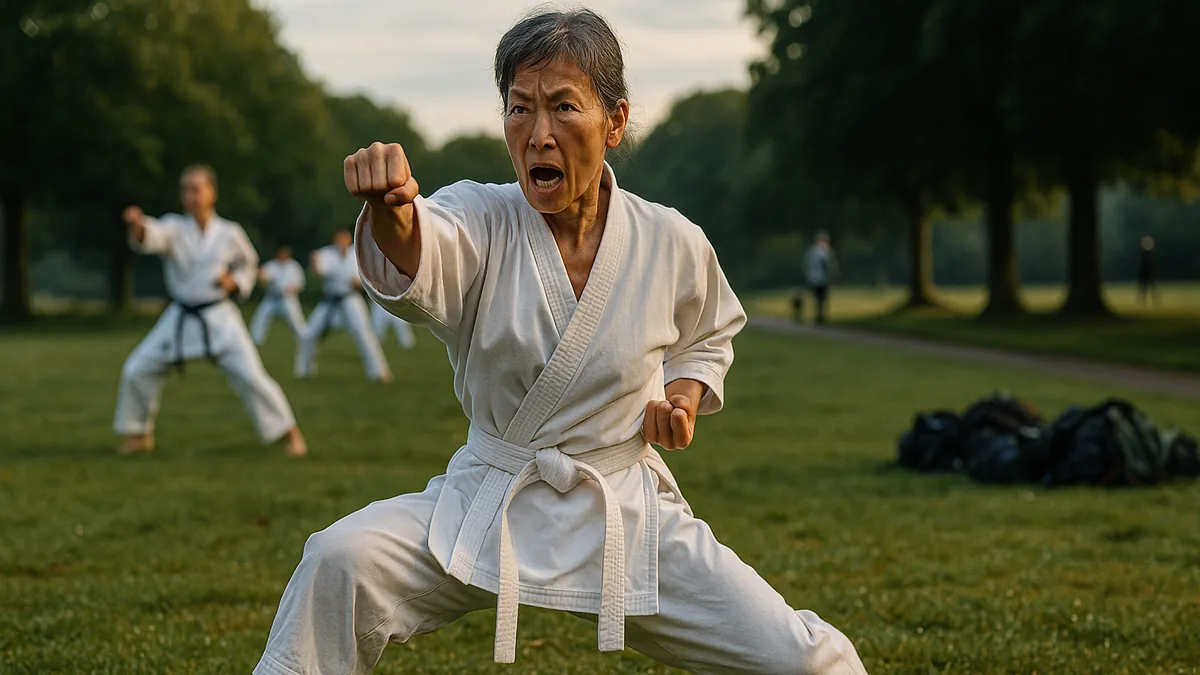
Most practitioners who train solo make the same mistake: they treat solo sessions as a scaled-down version of club training. They run through a few kata, do some basics, and call it done. That approach wastes the opportunity. Solo training is not a substitute for club sessions - it is a different kind of work entirely, and when it is structured properly, it targets the gaps that group training almost never addresses.
This framework gives you a 12-week block to run alongside your regular club attendance. The goal is not to replicate what your instructor does on the mat. It is to build the specific qualities - timing, precision, structural integrity under fatigue - that only develop through deliberate, repeated solo work.
If you are starting from scratch with solo training, read How to Train Alone When You Have No Club Access first. It covers the foundational setup questions. This guide assumes you already have a space, a routine, and the discipline to show up.
How the 12 Weeks Are Structured
The block divides into three phases of four weeks each. Each phase has a different emphasis, but all three contain the same core drills - what changes is the depth, complexity, and physical demand.
Phase 1 (Weeks 1 to 4): Precision over speed. Every repetition is deliberate. You are building accurate movement patterns, not testing them under pressure.
Phase 2 (Weeks 5 to 8): Load and volume. You increase repetitions, add fatigue, and begin working combinations. The patterns you built in Phase 1 should hold when you are tired. If they do not, that is useful information.
Phase 3 (Weeks 9 to 12): Integration and pressure. You apply what you have built to more complex sequences, directional changes, and self-imposed time pressure. This is where the work becomes recognisably karate rather than isolated drilling.
We recommend three to five solo sessions per week, 30 to 45 minutes each. Research on practice distribution consistently shows that more frequent, shorter sessions produce better skill acquisition and long-term retention than fewer, longer blocks of the same total volume.1, 2 That is not a coaching preference - it reflects how motor memory consolidates between sessions rather than within them.3
The Core Drills
These are the four drills that form the backbone of every phase. They are not glamorous. They are the ones that actually produce change.
1. Stationary Kihon with Deliberate Pause
Why it matters: Most kihon errors happen in the transition - the moment between the chamber and the execution, or between one technique and the next. Pausing at each position forces you to feel where your structure actually is, not where you assume it is. Deliberate practice of this kind - focused, goal-directed repetition with immediate self-assessment - is consistently associated with skill acquisition across sport and other performance domains.4
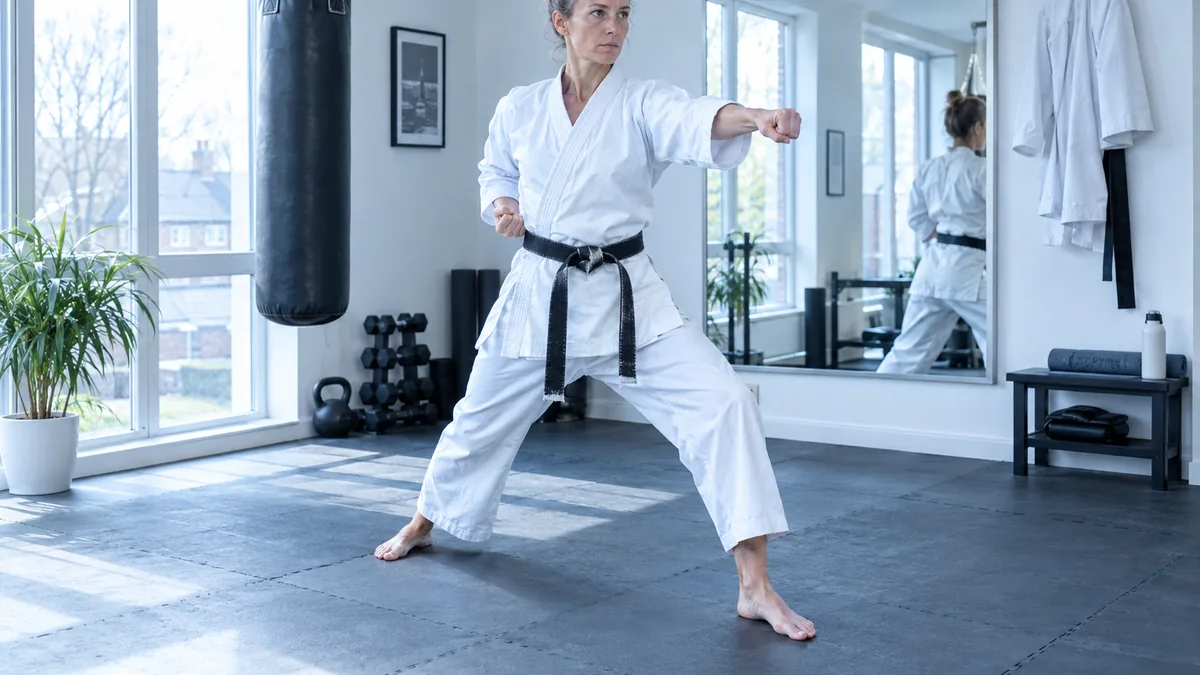
Setup: Stand in your fighting stance or a forward stance, depending on what you are drilling. No mirror for the first set - you need to feel the position, not watch it. (For guidance on when the mirror helps and when it becomes a crutch, see How to Use a Mirror Correctly in Karate Training.)
Execution:
- Execute one technique - a gyaku-zuki, a jodan uke, whatever you are focusing on this week.
- Hold the end position for three full seconds.
- During the hold, check: Is your weight where it should be? Is the technique fully extended or are you stopping short? Is your supporting structure - the non-striking arm, the hip, the back leg - actually engaged?
- Return to ready position. Reset completely. Repeat.
What to feel for: At the end position, you should feel a sense of solidity rather than suspension. If you feel like you are balancing on the technique rather than arriving at it, the hip has not committed. A correction that often works here is to think of the hip as leading the hand, not following it. When that clicks, the technique feels grounded rather than effortful.
The most common mistake: Rushing the pause. Practitioners hold for half a second and call it done. The three-second hold is the drill. If it feels pointless, that is because the technique is not landing in a structurally sound position - there is nothing to hold onto.
Phase progression: In Phase 1, ten repetitions per technique, full pause every time. In Phase 2, increase to twenty repetitions but pause only on every fifth. In Phase 3, remove the pause entirely and see whether the quality holds.
2. Slow-Motion Kata
Why it matters: Kata at full speed hides errors. At slow speed, you cannot use momentum to cover weak transitions, and you cannot rush through positions that feel uncomfortable. Slow kata is essentially a moving structural audit.
Execution:
- Choose one kata. Perform it at roughly one quarter of your normal speed.
- Every movement should take four to five times longer than it normally would.
- At each significant position - each block, each strike, each stance change - pause for two seconds and assess.
What to feel for: The moments where you want to speed up are the moments where something is wrong. That urgency to rush through a transition is your body telling you it does not know how to do that movement cleanly. Slow down further at those points, not faster.
The hip rotation at slow speed feels strange at first - almost mechanical and disconnected. That is normal. What you are looking for is the point where the hip and the hand arrive together rather than the hand arriving first and the hip catching up. When the timing is right, even at slow speed, you feel a sense of connection through the whole side of your body rather than just the arm extending.
The most common mistake: Treating slow kata as easy kata. Many practitioners reduce speed but not effort - they move slowly but with loose structure, as if they are just marking movements. The drill only works if you apply the same muscular engagement you would at full speed.
3. Shadowboxing with Intent
Shadowboxing is underused in traditional karate training and often done badly when it is used. For a full breakdown of how to make it a serious training tool, see Shadowboxing for Karateka: How to Make It a Serious Training Tool.
The key point for this block: shadowboxing should have a scenario. Not “throw some techniques” - a specific situation. For example: your opponent has just overcommitted on a gyaku-zuki and is slightly off-balance. What do you do in the next two seconds?
Why scenarios matter: Without a scenario, shadowboxing becomes choreography. With a scenario, it becomes decision-making practice. The physical quality of your movement changes when you are responding to something rather than performing something.
Phase progression: In Phase 1, use simple, single-exchange scenarios. In Phase 2, extend to three to four technique sequences. In Phase 3, add directional changes - your imagined opponent is moving, not standing still. This is where combination work often falls apart, and Why Your Combinations Fall Apart When You Change Direction addresses that specific problem in detail.
4. Kamae Integrity Drill
Why it matters: Your guard position under fatigue is almost certainly worse than your guard position at the start of a session. Most practitioners do not know by how much. This drill makes that gap visible and then trains it out.
Execution:
- Set an interval timer to sound at the 45-second mark of a 90-second countdown - or use a second timer set to 45 seconds alongside the main one. The point is to get an alert you are not consciously anticipating.
- Move continuously in your fighting stance - step forward, step back, angle left, angle right. Keep moving. Do not stop.
- When the alert sounds, freeze immediately and assess your kamae without adjusting it first.
- Where is your guard hand? Has your back arm dropped? Is your chin down or has it crept up?
What to feel for: A well-maintained kamae under movement does not feel relaxed - it feels alert. There is a difference between tension and readiness, and this drill teaches you to sustain readiness rather than defaulting to either rigidity or collapse. If your kamae is collapsing under pressure, the structural causes are covered in Why Your Kamae Keeps Collapsing Under Pressure.
The most common mistake: Adjusting the guard position before assessing it. The point of the freeze is to see where you actually are, not where you think you are.
What Changes Across the 12 Weeks
In Phase 1, most practitioners are surprised by how much they do not know about their own technique. The slow work and deliberate pauses reveal habits that full-speed training has been hiding for months or years.
By Phase 2, the physical sensations become more reliable guides than visual checks. You start to feel when a technique is structurally sound rather than needing to see it in a mirror or have someone tell you.
Phase 3 is where the work becomes genuinely satisfying. The patterns are stable enough that you can apply them under pressure without them degrading. That is the goal - not perfect technique in a controlled drill, but technique that holds when the conditions are not ideal.
For guidance on fitting this block into a broader training schedule without overloading your week, see How to Build a Karate Training Schedule That Actually Fits Your Life.
Community Perspective
There is a genuine disagreement in karate circles about how much value solo training adds for practitioners who already attend regular club sessions. Some instructors argue that solo work without corrective feedback simply reinforces existing errors. Others - and we sit firmly in this camp - argue that the quality of correction you receive at club depends partly on the quality of your self-awareness, and solo drilling builds exactly that.
The honest answer is that both positions contain truth. Solo training without any external feedback carries a real risk of ingraining errors. The mitigation is video review: film yourself regularly, compare against reliable reference points, and bring specific questions to your instructor rather than training in a vacuum. Research on self-controlled video feedback consistently shows that learners who choose when to review their own performance on video improve skill acquisition and retention compared with those who receive no video feedback.5
There is also an ongoing debate about whether kata or kihon should take priority in solo work. The answer varies by style and by where a practitioner is in their development. At kyu grade, kihon drilling tends to produce faster mechanical improvement. At dan grade, the nuance in kata repays deeper solo study in ways that repetitive kihon often does not. That is a generalisation, but it is a useful one.
Key Takeaways
- Structure the 12 weeks in three phases: precision, volume, integration. Do not skip to Phase 3 because it feels more like real training.
- The pause in stationary kihon is the drill, not a rest between repetitions. If it feels pointless, the technique is not landing correctly.
- Slow-motion kata is a structural audit, not easy kata. Apply full muscular engagement at reduced speed.
- Shadowboxing without a scenario is choreography. Give every session a specific tactical context.
- Film yourself at least once per phase. Research on self-controlled video feedback supports its value for motor skill learning and retention.5
- The goal of a solo block is not to replace club training - it is to arrive at club sessions with better questions, clearer self-awareness, and more stable foundations for your instructor to work with.
References
Checked by the KarateLifestyle editorial team against peer-reviewed motor learning literature (PubMed, journal pages), a Human Kinetics textbook, and a peer-reviewed meta-analysis in November 2026. The distributed practice evidence is strongest for continuous motor tasks; its application to discrete karate techniques is well supported but the effect size varies by task type.
- Motor Learning and Development, 3rd Edition. Magill, R. A. & Anderson, D. I. Human Kinetics, 2013. Cited via Human Kinetics excerpt on distribution of practice.
- Distribution of Practice in Motor Skill Acquisition: Learning and Performance Effects Reconsidered. Lee, T. D. & Genovese, E. D. Research Quarterly for Exercise and Sport, 59(4), 1988. Meta-analysis of 52 studies showing spaced practice outperforms massed practice for motor skill acquisition and retention (d = 0.96).
- Spacing practice sessions across days benefits the learning of motor skills. Shea, C. H. et al. Human Movement Science, 2000. Demonstrates that inter-session spacing across days enhances motor skill learning compared with short within-day intervals.
- The role of deliberate practice in the acquisition of clinical skills. van de Wiel, M. W. J. et al. BMC Medical Education, 11:101, 2011. Reviews Ericsson's deliberate practice model and its evidence base in skill acquisition across sports, music, and clinical domains.
- Learner-Controlled Self-Observation is Advantageous for Motor Skill Acquisition. Ste-Marie, D. M. et al. Frontiers in Psychology, 3:556, 2012. Peer-reviewed study demonstrating that learner-controlled video self-observation improves motor skill acquisition compared to externally controlled video feedback.
The weekly digest
New karate articles, once a week
One email every week with everything new on Karate Lifestyle. No spam; unsubscribe in one click.
We'll email you to confirm. See our privacy policy.