How to Use a Mirror Correctly in Karate Training: What It Fixes, What It Hides, and When to Turn It Off
Most students use the mirror the wrong way. They watch themselves perform, decide it looks good, and move on. That’s not training - that’s approval-seeking. The mirror is a diagnostic tool, not an audience, and the difference between those two mindsets is bigger than most people realise.
I’ve seen students with genuinely terrible alignment spend months in front of a mirror and get worse, not better, because they were watching the wrong things and interpreting what they saw incorrectly. I’ve also seen the mirror completely transform a student’s understanding of their own posture in a single session when they knew what to look for. The tool isn’t the problem. How you use it is.
Here’s what I’ve learned about using a mirror effectively, where it actively gets in your way, and when you need to put your back to it entirely.
What the Mirror Actually Tells You
The mirror is honest about structure. It will show you if your shoulders are creeping up, if your hikite is lazy, if your stance is too narrow, if your head is drifting forward on impact. These are real problems and the mirror catches them reliably.
What it won’t tell you is whether your technique is working. That’s a different question entirely, and conflating the two is where most students go wrong.
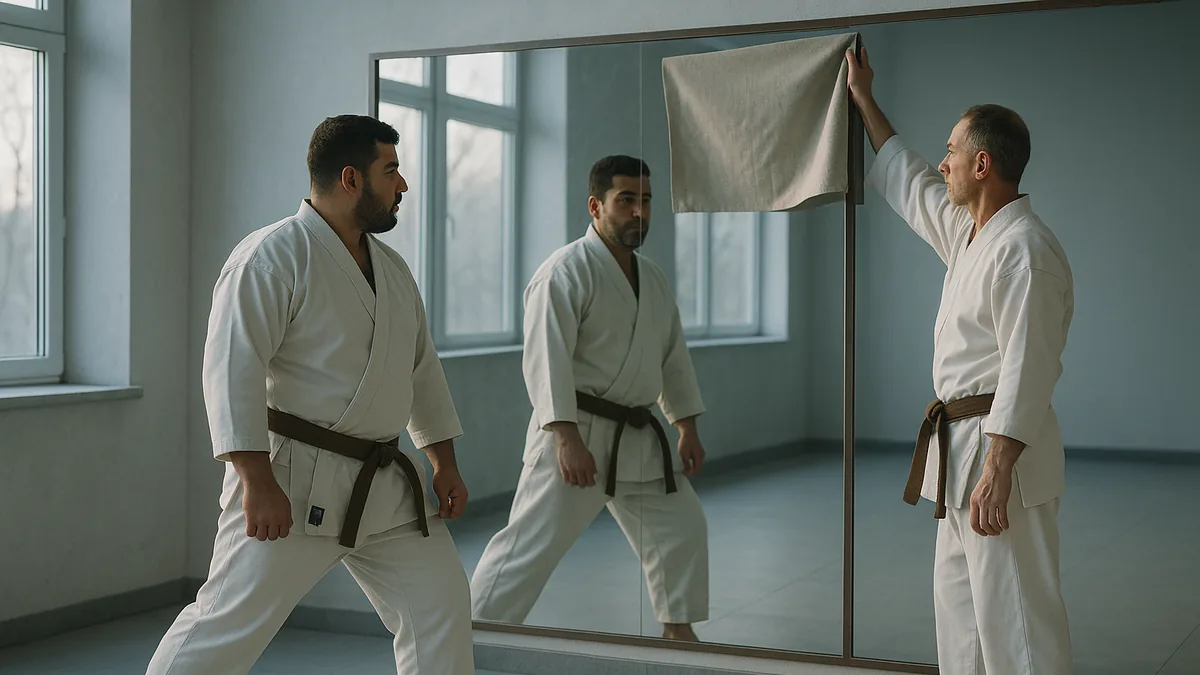
I used to think a technique that looked right was right. My instructor corrected that assumption during a basics session when he covered the mirror with a cloth and told me to do my gyaku-zuki. I immediately felt how much I’d been relying on visual feedback to position my arm, and how little I actually understood about where my body was in space. That was an uncomfortable session. It was also one of the most useful.
Checking Alignment and Posture
This is the mirror’s strongest use case. Stand in front of it in zenkutsu-dachi and check the following, one at a time:
- Is your front knee tracking over your second toe, or collapsing inward?
- Are your hips squared to the front, or is one hip pulling back?
- Is your spine vertical, or are you leaning forward from the waist?
- Where are your shoulders relative to your ears?
- When you pull your hikite, does it actually drive back to your hip, or does it stop somewhere around your ribs?
The mistake I see most often is students checking everything at once and seeing nothing clearly. Pick one thing. Check it. Fix it. Then move to the next. If you’re scanning your whole body simultaneously, you’re not correcting - you’re just looking.
Checking Chamber and Trajectory
The mirror is useful for seeing whether your punch is actually tracking straight or drifting across your centreline. This is harder to feel than you’d expect. I’ve had students who were convinced their oi-zuki was going straight forward, and the mirror showed them it was angling inward by about 20 degrees. They genuinely couldn’t feel it.
Stand side-on to the mirror occasionally, not just front-on. This gives you a completely different view of your posture and the angle of your techniques. Most students never do this and miss obvious problems with forward lean and hip position.
Where the Mirror Creates Problems
Here’s the part nobody talks about enough.
The mirror creates a false sense of competence because it gives you visual feedback, and humans are wired to trust what they see. If it looks right, we assume it is right. But karate technique is mostly about what you feel, not what you see - and the mirror actively trains you to prioritise the wrong sense.
I’ve noticed that students who train predominantly in front of mirrors often develop what I’d call “mirror technique” - it looks clean at low speed, but the moment they’re under pressure in kumite, it falls apart. The reason is that they’ve learned to produce a visual output rather than a physical sensation. They can’t replicate the technique without the mirror because they don’t actually know what it feels like from the inside.
The other problem is that the mirror only shows you one angle, and you start optimising for that angle unconsciously. Your technique looks great from the front. From the side, your elbow is flaring. From behind, your back leg is barely bent. You’ll never know, because you only ever checked from the front.
There’s also a subtler issue. When you’re watching yourself, your attention is outside your body. Effective technique requires your attention to be inside it - tracking the connection through your hips, the timing of your kime, the relationship between your feet and the floor. The mirror pulls your focus in exactly the wrong direction.
This connects to something I think is underappreciated in solo training generally. If you’re using the mirror during shadowboxing, you’re probably not shadowboxing properly. Real shadowboxing requires you to be present in an imaginary fight, not watching yourself move.
When to Turn the Mirror Off
My rule is simple: use the mirror to identify a problem, then turn away from it to fix the problem.
The correction happens through repetition with correct sensation, not through watching yourself in real time. Once you know your shoulder is rising on impact, you need to feel what it’s like when it doesn’t - and you can’t do that while you’re watching it.
The Closed-Eyes Drill
This is the drill I come back to more than any other for developing proprioception. It feels strange at first, and most beginners resist it, but it’s the fastest way I know to shift from visual to physical awareness.
Why it matters: You cannot rely on a mirror in sparring, in grading, or in any real application. If your technique only works when you can see it, it isn’t really in your body yet.
Setup: Stand in your fighting stance or kamae, two or three metres from any wall. You don’t need the mirror at all for this drill.
Execution:
- Perform a single technique - a gyaku-zuki works well to start - with your eyes open. Note what it feels like at the point of kime.
- Close your eyes. Perform the same technique.
- Open your eyes. Check your position. Did your stance shift? Did your hikite actually come back to your hip? Is your punching arm where you thought it was?
- Repeat ten times with eyes closed, checking after every third rep.
What to feel for: The goal is for the closed-eyes version to feel identical to the open-eyes version. At first it won’t. Your arm will drift, your stance will narrow, your posture will change. That gap between what you think you’re doing and what you’re actually doing - that’s the thing you’re training to close.
The mistake most people make is rushing through this and not actually checking their position after each rep. You need the honest feedback. If you’re just closing your eyes and punching without checking the result, you’re not learning anything.
What I tell students is that by the time this drill stops being surprising - when you open your eyes and your position is consistently where you expected it to be - you’ve genuinely internalised the technique. That’s a different quality of knowledge than what the mirror gives you.
Training Without the Mirror for Full Sessions
I’d recommend one full training session per week with no mirror access at all. If you train at home, face a wall or face away from any reflective surface. If this feels uncomfortable, that discomfort is information.
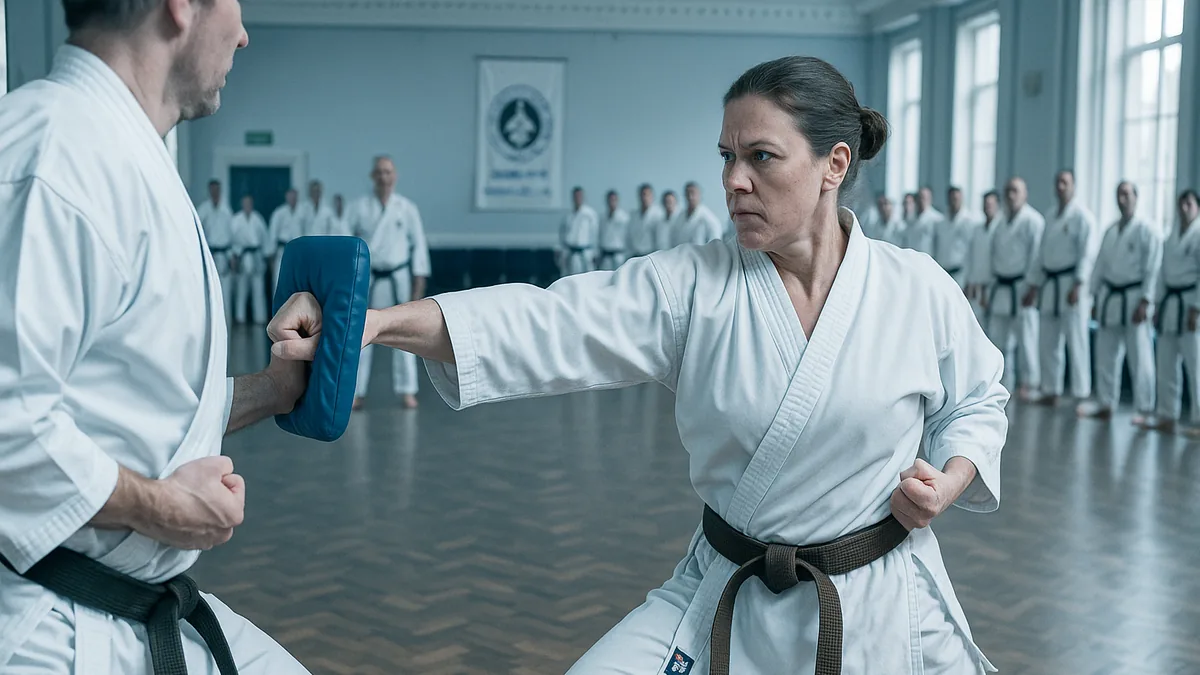
This is especially important if you’re working on timing and flow rather than static positions. The mirror is nearly useless for timing work - it can’t tell you whether your block is meeting the attack at the right moment, only whether your arm is in roughly the right place. For timing, you need a partner, a pad, or at minimum the pad work drills that force you to respond to something external rather than performing into a vacuum.
If you’re training alone without club access, solo training relies heavily on developing internal feedback, and over-dependence on the mirror is one of the fastest ways to undermine that development.
Community Perspective
There’s a genuine split in how different dojos approach mirror training, and it’s worth being honest about it.
Some traditional instructors won’t have mirrors in their dojo at all. The argument is that mirrors encourage self-consciousness and external focus, which are antithetical to the mental state you’re trying to develop. I have some sympathy with this view, particularly for intermediate and advanced students who should be developing their own internal reference points.
On the other side, many modern sports science approaches to skill acquisition support using visual feedback as part of learning, particularly in early stages. For a beginner who genuinely doesn’t know what their body is doing, the mirror provides information they can’t get any other way.
My position is that the mirror is a beginner’s tool that most intermediate students use too long. It should be doing less work for you as you progress, not more. If you’ve been training for two or three years and you still feel like you need the mirror to train effectively, that’s a sign your proprioception hasn’t developed the way it should.
The other thing practitioners often disagree on is whether mirror training builds bad habits for kumite. I think it can, specifically because it trains you to be aware of your own body as an object in space rather than as a system responding to another person. If you want to understand why your technique changes under pressure, part of the answer is often that you’ve been training for the mirror rather than for a resisting opponent.
Key Takeaways
- Use the mirror to identify one specific problem at a time, not to perform for yourself. Scanning your whole body simultaneously means you’re not actually correcting anything.
- Turn away from the mirror to fix what you found. The correction happens through feel, not through watching.
- The closed-eyes drill is the single most useful tool I know for developing the internal body awareness that mirror training doesn’t build.
- If your technique falls apart in sparring or under pressure, ask honestly whether you’ve been training for how it looks or how it feels. These are different things and they produce different results.
- One mirror-free session per week is a minimum. Not as a punishment - as a deliberate shift in how you’re gathering feedback.
- As you progress, the mirror should be doing less work for you, not more. Senior practitioners use it occasionally to check specific details. If you’re using it as a constant companion, you’re probably still in a stage of training you should be moving out of.
The weekly digest
New karate articles, once a week
One email every week with everything new on Karate Lifestyle. No spam; unsubscribe in one click.
We'll email you to confirm. See our privacy policy.