How to Give Useful Feedback to a Training Partner Without Overstepping, Undermining Their Instructor, or Killing the Session
The Moment You Start Teaching, You Risk Breaking Something
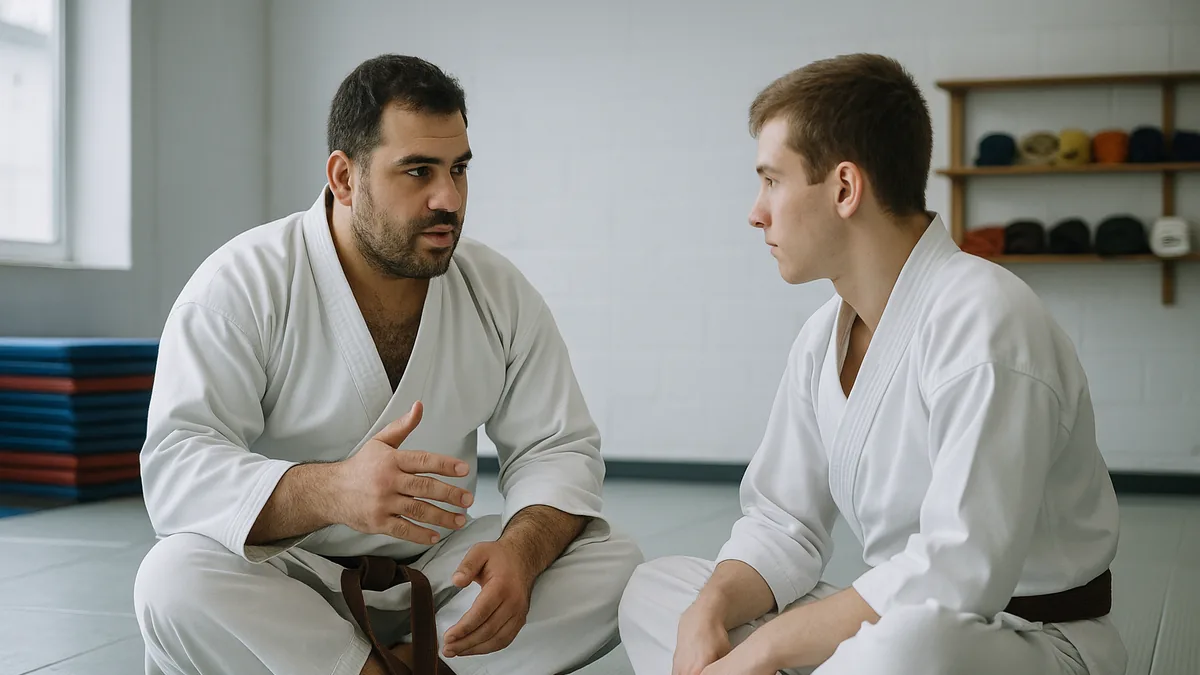
Most of us have been on the receiving end of it. You’re mid-drill, working through a combination your instructor just demonstrated, and your training partner stops you. “Actually, I think your elbow should be higher.” Then they grab your arm and reposition it. Then they add something else. Then something else. By the time you get back to training, you’ve forgotten what you were originally working on, you’re second-guessing every movement, and the session has quietly derailed.
I’ve done this to people. I’m not proud of it. And I’ve had it done to me by well-meaning partners who genuinely thought they were helping. The intention is almost never the problem. The execution is.
Giving useful feedback to a training partner is a skill that takes as long to develop as any technique. Most of us are never taught it explicitly. We pick up habits from watching senior students, from the way our instructors correct us, and sometimes from doing it badly enough times that we eventually figure out what went wrong.
Here’s what I’ve worked out over fifteen years of training, grading students, and occasionally being the person who nearly killed someone’s confidence in a Tuesday evening session.
Know Whose Job It Is
This is the foundation. Before you say anything to a training partner, you need to be clear in your own head about what role you’re playing.
You are not their instructor. Even if you’re a senior grade. Even if you can see exactly what they’re doing wrong. Even if you’ve heard the instructor give the same correction three times tonight and your partner still isn’t getting it.
The instructor has a plan. They might be working your partner toward a specific correction in a specific sequence. They might have decided to let something go for now because there’s a more fundamental issue to address first. You don’t have that context. When you jump in with your own correction - especially one that contradicts or complicates what the instructor just said - you’re not helping. You’re adding noise.
What I tell students when they’re working with lower grades is this: your job is to be a good training partner, not a second instructor. There’s a real difference. A good training partner holds the space. They give their partner something useful to work against. They notice things. They might mention one thing, carefully, when it’s genuinely useful. They do not run a parallel coaching session.
I’ve seen senior students completely undermine a junior’s progress by over-correcting in partner work. The junior ends up confused, trying to reconcile two different sets of instructions, and stops trusting their own body. That’s a hard thing to recover from.
When Feedback Is Actually Useful
That said, staying completely silent isn’t the answer either. There are moments when feedback from a training partner is genuinely valuable - sometimes more immediately useful than instructor feedback, because you’re the one feeling what’s happening.
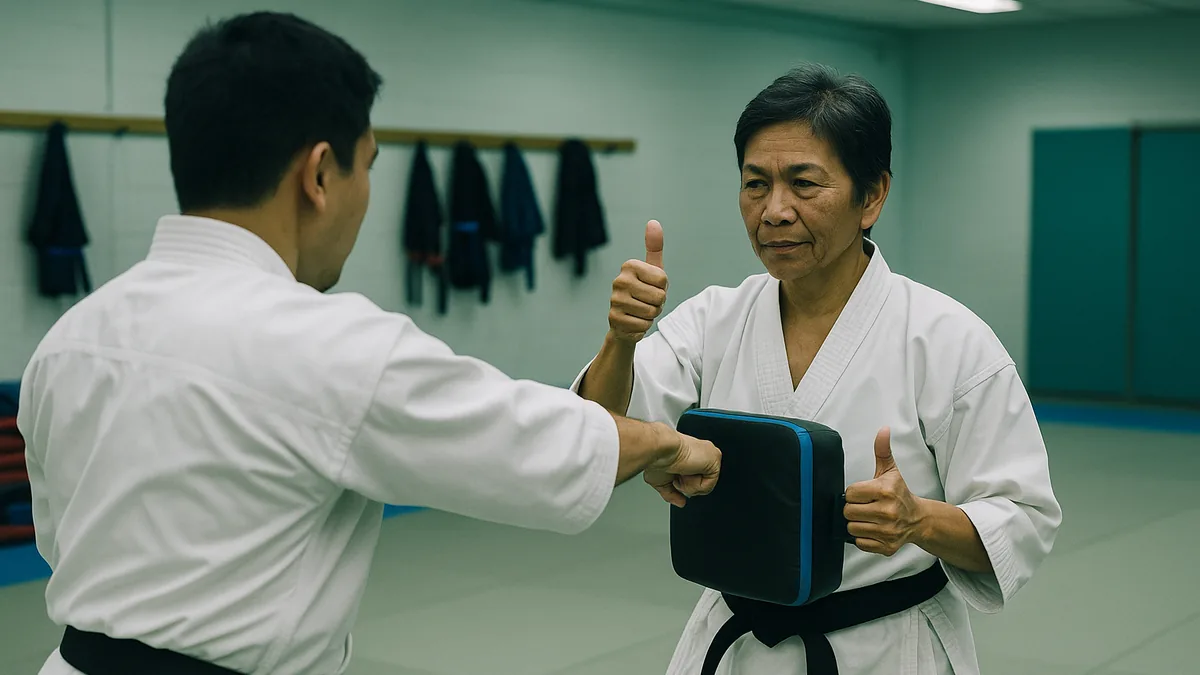
The clearest example is pad work. If you’re holding pads and your partner’s technique is landing without any real impact, that’s information they need. Not “your punch is weak” - that’s useless and slightly insulting. But “I’m not feeling much on this side, try driving through rather than stopping at the surface” - that’s something they can work with immediately. You’re giving them a physical reference point that the instructor across the room can’t provide in that moment.
The correction that makes the biggest difference in these situations is always specific and sensory. Not “your stance is wrong” but “you’re pushing me back instead of through me - try to punch to where I’m standing, not to where my pad is.” That’s a distinction that takes seconds to explain and can change what they feel in the next rep.
I’ve noticed that the best feedback I’ve ever received from training partners came in exactly this form - small, specific, tied to what we were both experiencing in that moment. Not a general observation about my technique, but something like “when you grab for the counter there, you’re telegraphing it - I can feel your shoulder drop before you move.” That kind of feedback is impossible for an instructor watching from the front to give. It comes from being right there.
How to Actually Say It
The difference between feedback that helps and feedback that deflates someone usually comes down to timing, framing, and volume.
Timing: Say it between reps, not during them. If someone is mid-combination, let them finish. Interrupting breaks their flow and means they end the rep on a failure rather than a completion. Wait for a natural pause.
Framing: Lead with what you noticed, not what they did wrong. “I noticed when you step in, your guard drops” is easier to receive than “you keep dropping your guard.” One is an observation. The other sounds like a verdict.
Volume: This matters more than most people think. Feedback delivered loudly across the dojo - even if it’s accurate - puts your partner on the spot. It draws attention to their mistake. Say it quietly, between the two of you. Keep it private.
And then there’s the question of how much. I have a rule I try to stick to: one thing per round. Not because there’s only one thing to improve - there’s almost always more - but because people can only process one correction at a time. If you give three corrections, they’ll either ignore all of them or tie themselves in knots trying to address all three simultaneously. Pick the most useful thing and leave the rest.
The Mistakes I See Constantly
One mistake I see constantly is partners focusing on personal style rather than technique. This is a subtle but important distinction. If your partner has a slightly wider stance than you, or holds their guard differently, or has a particular rhythm to their combinations - that might just be how they train. It might be something their instructor has specifically encouraged. It is almost certainly not yours to correct.
The things worth mentioning are the ones that affect safety or that are clearly outside what the instructor just demonstrated. If someone’s wrist is bent on impact and they’re going to hurt themselves, say something. If their blocking angle is leaving them completely open in a way that’s making the drill pointless, say something. If they’re doing something that’s simply different from your preference - let it go.
I used to think I was being helpful when I offered style-based corrections. My instructor eventually pointed out, not unkindly, that I was projecting. I was correcting people toward the way I trained, not toward what the drill was actually asking for. That was a useful thing to hear.
Another common mistake is wrapping feedback in a question to soften it, and then not actually listening to the answer. “Have you tried keeping your elbow in?” sounds collaborative but is really just a correction wearing a question as a disguise. If you’re going to ask a question, be genuinely open to the answer being yes, they have tried it, and their instructor told them something different.
The Instructor Dynamic Is Not a Technicality
I want to come back to this because I think it matters more than most people acknowledge. When you correct a training partner in a way that contradicts their instructor, you’re not just confusing them in the moment. You’re potentially eroding their trust in the person who is actually responsible for their development.
My instructor used to say that a student’s relationship with their instructor is one of the most important relationships in their training life. I didn’t fully understand what that meant until I started grading students myself and saw how much that trust affects what a student is willing to try, willing to fail at, willing to keep working on. If you chip away at that trust - even accidentally, even with good intentions - you can do real damage.
This is especially relevant if you train across multiple dojos or have trained under different instructors, as I have. What you learned somewhere else might be genuinely different from what’s being taught here. That doesn’t make it wrong. But it doesn’t make it right for this context either. Keep it to yourself, or raise it with the instructor directly, not through your training partner.
If you’re interested in how this dynamic plays out when there’s a significant gap in experience between partners, How to Train With a Partner Who Is Much Better Than You: Getting the Most Out of the Gap covers this from the junior partner’s side, and a lot of it applies here too.
Community Perspective
This is one of those topics where the dojo culture you trained in shapes your instincts in ways you don’t always notice. In some dojos, peer correction is actively encouraged - senior grades are expected to coach juniors, and feedback flows freely up and down the class. In others, it’s almost taboo. The instructor corrects. Everyone else trains.
I’ve trained in both environments, and I think the truth is somewhere in the middle, but closer to the second. Peer feedback works when the culture supports it, when the feedback is technically sound, and when everyone involved understands the limits of their role. When those conditions aren’t met - and they often aren’t - it creates more problems than it solves.
I’ve also noticed that opinions on this shift with experience. Most junior grades are either too hesitant to say anything or too eager to share everything they know. By the time you’re a few years in, you start to develop a feel for when to speak and when to stay quiet. That feel is worth developing deliberately rather than just stumbling into it.
For the broader question of how to structure partner training to get the most out of it, Line Work vs Pad Work vs Partner Drilling: How to Balance Your Kihon Time for Maximum Transfer is worth reading alongside this.
What Good Feedback Actually Feels Like to Receive
When feedback lands well, it doesn’t interrupt your training. It enhances it. You finish the session with one clear thing to think about, something you felt in your body rather than just heard with your ears. It feels like a small door opening rather than a problem being pointed out.
You’ll feel the difference between feedback that’s about your partner’s experience of training with you and feedback that’s about your partner’s ego or their desire to demonstrate knowledge. The first one leaves you energised. The second one leaves you slightly deflated, even if you can’t immediately say why.
The goal is always to keep the session alive. The moment feedback becomes the main event rather than the training, something has gone wrong.
Key Takeaways
- One correction per round, maximum. More than that and nothing lands.
- Focus on what you’re both experiencing physically, not on general technique observations. “I’m not feeling you drive through” is more useful than “your punch is weak.”
- If a correction would contradict or complicate what the instructor just said, keep it to yourself. Raise it with the instructor separately if it genuinely matters.
- Timing and volume are part of the feedback. Say it quietly, between reps, and keep it between the two of you.
- Ask yourself whether what you’re about to say is about their technique or their style. If it’s style, let it go.
- The measure of useful feedback is whether your partner trains better in the next rep. If they look more confused or self-conscious, you’ve overcorrected.
The weekly digest
New karate articles, once a week
One email every week with everything new on Karate Lifestyle. No spam; unsubscribe in one click.
We'll email you to confirm. See our privacy policy.