How to Train With a Partner Who Is Much Better Than You: Getting the Most Out of the Gap
Stop Surviving the Round. Start Using It.
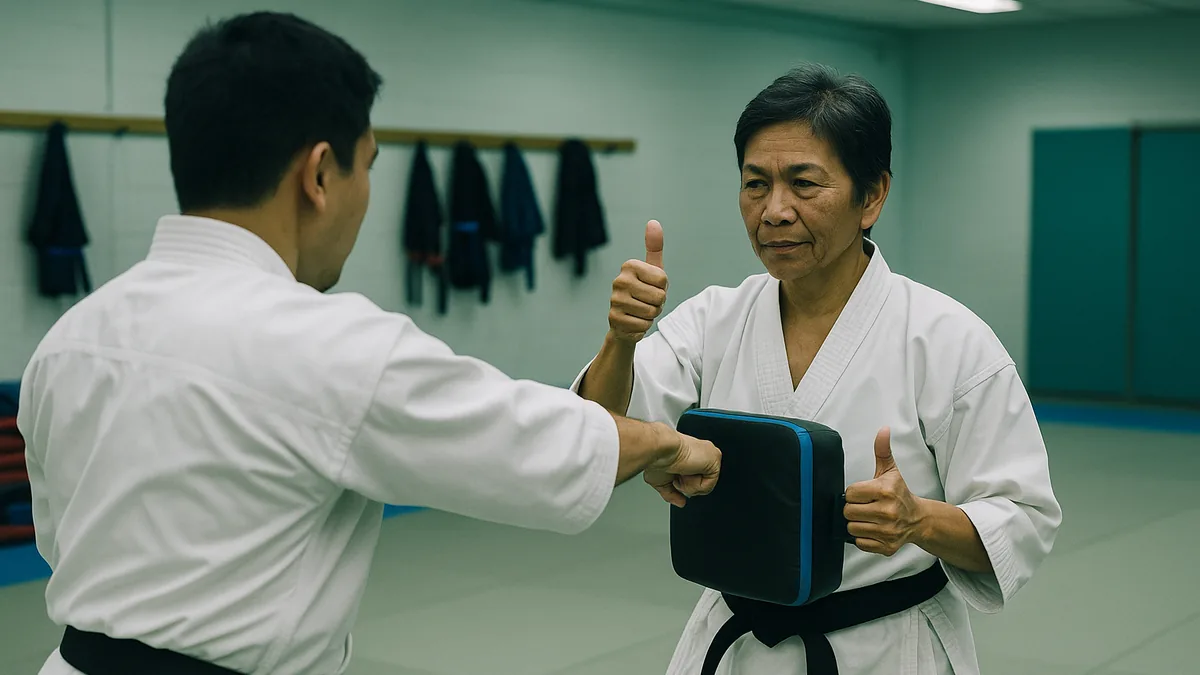
Most people, when paired with a significantly better partner, go into survival mode. You know the feeling - you tighten up, you stop thinking, you just try not to get embarrassed. I’ve done it. I’ve watched hundreds of students do it. And I understand why it happens. When someone is markedly better than you, the gap feels threatening rather than useful.
That instinct will cost you years of development if you let it run.
The best training I ever did was not with people at my level. It was with people who made me feel completely out of my depth. My instructor used to deliberately pair newer students with seniors, and he’d watch to see who used the opportunity and who just survived it. He told me once that you can learn more in ten minutes with someone who genuinely outclasses you than in a month of training with your peers - but only if you approach it correctly. It took me a long time to understand what he meant by “correctly.”
The Gap Is Information. Treat It That Way.
Here is the thing about training with a much better partner that most people miss: the discomfort you feel is diagnostic. Every time they land something you didn’t see coming, every time your technique gets nullified without effort, every time you feel like you’re moving through treacle while they move freely - that’s data. The question is whether you’re collecting it or just enduring it.
I’ve noticed that beginners and lower kyu grades tend to process these sessions emotionally. They come away feeling defeated or embarrassed, and the lesson they take is “I’m not good enough yet.” That’s the wrong lesson. The right lesson is “I have a specific gap in X, and I just had it demonstrated to me very clearly.” Those are completely different takeaways, and they lead to completely different training decisions.
What I tell students is this: before the round starts, pick one thing to pay attention to. Not everything - one thing. Watch how they close distance. Watch what they do after they attack. Watch where their weight is when they’re waiting. You cannot absorb everything from a senior partner in a single session, but you can absorb one thing deeply if you’re looking for it. Over time, those single observations stack up into a real understanding of how high-level karate actually works.
Ask for Feedback. Actually Ask.
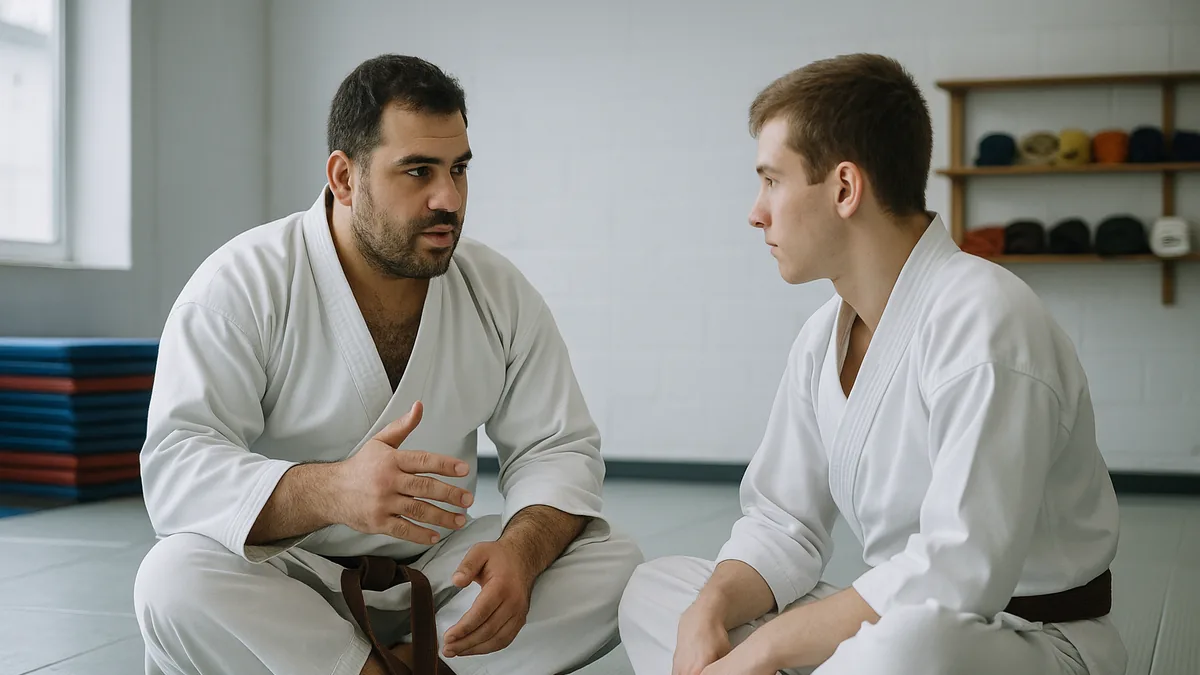
One mistake I see constantly is students who train with a senior, have a valuable session, and then bow out without ever asking a question. They’ll complain later that they didn’t learn much. They didn’t learn much because they didn’t ask.
Senior practitioners almost always know exactly what you were doing wrong. They felt it in the session. They noticed the pattern. But most of them won’t volunteer detailed feedback unless you ask, partly because they don’t want to be presumptuous, and partly because they’re not sure you want it. When you ask, you signal that you’re serious. And serious students get more.
The way you ask matters. “How was that?” is too vague and usually gets a polite non-answer. “I felt like I kept getting caught on the same counter - was there something in my entry that was telegraphing it?” is a question a senior partner can actually work with. You’re showing them you’ve already been thinking about it, and you’re giving them a specific thread to pull.
I’ve had some of the most valuable conversations of my training career in the two minutes after a round, standing at the edge of the mat. More valuable than formal instruction sometimes, because it was specific to what had just happened in my body, not a general principle delivered to the class.
Focus on What They’re Doing, Not What You’re Failing to Do
This is a mindset shift that took me years to make properly. When I was a lower grade training with seniors, my attention was almost entirely on my own performance - my mistakes, my failures, my slow reactions. By shodan I’d started to realise that the more interesting thing to watch was what the senior was doing.
Watch how they move when they’re not attacking. I’ve noticed that genuinely advanced practitioners have a quality of readiness that doesn’t look like tension. They’re not braced, they’re not static - there’s a kind of loose availability in how they stand and move. You can’t copy it by trying to copy it. But you can start to notice it, and noticing it is the beginning.
Watch their distance management. This is where the real education lives when you’re training with someone much better. They’re almost never where you expect them to be. They’ve already moved before you’ve committed. Understanding how slow reactions develop and how to train them out is part of this - but a lot of what looks like reaction speed in a senior partner is actually positional intelligence. They’re rarely surprised because they’ve already accounted for your most likely options.
Watch what they do after they score. Most beginners reset and wait. Most seniors don’t fully reset - they stay in a kind of provisional readiness that lets them follow up or adjust. That habit comes from thousands of rounds, but you can start building it earlier if you’re consciously watching for it.
The Specific Techniques Worth Studying Up Close
When you’re paired with a senior, you’re getting a live demonstration of techniques at a level you can’t replicate in drilling yet. Use that.
If they’re landing kizami-zuki repeatedly and you can’t read it, that’s a lesson in what a properly committed jab looks like from the receiving end - the speed, the angle, the way it comes before you’ve processed the initiation. Training your own kizami-zuki will feel different after you’ve been on the wrong end of a good one. You understand what “committed but not overextended” actually means when you’ve felt it land.
Same with mawashi-geri. I’ve had sessions where a senior’s roundhouse kick felt completely different from what I’d been drilling - not harder necessarily, but more certain. There’s a quality to a well-executed mawashi-geri that you feel through your guard even when you partially block it. That sensation is information about what hip rotation actually contributes to the technique. You can’t get that from drilling with a peer who’s at the same stage as you.
Pay attention to their oi-zuki too, if they use it. The thing that separates a senior’s oi-zuki from a beginner’s isn’t usually the punch itself - it’s the commitment and timing of the entry. When it works, you feel like the distance closed before you had time to respond. That’s not magic, it’s mechanics and timing. Watching it happen to you repeatedly gives you a felt understanding that you can then reverse-engineer in your own training.
Common Mistakes I’ve Seen in These Sessions
Trying to match them. I’ve watched lower grades attempt to go technique-for-technique with a senior partner, trying to show they can keep up. They can’t, and the attempt produces rushed, sloppy technique that teaches them nothing. You’re not trying to compete with them in this session. You’re trying to learn from the gap.
Going passive. The opposite mistake - becoming a compliant training dummy who barely engages. This doesn’t help you or them. Attack with intent. Commit to your techniques. The senior partner needs something real to work with, and you need the experience of committing fully and seeing what happens. The correction that makes the biggest difference in these sessions is usually “attack properly” - not “attack harder,” but attack with genuine structure and intent.
Ignoring the blocks. If your partner is blocking your attacks with ease, there’s information in that too. Watch how they receive your technique. A senior’s uke often tells you something about where your attack was weak - if they can redirect it with minimal effort, your structure probably broke down before contact. That’s not a blocking lesson, it’s an attacking lesson.
Not drilling what you notice. You have a session with a senior, you notice something specific, and then you go home and forget it. The observation only becomes useful if you bring it back to your own drilling and work on it deliberately. There’s a reason the balance between drilling and sparring matters - the live session shows you what to work on, the drilling is where you actually build it.
Community Perspective
There’s a genuine split in how different dojos approach this. Some instructors deliberately keep students with similar grades together for most partner work, on the grounds that it builds confidence and allows more equal exchange. Others - and I’m firmly in this camp - believe that regular exposure to significantly better partners is essential and irreplaceable.
I’ve heard the argument that training with a much better partner can be demoralising for newer students. I think that’s true if the senior partner is careless or the lower grade hasn’t been prepared for what to look for. But I’ve also seen the opposite - lower grades who train regularly with seniors develop a kind of calibration that their peers who only train with equals simply don’t have. They know what good technique feels like from the inside. That knowledge is hard to fake and hard to get any other way.
The disagreement usually isn’t about whether it’s valuable - most experienced practitioners agree it is. The disagreement is about how much of your training time should be spent this way, and how early in your development it’s useful. My view is earlier than most people think, and more often than most dojos schedule it.
Key Takeaways
- Pick one specific thing to observe before each round with a senior partner - distance management, post-attack positioning, entry timing. One focused observation beats ten scattered ones.
- Ask specific questions after the session. “What was I telegraphing?” or “Where was my structure breaking down?” gets you real answers. “How was that?” gets you nothing.
- Attack with genuine intent and structure. A passive lower grade is useless to a senior partner and learns nothing from the exchange.
- The discomfort you feel is diagnostic, not just demoralising - identify the specific gap it’s pointing to and bring it back to your drilling.
- Watch what the senior does when they’re not attacking. Readiness, distance, positional choices - this is where high-level karate actually lives, and you can start learning it before you can replicate it.
- Ask for a specific drill or exercise based on what they noticed. Most seniors are happy to give you two minutes of focused correction if you ask directly.
The weekly digest
New karate articles, once a week
One email every week with everything new on Karate Lifestyle. No spam; unsubscribe in one click.
We'll email you to confirm. See our privacy policy.