How to Train Kizami-Zuki So It Actually Lands: The Jab Most Karateka Underuse
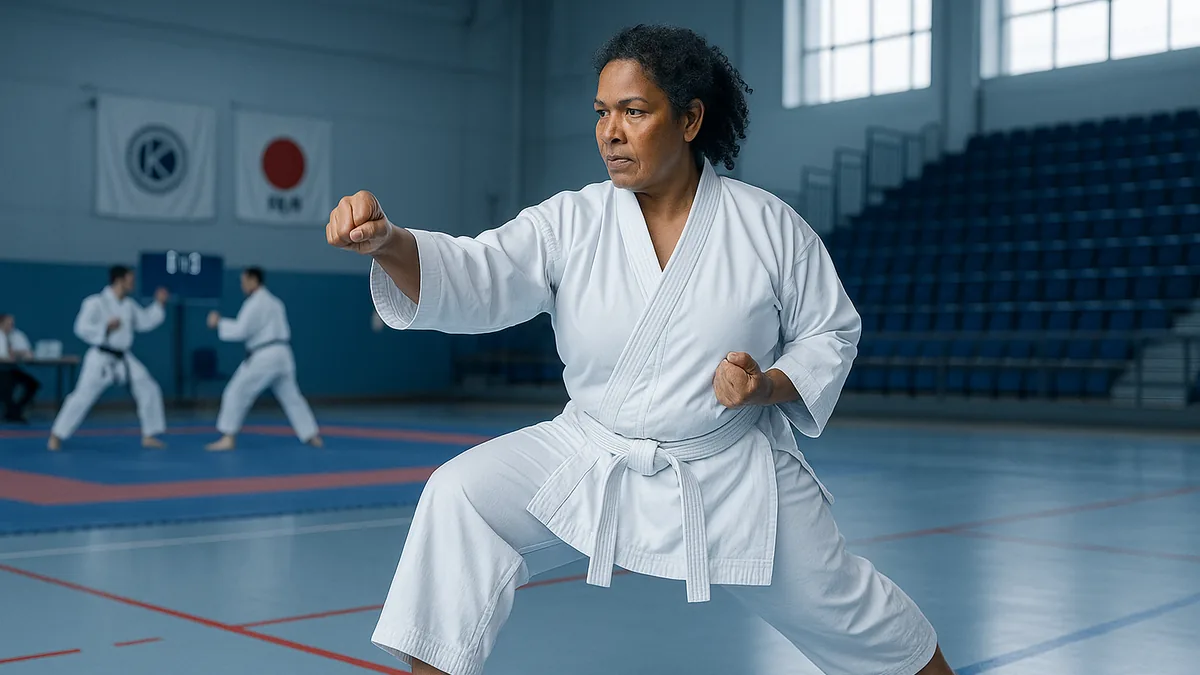
Most karateka treat kizami-zuki like a setup punch - something you throw to make your gyaku-zuki look good. I’ve seen this at every level, from white belts copying what senior students do to brown belts who’ve been training for years and still haven’t figured out why their jab never scores. The technique gets thrown, the opponent doesn’t react, and everyone moves on. Nobody asks why it didn’t work.
The answer is almost always the same: the kizami-zuki was never meant to land. It was thrown as a distraction, with distraction mechanics - no commitment, no structure, no real intention behind it. And the opponent felt that. You can always feel when a punch isn’t serious.
What I tell students is this: if you’re not training kizami-zuki to score, you’re training it to miss. Those are different skills, and most people are drilling the wrong one.
Why Kizami-Zuki Gets Underestimated
The jab has a reputation problem in traditional karate. It’s seen as the weak hand, the range-finder, the thing you do before the real technique. That framing is wrong, and it costs people matches and real-world effectiveness.
I used to think the same way. My instructor at the time ran a very gyaku-zuki-dominant dojo - everything was about the reverse punch. Kizami-zuki was something you threw to create an opening. Then I started competing more seriously and kept running into one particular fighter who would score with his lead hand again and again. Clean, fast, committed jabs that arrived before I’d processed the attack. I asked him about it afterward. He said something that stuck with me: “I don’t throw it to set up anything. I throw it to hit you.”
That’s the mindset shift. Kizami-zuki isn’t a distraction technique. It’s a scoring technique that happens to be fast enough to use as a setup as well. But if you train it as a distraction, it’ll never be good enough to score, and it won’t even be a convincing distraction.
The Mechanics That Actually Matter
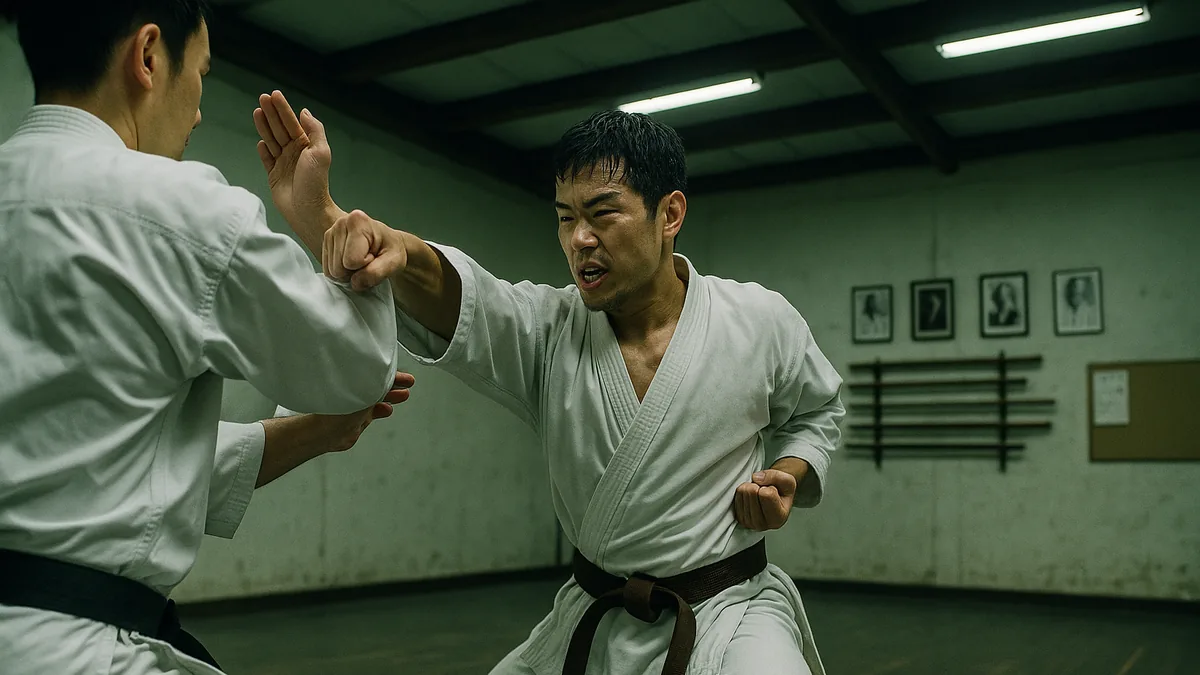
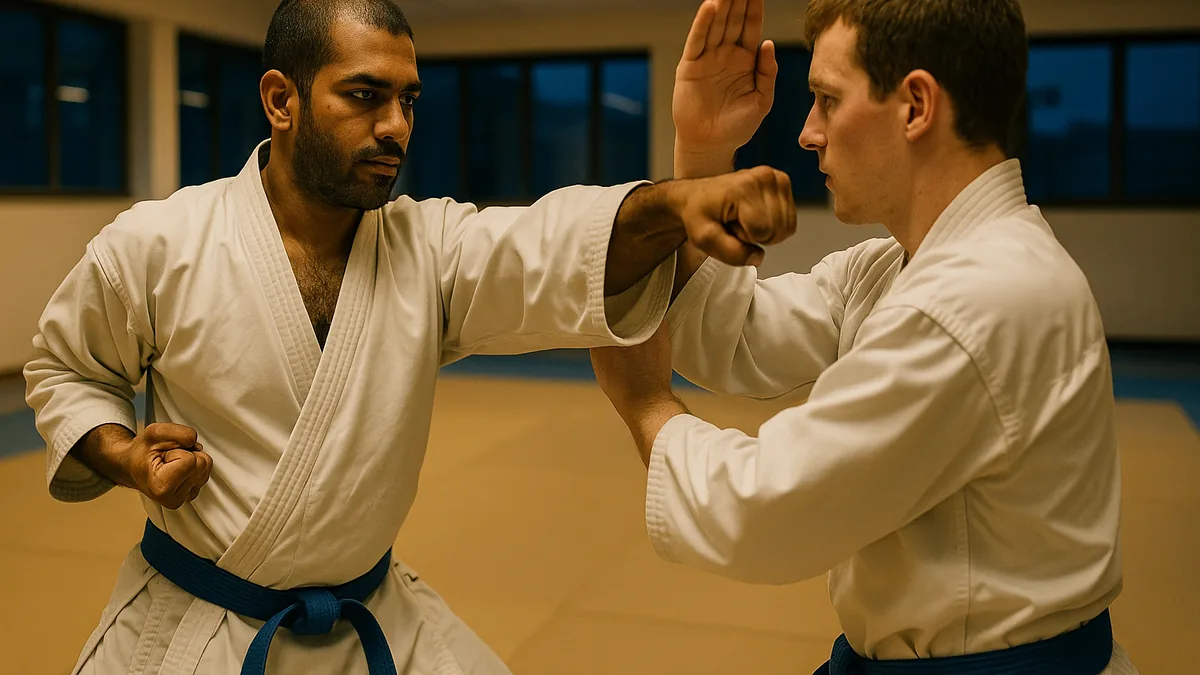
The hip rotation is the whole punch. Without it, you’re just throwing your arm - and your arm alone doesn’t have the mass or structure to deliver real impact or score in kumite. What I’ve noticed in students who struggle with kizami-zuki is that they treat it like a reach-and-tap. The front shoulder comes forward, the arm extends, and nothing below the shoulder joint is involved.
Here’s what correct execution feels like: the power starts from the lead foot, travels through a small but deliberate hip rotation - not a full gyaku-zuki-style hip turn, but a genuine engagement - and the shoulder follows the hip, not the other way around. When you get this right, the punch feels like it’s being pushed from behind rather than thrown from the front. You’ll feel the connection through your whole torso, not just tension in your shoulder.
The other thing most people miss is the elbow. In the early part of the extension, the elbow stays close to the body longer than feels natural. Most beginners flare the elbow out immediately, which telegraphs the punch and bleeds power. Keep the elbow tracking along the centreline for as long as possible before the final extension. It feels wrong at first, but trust the mechanics - it’s faster, tighter, and hits harder.
Shoulder and Stance Positioning
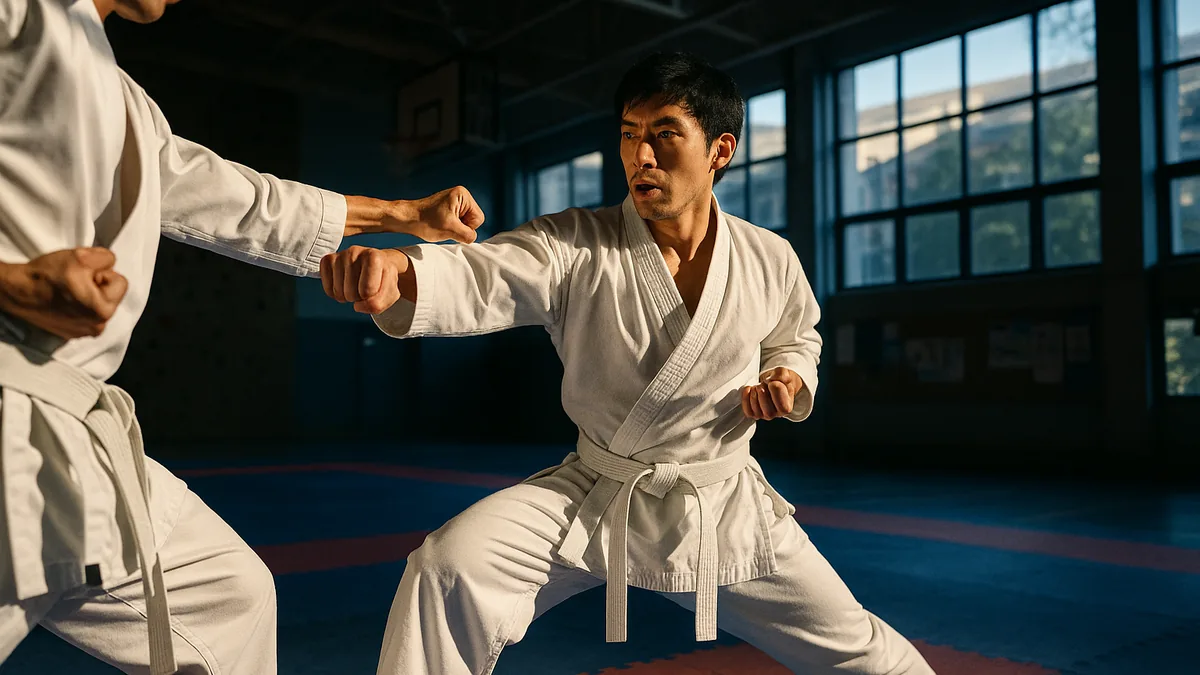
Your lead shoulder is already closer to the target than your rear hand. That’s your advantage. Don’t waste it by pulling the shoulder back before punching - I see this constantly, and it’s usually a habit carried over from kata where the hikite (pull-back hand) is exaggerated. In live application, any backward movement before the punch is a telegraph.
What actually works is maintaining tension in the shoulder - not rigidity, but readiness - so the punch can leave without any preparatory movement. Your opponent should not see the kizami-zuki coming. They should be processing it after it’s already arrived.
Drills That Build Real Kizami-Zuki
Drill 1: Mirror Commitment Drill
This is the drill I come back to most often with students who’ve been throwing half-hearted jabs for years. The value here is simple: it forces you to commit to the technique as a scoring punch, not a placeholder.
Setup: Stand in front of a mirror in your fighting stance. No partner, no bag - just you and your reflection.
Execution:
- Throw kizami-zuki at full speed and full commitment, aiming for your reflected eye level.
- Hold the extension for one full second. Don’t retract immediately.
- Look at where your fist landed. Is it on the centreline? Is the elbow fully extended without being hyper-extended? Is your shoulder forward, not pulled back?
- Retract with the same speed you extended with - most people retract slowly, which is a problem.
- Repeat 20 times per round, with genuine focus on each repetition.
What to feel for: At full extension, your fist should feel like it’s sitting in front of your shoulder, not out to the side. The shoulder should be slightly forward of where it started. Your back foot should still be grounded.
The thing most people get wrong: They check the mirror before the punch lands. Their eyes move first, which means their shoulder has already started adjusting. Throw the punch, then check. The mirror is feedback, not a guide.
Drill 2: Lead Hand Sparring (Jab-Only Rounds)
I prefer this drill over almost any other for developing kizami-zuki confidence. The constraint forces creativity and commitment simultaneously.
Setup: Two partners, standard kumite distance. The rule is simple - you can only score with the lead hand. No gyaku-zuki, no kicks. Just kizami-zuki and movement.
Execution:
- Start at ma-ai (proper fighting distance).
- Both partners can use any footwork, any defence, any combination of movement - but scoring is lead-hand only.
- Run three-minute rounds.
- After each round, both partners identify one moment where the jab nearly landed and discuss what was missing.
What to feel for: After a few minutes, you’ll start noticing gaps in your opponent’s guard that you’d normally ignore because you were waiting to set up a reverse punch. The jab-only constraint rewires your attention.
The thing most people get wrong: They stop trying after the first few unsuccessful attempts. The drill gets frustrating before it gets productive. Push through the frustration - that’s where the learning is. If you’re interested in how to structure this kind of constraint-based work into your broader training, How to Train Combinations in Karate: Moving Beyond Single Techniques covers that progression well.
Drill 3: Entry and Exit Timing on a Moving Target
This is where kizami-zuki becomes a real weapon. The punch is fast enough to catch someone mid-movement - entering, exiting, shifting weight. This drill trains you to read that timing.
Setup: One partner holds a focus mitt at head height and moves randomly - stepping forward, stepping back, shifting left and right. The other partner follows and throws kizami-zuki only when they feel the timing is right.
Execution:
- The mitt holder moves continuously and unpredictably. No patterns.
- The puncher follows with footwork, maintaining distance.
- Throw only when the mitt is momentarily still - usually at the end of a step, when the holder’s weight is transitioning.
- Aim for clean contact, not power. Speed and timing over force.
- Switch every two minutes.
What to feel for: When the timing is right, the punch arrives without effort. It feels almost lazy - you’re not chasing the target, you’re meeting it at the moment it stops moving. That’s the sensation you’re building toward. If you’ve struggled with reading timing in kumite, How to Fix Slow Reactions in Kumite goes into the underlying causes in detail.
The thing most people get wrong: Throwing when the target is moving. This teaches you to chase, which is exactly the wrong habit. Wait. The moment will come.
Visualization for Accuracy and Timing
I’ll be honest - I was skeptical about visualization for a long time. It felt like something people did instead of training, not alongside it. What changed my view was a period where I had a knee injury and couldn’t train physically for six weeks. I spent that time visualizing kizami-zuki combinations in detail - the entry, the moment of contact, the retraction, the follow-up. When I came back, my timing was sharper than when I’d left. That was hard to dismiss.
What I tell students now is that visualization works when it’s specific. Not “imagine throwing a good jab” - that’s useless. Instead: imagine a specific opponent at a specific distance. See their guard. See the gap. Feel your weight shift forward, feel the hip engage, feel the contact on the knuckles, feel the retraction. Run the whole sequence at full speed in your mind.
Do this for five minutes before shadowboxing. The Shadowboxing for Karateka article covers how to make that session meaningful rather than just going through the motions - the two practices complement each other well.
The specific thing to visualize for kizami-zuki is the moment just before contact. Your opponent is mid-movement, slightly off-balance, guard slightly open. You see it, you move, the punch arrives. Repeat that specific scenario until it feels automatic. You’re not imagining success - you’re rehearsing the decision-making process.
Progression: Making It Harder
Once the mechanics are consistent and you’re landing the jab in constrained sparring, add these layers in order:
Add the combination exit. Kizami-zuki followed immediately by oi-zuki or gyaku-zuki. The jab creates the opening; the follow-up exploits it. Don’t wait to see if the jab landed before committing to the next technique.
Add defensive pressure. Have your partner apply light pressure - not attacking, just advancing. Throw kizami-zuki against forward pressure. This teaches you to use the punch as a stop-hit, which is one of its best applications in jiyu-kumite.
Add reaction constraints. Your partner signals randomly (a slight weight shift, a breath) and you have to throw within one second. This builds the automatic response that makes kizami-zuki dangerous - it has to be a reflex, not a decision.
If you’re training without a regular partner, most of this is adaptable to solo work. How to Train Alone When You Have No Club Access has practical frameworks for maintaining this kind of development between dojo sessions.
Community Perspective
There’s a genuine split in the karate community about how much the lead hand should be developed relative to the reverse punch. Traditional Shotokan training tends to emphasise gyaku-zuki as the primary scoring technique, with kizami-zuki playing a supporting role. Styles with more competition exposure - particularly WKF-oriented dojos - often develop the lead hand much more aggressively because the speed advantage matters at that level.
I’ve seen both approaches up close, and my honest view is that the traditional hierarchy made more sense when karate competition was slower and more controlled. Modern kumite is faster, distances are closer, and opponents are better at defending the obvious rear-hand attack. The lead hand has become more important, not less.
That said, I’ve also trained with senior practitioners who have devastating kizami-zuki built entirely within a traditional framework - not because they trained it differently, but because they understood the commitment principle deeply. The mechanics are the same. The mindset is the same. The disagreement is mostly about how much emphasis to place on it relative to everything else.
My position: train it as a primary weapon. If it ends up being your best setup tool as well, that’s a bonus. But don’t let it stay weak by treating it as secondary from the start.
Key Takeaways
- Kizami-zuki fails when it’s trained as a distraction. Train it to land, and it becomes a distraction as a side effect - not the other way around.
- The hip engagement is small but non-negotiable. Without it, you’re throwing your arm. With it, you’re throwing your body weight through your arm.
- Jab-only sparring rounds are the fastest way to build lead-hand confidence. Run them regularly, especially if you notice your kizami-zuki is always a setup for something else.
- Visualization works when it’s specific - a particular opponent, a particular gap, a particular moment. Vague mental rehearsal produces vague results.
- The retraction matters as much as the extension. A slow retraction leaves your arm out and telegraphs your next move. Train both directions at the same speed.
- In jiyu-kumite, your best opportunity for kizami-zuki is the moment your opponent’s attack fails - they’re extended, slightly off-balance, and their guard is compromised. That’s not a setup situation. That’s a scoring situation.
The weekly digest
New karate articles, once a week
One email every week with everything new on Karate Lifestyle. No spam; unsubscribe in one click.
We'll email you to confirm. See our privacy policy.