The Problem With Always Training at Full Speed: Why Karateka Who Never Slow Down Stop Improving
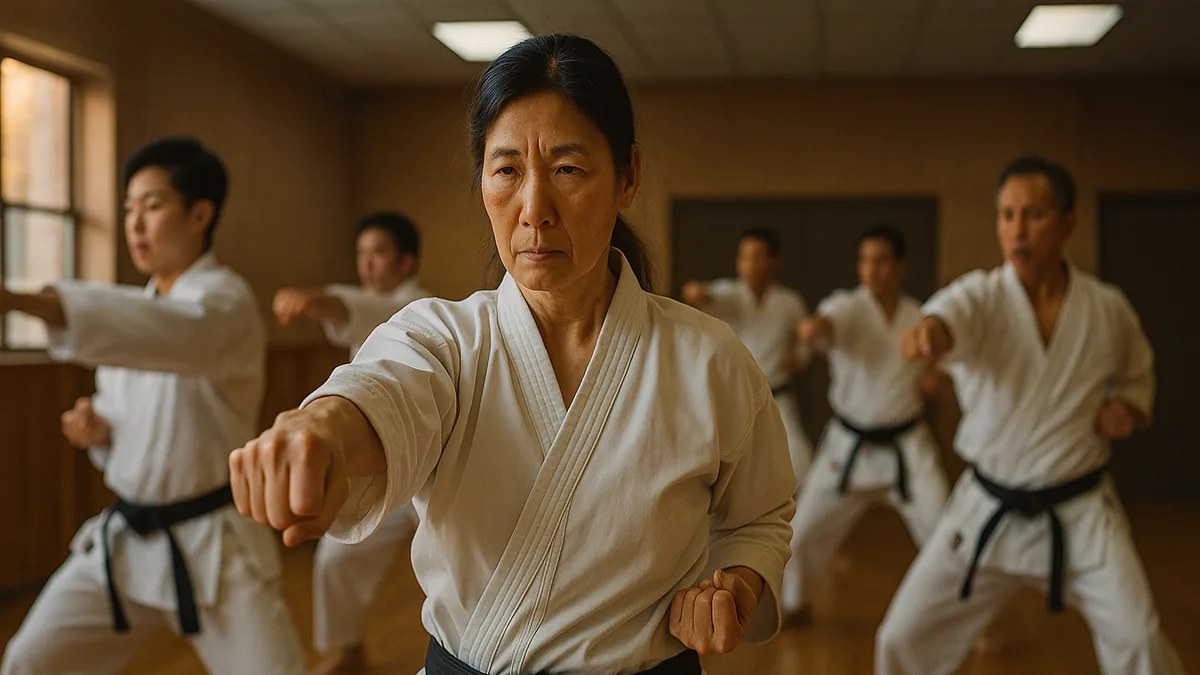
Speed is not the problem. The obsession with speed is.
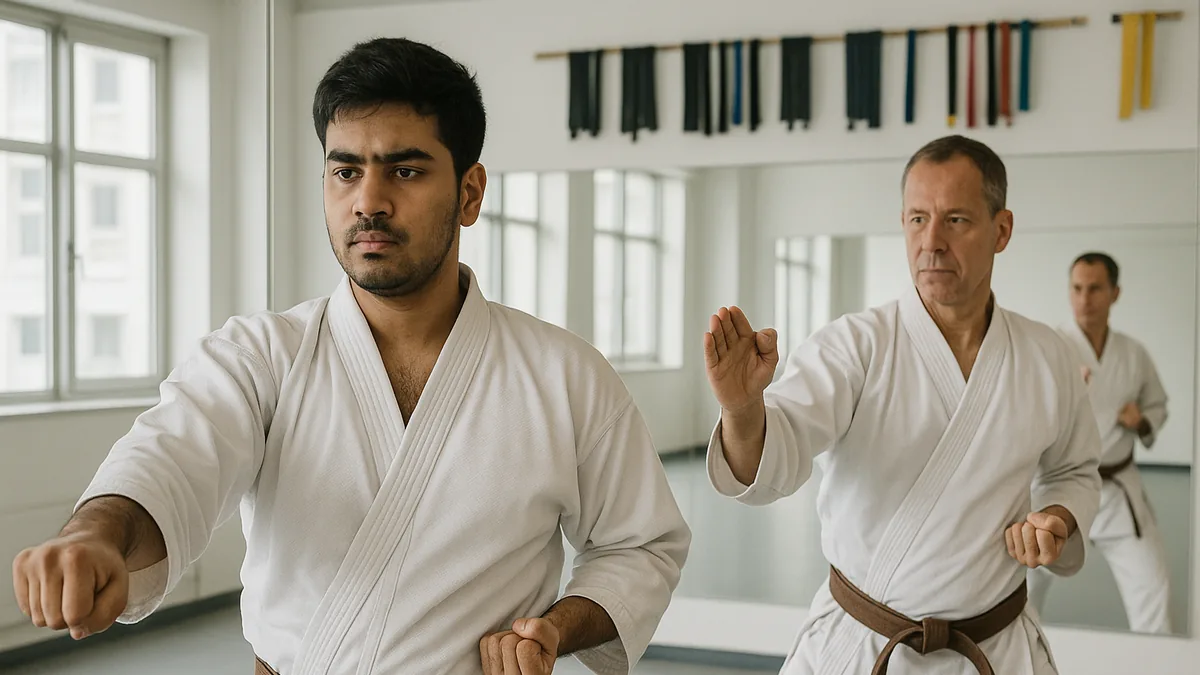
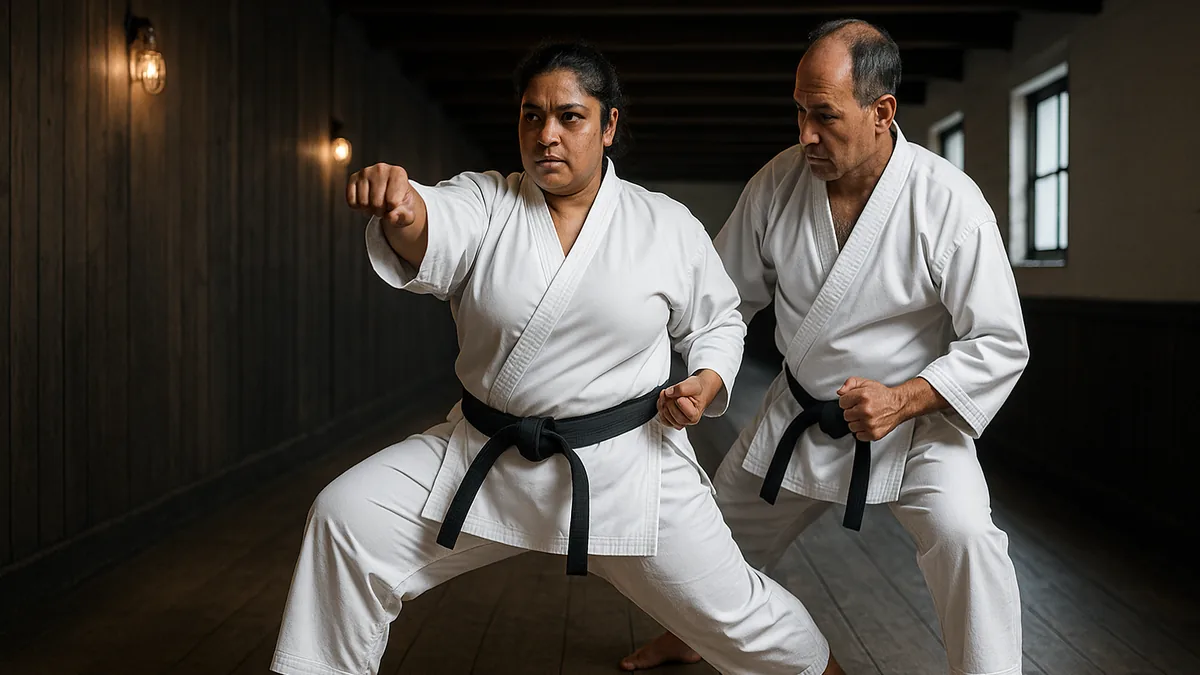
Walk into most karate dojos on any given night and you will see the same pattern: practitioners hammering through combinations at full pace, treating every repetition like a grading or a fight. The faster the better. The louder the kiai, the more committed the training. And on the surface, it looks impressive. But watch what happens when you ask those same practitioners to slow down by fifty percent. The technique often falls apart. The hip stops turning. The elbow flares. The weight distribution shifts somewhere it should not be. What looked like good karate at speed was, in many cases, speed hiding bad karate.
This is not a minor problem. It compounds over years.
Speed Conceals What You Have Not Yet Learned
The core issue is that fast movement masks mechanical errors in a way that slow movement cannot. When you punch at full speed, momentum carries the technique through. The snap, the kime, the retraction - it all blurs into something that looks and sounds correct. But the error is still there, baked into the movement pattern, getting stronger with every repetition.
A common mistake is treating speed as evidence of competence. It is not. Speed is a quality that gets layered onto good technique once the technique is sound. Doing it in the wrong order - chasing speed before the mechanics are clean - means you are rehearsing a faster version of the wrong movement. The more reps you put in, the more deeply that pattern is grooved. Motor learning research supports this: motor skill can be broadly characterised by three key features - optimal movement selection and execution, improved movement speed and accuracy, and reduced movement variability and error, as a consequence of extensive practice.1 Rushing to the third feature before the first two are established is where many practitioners go wrong.
This is why many instructors cue beginners to slow down and why beginners resist it. Slow movement feels uncertain, unconvincing, almost embarrassing. Fast movement feels like karate. But that discomfort at slow speed is diagnostic. It tells you exactly where the gaps are.
What Slowing Down Actually Reveals
Reduce your oi-zuki to about a third of full speed and pay attention to what you feel through your body. The hip rotation that drives the punch - does it arrive before the fist, with it, or after? At full speed, the timing collapses into a single blur. At slow speed, you can feel the sequencing. You will notice whether you are leading with the shoulder, which is the most common fault, or whether the power is genuinely being generated from the centre and transferred forward.
One reason slower movement exposes errors so effectively is the speed-accuracy tradeoff: slower movements are more accurate, at least in part, because there is more time to detect errors and make corrections.2 That extra detection time is precisely what makes slow practice uncomfortable - it removes the cover that speed provides and forces you to feel what is actually happening.
Correct technique at slow speed feels almost uncomfortable in a specific way - there is a moment of suspension where the hip has turned but the arm has not yet arrived, and it requires trust to hold that sequence rather than rushing the arm forward. Many practitioners skip that moment. They have never felt it because they have never gone slowly enough to find it.
The same applies to stances. Run through a kata at full speed and your transitions will feel fluid. Walk through the same kata at a pace where you can feel every weight shift, and you will discover whether you are actually loading into the correct leg or simply moving through a position without ever being in it. There is a significant difference between passing through a stance and being in one. Slow practice is how you learn the difference.
The Habits That Form in the Fast Lane
Three specific bad habits are almost exclusively products of always training at full speed:
- Telegraphing. When practitioners rush, they often wind up before striking - a small shoulder drop, a hip shift, a preparatory breath that becomes visible. At full speed, the practitioner does not notice it. A more experienced partner does.
- Incomplete retraction. The hikite - the pulling hand - gets lazy when the focus is on the striking hand moving fast. Many instructors cue hikite as the engine of hip engagement: a sharp pull is said to increase the counter-rotation that drives the punch. You will not feel the difference at full speed. At slow speed, the contrast in how the hip engages when the hikite is sharp versus slack becomes immediately obvious.
- Loss of zanshin. Practitioners who always train fast develop a habit of mentally leaving the technique the moment it lands. The awareness - the maintained readiness - disappears. Slow, deliberate practice rebuilds the habit of staying present through and after the technique. Zanshin is not just a training value: it is the criterion most often missed when a score is assessed in WKF competition, and is defined as the state of continued commitment in which the competitor maintains awareness of the opponent’s potentiality to counter-attack.3
None of these faults will be corrected by doing more repetitions at full speed. If anything, volume at speed makes them worse. This is worth reading alongside our article on why counting repetitions misleads karateka - more reps of a flawed pattern is not progress.
How to Actually Structure the Balance
The correction that usually helps most is not telling practitioners to “slow down more” as a general instruction. It is giving slow practice a specific purpose. Vague slow practice drifts. Purposeful slow practice transforms.
Here is a practical approach that works across most styles:
Diagnostic slow practice - Move at roughly twenty to thirty percent of full speed. The goal here is not to feel powerful or smooth. The goal is to find what is wrong. Stay at this speed until you can identify the mechanical fault clearly.
Technical consolidation - Move at fifty to sixty percent of full speed. This is where you correct the fault and practise the corrected version enough times that it begins to feel natural. This is uncomfortable because correct technique often feels wrong at first when you have been doing it incorrectly for a long time.
Speed integration - Gradually bring the speed up to full, checking that the corrected mechanic survives the acceleration. If it disappears at eighty percent, you have not consolidated it yet. Drop back down.
Research on motor skill acquisition supports this kind of structured progression: skilled motor performance is acquired in several stages - an initial, fast improvement phase, followed by a period of consolidation, and then slow learning, consisting of delayed, incremental gains in performance emerging after continued practice.4 The diagnostic and consolidation phases described above are an application of that consolidation principle. From a perceptual-motor skills perspective, slow practice may be useful during the early associative phase of skill acquisition, in which feedback from the movement itself is most instructive.5
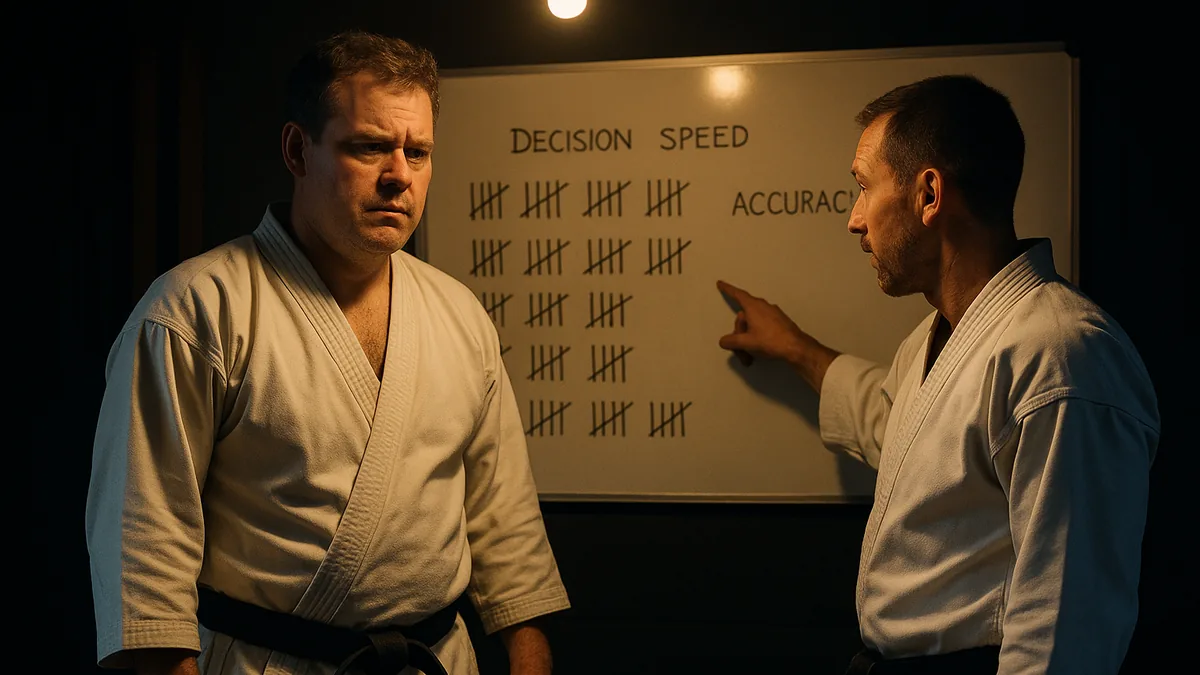
The biggest difference between practitioners who plateau and those who keep improving is usually not talent or frequency of training. It is whether they have a process for identifying and correcting faults, or whether they are simply repeating what they already do.
The Sparring Argument - and Why It Does Not Override This
The most common pushback against slow practice is that karate is ultimately performed at full speed under pressure, so training should reflect that. This is a reasonable point taken too far.
Yes, you need to train at full speed. Jiyu-kumite at full pace develops timing, distancing, and the ability to read an opponent - qualities that cannot be replicated at slow speed. Nobody is arguing otherwise.
But here is what actually happens in sparring when technique is built on unexamined speed: the errors that were invisible in training become visible under pressure. The telegraphing gets read. The incomplete hikite means the counter may lack power at the moment it is most needed. The absent zanshin means a follow-up attack lands because the practitioner had already mentally moved on.
Slow practice is not the opposite of sparring preparation. It is the foundation of it. The two work in sequence, not in opposition.
If you are using sparring to develop technique rather than to test it, that is a separate problem - and one worth thinking about in the context of what to do when you feel stuck waiting until you are “ready” enough. Sparring is for testing what you have. Slow practice is for building what you do not yet have.
Community Perspective
This is an area where genuine disagreement exists between training cultures. Traditional Japanese and Okinawan dojo environments have typically placed high value on slow, deliberate kihon practice - the idea being that speed is a product of correct mechanics, not something to be chased directly. In Goju-ryu, for example, Sanchin - the foundational kata - focuses heavily on breathing, stance stability, and developing internal energy, with slow, deliberate movements that emphasise tension and relaxation in the muscles, perfecting body alignment and reinforcing the hard-soft philosophy. This makes it a built-in technical audit tool, performed at slow speed by design.
WKF competition does demand technical precision, but it is worth being clear about what that means: in order to be considered a score, the technique must have the potential to be effective if it had not been controlled, and must fulfil the criteria of good form, sporting attitude, vigorous application, and maintaining awareness of the opponent both during and after execution.3 Speed is one factor within “vigorous application”; it is not the only criterion, and zanshin - the same quality built through slow, deliberate practice - is explicitly required for a score to count.
Where practitioners most commonly change their view is around the brown and black belt transition. The pattern is consistent enough to be worth naming: many practitioners who dismissed slow practice in their earlier years return to it as they progress, often because they hit a ceiling and cannot work out why. The technique looks right. It has always looked right. But something is missing. Slow practice is frequently where they find it.
The honest position is that neither extreme serves practitioners well. A dojo that never trains at full speed produces practitioners who cannot perform under pressure. A dojo that never slows down produces practitioners who are fast at doing things incorrectly. The balance is not fifty-fifty - it shifts depending on what the practitioner needs at a given stage. But most practitioners in most dojos are tilted heavily towards speed, which means the correction almost always runs in one direction.
Key Takeaways
- Speed hides errors; it does not fix them. If your technique breaks down when you slow down, that is the real level of your technique - not the fast version.
- Slow practice needs a purpose. Vague slow movement drifts. Use it diagnostically first, then for consolidation, then test whether the correction survives acceleration.
- The three faults most reliably caused by always training fast are telegraphing, incomplete hikite, and loss of zanshin. All three require slow, deliberate practice to identify and correct.
- Sparring tests technique; slow practice builds it. Confusing the two is why many practitioners plateau - they keep testing something they have not yet built properly.
- Discomfort at slow speed is information. If correct technique feels wrong, that is because you have been practising the wrong version long enough to make it feel normal. The discomfort is the correction working.
- Most practitioners need more slow practice, not less. The default in most training environments tilts heavily towards speed. The correction almost always runs the other way.
References
Checked by the KarateLifestyle editorial team against WKF official rules, peer-reviewed motor learning literature (PMC/NIH, PNAS, Psychology of Music), and association primary sources in October 2026. The motor learning evidence for slow practice comes largely from general motor skill and music performance research; no peer-reviewed studies specific to karate or martial arts slow practice were identified.
- Reflecting on what is 'skill' in human motor skill learning. PMC/NIH, 2023. Peer-reviewed review article on motor skill characteristics.
- Motor Learning Chapter 5 (Speed-Accuracy Trade-Off / Fitts' Law). Summary of established Fitts' Law principles from motor learning literature; original source: Schmidt & Lee, Motor Learning and Performance (Human Kinetics).
- WKF Kumite Competition Rules 2026, Version 11. World Karate Federation, 2026. Official competition rules document.
- The acquisition of skilled motor performance: Fast and slow experience-driven changes in primary motor cortex. Karni et al., PNAS, 1998. Peer-reviewed study on stages of motor skill acquisition.
- Slow practice in motor skill acquisition (Psychology of Music). Peer-reviewed article in Psychology of Music, 2022. Examines the role and function of slow practice in perceptual-motor skill acquisition.
The weekly digest
New karate articles, once a week
One email every week with everything new on Karate Lifestyle. No spam; unsubscribe in one click.
We'll email you to confirm. See our privacy policy.