The Problem With Counting Repetitions: Why Volume Metrics Mislead Karateka and What to Measure Instead
I’ve watched students walk out of class feeling good about themselves because they hit 200 punches in kihon. Two hundred punches. They’ll tell you that with a straight face, like the number means something. Then you put them in front of a live opponent and they freeze, telegraph every attack, and get picked apart by someone who threw maybe 80 punches in the same session but actually thought about every one of them.
That’s the problem. We’ve confused volume for quality, and repetitions for readiness.
The Rep Count Trap
It happens gradually. You start tracking reps because it feels like progress. You do 50 gyaku-zuki, then next week you do 60, then 80, and there’s a satisfying logic to it. Numbers go up, you must be improving. Coaches sometimes reinforce this without meaning to - “give me another 20” is easier to shout than “give me 20 where you’re actually reading your partner’s shoulders.”
I’ve noticed this pattern in almost every dojo I’ve trained in. The students who count loudly are often the ones who check out mentally halfway through. They’re doing the reps, but they’re not training. Their body is moving, but their mind has gone somewhere else. And in kumite, your mind is the thing that actually wins fights.
Here’s what I think is actually happening: rep counting gives us a way to feel productive without confronting the uncomfortable reality that we might not be improving. It’s measurable, it’s simple, and it doesn’t require you to examine whether what you’re doing is actually working. Honest self-assessment is harder. So we count instead.
What Kumite Actually Demands
Kumite is not a volume sport. It’s a decision sport.
Every exchange you have in jiyu-kumite is a compressed sequence of reads, choices, and responses. You’re reading distance, reading intention, reading timing. You’re deciding whether to attack, counter, evade, or bait. You’re managing your own adrenaline while trying to disrupt your opponent’s rhythm. None of that gets trained by counting punches on a makiwara.
I used to think that if my technique was sharp enough, the mental side would take care of itself. My instructor at the time kept telling me the opposite - that technique without decision-making is just gymnastics. I didn’t really understand what he meant until I hit a wall in competition. I was technically better than a lot of the people beating me. But they were faster at deciding. They knew what they wanted to do before the opportunity appeared, so when it appeared, they were already moving.
That’s what you’re actually trying to build. Not a bigger rep count. Faster, better decisions under pressure.
This connects directly to the slow reactions problem that most fighters misdiagnose. Slow reactions are rarely about slow reflexes. They’re usually about delayed decision-making - and that’s a training problem you can actually solve if you’re measuring the right things.
What to Measure Instead
If reps are the wrong metric, what do you track?
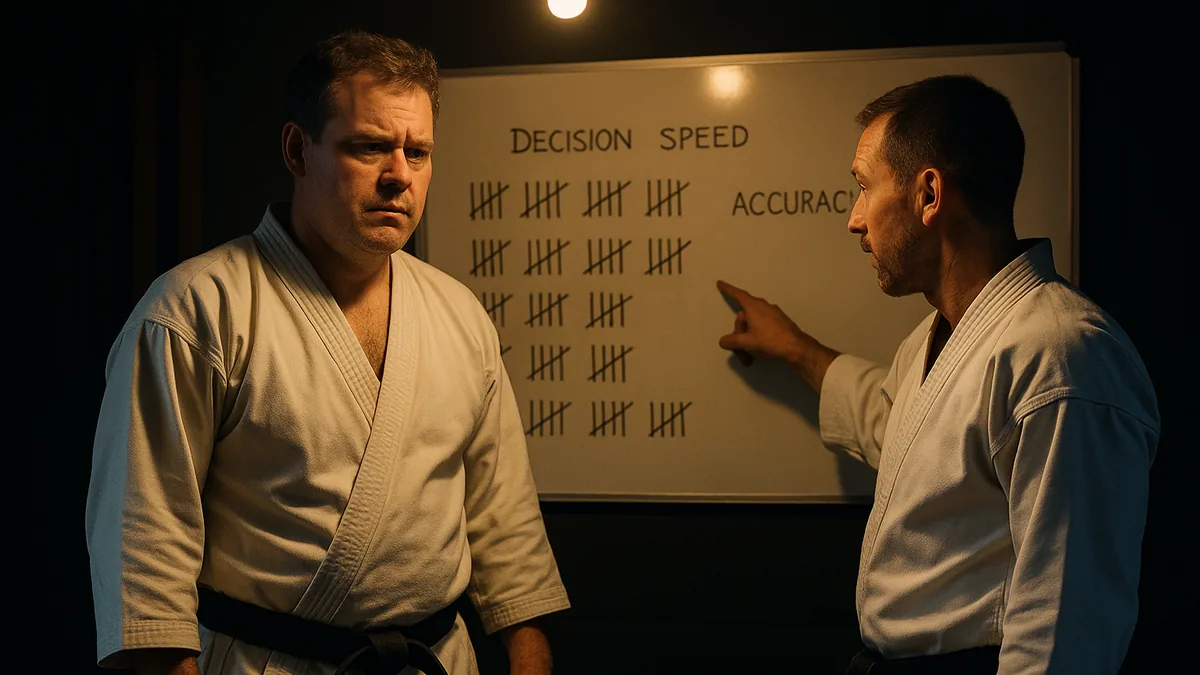
I’m not saying stop counting entirely. I’m saying count things that matter. Here are the things I actually pay attention to now, and what I tell students to track:
- Decision speed in drills: How quickly do you commit to a response when your partner gives you a cue? Not after thinking - immediately.
- Accuracy under fatigue: Not how many techniques you threw, but how many landed cleanly when you were tired in the last round.
- Successful reads: How often did you correctly anticipate what your partner was about to do? Start noticing this.
- Recovery after failure: When you miss or get caught, how many exchanges does it take you to reset mentally? One? Five? This matters enormously in competition.
- Pressure tolerance: Can you stay composed when someone is crowding you, being aggressive, or doing something unfamiliar?
None of these show up in a rep count. All of them are trainable if you start paying attention to them.
Building Decision-Making Drills That Actually Work
The biggest difference between a drill that builds kumite skill and a drill that just burns time is whether it forces a decision under uncertainty.
Here’s a simple one I use regularly. Two partners, one attacker, one defender. The attacker has three options - they can attack jodan, chudan, or kick. The defender doesn’t know which is coming. The defender’s job isn’t to block perfectly. The defender’s job is to commit to a response within half a second of reading the first movement cue. You score the drill on commitment speed, not on whether the block was textbook.
What you’ll find - and I’ve seen this reliably across different training groups - is that students who are technically polished often freeze longer than students with rougher technique. They’re waiting until they’re sure. In kumite, by the time you’re sure, you’re already hit.
You can build more complexity into this once the base response is fast. Add a third partner who calls out a point restriction mid-drill. Add fatigue by running the drill at the end of class. Add an unfamiliar partner whose movement patterns you haven’t read before. The goal is always the same: make decisions faster, with less information, under worse conditions.
If you’re working on combinations, the same principle applies. The combination isn’t the goal. The decision to throw it - and the read that told you the opening was there - that’s what you’re actually training.
Pressure Is the Only Real Test
Here’s an opinion I’ll stand behind: you cannot simulate competition without pressure, and most dojo training doesn’t have enough of it.
Controlled drilling is necessary. Kihon is necessary. But if every session is comfortable and predictable, you’re not preparing for what kumite actually feels like. The adrenaline, the noise, the unfamiliar opponent, the consequence of losing - these aren’t just context. They change how you move, how fast you think, and how well your technique holds up.
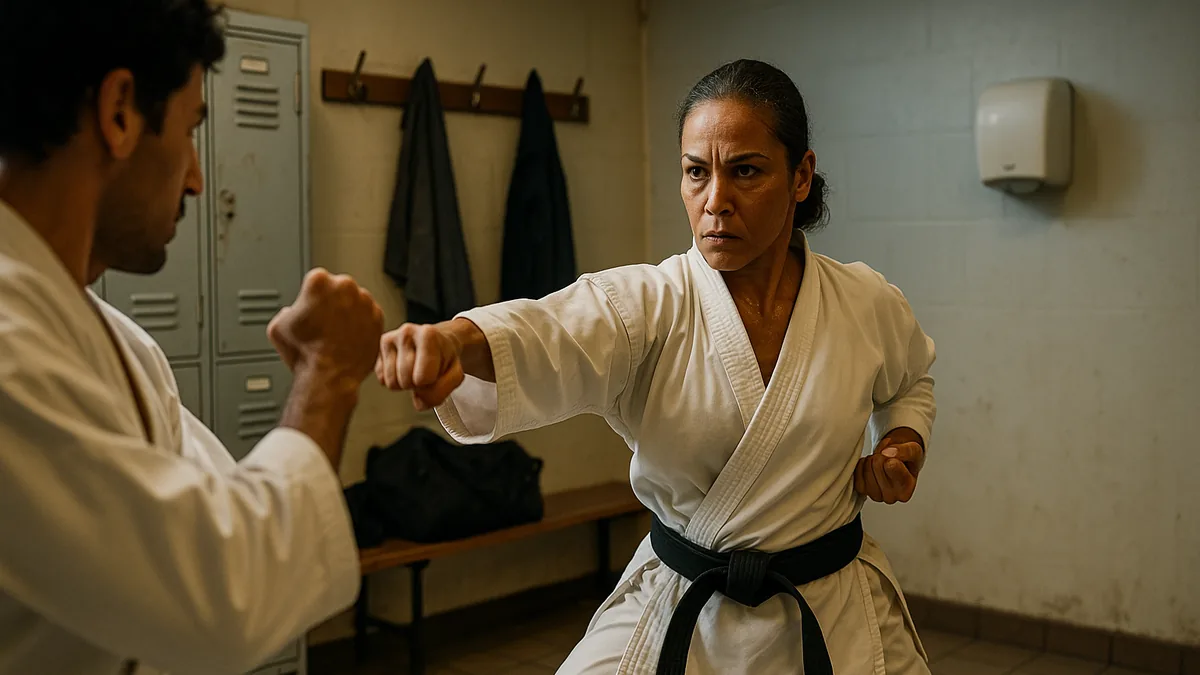
I’ve seen technically excellent students fall apart in their first shiai because nothing in their training had ever made them uncomfortable enough. Their kizami-zuki was crisp in the dojo and disappeared entirely under pressure. Their mae-geri had penetration in pad work and turned into a gentle tap when someone was actually fighting back.
This is a training design failure, not a character failure. Those students weren’t weak. They just hadn’t been trained under conditions that forced their nervous system to adapt.
Pressure training doesn’t mean chaos. It means intentional discomfort. It means sparring with someone better than you and being required to attack, not just survive - which is something worth thinking about if you haven’t read about training with a stronger partner. It means running a drill when you’re already gassed and holding yourself to the same decision-speed standard you’d hold when fresh. It means occasionally making the stakes feel real, even in training.
The psychological side of kumite doesn’t get discussed enough. Confidence in competition isn’t something you have or don’t have. It’s something you build by repeatedly proving to yourself, in training, that you can handle discomfort and still function. Every time you stay composed under pressure in the dojo, you’re building evidence that you can do it when it counts. Rep counts don’t build that evidence. Surviving hard training does.
Community Perspective
There’s a genuine split on this, and I think it’s worth being honest about it.
Traditional training culture - particularly in Japanese-lineage dojos - places enormous value on volume and repetition as a path to mushin, the state of no-mind where technique becomes automatic. The argument is that you can’t shortcut the hours. You have to earn the automaticity through repetition before you can think about decision-making. I have real respect for that view, and I’ve trained with instructors who hold it seriously.
The counter-argument, which I lean toward, is that the type of repetition matters as much as the volume. Mindless reps build mindless habits. If you’re not training decision-making alongside technique, you’ll have polished technique that you can’t deploy under pressure.
I think both camps are partly right, and the honest answer is that you need both - a foundation of technical repetition and a deliberate training structure that forces you to make decisions under uncertainty. What I’d push back on is the idea that volume alone is enough, or that the mental side will somehow develop automatically if you just do enough kihon. In my experience, it doesn’t. You have to train it directly.
Key Takeaways
- Stop using rep counts as your primary progress metric. Track decision speed, accuracy under fatigue, and pressure tolerance instead - these actually predict kumite performance.
- Build decision-making into every drill. If your partner drill doesn’t require a read and a choice, it’s technique practice, not kumite preparation. Both matter, but know which one you’re doing.
- Pressure is a training variable, not a side effect. Design sessions that include intentional discomfort - fatigue, unfamiliar partners, consequence-based scoring. Your nervous system adapts to what you actually experience.
- Confidence is built through evidence, not repetition. Every time you stay composed under hard conditions in the dojo, you’re building the psychological foundation for competition. That’s not soft - that’s training.
- The freeze response is a decision-making problem. If you’re hesitating in kumite, you’re probably waiting for certainty before committing. Train to commit faster with less information, not to wait until you’re sure.
- Honest self-assessment is harder than counting reps, and more valuable. Ask yourself after every session: did I make better decisions today? Did I read my partner faster? That’s the question that matters.
The weekly digest
New karate articles, once a week
One email every week with everything new on Karate Lifestyle. No spam; unsubscribe in one click.
We'll email you to confirm. See our privacy policy.