The Problem With Copying Your Instructor's Karate: Why Imitation Has a Ceiling and What to Do When You Hit It
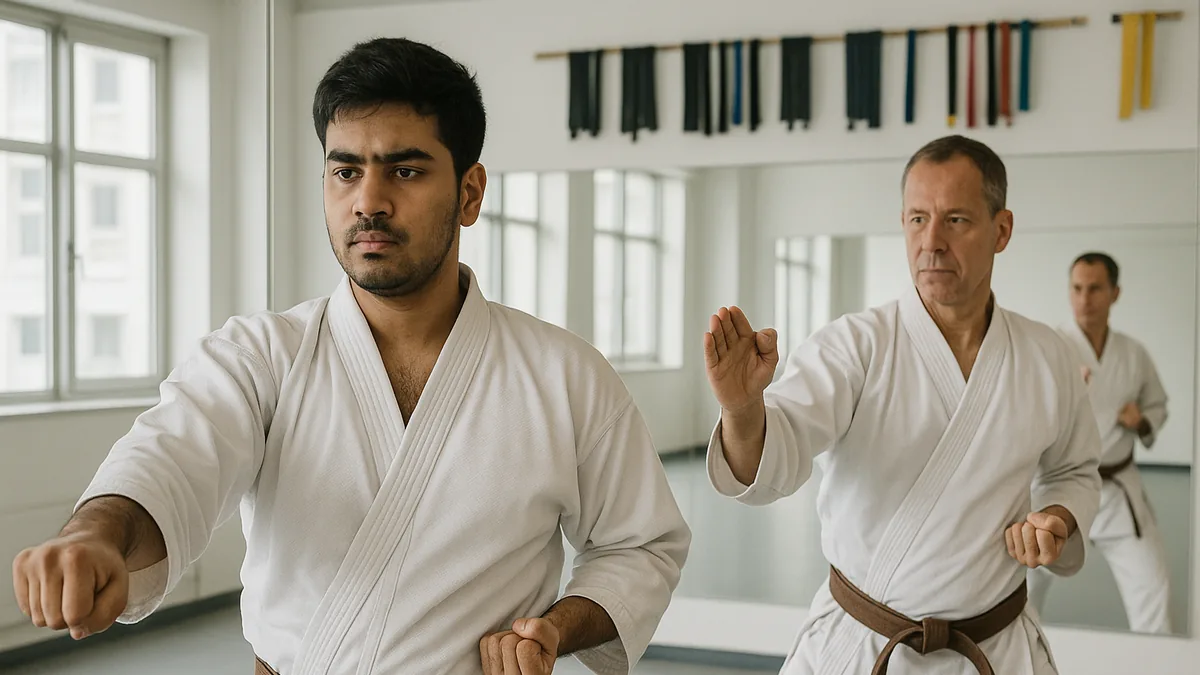
Imitation is how karate training starts, and it works well - for a while. You watch your instructor, you copy the shape, you repeat it until it stops feeling completely foreign. That’s the correct process for a beginner. The problem is that many practitioners never move beyond it. They keep copying, keep refining the visual match to their instructor’s movement, and then wonder why they’ve stopped improving. The ceiling of imitation is real, and hitting it feels like a plateau that no amount of extra training seems to fix.
This article takes a position on that: copying your instructor is a starting point, not a method. At some stage, you have to stop asking “does this look like what they do?” and start asking “does this work, and why?”
Why Imitation Works - And Why It Stops Working
The early stages of karate are essentially a perception problem. You don’t yet have the body awareness to feel whether your hip is rotating correctly, so you need an external reference. Your instructor’s movement gives you that. You copy the shape, you get corrected, the shape improves. This is efficient and appropriate.
Research on motor skill learning consistently finds that visual feedback is the more powerful channel in early acquisition, and that learners typically rely heavily on visual information from both their bodies and the external environment at this stage.1 In karate, that reliance on visual reference is exactly what imitation exploits: you watch, you match, you get physical correction, you repeat.
The correction that usually helps at this stage is a physical one - an instructor adjusting your elbow, your stance width, the angle of your fist at completion. You feel the correct position, you try to reproduce it. Progress is visible and relatively fast.
But somewhere around the transition from kyu grades to the upper belts, this process slows down dramatically. The shapes are largely correct. The technique looks reasonable. And yet something is missing - the punch doesn’t land with any real effect, the block doesn’t actually control the attack, the kata feels like a sequence of positions rather than a coherent thing.
Motor learning theory suggests that skill acquisition involves gradually internalising stable action-sensation mappings, rather than merely understanding external performance outcomes.2 Imitation develops the external match; it does not develop the internal mapping. When you’ve optimised for appearance and run out of road, the gap between what your technique looks like and what it actually does becomes the problem you can’t solve by copying more carefully.
Imitation can teach you where your limbs go. It cannot teach you timing, pressure, intent, or the specific way your body generates force most efficiently. Those things can only be discovered from the inside.
The Instructor’s Karate Is Not Your Karate
Here’s the part that doesn’t get said enough: your instructor’s technique is built on their body, their history, their physical attributes, and decades of accumulated adjustment. A taller instructor with long arms and a deep hip rotation has developed a reverse punch that works for that body. If you’re shorter with a different reach and different hip mobility, copying that movement precisely will not produce the same result - it will produce a slightly wrong version of someone else’s solution.
This is not a criticism of imitation as a teaching method. It’s a structural limitation. The most technically accomplished instructors understand this, which is why the best correction you’ll ever receive isn’t “do it like me” - it’s “what are you trying to achieve, and is this movement achieving it?”
Most beginners think karate technique is about power. By the time you’re approaching brown belt, you start to realise it’s about timing and structure - and that power is a byproduct of those things being right. That shift in understanding is where personal adaptation begins.
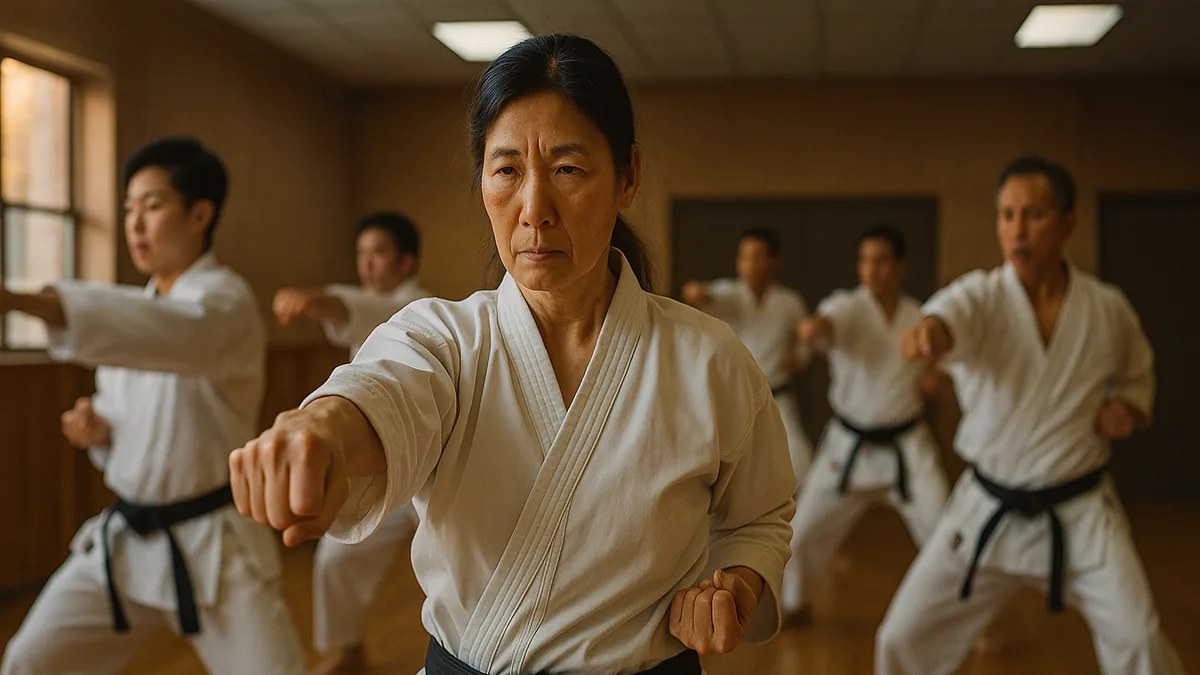
A common mistake at this stage is to interpret “adapt the technique” as “do whatever feels comfortable.” That’s not the same thing. Comfort often means compensating for a weakness rather than resolving it. Adaptation means understanding the mechanical principle behind a technique and then finding how your specific body executes that principle most effectively. In the reverse punch, that principle is a sequential kinetic chain: the lower body initiates, the hip rotates, the shoulder follows, and the arm arrives last. Research on the straight punch confirms this: each participant establishes a kinetic chain starting from the lower extremity before moving to the fist - from ankle, to knee, to hip, with peak shoulder velocity following peak hip velocity before force transfers to the elbow and finally the fist. Your job is to find how your body executes that chain efficiently, not to reproduce the visual shape of someone else doing it.
What Instructors Repeat (And Why It Doesn’t Always Land)
Many instructors cue the reverse punch with “drive from the back leg.” It’s correct. It’s also nearly meaningless until you’ve felt it working. The correction that actually gets through is usually a partner drill where someone resists your punch with a pad and you discover that your arm is doing all the work while your legs and hips are essentially passengers. That moment of resistance makes the cue make sense.
This is why training with a partner who is much better than you accelerates development in a way that solo repetition cannot. A senior partner’s resistance, timing, and movement quality expose the gaps in your technique that mirror-matching your instructor will never reveal.
The same applies to kata. Most practitioners perform kata as a sequence of techniques. Senior practitioners perform it as a sequence of responses to specific pressures - and you can feel the difference in your own body when you start to understand what each movement is actually for. A gedan barai that you understand as a downward block feels like a large arm movement. A gedan barai that you understand as a deflection and counter-grab feels completely different - shorter, sharper, with the weight shifting into it rather than just the arm moving.
When You Hit the Ceiling: What to Do
The plateau that imitation produces has specific characteristics. Your technique looks correct under static observation but breaks down under pressure. Your sparring feels reactive and slow. Your kata is clean but lifeless. These are symptoms of technique that has been learned visually but not yet owned physically.
The correction that works here is not more repetition. Counting repetitions as a measure of progress is already a flawed approach, and when you’ve hit an imitation ceiling, volume makes it worse - you’re just reinforcing patterns that have stopped developing. The sheer number of hours engaged in practice is not as important as the quality of deliberate practice.3
What actually works is constraint-based training and honest feedback. The constraints-led approach has been established as a framework for understanding how people acquire perceptual-motor skills, based on the interaction of three categories of constraint: those related to the individual, to the task, and to the environment.4 In practice, this means deliberately limiting or changing conditions to force adaptation. Slow a technique down until you can feel every stage of it. Do it with your eyes closed and notice where your body awareness fails. Do it against resistance and notice where the force leaks out. Research findings suggest that to facilitate learning of motor skills, it is important to manipulate the practice environment using task constraints to address the factors that restrict exploration.4 These methods reveal what’s actually happening in your body rather than what you think is happening.
Honest feedback means seeking assessment that goes beyond “that looks good.” Ask your instructor not whether the technique looks correct, but whether it would work - and in what context. The answer to that question is almost always more useful than a visual correction.
In jiyu-kumite, the imitation ceiling shows up most clearly when you’re trying to counter off a failed attack. If your technique is built on copying shapes, you’ll find yourself resetting to a position before countering. A practitioner who has genuinely internalised the mechanics will counter from wherever they are, because they understand the principle rather than the shape. That’s the practical difference.
The Role of Feedback in Breaking Through
Feedback works best when it’s specific and tied to an outcome. “Your punch is dropping” is useful. “Your punch is dropping, which is why you’re not getting any power through the pad” is better. “Your punch is dropping because your shoulder is rising first - keep the shoulder down and lead with the hip” is the correction that actually changes something.
When you’re seeking feedback to break through a plateau, be specific about what you’re trying to fix. Don’t ask for a general assessment - describe the problem as you experience it. “My gyaku-zuki feels like it’s all arm and I can’t seem to get the body into it” gives an instructor something to work with. That specificity also forces you to develop your own awareness of what’s happening, which is itself part of the solution.
How often you train matters here too, but not in the way most people assume. Training four days a week using imitation will not break a plateau faster than training twice a week with deliberate attention to what you’re trying to change. Deliberate practice is defined as engagement, with full concentration, in a training activity designed to improve a particular aspect of performance, with immediate feedback and opportunities for gradual refinement.3 The quality of attention is the variable, not the frequency.
Community Perspective
There is a genuine disagreement within karate communities about how much stylistic adaptation is acceptable, and it tends to run along traditional versus sport lines. Traditional dojos often hold that the kata represents the correct form, and deviation is error. Sport-oriented training tends to be more pragmatic - if a modified version of the technique scores in competition, it’s working.
Both positions have merit, and the tension between them is actually useful. The traditional view preserves the integrity of principles that have been tested over time. The sport view forces honest assessment of whether technique actually functions under pressure. The practitioners who develop furthest tend to hold both simultaneously - they respect the form enough to understand why it is the way it is, and they’re honest enough to acknowledge when their execution of it isn’t yet functional.
What changes with experience is the understanding of why the traditional form exists. Most practitioners who dismiss kata as impractical haven’t yet understood what the movements are for. Most practitioners who insist on exact replication of their instructor’s form haven’t yet asked what the form is trying to achieve. Both are imitation problems, just at different levels.
Key Takeaways
- Imitation is the correct starting point, not the destination. Once your technique has a reasonable shape, continuing to optimise for visual match to your instructor will not produce further development.
- Understand the mechanical principle, then adapt it to your body. The lower body initiates, the hip rotates, the shoulder follows, and the arm arrives last - find how your specific body executes that chain most effectively, not how your instructor’s body does it.
- Constraint-based training breaks imitation ceilings. Slow the technique down, do it against resistance, do it with eyes closed. These methods reveal what’s actually happening rather than what you think is happening.
- Seek feedback tied to outcomes, not appearances. “Does this look right?” is less useful than “would this work, and why or why not?” Ask the second question.
- The plateau that imitation produces is not fixed by more repetition. If your technique isn’t developing, review what you’re actually doing in solo sessions before adding more volume.
- Functional technique feels different from copied technique. When the mechanics are genuinely yours, a reverse punch feels like your whole body arriving at a point. When it’s still imitation, it feels like your arm moving with your body following. That distinction is worth chasing.
References
Checked by the KarateLifestyle editorial team against peer-reviewed motor learning and sports biomechanics literature, and official karate grading references in October 2026. The constraints-led approach is well established in the academic literature; the biomechanics citations draw on studies of karate and combat-sport punching that use relatively small sample sizes, which is typical for this field.
- Effects of visual and proprioceptive feedback on motor learning. Magill, R.A. (1973). Psychological Review. Reviewed via ResearchGate.
- From Scaffolding to Internalization: Enhancing CPR Training with In-Situ Visualization and Kinesthetic Feedback. Callaghan & Reinkensmeyer, University of California Irvine. arXiv preprint, 2025.
- Deliberate Practice and Proposed Limits on the Effects of Practice on the Acquisition of Expert Performance: Why the Original Definition Matters. Ericsson, K.A. Frontiers in Psychology, 2019. PMC6824411.
- Sport expertise development and the constraints-led approach. ResearchGate review article. Citing Newell (1986) and Davids et al. framework.
The weekly digest
New karate articles, once a week
One email every week with everything new on Karate Lifestyle. No spam; unsubscribe in one click.
We'll email you to confirm. See our privacy policy.