Do Karate Shoes Actually Help? Grip, Protection, and Performance Compared
Karate shoes are genuinely useful in certain training contexts - but the honest answer is that most practitioners training in a traditional dojo don’t need them, and in many cases, they’ll actually hold you back. That said, there are real scenarios where they make a meaningful difference, and ignoring that isn’t honest either. The nuance is in knowing when they help, when they don’t, and what you’re actually solving for.
Do Karate Shoes Actually Improve Your Grip?
It depends almost entirely on the surface you’re training on.
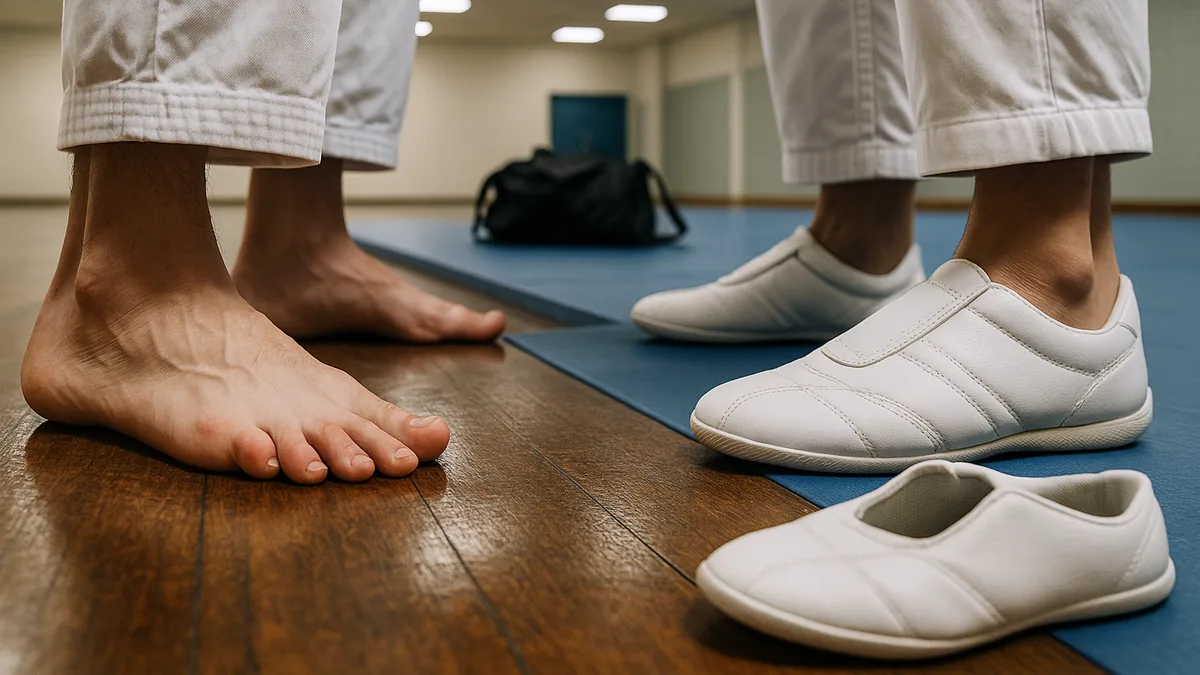
On a traditional wooden dojo floor that’s been maintained properly, bare feet give you more feedback and better control than any shoe. You feel the floor through your foot. You can grip slightly with your toes on pivots. When you’re throwing a gyaku-zuki and driving off the back leg, that tactile connection to the floor is part of how you generate power. The hip rotation is the whole punch - but the foot is what anchors it.
I’ve noticed that students who train exclusively in shoes on smooth floors often have weaker stances when they transition to bare feet. The shoe has been compensating for something they haven’t actually developed.
Where shoes genuinely earn their keep is on rougher or more variable surfaces - sports hall floors, outdoor demonstrations, school gym floors that haven’t been swept since 2009. I’ve done demo work on surfaces where bare feet were a liability, and having a thin-soled karate shoe meant I could move without hesitation. The grip is more consistent when the surface itself is inconsistent.
The key word is thin-soled. A proper karate shoe - the kind made specifically for martial arts, not a cross-trainer someone grabbed from a sports shop - sits close to the floor. You still feel what’s underneath you. That’s very different from a running shoe, which disconnects you from the floor almost completely.
What Protection Do They Actually Offer?
More than you’d think, and in ways that aren’t obvious at first.
The obvious protection is against stubbed toes and mat burns. Less obvious is the protection during prolonged training sessions on hard floors - concrete community halls, for example, where the repeated impact of basics over an hour starts to fatigue the foot in a way a wooden sprung floor doesn’t.
I’ve seen students develop stress-related foot soreness from training on unforgiving surfaces without any protection. It’s not dramatic, but it accumulates. A lightweight karate shoe absorbs a small amount of that repetitive impact without removing the feedback you need.
What shoes don’t protect well against is the kind of impact that actually matters in sparring - a stamped kick or an accidental foot collision. For that kind of protection, you’d be looking at proper sparring gear rather than training shoes. Don’t confuse the two jobs.
There’s also a hygiene angle that doesn’t get mentioned enough. Shared dojo floors carry fungal infections. This is just reality. Some practitioners use lightweight shoes specifically to manage this risk, particularly when training at unfamiliar venues.
Will They Affect Your Technique?
Yes - and this is where I’d push back on the idea that shoes are a neutral addition.
The biggest difference I’ve noticed between practitioners who train barefoot from the start and those who rely on footwear is in their pivoting and turning. Bare foot training forces you to learn how to turn correctly - using the ball of the foot, keeping the heel slightly raised through the rotation. When you’re wearing shoes, the sole does some of that work for you, and the feedback that tells you you’re doing it wrong gets muffled.
My instructor used to say that the floor teaches you more than he does. I didn’t fully understand that until I watched a student who’d been training in shoes for two years try to perform a mawashi-geri on a bare wooden floor for the first time. The pivot was completely wrong - they’d built a habit around the shoe compensating for a technique error.
That said, this is a training context issue. If you’re doing kata on a competition surface where shoes are standard, training in shoes makes sense. You practice what you perform.
When Should You Actually Wear Them?
I’d recommend shoes in these specific situations:
Outdoor or demonstration training - surfaces you can’t control, where bare feet are a genuine risk.
Training on hard, unsprung floors - if your regular venue is a concrete or tile floor and you’re doing high-volume basics, the cumulative impact is worth managing.
Rehabilitation or foot injury - if you’re returning from a foot or ankle issue and need some additional support to train safely.
Competition where they’re required - some sport karate formats include footwear. Train in what you compete in.
What I’d push back on is wearing shoes simply because they feel comfortable or familiar. That comfort is often the feedback you need being removed. If your feet hurt after training on a hard floor, that’s information about the floor, your technique, or your training load - not necessarily a problem to be solved with footwear.
What Type of Karate Shoe Is Worth Buying?
If you’re going to wear them, get the right thing. A martial arts-specific shoe with a split sole or very thin, flexible sole is what you want. The split sole allows independent movement of the forefoot and heel, which matters for kicks and pivots. You’ll feel it immediately - it feels almost like a second skin compared to a conventional shoe.
Avoid anything with a thick cushioned sole. I’ve seen students show up to training in running shoes and spend the whole session fighting their own footwear through basic turns. The shoe wants to go one way, the technique requires another, and the result is a compromised movement pattern that’s harder to unlearn than it would have been to just train barefoot from the start.
Brands like Blitz, Adidas, and Tokaido make decent purpose-built options. Price matters less than sole thickness and flexibility - you can spend a lot on a shoe that’s still wrong for the job.
Community Perspective
This is a topic that genuinely divides practitioners, and the division often falls along traditional versus sport karate lines.
Traditional Shotokan and Goju-Ryu practitioners tend to be firmly in the barefoot camp - the floor connection is considered part of the training, not an inconvenience to be managed. Some senior instructors I’ve trained with treat shoes as a sign that you’re not serious about developing proper foot mechanics.
Sport karate competitors, particularly in WKF-style events, are often more pragmatic. Competition surfaces vary, footwear is sometimes part of the format, and training in shoes is just preparation for the conditions you’ll face.
I think both positions are defensible, but I’d say this: if you’re training in a well-maintained dojo with a proper wooden floor, you don’t need shoes, and you’ll probably develop better technique without them. If your training circumstances involve variable surfaces, hard floors, or competition formats that include footwear, then a proper karate shoe is a legitimate piece of kit - just like choosing the right karate gi for your training context matters.
The mistake is treating shoes as either always necessary or always wrong. They’re a tool. Use them when the situation calls for it.
Key Takeaways
- Bare feet on a good dojo floor gives you more feedback and better technique development than any shoe
- Shoes genuinely help on variable or hard surfaces - outdoor training, concrete halls, demonstration work
- A proper karate shoe with a thin, flexible or split sole is completely different from a cross-trainer - don’t substitute one for the other
- If you train in shoes regularly, periodically train barefoot to check that your pivoting and foot mechanics are actually correct, not just compensated for
- Shoes don’t replace proper sparring protection - they serve a different function entirely
- When your feet hurt after training, diagnose the cause before reaching for footwear as the solution
The weekly digest
New karate articles, once a week
One email every week with everything new on Karate Lifestyle. No spam; unsubscribe in one click.
We'll email you to confirm. See our privacy policy.