Foam Flooring for Home Dojo: Interlocking Mats, Tatami Tiles, and Roll-Out Options Compared for Karateka Who Train at Home
What Your Floor Actually Needs to Do
Before comparing products, be clear about what you’re asking your floor to do. If your home training is primarily kata, kihon, and bag work, your requirements are different from someone doing partner drilling, light sparring, or self-defence practice that involves takedowns.
The floor needs to:
- Absorb enough impact to protect your joints during jumping techniques and falls
- Provide enough grip that your foot doesn’t slide when you drive off it for a reverse punch or a kick
- Stay stable - tiles that shift under load are a genuine injury risk
- Survive regular use without compressing permanently or breaking down at the edges
A common mistake is prioritising cushioning above everything else. Extremely soft foam feels comfortable underfoot but it destabilises your stances. You’ll feel it immediately in sanchin or zenkutsu-dachi - the mat compresses unevenly under your heel and ball of the foot, and your weight distribution goes wrong. Many instructors cue this as “feel the floor pushing back.” On foam that’s too soft, you never get that sensation, and your stance work suffers for it.
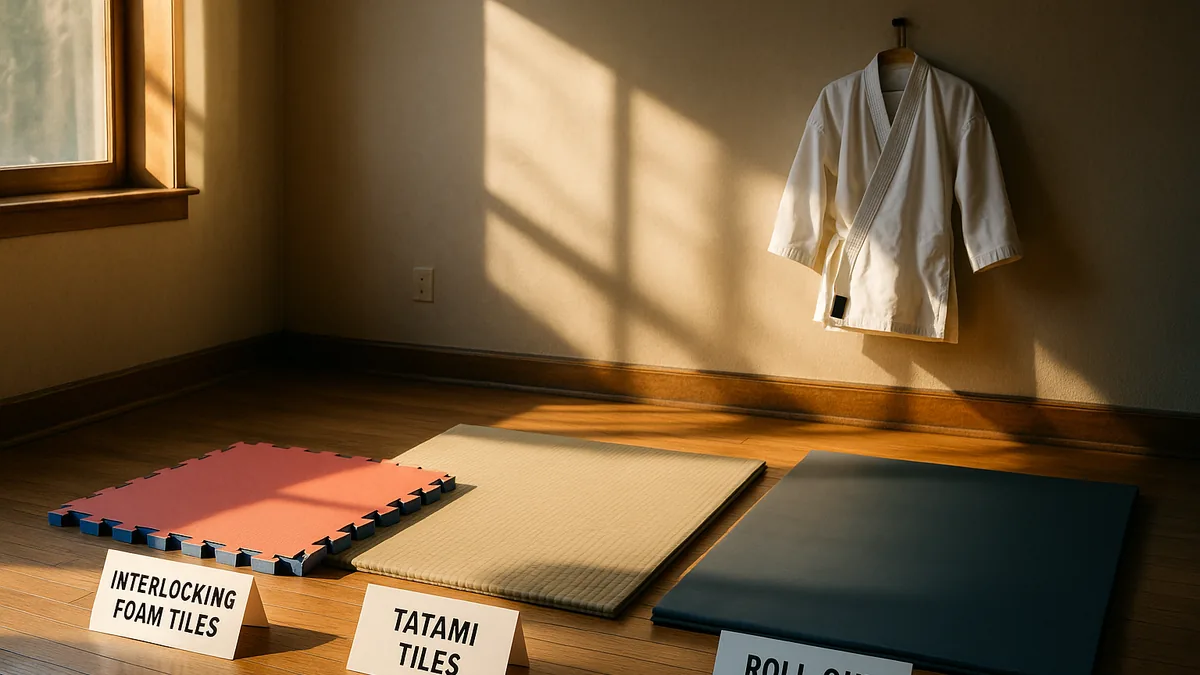
Interlocking EVA Foam Tiles
This is the most popular choice for home dojos, and for good reason. Interlocking EVA (ethylene-vinyl acetate) tiles are widely available, affordable, and genuinely practical. A standard 1m x 1m tile at 20mm thickness costs roughly £8 to 15 depending on brand and density, which makes covering a 4m x 4m space achievable for under £200.
The real advantage is modularity. You can cover exactly the space you have, expand when you move to a bigger room, and store unused tiles flat. If you train in a garage that doubles as a workshop, you can lay the tiles for training and stack them against the wall when you need the space back.
What to look for:
- 20mm minimum thickness for karate - 10mm tiles are too thin for anything involving falls or jumping
- High-density EVA, not low-density foam - it should feel firm underfoot, not like memory foam
- A tatami-grain or ribbed surface texture rather than smooth - smooth EVA becomes a slip hazard in bare feet
- Tight-fitting puzzle edges - cheap tiles have loose connections that open up under lateral movement
The biggest difference between budget and mid-range interlocking tiles is density. Foam density is a measurement of mass per unit volume, expressed in kilograms per cubic metre (kg/m³). The higher the density, the greater the impact resistance. Budget tiles marketed for general fitness use typically fall in the 60 to 70 kg/m³ range and compress permanently within months of regular training.1 For martial arts, look for tiles in the 90 to 110 kg/m³ range if you can find the specification - one specialist mat supplier recommends 100 kg/m³ as the benchmark for impact absorption that does not sacrifice durability, and that figure is consistent with WKF-approved karate competition tatami, which is independently specified at the same density.1 Buy from martial arts suppliers rather than general sports retailers; the density is rarely disclosed on general fitness products.
Where interlocking tiles fall short: the joins. No matter how good the tiles are, the puzzle edges create a seam that you’ll feel underfoot during footwork drills. In jiyu-kumite, that seam can catch your foot mid-pivot. The correction that usually helps is orienting your training area so the joins run parallel to your primary movement direction rather than across it - but you cannot eliminate this issue entirely.
Tatami Tiles
“Tatami” is the term used both for the surface texture and for competition mats. It is worth being precise here, because the two categories have very different specifications.
WKF competition tatami is the reference point for serious karate training. The WKF-approved tatami is a puzzle-type tile, formed by two pieces of 1m x 1m and 2cm (20mm) thick, connected with a system that stops them separating during use.2 The tatami must be made of a material with an impact absorption rate that complies with WKF regulations, and the upper surface must have a friction rate that avoids excessive friction while preventing the contestant from sliding.2 These tiles are typically made from crosslinked polyethylene foam rather than standard EVA, and carry independent homologation testing.
Home-use tatami-surface tiles are interlocking EVA tiles with a woven or rice-straw-texture surface layer pressed or bonded onto the foam. They look and feel closer to competition tatami, and the surface texture is the key practical difference. That woven pattern gives bare feet grip without abrasion. You’ll feel the difference most clearly during kizami-zuki combinations where you’re driving off the rear foot and recovering quickly - on a smooth EVA tile, there’s a fraction of a second where your foot has to find grip; on a tatami surface, it is there immediately.
If you want the benefits of a tatami texture and also need fall protection for ground work and partner drilling, the correct choice is a thicker EVA tile - typically 40mm - rather than a standard-spec 20mm tile. High-impact training requires high-density EVA foam, often above 90 kg/m³, to effectively dissipate energy and prevent compression set - the permanent deformation of the material after prolonged stress. The extra thickness is protecting your joints from a completely rigid surface and providing meaningful cushioning for breakfalls.
Tatami-surface tiles at 40mm run roughly £20 to 35 per 1m x 1m tile and are heavier and harder to store than 20mm tiles. The surface layer can also peel or delaminate at the edges over time if the quality is poor - check that the surface is bonded rather than just pressed, and buy from a reputable martial arts supplier.
We’d recommend 40mm tatami-surface tiles as the better long-term investment for anyone whose home training involves partner work, takedowns, or groundwork - even occasional groundwork. For pure striking, kata, and bag work, standard high-density interlocking EVA at 20mm is sufficient and more practical.
Roll-Out Mats
Roll-out mats are a single continuous piece of foam - typically 1 to 2m wide and 6 to 10m long - that rolls up for storage. They’re common in school PE departments and smaller clubs, and they have a specific use case where they genuinely outperform tiles.
The advantage is a completely seam-free surface. There are no joins to catch your feet, no tiles to shift under load, and no puzzle edges to degrade over time. For kata practice and kihon drills where you’re moving continuously across the surface, a roll-out mat feels cleaner underfoot.
Where roll-out mats create problems:
- They require a flat, smooth subfloor - on concrete with any texture or unevenness, the mat moves unless it’s secured or weighted
- Rolling and unrolling a heavy mat is awkward on your own, particularly in a tight space
- The foam is typically lower density than good interlocking tiles, because the manufacturing process prioritises flexibility for rolling
- They don’t conform to irregular room shapes
The storage argument is often overstated. A 10m roll of 25mm foam is heavy and awkward. It does not store as neatly as people imagine. If your training space is a spare room that stays as a spare room, a roll-out mat works. If you’re sharing the space with anything else, interlocking tiles are easier to manage.
Roll-out mats make most sense as a temporary solution or as an addition to a permanent tile setup - for example, a roll-out crash mat behind a makiwara or striking post. Speaking of which, if you’re setting up a wall-mounted striking area, have a look at our guide to wall-mounted punch shields and striking pads for home dojo training to think through the full setup.
Surface Texture and Bare Feet
This point deserves more attention than it usually gets. Karate is trained barefoot, and bare feet interact with a surface differently from shoes or socks. Smooth foam becomes slippery with sweat. Abrasive surfaces cause friction burns during low stances and sweeping movements. The ideal surface has a mild texture - enough to grip, not enough to abrade.
Tatami-pattern and ribbed surfaces are the standard recommendation for this reason. If you’re buying interlocking EVA tiles, avoid smooth-surfaced tiles marketed for gym or garage use - they’re designed for shoes. The texture that feels slightly rough under your fingers when you run your hand across it is approximately right. If it feels like sandpaper, it will tear your skin. If it feels like a chopping board, it will let you slip.
Thickness and Your Subfloor
The right thickness depends partly on what’s underneath. On a suspended timber floor (common in UK houses), 20mm high-density EVA is sufficient for striking, kata, and bag work - the floor itself has some structural give. On concrete, you want 40mm minimum, because the extra thickness is protecting your joints from a completely rigid surface.
A suspended timber floor also means noise transmission to the room below. Because the timber structure - the joists, the floorboards and the ceiling below - is usually mechanically fixed, there are efficient paths for impact sound to transmit from the upper floor into the room below. Thicker mats reduce impact noise but do not eliminate it. Impact noise from footsteps, dropped objects and movement enters the floor structure directly as vibration, and foam mats address only part of that problem. If you’re training above a living space, kicking drills and jumping techniques will still travel. This is a real constraint for flat-dwellers, and no floor mat fully solves it - it just reduces the problem.
Community Perspective
There is genuine disagreement in the karate community about how much the floor surface matters for striking arts versus grappling arts. Judoka and BJJ practitioners are rightly focused on fall absorption and ground texture. Many traditional karate instructors trained for decades on polished hardwood and are sceptical that foam flooring is necessary at all.
The hardwood argument has merit for pure striking practice - hardwood gives honest feedback about foot placement and forces correct weight distribution. The problem is that hardwood is expensive to install, slippery when polished, and unforgiving if you’re doing any solo falling practice or training with a partner.
The practical compromise that most experienced home practitioners land on is high-density interlocking EVA or tatami-surface tiles as the base surface, with the understanding that this is a reasonable approximation of a dojo floor rather than a perfect substitute. The floor matters, but it’s not the most important variable in your home training setup. Your gi, your striking equipment, and your training structure matter more.
One opinion that tends to shift with experience: newer practitioners often over-invest in floor surface and under-invest in striking equipment. The floor is where you stand - but it’s the makiwara or striking pads that actually develop your technique.
What to Buy Based on Your Training
For kata, kihon, and solo bag work on a suspended timber floor: High-density interlocking EVA tiles, 20mm, tatami-grain surface. Budget £120 to 180 for a 4m x 4m space. Buy from a martial arts supplier, not a general sports retailer.
For partner drilling, light sparring, or any ground work on concrete: Tatami-surface interlocking EVA tiles, 40mm, high-density (look for 90 to 110 kg/m³). Budget £300 to 400 for a 4m x 4m space. The extra cost is worth it for the surface quality and fall protection.
For a temporary setup or as a secondary surface: Roll-out mat, 25mm minimum, only if your subfloor is flat and you have a clean storage solution.
If you’re building out a full home dojo, the floor is the foundation - but also check what you’re training with, not just what you’re training on. Our guides to karate gloves and karate shoes cover the equipment that interacts most directly with your floor surface.
Key Takeaways
- Density matters more than thickness. A 20mm high-density EVA tile performs better than a 40mm low-density tile for stance work and footwork. If the mat feels like memory foam, it’s too soft. Look for 90 to 110 kg/m³ if the specification is published.
- Buy tatami-surface tiles at 40mm if you’re doing any partner work or ground practice. The surface texture and extra thickness are not cosmetic - they change how your feet grip and how safely you absorb falls. WKF competition tatami is only 20mm, but home use with partner drilling demands more cushioning than a competition floor.
- Tile joins are a genuine hazard in sparring. Orient your training area so joins run parallel to your primary movement direction, and check tile fit before committing to a brand.
- Roll-out mats have one good use case - a seam-free surface for continuous kata practice - but they’re harder to store and typically lower density than good interlocking tiles. Don’t buy them as your primary surface unless your subfloor is perfectly flat.
- Concrete subfloors need more protection than timber floors. On concrete, go to 40mm minimum. On suspended timber, 20mm is usually sufficient for solo training.
- The floor is infrastructure, not training equipment. Get it right, then invest in the striking tools and training aids that actually build your karate.
References
Checked by the KarateLifestyle editorial team against WKF official equipment specifications, specialist mat manufacturer data sheets, and UK acoustic insulation technical guides in October 2026. EVA density figures for budget tiles are indicative; published specifications vary by manufacturer and are not always disclosed on consumer products.
- Hardness and Density - Martial Mats. Martial Mats (UK specialist supplier), product specification page, accessed October 2026
- Tatami - WKF Approved Equipment. World Karate Federation official equipment approval page, accessed October 2026
The weekly digest
New karate articles, once a week
One email every week with everything new on Karate Lifestyle. No spam; unsubscribe in one click.
We'll email you to confirm. See our privacy policy.