Do Karate Gloves Ruin Your Technique? An Honest Look at Training Gloves for Karateka
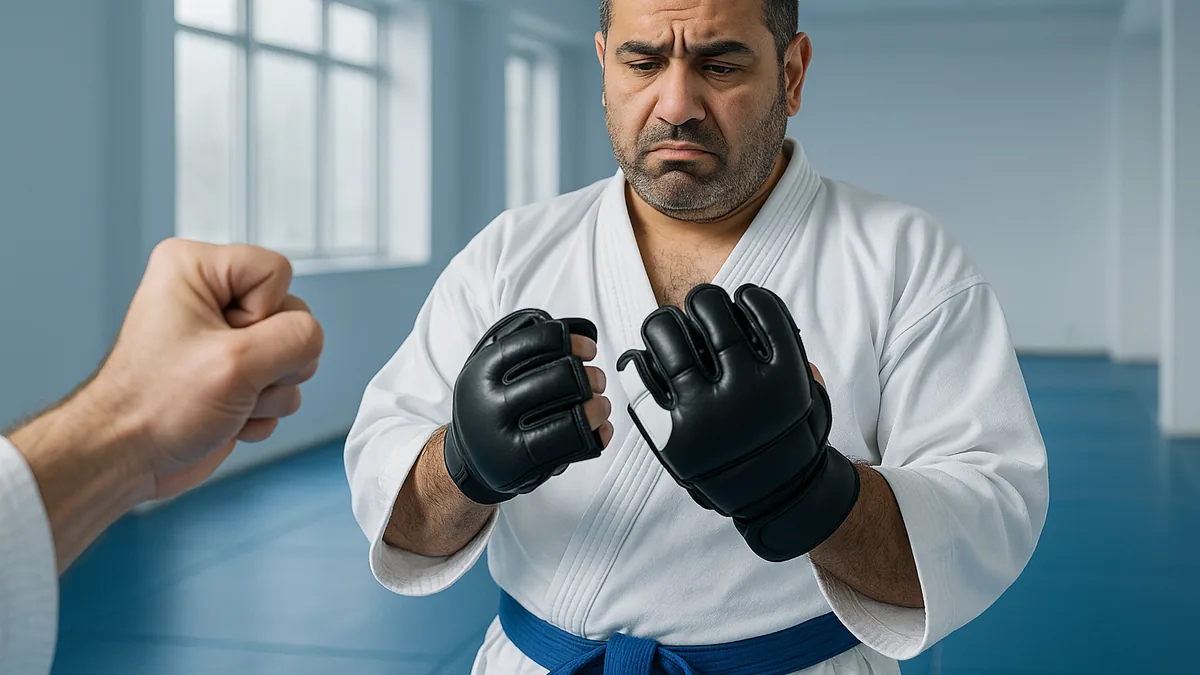
I’ve had this argument in three different dojos. Someone shows up to sparring with a pair of MMA-style gloves, throws a gyaku-zuki, and the whole thing looks off. The hand position is wrong, the wrist is cocked slightly, and the punch lands with the wrong part of the fist. When you ask them about it, they say the gloves feel fine. That’s exactly the problem.
Gloves do something subtle that most people don’t notice until it’s too late: they change what “correct” feels like. And once your nervous system adapts to that altered feedback, you’re not training karate anymore - you’re training a gloved approximation of it.
That’s my honest position. But it’s not as simple as “gloves bad, no gloves good.” There’s a real conversation to have here, and I’ve changed my view on parts of it over the years.
What Gloves Actually Do to Your Hand Position
The mechanics matter here, so let me be specific. In bare-knuckle karate, proper seiken (forefist) alignment means the first two knuckles are forward, the wrist is flat, and the forearm, wrist, and striking surface form a straight line. You feel that alignment every time you punch correctly. You also feel it - painfully - when you don’t.
Gloves remove that feedback loop almost entirely. The padding distributes the impact across the whole fist, so a slightly bent wrist or a punch that lands across three knuckles instead of two feels roughly the same. You’ll feel the impact, but you won’t feel whether you hit correctly.
I’ve noticed this most clearly when students who train regularly with boxing gloves come to bare-knuckle pad work. The wrist buckles on harder shots. Not because they lack strength - they’ve been punching for months - but because they’ve never had to stabilise that alignment under pressure. The gloves were doing it for them.
What correct wrist alignment feels like is hard to describe until you’ve got it. There’s a kind of solidity through the forearm when it’s right - like the punch has a spine to it. When it’s wrong, the impact feels diffuse, almost spongy, even on a hard surface. That sensation is your most honest instructor. Gloves muffle it.
The Protection Argument Is Real - Don’t Dismiss It
Here’s where I’ll acknowledge the other side, because I’ve seen what happens without protection and it’s not always instructive.
In my early years, I trained in a dojo where gloves were considered unnecessary - traditional values, no compromise. The result was a lot of bruised knuckles, split skin, and one student who developed a chronic knuckle issue in his early twenties that still bothers him. That’s not character-building. That’s just damage.
For beginners especially, the case for some hand protection is legitimate. Most white belts don’t have conditioned knuckles, and asking them to punch a pad or a bag repeatedly with bare fists before they’ve developed proper alignment is a fast track to injury. The problem isn’t protection itself - it’s using protection as a permanent substitute for developing the underlying skill.
What I tell students is this: think of gloves the way you’d think of training wheels. They have a place. The mistake is never taking them off.
If you’re also working on conditioning through tools like a makiwara, you’re building the kind of hand toughness that reduces your dependence on gloves over time. That’s the progression I’d recommend.
The Grip Problem Nobody Talks About
Punching aside, gloves create a second issue that gets almost no attention: they ruin your grip.
A lot of karate technique - especially in grappling-adjacent work, in kata application, and in self-defence scenarios - involves gripping, pulling, or controlling a limb. Even in basic partner drills, you’re grabbing a sleeve, a wrist, a collar. Gloves make all of that either impossible or artificial.
I used to think this was a minor concern, only relevant for styles that do more bunkai work. Then I started training with a Goju practitioner who pointed out how many of his kata applications relied on simultaneous block-and-grab combinations. With gloves, you can’t feel whether your grip is on the wrist or the forearm. You can’t feel the rotation of the limb you’re controlling. You’re essentially training half the technique.
For pure striking practice, this matters less. But if your training includes any application work, partner drills, or self-defence scenarios, gloves are actively cutting you off from a significant part of what you’re trying to learn.
Where Gloves Actually Make Sense
I’m not anti-glove across the board. There are specific contexts where I’d recommend them without hesitation.
Light contact sparring with beginners. When you’re pairing an experienced student with someone who’s been training six months, gloves reduce the risk of accidental damage from mistimed blocks and poor target selection. The beginner benefits from some protection while they develop control.
Bag work and heavy pad rounds. If you’re putting in volume on a heavy bag - multiple rounds, sustained combinations - bare-knuckle work over that duration will chew up your hands before your conditioning is there to handle it. Gloves let you build striking power and cardiovascular capacity without the skin becoming the limiting factor.
Full-contact or semi-contact competition formats. If the format requires gloves, you train with gloves. That’s just being practical. But you also train without them the rest of the time, so you maintain both skill sets.
The focus mitt and Thai pad question is connected to this - the tool you’re hitting partly determines whether gloves are appropriate. Mitts designed for bare-knuckle work change the equation compared to boxing-style pad rounds.
The Mistake I See Most Often
The most common mistake I see is students using gloves to avoid confronting weaknesses rather than to work around a temporary limitation.
Here’s what it looks like in practice: a student has sore knuckles from a previous session, or they’re anxious about partner work, or they just prefer the feel of gloves. So they put them on for everything - kihon, kata application, kumite, bag work - and over time, gloves become their default. They stop knowing what their technique feels like without them.
The correction that works is progressive. I tell students to do their first round of any session bare-knuckle, even if it’s light work. Get the feedback. Feel where the alignment is off, where the wrist is soft, where the knuckles aren’t landing correctly. Then, if the session calls for gloves, put them on. But don’t start with them.
This keeps the sensory feedback active. Your hands remember what correct feels like, and the gloves become a layer on top of that knowledge rather than a replacement for it.
Community Perspective
This is genuinely one of those topics where dojos disagree, and I think the disagreement is worth being honest about.
Traditional Shotokan and Goju dojos often treat gloves with suspicion - not out of machismo, but out of a genuine belief that bare-knuckle training develops something that padding can’t replicate. That’s a position I largely agree with, but I’ve also seen it taken too far, to the point where students are training in pain constantly and developing bad habits to protect their hands rather than because of gloves.
Dojos with a competition focus, particularly those training for WKF-style kumite, are more likely to integrate gloves naturally because the competition format demands them. That’s pragmatic and makes sense in context.
What I’ve noticed among senior practitioners - people with 20-plus years - is that most of them have a clear preference for bare-knuckle kihon and kata work, but are fairly relaxed about gloves in controlled sparring. That balance seems to come from experience rather than ideology, and I think it’s the right place to land.
The debate also shifts depending on what else is in your equipment kit. How you approach your gi, your footwear, and other gear choices all reflect how you think about the relationship between protection and authentic training feel. Gloves are just one piece of that.
Key Takeaways
-
Do your first round of any session bare-knuckle. Get the feedback before you add any padding. This keeps your sensory awareness of correct alignment sharp.
-
If gloves change how your technique feels, that’s a warning sign, not a comfort feature. The discomfort of bare-knuckle work is often the most accurate correction you’ll receive.
-
Use gloves for volume work, beginner sparring, and competition-specific preparation. Don’t use them as a default for everything.
-
If your training includes any bunkai, partner application, or grip-based technique, gloves are cutting you off from half the skill. Do that work with bare hands.
-
Watch your wrist alignment specifically when you remove gloves after a glove-heavy session. That’s where the damage shows up first.
-
The goal is to not need gloves, while knowing when using them is sensible. That’s a different mindset than treating them as standard equipment.
The weekly digest
New karate articles, once a week
One email every week with everything new on Karate Lifestyle. No spam; unsubscribe in one click.
We'll email you to confirm. See our privacy policy.