Wall-Mounted Punch Shields and Striking Pads for Home Dojo Training: What Works and What Wastes Your Wall Space
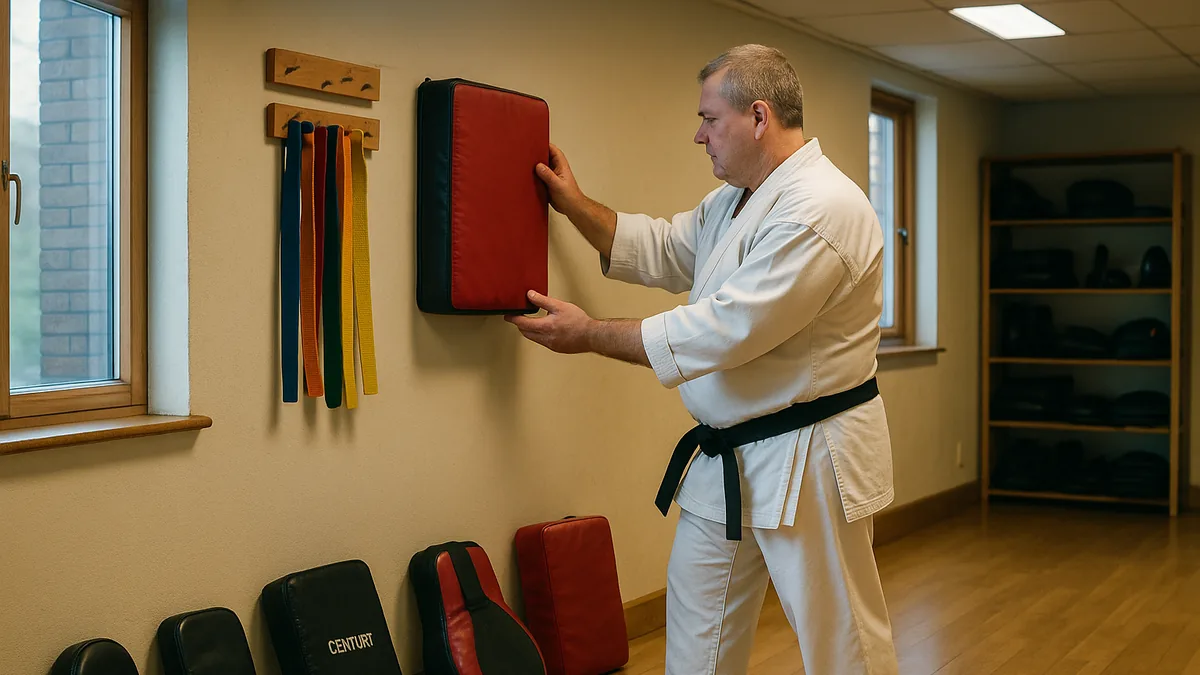
Most people buying their first wall-mounted striking pad make the same mistake: they treat it like buying a picture frame. They measure the wall, check the weight limit, and order whatever has decent reviews. Then six months later the thing is either falling apart, vibrating loose from the wall, or sitting in a corner because it never felt right to hit in the first place.
I’ve set up three home dojos across different houses over the years, and I’ve advised students on their setups more times than I can count. The wall-mounted pad question comes up constantly - partly because floor space is always the limiting factor at home, and partly because people genuinely don’t know what they’re buying until they’ve already bought the wrong thing twice.
Here’s what I’ve actually learned from using this equipment, watching others use it, and occasionally regretting my own purchases.
Why Wall-Mounted Pads Are Different From Everything Else in Your Home Dojo
When you hit a hanging bag, it swings. That swing absorbs energy, gives you feedback, and honestly forgives a lot of technical errors. When you hit a wall-mounted pad, there’s nowhere for that energy to go except back through your structure. That’s not a bad thing - it’s actually one of the most honest training tools you can own. But it means the quality of the pad matters in a completely different way.
I used to think the pad was just a target. My instructor at my second dojo set me straight on this. He had an old wall-mounted shield - nothing fancy, just solid foam with a canvas cover - and he’d have us do set combinations against it at the end of every class. After a few weeks he pointed out that I was pulling my punches slightly on the last technique of every combination. I hadn’t noticed. The pad had. Because there was no swing, no movement, no give that could mask the drop in commitment, the feedback was immediate and honest. You’ll feel the difference between a punch you committed to and one you didn’t in a way you simply don’t get from a hanging bag.
That’s the first thing to understand about wall-mounted equipment. It doesn’t lie.
What Actually Matters When You’re Evaluating These Pads
Foam Density and Layering
This is where most budget pads fail and where most buyers don’t know what to look for. The foam inside a striking pad isn’t just about softness - it’s about how the pad handles repeated impact over months and years.
I’ve noticed that cheap pads tend to use a single layer of uniform foam. It feels fine when it’s new. After a few months of regular training, you start to feel the backing through the foam on harder shots. That’s called bottoming out, and once it starts happening, the pad is working against you. Your wrists absorb impact they shouldn’t, your technique starts compensating unconsciously, and you end up with either an injury or a bad habit - sometimes both.
What you want is layered foam with different densities. A softer outer layer absorbs the initial impact, a denser inner layer stops the bottoming out. Some higher-end pads use memory foam in the outer layer, which feels genuinely good to strike but can compress permanently over time if you’re training heavy. I prefer traditional layered foam for longevity, especially for home use where you’re not replacing equipment every season.
The cover material matters too. Vinyl covers are cheaper and easier to wipe down, but they crack in cold garages and eventually split at the seams. Genuine leather costs more and needs occasional conditioning, but it handles temperature changes better and the stitching holds up. Synthetic leather sits somewhere in the middle - better than vinyl, not as durable as leather, usually the right call for most home setups.
Size and Weight - Getting This Right For Your Space
One mistake I see often is people buying pads that are too small because they’re thinking about wall space rather than training function. A pad that’s too small forces you to aim rather than strike, and that’s not the same skill. In real application - whether that’s jiyu-kumite or a grading situation - you’re not aiming at a small target. You’re committing to a zone.
For general striking practice, you want a pad that covers roughly the torso area of a person. That’s typically somewhere around 60-70cm tall and 40-50cm wide for a punch shield style pad. If you’re working kicks as well, you need something larger - or a second pad mounted lower.
Weight is something people underestimate. A heavy pad transfers more force back into the wall mounting, which means you need better fixings and a more solid wall. But a heavier pad also stays put better and doesn’t rattle or shift during training. I’d rather deal with a more involved installation once than have a lightweight pad that creeps across the wall over six months of use.
Think about your ceiling height too, especially for any head-height kicks. I’ve seen home dojos where the pad was mounted at the right striking height but there wasn’t enough clearance above it for a proper mawashi-geri without adjusting the technique. That’s a small thing that compounds over time - you end up training a modified kick without realising it.
Mounting Systems - The Part Everyone Underestimates
This is genuinely where I’d spend the most time before buying. The pad itself is only as good as what’s holding it to the wall.
Most wall-mounted pads come with one of three mounting approaches. The first is a simple bracket system with fixed bolts - solid, permanent, not adjustable. The second is a rail or channel system that lets you slide the pad up and down to change height. The third is a hook-and-loop or strap system that’s faster to install but gives you less stability.
I prefer the bracket system for a dedicated home dojo. Yes, you have to commit to a height, but the stability is noticeably better. You’ll feel it in the feedback when you strike - there’s a solidity to a properly bracketed pad that a strap-mounted one just doesn’t have. The strap systems are fine for lighter pads and lighter use, but if you’re training seriously, they start to feel loose within a year.
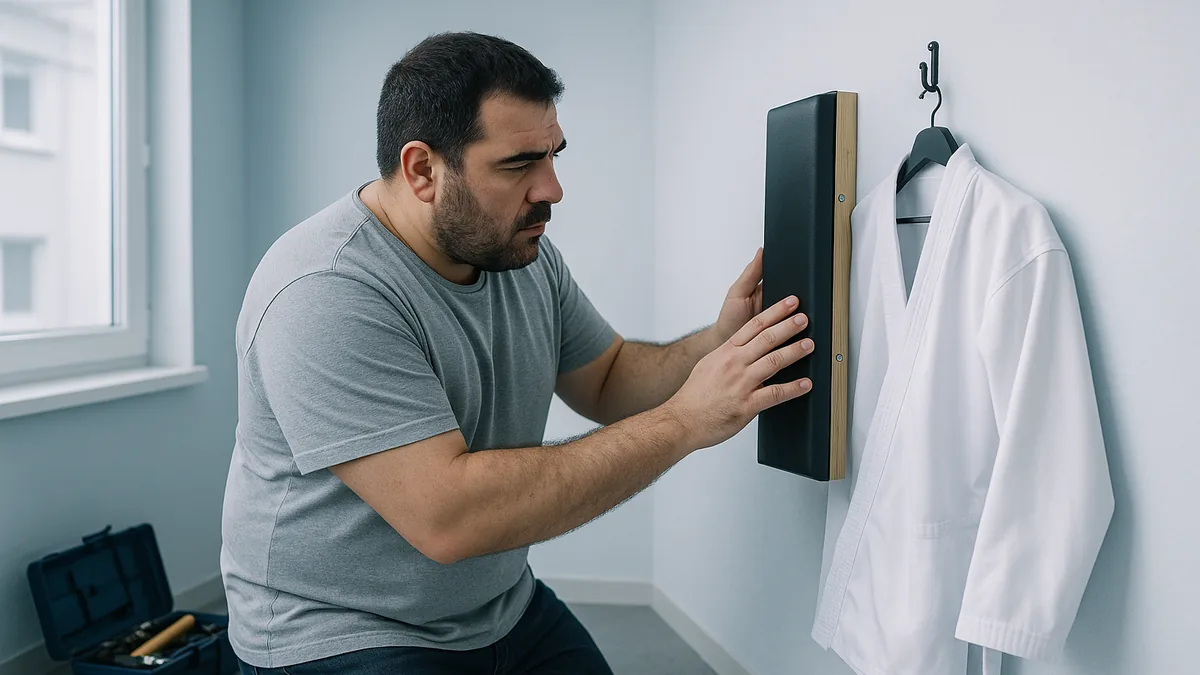
The wall itself matters as much as the mounting hardware. Plasterboard alone won’t hold up to sustained heavy striking. You need to hit studs, use wall anchors rated for dynamic loads, or ideally mount to a solid masonry wall. I’ve seen setups where someone used standard picture hooks and wondered why the pad was gradually pulling away from the wall. Dynamic impact loads are completely different from static weight loads - the fixings that hold a painting won’t hold a striking pad through a year of training.
If you’re renting or you’re not sure about your walls, look at freestanding alternatives before committing to a wall mount. It’s not the same training experience, but a good freestanding shield is better than a poorly mounted wall pad.
Community Perspective
There’s a genuine split in the karate community about whether wall-mounted pads belong in traditional training at all. Some instructors I’ve trained under wouldn’t have one in their dojo - their view is that solo striking practice should happen on a makiwara, and pad work should always involve a partner. I understand that position. The [makiwara]((/equipment/the-best-makiwara-boards-for-home-training-what-to-buy-and-w/) develops something that no foam pad replicates - the conditioning, the feedback through bone and tendon, the specific discipline of striking a fixed point with full commitment.
But I think that’s a false choice for most home practitioners. Not everyone can install a makiwara. Not everyone has a regular training partner available. A wall-mounted pad fills a gap that genuinely exists in solo home training, and dismissing it entirely because it’s not traditional seems like letting the perfect be the enemy of the good.
Where I do agree with the traditionalists is on the question of over-reliance. If wall pad work becomes your primary striking training and you’re rarely doing partner work or makiwara training, you’re missing things the pad can’t teach you. The pad doesn’t move, doesn’t react, doesn’t close distance. It’s a tool for developing power and combinations, not a complete training solution.
The [comparison between different wall targets and striking tools]((/equipment/speed-bags-double-end-bags-and-wall-targets-which-karate-pra/) is worth reading if you’re still working out what belongs in your home setup. The honest answer is that different tools develop different things, and most serious home practitioners end up with more than one.
Pairing Your Wall Pad With Other Training Tools
A wall-mounted pad on its own gives you a target for combination work and power development. What it doesn’t give you is the timing, distance management, or partner feedback that makes those combinations actually work under pressure.
What I tell students setting up home dojos is to think about the wall pad as one layer of a training system, not the whole thing. If you’re also working with target pads for partner drilling when you have a training partner available, you’re covering different aspects of the same skill. The wall pad builds the technique. The partner pad builds the application.
Some practitioners add reusable breaking boards to their home setup as a way of testing commitment and focus on individual techniques. That works well alongside wall pad training - the pad for combinations, the board for single-technique focus and mental commitment. They address different things.
If you’re training with gloves on your wall pad - and many people do, especially if they’re working heavier combinations - it’s worth reading about how gloves affect karate technique before you commit to that habit. It’s a genuine debate and the answer isn’t straightforward.
What I’d Actually Buy
I’ll give you a direct answer rather than a neutral rundown of options.
For most home practitioners doing karate-specific training, I’d prioritise a mid-weight pad (somewhere around 5-8kg) with layered foam construction, a synthetic leather or genuine leather cover, and a solid bracket mounting system. Size should be large enough to represent a realistic target zone - don’t go small to save wall space, it trains the wrong habits.
Avoid anything marketed primarily at boxing or MMA training. The striking angles are different, the pad geometry is different, and you’ll end up with something that doesn’t suit the techniques you’re actually training. Karate combinations involve more linear striking, more varied heights, and often more hip-driven power than the pad was designed for.
Spend more on the mounting hardware than you think you need to. I’ve seen people spend serious money on a quality pad and then try to mount it with whatever fixings came in the box. That’s backwards. The pad is only as useful as how solidly it’s fixed to the wall.
Key Takeaways
-
Layered foam density is the single most important quality indicator - single-layer foam bottoms out under sustained training and starts working against your technique within months
-
Size the pad for training function, not wall space - a pad that’s too small forces aiming rather than striking, which is a different and less useful skill
-
Mount into studs or masonry, not just plasterboard - dynamic impact loads are completely different from static weight, and inadequate fixings will fail gradually in ways that are hard to notice until the pad is pulling away from the wall
-
Wall-mounted pads are honest in a way hanging bags aren’t - there’s nowhere for the energy to go except back through your structure, which means technical errors show up clearly; use that feedback deliberately
-
Treat the pad as one layer of a training system - it develops power and combinations, but it doesn’t replace partner work, makiwara conditioning, or the timing that only comes from training against something that moves and reacts
-
Avoid pads designed primarily for boxing or MMA - the geometry and angle assumptions are different; buy something designed for the striking patterns you’re actually training
The weekly digest
New karate articles, once a week
One email every week with everything new on Karate Lifestyle. No spam; unsubscribe in one click.
We'll email you to confirm. See our privacy policy.