Breaking Boards for Karate: Reusable vs Wood, and What Actually Improves Your Technique
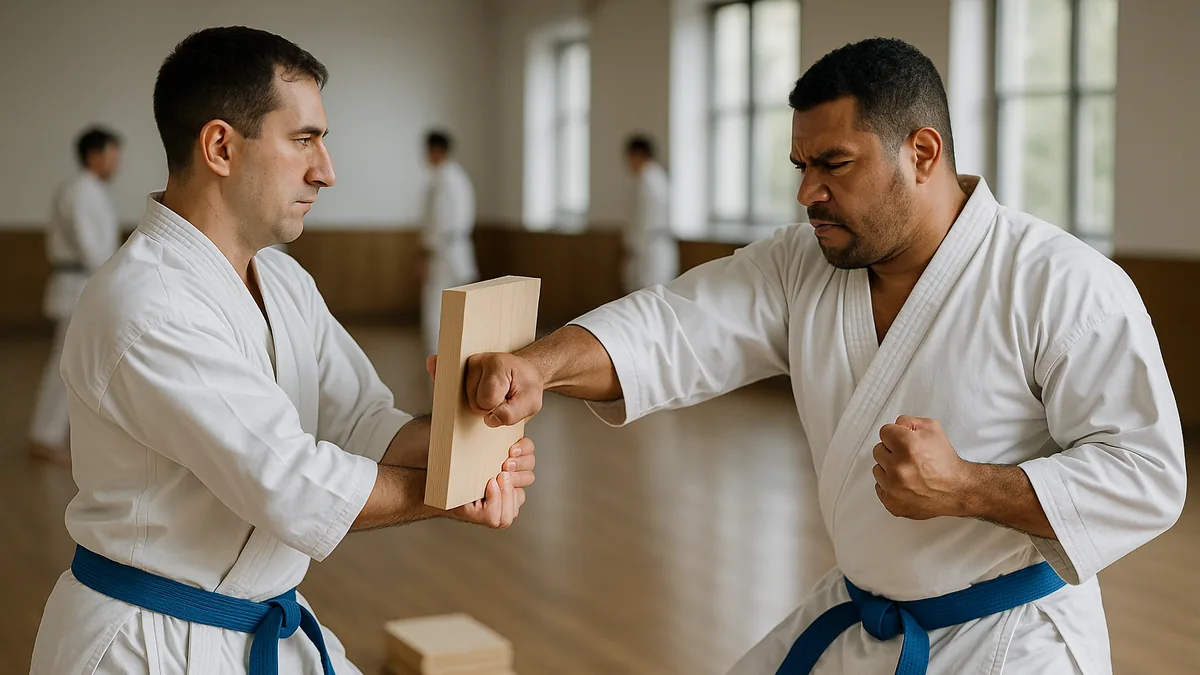
Most people who break boards badly aren’t failing because of strength. They’re failing because they’re punching at the board instead of through it. I’ve seen this hundreds of times - a student winds up, commits hard, and then pulls back just before contact because some part of their brain decides a solid object is where the movement stops. The board doesn’t break. Their confidence takes the hit instead. That’s the real problem with tameshiwari training when it’s not set up properly, and it’s exactly why the equipment you use matters more than most people realise.
Reusable Boards: What They’re Actually Good For
I’ll be direct - I think reusable plastic boards are underused in most dojos, and they’re underused for a bad reason. People dismiss them as “not real” breaking. But that misses the point of what they’re designed to do.
Reusable boards are conditioning tools. They’re for building the habit of committing through the target. When you’re working with a student who flinches on impact - and most beginners do - putting them in front of a wooden board they might fail to break is counterproductive. You’re adding performance pressure on top of a technique problem. The reusable board removes that pressure. It breaks at a consistent resistance level, it resets, and you can go again immediately.
What I tell students is this: the reusable board is honest. If your technique is wrong, it doesn’t break. If your technique is right, it does. There’s no grain to read, no weak spot to find, no way to get lucky. That consistency is actually a coaching advantage.
I’ve noticed that students who train regularly on reusable boards develop better follow-through than those who only ever break wood occasionally. The repetition builds the right motor pattern. By the time they step in front of a wooden board for a grading, the movement is already grooved. The wood just confirms what the plastic already told them.
The practical side is obvious too. You’re not buying boards every session. For home training especially, a decent set of reusable boards means you can drill tameshiwari without a budget problem. If you’re also looking at setting up a proper home training space, the makiwara board guides are worth reading alongside this - the two tools complement each other well.
Wood Boards: What You Actually Get From Them
Here’s where I’ll annoy some people - I don’t think wood breaking is primarily about proving power. I think it’s about experiencing a specific type of feedback that you can’t replicate with plastic.
When you break a pine board cleanly, you feel it differently than you feel a reusable board give way. There’s a sharp transmission of force that travels back up through your hand and into your shoulder if your structure is right - or punishes your wrist if it isn’t. That feedback is diagnostic in a way that plastic isn’t. I’ve had students break reusable boards with decent technique but poor wrist alignment, and they didn’t notice. Put them in front of pine and they felt it immediately. The wood doesn’t lie about structure the way plastic can.
The grain matters too. One mistake I see often with wood breaking is students who test the board before they strike - they push it slightly, feel where it flexes, and orient their break around the weak axis. That’s not technique, that’s cheating the exercise. What I tell students is that you should be able to break a board in any orientation if your technique is sound. If you need to find the grain to succeed, you’re not breaking with technique, you’re breaking with geometry.
Traditional pine boards - the standard 1-inch thickness - break at a resistance that corresponds roughly to a well-delivered strike. That calibration isn’t arbitrary. It’s why they’ve been used in demonstrations and gradings for so long. There’s a reason your instructor doesn’t hand you a 2x4 at your first grading.
The downside is obvious: cost, waste, and the fact that you can’t repeat the same board. For training volume, wood is impractical. For grading, demonstrations, and the occasional diagnostic session, it’s still the better tool.
The Technique Problems That Neither Board Will Fix
This is the part that matters most. I’ve watched students obsess over which boards to buy while their hip rotation is weak, their kime is absent, and their focus point is wrong. The board doesn’t fix technique. The board reveals it.
The biggest technical error I see in breaking attempts isn’t the flinch, actually - it’s the focus point. Students aim for the surface of the board. You need to aim past it. Your mental target should be six to eight inches beyond the board’s far side. When you do this correctly, the board becomes an obstacle your strike passes through rather than a surface your strike hits. It feels completely different. Instead of a thud and a stop, you feel the strike accelerate through contact. The snap at the end of the technique is what breaks the board, not the approach.
I used to think breaking was about generating maximum power at the point of contact. My instructor kept telling me to “strike through” and I understood it intellectually but not physically. The moment it clicked was during a training session where he had me punch through a piece of paper held in front of the board - just to get my eye on the right focal point. When I lined up on the board again, I broke it on the first attempt after three previous failures. Nothing changed in my physical technique. Everything changed in my intention and focus point.
Kime is the other one. That sharp contraction at the end of the technique - the moment of maximum tension through your whole body - is what delivers force efficiently. Without it, you’re pushing. Pushing doesn’t break boards. A properly focused strike with kime feels like a controlled explosion through your arm. You’ll feel it from your feet through your hips and out through your knuckles in a fraction of a second. When it’s right, you know it before the board breaks. There’s a certainty to the contact.
If you’re working on conditioning your striking surfaces alongside this, hand and wrist protection is worth reading - particularly around when to use wraps during high-volume breaking practice.
Community Perspective
There’s a genuine split in the karate community about whether board breaking belongs in serious training at all. Traditional Okinawan stylists often dismiss it as showmanship. Sport karate practitioners don’t train it much because it doesn’t appear in competition. Some JKA-lineage instructors I’ve trained with treat it as an occasional grading tool and nothing more. Others - particularly in some Korean-influenced styles and certain Kyokushin circles - treat it as a core training method.
My honest view is that both extremes miss the point. Dismissing it entirely means ignoring a useful diagnostic tool. Overemphasising it means confusing demonstration skill with fighting ability. A board doesn’t hit back. Breaking one doesn’t tell you much about your timing, distance management, or ability to generate power from a compromised position.
Where I’ve landed after years of training is this: breaking boards is useful for developing commitment, follow-through, and kime. It’s a training aid, not a goal. The practitioners I’ve seen who are genuinely impressive at tameshiwari are also usually technically excellent in other areas - because the same qualities that make breaking work also make everything else work. But I’ve also seen people who can break five boards at once and fall apart in controlled sparring. The board doesn’t lie about technique, but it also doesn’t tell the whole story.
What Actually Improves Your Breaking
The things that have made the biggest difference for me and for students I’ve worked with:
- Fix your focus point first. Aim past the board, not at it. This single change fixes more failed breaks than anything else.
- Train commitment separately. Use the reusable board for volume work specifically to build the habit of following through. Don’t mix diagnostic sessions with conditioning sessions.
- Check your structure, not your power. Wrist alignment, elbow path, hip engagement - these matter more than how hard you think you’re hitting.
- Break with your weakest technique, not your best. If you can only break with your reverse punch, your breaking is a party trick. Train until you can break with the techniques that need the most development.
- Don’t neglect the supporting work. Makiwara training, focus mitt work, and general conditioning all feed into your breaking ability. If you haven’t looked at whether a makiwara is worth adding to your training, it’s a relevant question here.
- Use wood for diagnosis, plastic for volume. That’s the honest split. One tells you what’s wrong, the other builds the pattern that makes it right.
The practitioners I respect most treat breaking as one honest test among many - not a performance, not a gimmick, and not the point of everything. Get your technique right and the board is just confirmation. Get it wrong and no amount of board selection will save you.
The weekly digest
New karate articles, once a week
One email every week with everything new on Karate Lifestyle. No spam; unsubscribe in one click.
We'll email you to confirm. See our privacy policy.